


USTC Staking Proposal: A Sustainable and Governance Driven Rewards Mechanism
The USTC staking proposal introduces a structured rewards mechanism designed with sustainability and flexibility at its core. Instead of relying on a single funding source, the framework outlines multiple potential revenue streams, ensuring long term stability while allowing governance to adapt as the ecosystem evolves.
A Multi Source Approach to Staking Rewards
Staking requires a reliable and sustainable reward system. To achieve this, the proposal presents several potential sources of rewards. These include fees generated from mechanisms such as Market Module 2, protocol revenue, and unused or inactive allocations. Minting is included only as a last resort option.
This diversified approach reduces dependency on any single mechanism and strengthens the overall resilience of the staking system.
Minting Is Not Active at Launch
A key clarification within the proposal is that minting is not enabled at launch. It is initially set to zero and can only be considered later through governance.
Before any decision on minting is made, the system will gather real data over an estimated three month period. This includes insights into participation levels, user behavior, and on chain activity. During this time, additional reward sources such as Market Module 2 and other ecosystem products are expected to begin contributing.
This ensures that decisions are based on actual performance rather than assumptions.
No Immediate Minting and Controlled Emissions
The model does not rely on immediate minting. Emissions are set to zero at the beginning and are only considered later based on real data and a separate governance vote. This means that the reflexive dilution scenario is not present within the initial design of the system.
Minting remains optional, controlled, and entirely dependent on community approval.
Governance Driven Decision Making
Governance plays a central role in the rewards mechanism. Any future consideration of minting is entirely dependent on community approval. If the community does not support it, minting will not be implemented.
This reinforces decentralization and ensures that control remains with stakeholders.
Addressing Sell Pressure and Supply Dynamics
The proposal also outlines how it aims to manage sell pressure within the ecosystem.
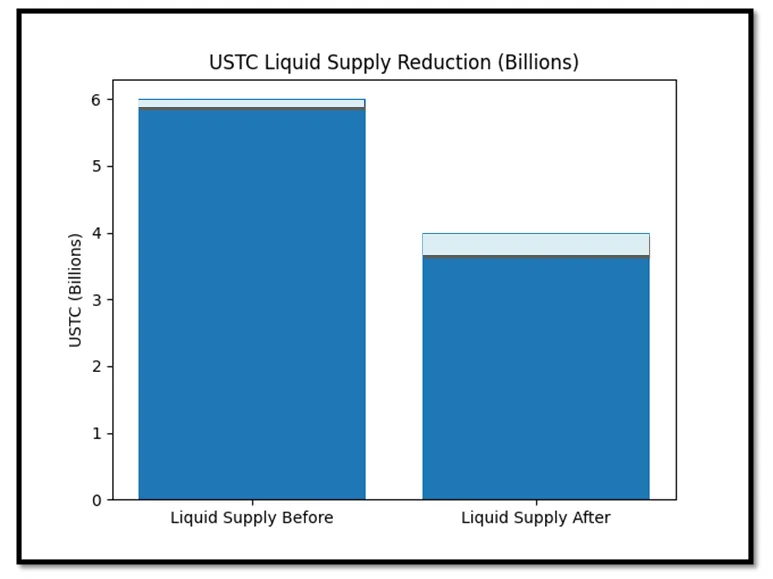
Rewards are distributed gradually rather than being released all at once. At the same time, the system targets locking a significant portion of the supply, estimated at around 2 billion USTC.
This approach shifts supply from liquid to non liquid, which structurally reduces potential sell pressure in the market.
Driving On Chain Value Creation
It is acknowledged that staking alone does not create value. However, the primary objective of this proposal is to move activity on chain, where value generation becomes possible.
This includes fees, increased usage, and integrations with ecosystem components such as Market Module 2. By encouraging participation and activity, the system creates the foundation for organic value growth.
Foundation for Future Utility
Suggestions such as lending, liquidity, and collateral use cases are valid and important for long term development. However, these models require sufficient on chain liquidity and active participation.
The staking proposal aims to establish this foundation first by increasing engagement and locking supply within the ecosystem.
Addressing Historical Concerns
The proposal also addresses concerns related to past issues. It clarifies that previous challenges were linked to the mechanism rather than USTC itself.
The current USTC supply stands at approximately 6 billion, significantly lower than the pre depeg level of around 18 billion.
The new framework differs from past approaches by incorporating safeguards and a staged rollout strategy to reduce risk.
A Phased Path to Sustainability
For long term sustainability, the rewards system follows a phased approach. It begins with gradual distribution from the Community Pool. As the ecosystem grows, on chain activity is expected to generate fees that contribute to rewards. New products such as Market Module 2 are also anticipated to play a role.
Only after evaluating the effectiveness of these sources would additional options be considered.
If these mechanisms prove sufficient, minting will not be required.
Conclusion
The USTC staking proposal presents a balanced and forward looking rewards mechanism. By prioritizing sustainability, leveraging multiple revenue sources, and placing governance at the center of decision making, the framework aims to support long term growth without relying on inflationary practices.