Home Blog Page 39

Luna Classic Community Pool Surpasses 8 Billion LUNC and 60 Million USTC

0

Luna Classic Community Pool Surpasses 8 Billion LUNC and 60 Million USTC

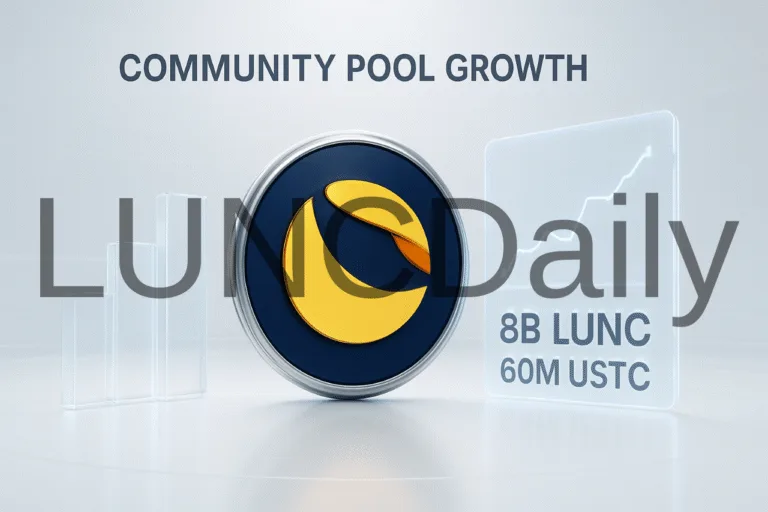
The Luna Classic (LUNC) community has achieved a significant milestone as the community pool balance rises to over 8 billion LUNC and 60 million USTC. This marks one of the strongest growth periods in recent months, reflecting increased on-chain activity and community engagement.

According to recent data, the community pool currently holds 8,001,578,357 LUNC and 60,343,797 USTC. Over the past month, both assets have shown steady growth, with a noticeable spike in late September, likely due to governance proposal funding and validator contributions.

The community pool plays a vital role in supporting development, ecosystem incentives, and key upgrades within the Terra Classic network. As these balances continue to rise, it strengthens the foundation for future initiatives aimed at ecosystem revival and long-term sustainability.

This increase demonstrates the ongoing commitment of the LUNC community to restore value and utility to the chain. The steady inflow of funds highlights a healthy and active network, preparing Terra Classic for upcoming developments and potential integrations within the Cosmos ecosystem.

With the community pool now above 8 billion LUNC, confidence in the chain’s governance and funding capacity continues to grow, positioning Luna Classic for its next phase of progress.

LUNC Price Falls After $160 Million in Crypto Longs Are Wiped Out

0

LUNC Price Falls After $160 Million in Crypto Longs Were Liquidated

In the past 11 hours, more than $160 million worth of crypto long positions were liquidated in just one hour. This sudden event caused prices across the crypto market to drop sharply, including Terra Classic (LUNC).

LUNC price

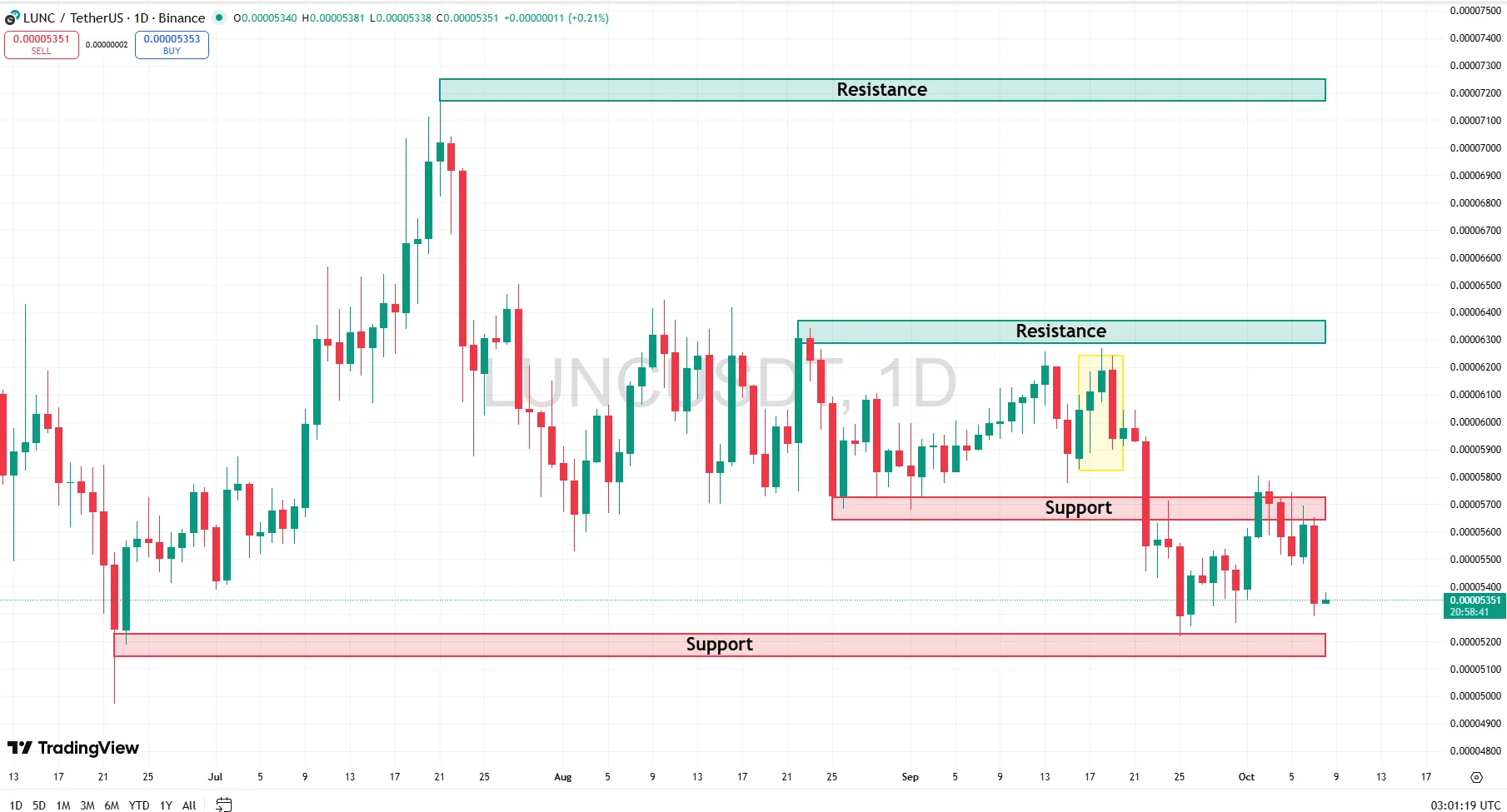
LUNC’s price fell after facing strong resistance near 0.000056 and is now trading around 0.000053. If the price breaks below this support, it could move down to the next support area near 0.000052. On the other hand, if LUNC can recover above 0.000056, it may aim again for the next resistance around 0.000063.

The large liquidations happened because many traders used high leverage during a period of strong volatility. This shows how quickly the market can change and why careful risk management is important for all traders.

Even with the current drop, many in the Terra Classic community remain active and focused on long-term development for the project.

304,781 USTC Burned in Latest Round as Terra Classic Pushes Supply Reduction

0

304,781 USTC Burned in Latest Round as Terra Classic Pushes Supply Reduction

The Terra Classic community has completed another significant burn event, removing 304,781 USTC from circulation. This latest burn adds to the growing total of 1,080,000 USTC burned over the past seven days, valued at approximately $11,560.

Regular burn events like this demonstrate the community’s ongoing commitment to restoring the stability and value of TerraClassicUSD (USTC). By reducing the circulating supply, supporters aim to strengthen the token’s long-term fundamentals and rebuild market confidence.

Terra Classic Proposal to Upgrade Terrad Client to v3.6.0: Technical Improvements and Voting Progress

Terra Classic Proposal to Upgrade Terrad Client to v3.6.0: What It Means

The Terra Classic community is currently voting on a new on-chain proposal to upgrade the Terrad client to version v3.6.0 (upgrade name: v13).
This proposal aims to align Terra Classic with the latest Cosmos SDK standards, improve smart contract compatibility, and enhance validator performance through key technical updates.

If approved, the upgrade will take place on October 20, 2025, at approximately 2:45 PM UTC, when the chain halts automatically at block height 25,619,230.
Validators will then install the new client before block production resumes.

Summary of v3.6.0 Technical Changes

Change Description Impact
IBC Tax Calculation Fix Corrects tax handling for reverse charge contracts within IBC transactions. Ensures accurate cross-chain tax logic and smoother IBC operations.
Unfork Wasmd Package (Phase 2) Migrates Terra Classic to the mainstream wasmd v0.46.0, replacing the custom fork. Improves compatibility with Cosmos networks and modern smart contracts.
CI and API Regression Updates Adds tests for checking API regressions and updates continuous integration configurations. Improves testing reliability and codebase stability.
Testnet & Mainnet Upgrade Height Updates Adjusts upgrade heights to prepare for smooth migration. Reduces risk of mismatch or desynchronization during upgrade.
Improved Debug Logs Enhances log info for debugging. Helps developers diagnose and fix issues faster.

In essence, the v3.6.0 upgrade modernizes Terra Classic’s architecture, strengthens its developer environment, and improves interoperability within the Cosmos ecosystem.

Proposal and Voting Details

Proposal Title Terrad Client Upgrade to v3.6.0 (v13)
Upgrade Block Height 25,619,230
Estimated Upgrade Time October 20, 2025, 2:45 PM UTC
Voting Period October 4 – October 11, 2025
Chain Halt & Restart Chain halts at target block height, validators install new version, then resume.

Current Voting Status

Turnout 29.20% / 40% quorum required
Yes 99.83% (277.29B LUNC)
Abstain 0.17% (472.06M LUNC)
No 0%
No with Veto 0%
Expected Result Not passing yet — quorum not reached
Voting Ends October 11, 2025, 14:02:40 UTC

Although the community strongly supports the proposal, participation remains below the 40% quorum threshold.
Validators and LUNC holders are encouraged to vote before the deadline to ensure the upgrade proceeds as planned.

Validator and Delegator Participation

Group Yes Abstain No / No with Veto Total Participants
Validators 19 (99.83%) 1 (0.17%) 0 20 / 110
Delegators 170 (99.99%) 2 (0.01%) 0 172

Testing and Rollback Plan

The release candidate v3.6.0-rc.0 was tested on the rebel-2 testnet on September 4, 2025, confirming upgrade stability and compatibility.
In the unlikely event of an issue, validators may temporarily revert to v3.5.0 under the same upgrade name (v13) while awaiting a patch.

Official Resources:

Conclusion

The Terra Classic v3.6.0 upgrade represents a key step in the network’s evolution.
By merging with the mainstream wasmd framework and refining IBC operations, the network achieves better stability, interoperability, and efficiency.

Community members are encouraged to vote before October 11, 2025, to help Terra Classic move forward with this critical technical upgrade.

733.79 Million LUNC Burned in 7 Days

733.79 Million LUNC Burned in 7 Days

The Terra Classic (LUNC) community has burned 733.79 million tokens in the past seven days. This shows that the community is still active and focused on reducing the large supply of LUNC.

What Does Burning Mean?

When tokens are burned, they are sent to a special wallet that no one can access. These tokens are gone forever. Burning helps lower the total supply, which can make the remaining tokens more valuable over time.

Why This Matters

  • Less Supply: Fewer tokens in circulation can support long-term value growth.
  • Active Community: Regular burns show that the LUNC community remains committed and engaged.
  • Better Market Sentiment: Consistent burning activity can improve investor confidence.

What’s Next

The key factor is consistency. If the community and major contributors continue burning LUNC, the long-term effects could become stronger. However, burns alone do not raise prices. Market demand, development, and adoption are still the most important factors for growth.

Final Thoughts

This latest burn shows that the Terra Classic community has not given up. The effort to reduce supply and rebuild continues, keeping the project’s revival alive and moving forward.

The Crypto World Heats Up in Uptober as Bitcoin Breaks Another All Time High

0

Bitcoin Hits $126,000 in Uptober Rally After Consecutive Record Highs

Bitcoin continues its powerful October rally. In just a few days, the leading cryptocurrency recorded two consecutive all time highs. First, Bitcoin surpassed 125,000 dollars, and shortly after it reached 126,000 dollars. This strong momentum has reignited optimism across the global crypto market.

What Is Driving the Rally

The price surge is fueled by several major factors. Institutional investors have continued to increase their exposure to Bitcoin, adding strong demand pressure. Macroeconomic conditions also play a role, as a weaker United States dollar and ongoing economic uncertainty push more investors toward digital assets.

At the same time, fewer coins are available on exchanges as more holders transfer their Bitcoin into long term storage. This reduction in supply contributes to price growth. Additionally, once Bitcoin broke above previous resistance levels, it triggered a wave of momentum buying that further accelerated the rally.

Risks to Watch

Despite the strong bullish momentum, analysts caution that short term corrections remain possible. Profit taking after large price movements is common and can temporarily pull prices down. Bitcoin could also face resistance near the 126,500 to 128,000 dollar range. External factors such as new regulations or unexpected macroeconomic events could also impact investor sentiment.

Market Outlook and Scenarios

Continued Rally

Bitcoin could extend its gains toward 128,000 to 135,000 dollars if institutional inflows and positive market sentiment persist.

Sideways Consolidation

Prices may stabilize between 122,000 and 128,000 dollars as buyers and sellers balance and the market digests recent gains.

Short Term Correction

A pullback toward the 118,000 to 122,000 dollar range could occur if profit taking increases or negative macroeconomic developments emerge.

Conclusion

Bitcoin’s rise to 126,000 dollars highlights renewed investor confidence and marks a defining moment in the Uptober 2025 rally. The coming weeks will determine whether this momentum can be sustained or if the market enters a brief consolidation phase. Either way, Bitcoin has reaffirmed its dominance as the leading digital asset in a rapidly evolving market.

Tether introduces USAT, a U.S.-based stablecoin built to comply with the GENIUS Act. As the stablecoin race intensifies, can Luna Classic’s USTC be repegged and rise again to compete?

The stablecoin race is becoming more intense as Tether prepares to launch its new U.S.-based stablecoin, USAT. The company behind USDT, the world’s largest stablecoin by market capitalization, is positioning itself to expand directly into the American market under strict new regulations.

Tether confirmed that USAT will be designed to fully comply with the GENIUS Act, a U.S. law passed in July 2025 that sets rigorous standards for stablecoin issuers. The law requires transparent reserves, licensed custodians, and regular audits to ensure user protection and financial stability.

According to Reuters and Blockworks, USAT will be issued through Anchorage Digital Bank, a federally chartered institution regulated by U.S. authorities. The stablecoin is expected to launch by the end of 2025, led by Bo Hines, a former White House crypto policy adviser appointed to oversee Tether’s U.S. operations.

Tether will maintain its global product USDT for international markets while introducing USAT specifically for U.S. users seeking compliant and regulated stablecoin options. This dual-track strategy may help Tether preserve its global influence while expanding its legitimacy within the United States.

Market observers suggest that the introduction of USAT could reshape the stablecoin landscape. Competing issuers such as Circle (USDC) and PayPal (PYUSD) are already deeply established in the U.S., and Tether’s entry is expected to heighten competition while encouraging more transparency across the industry.

Although full details about USAT’s reserves and audits remain under development, this step marks a turning point for Tether. A compliant U.S. stablecoin could enhance public confidence and drive broader adoption of digital dollars across both retail and institutional markets.

As multiple projects race to release their own stablecoins, one question resonates within the Terra Classic community:
Can USTC, the original Luna Classic stablecoin, find a path to repeg and reenter this increasingly competitive stablecoin race?

How Terra Classic Handles IBC: Inter-Blockchain Communication Explained

In the evolving world of blockchain technology, interoperability is key to scalability and adoption. Terra Classic, the resilient original Terra chain (LUNC), excels in this through its integration with the Inter-Blockchain Communication (IBC) protocol. As a Cosmos SDK-based network, Terra Classic IBC enables secure, efficient data and asset transfers across independent chains, fostering a symbiotic ecosystem.

Originally launched in October 2021, IBC connected Terra to over 100 Cosmos chains, allowing seamless movement of LUNA (now LUNC) and UST (USTC) tokens. This opened doors to decentralized apps (dApps) like Osmosis DEX, boosting liquidity and DeFi opportunities. However, the May 2022 ecosystem collapse prompted a temporary shutdown of all IBC channels to mitigate impermanent losses in liquidity pools. Users couldn’t access trapped assets, stalling cross-chain utility.

Post-crash, the community-driven Terra Rebels spearheaded recovery. In September 2022, proposals emerged to reopen channels, emphasizing IBC’s role in revitalizing LUNC. By December, key links to Osmosis, Juno, and Crescent were restored via the v2.3 upgrade, enabling users to withdraw billions in locked liquidity. Developers like Edward Kim and Jacob Gadikian coded solutions for safe reactivation, ensuring no repeat vulnerabilities.

Today, in 2025, Terra Classic handles IBC via Tendermint consensus for light-client verification, preventing double-spending while supporting token fungibility. Packets carry fungible tokens (FTs) or non-fungible (NFTs) across chains, with relayers incentivized by fees. This setup enhances Terra Classic’s utility, attracting projects for payments and integrations.

Benefits abound: Reduced bridging risks, lower costs than centralized exchanges, and expanded DeFi access. For LUNC holders, IBC drives on-chain volume, burns, and adoption. As Cosmos grows to 115+ chains, Terra Classic IBC positions it as a stablecoin powerhouse. Future upgrades promise even broader connectivity, solidifying its role in blockchain symbiosis

The Vital Role of Terra Classic Community Pool in Driving Ecosystem Growth

In the resilient world of blockchain, the Terra Classic community pool stands as a cornerstone for sustainable development. As the on-chain treasury of the Terra Classic (LUNC) network—a Cosmos-based chain reborn from the 2022 crash—this pool empowers decentralized governance to propel ecosystem expansion. Unlike centralized funds, it ensures no single entity holds sway, fostering true community-driven progress.

At its core, the Terra Classic community pool is funded through strategic mechanisms like seigniorage allocations and transaction fees. For instance, Proposal 5234 adjusted the RewardWeight parameter to 0.9, directing 10% of burned LUNC tokens back into the pool at epoch’s end. This recycles burn rewards—now exceeding billions via whale transactions—into usable capital. Recent burns, such as a 1 billion LUNC fee torch in September 2025, indirectly bolster the pool by enhancing token scarcity and validator incentives.

The pool’s true power lies in its role fueling ecosystem growth. Through CommunityPoolSpendProposals, LUNC holders vote to allocate funds for critical initiatives. In 2025, it granted $48,000 to Orbit Labs for the SDK50 upgrade, modernizing developer tools and attracting dApps. Proposals like a community DEX aim to generate protocol revenue, refilling the pool while burning excess fees to combat inflation. This volunteer-driven model supports partnerships, such as with WESO World, expanding DeFi and NFT integrations.

Moreover, the pool promotes decentralization. With validators holding over 50% voting power concentrated in top nodes, it democratizes funding—bypassing biases and enabling emergency developer payouts. Critics warn of drain risks, as in Proposal 11820 debates, but safeguards like quorum thresholds maintain integrity.

Looking ahead, the Terra Classic community pool is pivotal for LUNC’s revival. By incentivizing burns, upgrades, and innovation, it transforms challenges into opportunities, positioning Terra Classic as a beacon of resilient blockchain growth. As governance evolves, expect bolder proposals to unlock even greater potential.

Uptober Fest Just Start: Bitcoin and BNB Break All-Time Highs as the Bull Market Heats Up

0


Uptober starts with a bang as Bitcoin hits $125,000 and BNB soars to $1,190


Uptober starts with a bang as Bitcoin hits $125,000 and BNB soars to $1,190

The long-awaited Uptober has finally arrived, and the crypto market is already on fire. Bitcoin has officially broken its all-time high, reaching an impressive $125,000. Meanwhile, Binance Coin (BNB) also shattered its previous record, now trading at $1,190.

This surge marks one of the most explosive starts to Uptober in crypto history. Bitcoin’s rally is fueling optimism across the market, with traders and investors anticipating that other major altcoins will soon follow. Many experts believe this could signal the start of a new bullish cycle driven by institutional demand and growing mainstream adoption.

BNB’s record-breaking run highlights the continued strength of the Binance ecosystem. As one of the top-performing assets of the year, BNB’s momentum is being supported by increased trading volume, ecosystem growth, and renewed confidence in the broader market.

With Uptober kicking off in such a powerful way, the next few weeks could define the tone for the rest of 2025. Analysts are watching closely to see if Bitcoin can sustain its new level or push even higher toward $150,000, while BNB’s performance could lead the way for a broader altcoin rally.

Uptober has only just begun, but the message is clear: the bulls are back.