
Home Blog Page 43

How the Terra Classic Burn Mechanism Reduces LUNC Token Supply?

The Terra Classic burn mechanism has emerged as a cornerstone of the LUNC ecosystem’s revival strategy following the 2022 collapse. Designed to combat hyperinflation, this deflationary tool permanently removes Luna Classic (LUNC) tokens from circulation, gradually shrinking the token supply and fostering scarcity. But how exactly does the Terra Classic burn mechanism affect LUNC token supply, and what does it mean for investors?

At its core, the burn process operates via an on-chain transaction tax. Implemented through community governance proposals like 3568 and 4159, it levies a 0.5% fee on all LUNC transfers as of mid-2025—down from an initial 1.2% to balance usability and deflation. This tax deducts tokens from each trade and sends them to an inaccessible burn address, effectively destroying them. The mechanism exempts swaps between LUNC and USTC (TerraClassicUSD) to support stablecoin liquidity, ensuring the focus remains on reducing overall supply without hindering core functions.

Complementing the tax are community-driven burns. Major exchanges like Binance contribute significantly, donating trading fees—often over 50% of total burns—to the official address. Validators, developers, and holders also donate directly, accelerating the process. Since May 2022, over 410 billion LUNC have been incinerated, trimming the circulating supply from a peak of 6.5 trillion to around 5.4-5.8 trillion today. Daily burns average 48 million tokens, with weekly peaks exceeding 383 million.

This sustained reduction creates deflationary pressure, theoretically elevating LUNC’s value by increasing scarcity amid steady demand. For instance, a 320 million token weekly burn in late 2024 correlated with a short-term price surge, as lower supply can amplify bullish momentum. However, challenges persist: the remaining trillions dilute immediate impact, and external factors like market sentiment influence outcomes. The tax deactivates at a 10 billion supply cap, locking in permanence.

Overall, the Terra Classic burn mechanism exemplifies community resilience, transforming a crisis into a path for long-term stability. By methodically eroding excess supply, it positions LUNC for potential recovery, underscoring the power of tokenomics in crypto ecosystems.
Luna Classic Staking Ratio Falls to 14.79%

0
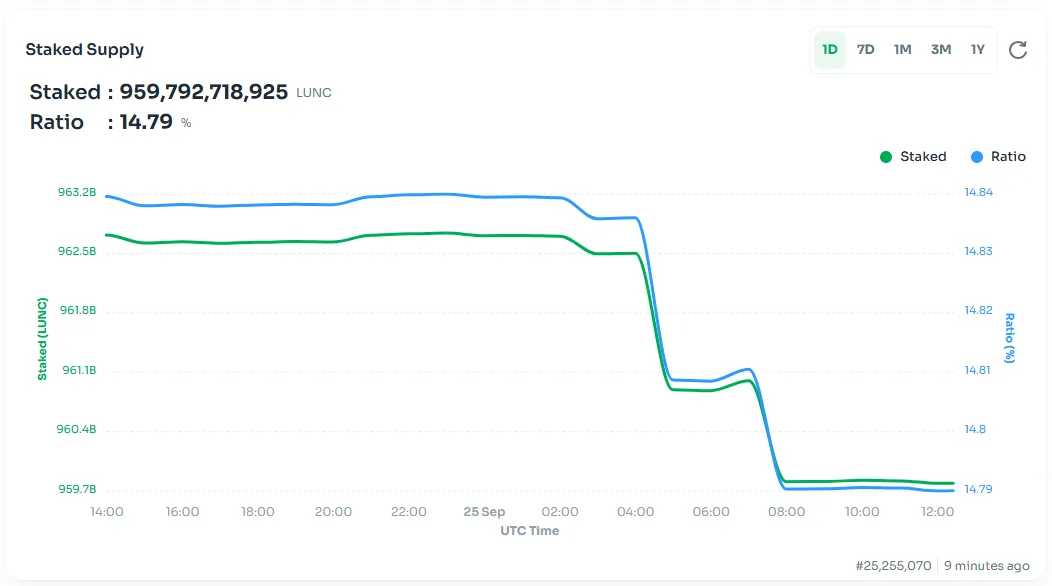
Luna Classic staking ratio falls to 14.79%
Luna Classic staking ratio drop to 14.79%

The Luna Classic (LUNC) staking ratio has fallen to
14.79%, raising questions about investor sentiment and network participation.
The total staked supply now stands at 959.79 billion LUNC.

Sharp Decline in Staked Supply

Over the past 24 hours, the network experienced several sharp decreases in staked amounts.
These sudden drops suggest that a significant portion of tokens has been unstaked.
Possible reasons include short-term market positioning, validator adjustments, or investors
reallocating their assets in anticipation of price movements.

Why Staking Matters

Staking plays a vital role in the Luna Classic ecosystem. It not only secures the blockchain
but also provides rewards to participants. A lower staking ratio can reflect reduced confidence
in the market or simply tactical moves by large holders seeking liquidity.

Outlook for the Network

Despite the recent decline, Luna Classic continues to remain among the most actively staked
tokens within the Cosmos ecosystem. However, further decreases in the staking ratio could
affect validator performance, governance voting power, and overall decentralization.

Community members and investors should closely monitor upcoming developments and validator
updates to ensure that the network’s stability and security remain strong.

USTC Price Faces Breakdown at Critical Support as Crypto Market Declines

0


The following analysis summarises current technical structure and the primary fundamental drivers affecting TerraClassicUSD (USTC). The goal is clarity: key levels to watch, likely scenarios and the market context that explains recent weakness.

Technical outlook

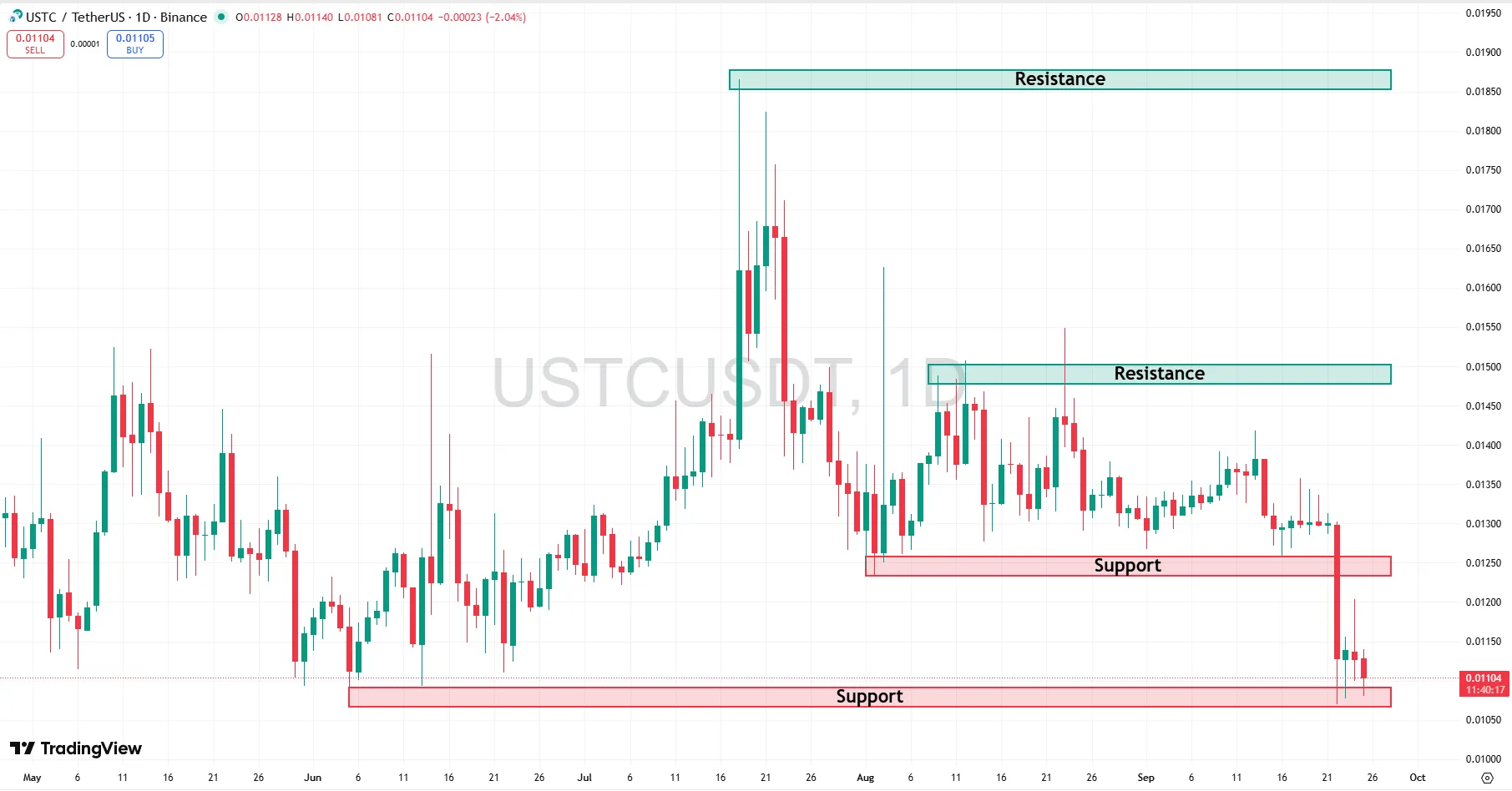
USTC is testing a critical support zone near $0.010. This area has acted as a significant demand level in prior price action. If this zone holds, a technical rebound toward $0.012–$0.013 is a reasonable short-term scenario. A decisive daily close below $0.010, however, would increase the probability of a deeper decline, as there are limited structural supports until sub-cent levels.

USTC daily chart with support and resistance zones
USTC daily chart with support and resistance levels

Why the price is down

  1. Global macro conditions. Risk assets have come under pressure as bond yields remain elevated and the US dollar has strengthened. Investors are reducing exposure to speculative assets, and cryptocurrencies have been affected directly.
  2. Regulatory concerns. Ongoing regulatory scrutiny across major jurisdictions has weighed on market sentiment. Even minor announcements can produce outsized reactions in low-liquidity tokens.
  3. Liquidity rotation. Bitcoin’s market dominance is absorbing much of the available capital, leaving smaller altcoins without the same inflows. This reduces buying depth and increases volatility for tokens like USTC.
  4. USTC-specific fundamentals. The token still carries legacy risk from the Terra ecosystem failure. Community-led recovery efforts exist, but market confidence remains fragile and sellers have been dominant at major supply levels.

Market outlook

USTC currently sits at an inflection point. Defending the $0.010 zone would allow for a controlled, technical recovery toward the $0.012–$0.013 range. Failure to hold this level would likely open the path to lower prices, especially while the broader market remains risk-off. Short-term traders should prioritise risk management and wait for confirmation above the $0.012–$0.0125 area before assuming a reversal.

Investment perspective

For long-term investors, accumulation at major support levels can be considered, provided position sizing reflects the high-risk profile and potential for further downside. For active traders, a clear structure break below $0.010 should be treated as a trigger to reduce exposure rather than a buy signal.


LUNC Price Drops as Market Pressure Mounts: Is This the Last Support Before a Bigger Move?

LUNC Price Drops as Market Pressure Mounts: Is This the Last Support Before a Bigger Move?


LUNC Price Drops as Market Pressure Mounts: Is This the Last Support Before a Bigger Move?

The price of Terra Classic (LUNC) has once again come under pressure, reflecting both technical weakness and broader challenges facing the crypto market. Traders are closely watching support levels as the asset struggles to hold key zones, while investors are weighing the impact of global market sentiment and regulatory uncertainty.

Technical Analysis of LUNC

On the daily chart, LUNC is trading around $0.000054 after breaking below its short-term support zone at $0.000057–$0.000055. This breakdown signals fading bullish momentum and puts the next support level at $0.000052–$0.000053 in focus.

If this support does not hold, a deeper pullback toward $0.000048–$0.000050 could follow. On the upside, buyers face strong resistance at $0.000062–$0.000064, with a major rejection already confirmed at that range. A decisive move above $0.000062 would be needed to shift momentum back toward the bullish side.

In summary, the short-term outlook remains bearish while the mid-term structure is range-bound.

LUNC Technical Chart Analysis

Why the Market is Down

  • Global Market Conditions: Rising uncertainty around United States Federal Reserve policy and interest rates has pushed investors away from risk assets, including cryptocurrencies.
  • Bitcoin Correlation: Bitcoin remains the dominant force in the market, but its struggle to hold key levels has placed additional weight on altcoins.
  • Regulatory Uncertainty: Ongoing enforcement actions by regulators against exchanges and tokens continue to spook investors.
  • LUNC-Specific Challenges: The Terra Classic ecosystem is still in the process of rebuilding after its 2022 collapse.

Outlook

For short-term traders, the $0.000052 support level will be the key line to watch. A break below this zone could trigger further downside toward $0.000048, while a recovery above $0.000062 would be the first sign of strength.

For long-term investors, the current downturn reflects broader market sentiment rather than only LUNC-specific issues. Any sustainable recovery will depend not just on technical rebounds but also on continued progress in rebuilding utility and adoption within the Terra Classic ecosystem.

Take Action Today

Interested in Terra Classic? Join one of the world’s largest exchanges and be part of the growing LUNC community.

Buy LUNC on Binance

© 2025 Your Website. All rights reserved.


Terra Classic Makes Bold Move with Cosmos SDK v0.53 and IBC v2 Upgrade

Terra Classic Makes Bold Move with Cosmos SDK v0.53 and IBC v2 Upgrade

OrbitLabs proposes skipping the v0.50 update to deliver faster, more secure, and more connected blockchain performance.

Terra Classic is preparing for one of its most significant upgrades yet. Instead of upgrading step by step, OrbitLabs has proposed to move the network directly to Cosmos SDK v0.53, which also brings IBC v2 (Eureka) support.

This streamlined approach is designed to reduce risks, cut down on coordination time, and provide the community with faster access to cross-chain interoperability and technical improvements.

Why This Upgrade Matters

  • Fewer Disruptions: A single coordinated upgrade event instead of multiple steps.
  • Future-Ready: Aligns Terra Classic with the latest long-term Cosmos SDK release.
  • Cross-Chain Power: IBC v2 (Eureka) enables multi-hop routing for stronger connectivity with Cosmos Hub and beyond.
  • Security and Performance: Gains enhancements from CometBFT v0.38, Wasmd v0.61, and updated IAVL.

What Will Change

1. Core Upgrade

  • Migration to Cosmos SDK v0.53
  • Upgrade to CometBFT v0.38
  • Wasmd v0.61 / WasmVM v2.2
  • IBC-Go v10 with IBC v2 support
  • Optional features (x/protocolpool, x/epochs, unordered transactions) remain off until governance enables them.

2. IBC v2 (Eureka)

  • Multi-hop token transfers between chains.
  • Improved reliability through stronger error handling and retries.

3. Testing

  • Deployment on the rebel-2 testnet.
  • Validation of connections, ICS-20 transfers, and IBC v2 routing.
  • Full app and validator testing with published results.

4. Documentation

  • Updated validator runbooks for smooth upgrades.
  • Migration steps for dApps clearly outlined.
  • Examples of IBC v2 message formats for developers.

Budget

The proposed upgrade has a total budget of $56,000 USD, to be funded in LUNC at the time of spending proposals.

Final Take

This upgrade represents a bold leap forward for Terra Classic. By moving directly to Cosmos SDK v0.53 with IBC v2 (Eureka), the network will gain stronger security, smoother performance, and advanced interoperability across the Cosmos ecosystem. It positions Terra Classic for a more resilient and connected future.

Crypto Bloodbath: $1.5 Billion Liquidated as $1 Billion Vanishes in Just 30 Minutes

0

Crypto Market Hit by $1.5 Billion Liquidation Wave

The cryptocurrency market has been shaken by one of the largest liquidation events of the year. In total, more than US$1.5 billion in leveraged positions were wiped out, with an astonishing US$1 billion of long positions erased in just 30 minutes.

Bitcoin, Ethereum, and major altcoins all suffered steep losses as traders faced a wave of forced liquidations. Those betting on rising prices were hit the hardest, with long positions accounting for the majority of the collapse.

The speed of liquidations triggered a domino effect, accelerating the sell-off and intensifying market volatility. Bitcoin, the largest cryptocurrency, recorded sharp declines, pulling Ethereum and other altcoins down with it.

This event marks the biggest liquidation wave since March and highlights the dangers of excessive leverage in the crypto market. Analysts caution that while liquidation cascades are not uncommon, the sheer scale of this one underscores fragile investor sentiment.

For traders and investors, the lesson is clear: risk management is essential in a market that can reverse course within minutes.

Crypto Crash Explained: The Real Reasons Bitcoin, Ethereum, LUNC and Altcoins Are Dropping

0

The cryptocurrency market has been hit with another wave of losses, leaving investors wondering why Bitcoin, Ethereum, LUNC and major altcoins are all moving down.

In the past 24 hours alone, the market has seen billions of dollars wiped out, and the answer lies in a mix of technical and economic factors that are easy to understand.

Massive Liquidations Shook the Market

One of the biggest drivers behind the crash is the sudden liquidation of leveraged trading positions. Many traders borrowed heavily to bet on prices going higher. When the market started to dip, those positions were forcefully closed, adding even more selling pressure and accelerating the decline.

Profit-Taking After Recent Gains

After weeks of upward momentum, large traders and institutions have been locking in profits. This type of selling is common in volatile markets and often triggers short-term corrections as smaller investors follow suit.

Global Economic Pressures

The broader economy is also playing a role. Rising bond yields in the United States are making traditional investments look more attractive compared to high-risk assets like cryptocurrencies. Uncertainty around interest rates and inflation has only added to the cautious mood in global markets.

Technical Levels Breaking Down

Bitcoin and other major coins recently broke below important technical support levels on price charts. When these levels fail, it often leads to panic selling as traders rush to cut losses. This technical domino effect has amplified the current downtrend.

Investor Sentiment Turns Risk-Off

Overall, market sentiment has shifted from optimism to caution. Regulatory updates, geopolitical risks, and sudden price volatility are making many investors step back from the market. This risk-off attitude is one of the main reasons crypto continues to struggle in the short term.

What Happens Next?

While the current dip feels severe, some analysts believe it could also be a healthy correction. By shaking out excess leverage and cooling off speculation, the market might be preparing for its next major move. The key will be how global economic signals and central bank decisions unfold in the coming weeks.

What Are the Risks and Rewards of Delegating LUNC to a Validator?

Delegating LUNC (Luna Classic) to a validator is one of the most effective ways to participate in the Terra Classic blockchain ecosystem. By doing so, token holders can earn passive income while supporting the security and decentralization of the network. However, just like any investment decision, delegation carries both risks and rewards that every user should understand before committing.

Rewards of Delegating LUNC

The primary benefit of delegating LUNC is earning staking rewards. Validators distribute a share of transaction fees and block rewards to their delegators, offering an attractive way to grow holdings over time. Additionally, delegation contributes to the security and stability of the Terra Classic network, as more staked tokens make the blockchain harder to attack. Delegators also have indirect participation in governance since they can influence validator votes on proposals.

Risks of Delegating LUNC

Despite the rewards, delegators face certain risks. The most significant is the slashing penalty, which occurs if a validator misbehaves, such as double-signing or extended downtime. This can cause a portion of delegated LUNC to be lost. Another risk is centralization—choosing large validators may weaken network decentralization. Finally, there is a lock-up period (unbonding), during which tokens cannot be instantly withdrawn, making them temporarily illiquid.

Final Thoughts

Delegating LUNC to a validator can be highly rewarding, but it requires careful validator selection and risk awareness. By diversifying delegation across multiple validators and staying updated on governance, delegators can maximize rewards while minimizing potential losses.

How Do Governance Proposals Work in Terra Classic?

Governance is at the heart of every decentralized blockchain, and governance proposals in Terra Classic play a crucial role in shaping the network’s future. Through this process, LUNC holders have the power to propose, discuss, and vote on important changes that directly affect the blockchain and its community.

A governance proposal begins when a community member submits an idea for improvement, whether it’s a technical upgrade, parameter change, or funding request for ecosystem development. To submit a proposal, the proposer must deposit a small amount of LUNC tokens as collateral. This ensures only serious and well-considered ideas enter the voting stage.

Once submitted, the proposal enters the voting period, where validators and token holders can cast their votes. The voting options typically include Yes, No, No with Veto, or Abstain. The outcome depends on both voter participation (quorum) and the overall voting power behind each choice.

If a proposal passes, the approved changes are implemented by validators and developers, making governance a truly community-driven process. This system reflects the decentralized nature of Terra Classic, where decisions are not controlled by a single entity but by the collective voice of stakeholders.

In summary, governance proposals in Terra Classic are essential for maintaining transparency, trust, and innovation. They empower the LUNC community to steer the project’s direction while reinforcing the principle of decentralization.

Terra Classic Upgrade to Cosmos SDK v0.53 with IBC v2 (Eureka) Support

Executive Summary

Following Proposal 12142 and feedback from the community and validators on the original v0.50 upgrade plan, OrbitLabs proposes upgrading Terra Classic directly to Cosmos SDK v0.53.x â€” skipping the intermediate v0.50 mainnet deployment.

This approach is more efficient because we skip the intermediate SDK v0.50.x upgrade entirely and move directly to SDK v0.53.x.

By going straight to SDK v0.53.x, we consolidate the migration effort, avoid two separate mainnet upgrade events, and still deliver all the benefits originally planned – plus IBC v2 (Eureka) support.


Motivation

  • Efficiency: Single mainnet upgrade event, reducing the collaboration/testing effort for mainnet upgrade
  • Future-proofing: SDK v0.53.x is the latest stable long-term release.
  • Interoperability: Enables IBC v2 (Eureka), unlocking hub-and-spoke routing through Cosmos Hub.

Scope of Work

1. SDK & Module Upgrade

  • Migrate main modules to SDK 0.53.x compatible
    • Cosmos SDK v0.53.x
    • Wasmd v0.61.x

2. IBC-Go v2 (Eureka) Enablement

  • Upgrade IBC-Go directly from v7.10.0 to v10.x.0
  • Enable IBC v2 routing logic in app wiring and parameters.
  • Validate IBC v2 message flow (e.g. multi-hop MsgTransfer) between two Cosmos SDK v0.53 chains.

3. Testnet & QA

  • Deploy on rebel-2 testnet with v0.53.x + IBC v2 enabled.
  • Run:
    • Channel/connection handshake tests.
    • ICS-20 token transfer tests.
    • IBC v2 message routing tests (two-chain environment).
  • Further tests on Wasm and SDK messages to verify continued normal operation after the upgrade.
  • Publish test results and known issues for dApp developers and validators.

4. Documentation

  • Update validator runbooks for single-step upgrade to v0.53.x.
  • Document breaking changes if any
  • Provide examples of IBC v2 message format for integrators.

Comparison to Previous Proposal

AreaOriginal Proposal (v0.50)Updated Plan (Direct to v0.53)
SDKv0.50.xv0.53.x (latest stable)
IBCIBC-Go v8 (classic)IBC-Go v10 (IBC V2 / Eureka) enabled
WorkloadCore migrations (store upgrades, SDK base changes)Same + small delta for SDK 53 changes + IBC v2 wiring
Test FocusdApp compat, store integritySame + IBC v2 message flow between SDK chains
ExecutionTwo upgrade events (v0.50 then v0.53 later)Single upgrade event

Budget

The total budget for this combined upgrade is $56,000 USD, split into two phases to ensure accountability and align with deliverables:

  • Phase 1: Testnet Implementation & Validation — $40,000 USD
    • Code migration directly to Cosmos SDK v0.53.x (including CometBFT v0.38.x, Wasmd v0.61.x and IBC-Go v10.x).
    • Rebel-2 testnet deployment and monitoring.
    • Extended IBC v2 (Eureka) message testing between two SDK v0.53 chains.
    • Publication of preliminary documentation and dApp guidance.
  • Phase 2: Mainnet Execution & Post-Upgrade Support — $16,000 USD
    • Preparation of mainnet upgrade governance proposal.
    • Validator coordination and upgrade support.
    • Mainnet upgrade execution and immediate post-upgrade monitoring.

Incremental Effort: The additional $8,000 USD (compared to the original $48,000 proposal) accounts for:

  • Migration to SDK v0.53.x instead of v0.50.x.
  • IBC-Go v10.x and IBC v2 (Eureka) enablement.
  • Longer testing phase to validate IBC v2 functionality.

The LUNC equivalent for each phase will be calculated at the time of its respective community spend proposal submission.


Timeline

WeekMilestone
1-8Core upgrade execution: code migration to SDK v0.53.x, Wasmd v0.61.x, ibc-go v10.x.0, and rebel-2 deployment
9-10Extended two-week testnet phase: IBC v2 message testing (multi-hop routes, failure scenarios) and verification that optional SDK v0.53 features (x/protocolpoolx/epochs, unordered tx) remain disabled
11Validator & dApp documentation, final review, governance proposal preparation
12-13Governance proposal submission and mainnet upgrade execution

Note: This plan adds ~2 weeks to the original v0.50.x proposal timeline, ensuring sufficient time for IBC v2 validation before mainnet rollout.

Risks & Mitigation

  • SDK v0.53.x introduces three optional features:
    Mitigation: Disable x/protocolpool and x/epochs modules, as well as unordered transactions (disabled by default). These can be enabled at a later time if governance decides they are needed.
  • IBC v2 Interoperability Bugs:
    Mitigation: Full e2e tests with two / three Cosmos SDK v0.53.x chains to ensure packet flow works as expected.

An extended two-week testnet phase will be conducted to ensure IBC v2 works properly and that additional features of Cosmos SDK 0.53.x are correctly disabled.


Outcome

When completed, Terra Classic will:

  • Run the latest stable Cosmos SDK release (v0.53.x).
    • Be fully IBC v2 (Eureka) capable and hub-route ready.
  • Save the community from a second upgrade event, reducing downtime and coordination overhead.
  • Provide a validated and documented upgrade path for validators and dApps.

MORE INFO