Home Blog Page 47

LUNC Price Analysis: Bullish Momentum Targets Key Resistance

Terra Classic (LUNC) has shown consistent upward momentum over the past days, signaling renewed interest from buyers. The market structure is developing a bullish pattern as the token approaches a critical resistance zone. This article provides a clear technical analysis of the LUNC/USDT daily chart, highlighting key support, resistance, and potential bullish targets.

Current Market Structure

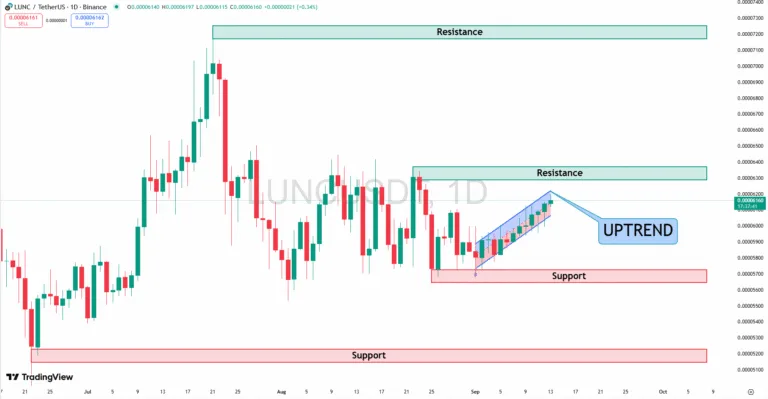
LUNC is trading in a short-term uptrend, with price movement forming higher highs and higher lows. The recent rally has positioned the token inside a rising channel, showing steady bullish momentum. Traders are closely watching the immediate resistance at 0.00006200–0.00006300, which has capped gains in recent sessions.

Support and Resistance Levels

● Immediate support: 0.00005700–0.00005800, a zone where recent buying pressure has been observed.

● Major support: 0.00005100–0.00005300, a historical demand area that previously triggered strong rebounds.

● Immediate resistance: 0.00006200–0.00006300, the short-term ceiling that LUNC must break for further gains.

● Major resistance: 0.00007200–0.00007300, the key barrier from the previous rally that will be the next bullish target if the breakout occurs.

Bullish Outlook

If LUNC successfully breaks above 0.00006300 with strong daily closes, the next upside target will be the 0.00007200 resistance. A sustained move beyond this level could open the way to the psychological level of 0.00008000. The current trend remains bullish as long as price holds above the 0.00005700 support.

Risk Consideration

While momentum favors the bulls, traders should be cautious of false breakouts around resistance. A daily close below 0.00005700 would weaken the bullish structure and potentially send the price back toward the major support at 0.00005100.

Conclusion

LUNC is showing promising signs of strength in its recent uptrend. Holding above support and breaking through resistance at 0.00006300 will be the key confirmation for continued bullish movement. If successful, buyers could target 0.00007200 in the near term and potentially higher levels in the following weeks.
BloFin Sets Delisting Date for LUNCUSDT Perpetual Contract

0

BloFin is a global cryptocurrency exchange and derivatives trading platform known for offering a wide range of futures, spot, and perpetual contract products. The exchange has built a reputation for strong risk management practices and its focus on providing traders with a secure and transparent trading environment.

In its latest announcement, BloFin confirmed that it will delist the LUNCUSDT Perpetual Contract on September 18, 2025, at 06:15 (UTC). The move comes as part of the platform’s periodic token review process, which ensures that all listed products meet industry standards and market requirements.

Key Delisting Details

● New positions for LUNCUSDT perpetual contracts are no longer permitted.

● Reduce-only orders will remain available for users to close existing positions.

● All active and conditional orders will be canceled at 06:15 (UTC) on September 18, 2025.

● BloFin Futures will close all open positions and carry out automatic settlement at the same time.

Important Notes for Users
The delisting only applies to BloFin’s contract products, including contract copy trading. Traders are advised to close any open positions before the deadline to avoid automatic settlement.

To further safeguard users in volatile market conditions, BloFin reserves the right to implement additional protective measures. These may include changes to leverage limits, margin requirements, funding rates, or updates to the pricing mechanism.

This decision reflects BloFin’s continued commitment to maintaining a high-quality trading environment while protecting user interests.

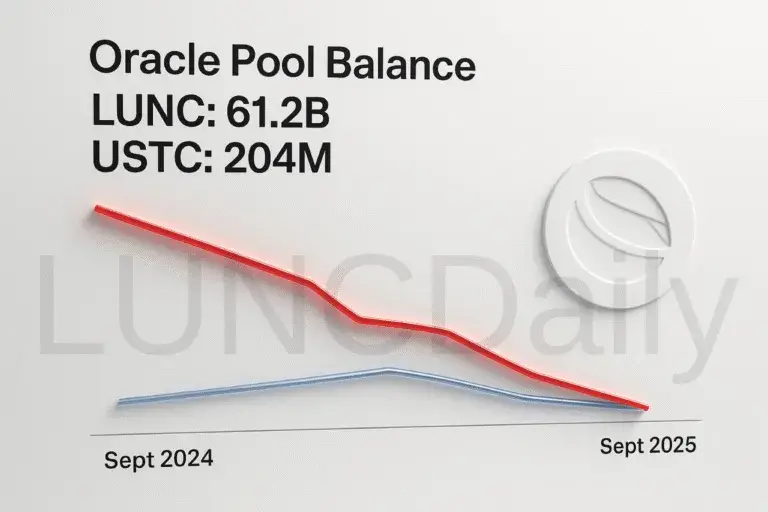
Luna Classic Oracle Pool Balance Drops Sharply Over the Past Year

0

The Luna Classic Oracle Pool has seen a significant decline in reserves over the past year. In September 2024, the pool held approximately 102 billion LUNC and 348 million USTC.

By September 2025, the balances have fallen sharply, with the pool now holding only 61.2 billion LUNC and 204 million USTC.

The Oracle Pool is a vital component of the Luna Classic ecosystem as it funds staking rewards for delegators and validators. A continuous reduction in these reserves means fewer tokens are available for distribution, which directly impacts staking APR. Lower staking rewards may reduce incentives for participation in staking and could affect the overall security and stability of the network.

Luna Classic Staking Rewards Plunge to 3.89 Percent

0

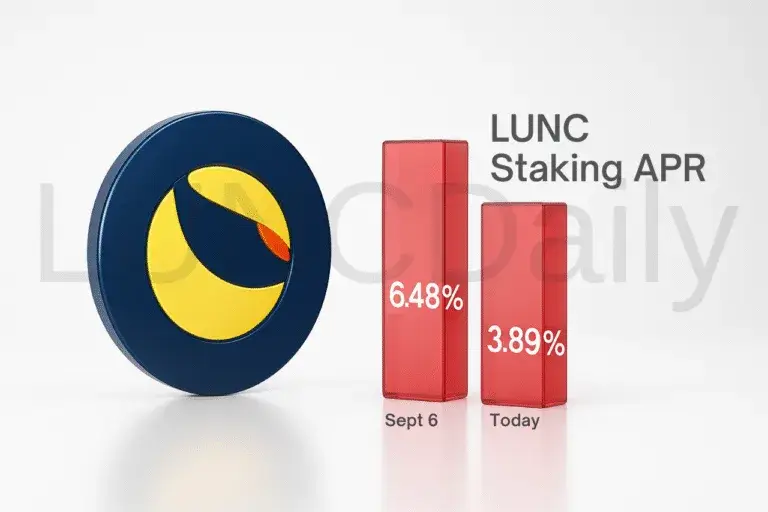
Luna Classic staking has seen a significant drop in annual percentage rate (APR), sparking concern across the community.

On September 6, the Luna Classic staking APR was recorded at 6.48 percent. However, in just a few days, it has fallen to 3.89 percent. This decline marks one of the steepest short-term changes in staking rewards that the network has faced recently.

The reduced APR directly impacts stakers, as lower returns may discourage participation and weaken overall network security.

Only 138.04 Million LUNC Burned in the Last 7 Days

0

In the last seven days, the Terra Classic community recorded a total of 138.04 million LUNC burned. This figure, while still a positive step toward reducing the circulating supply, remains relatively small compared to earlier burn activity.

The LUNC burn mechanism plays a crucial role in the community’s efforts to restore value to Terra Classic. By consistently lowering supply, the initiative aims to increase scarcity, which may support long-term price growth.

Community continue to encourage stronger participation in burning initiatives. They stress that greater collective involvement is necessary to achieve a meaningful reduction in supply and accelerate the recovery path for LUNC.

The results from this period highlight both the progress made and the challenges ahead. Ongoing community-driven burns, coupled with technical development and ecosystem growth, will remain essential in shaping the future of Terra Classic.

Proposal: Fix legacy contracts by core upgrade

Summary

This proposal seeks approval for a patch to the chain core that will re-introduce support for legacy CosmWasm contract execution. The change consists of a small fix (~30–50 lines of code) that restores functionality broken during the v2.1.0 upgrade in 2022.

Affected contracts include not only a number of Astroport pools and potentially some remaining Terraswap pools. While re-enabling these contracts would make currently locked liquidity accessible again without requiring contract migration, the fix would also allow a lot more legacy contracts that include tax handling on chain to work again.

Context

During the v2.1.0 upgrade, custom Terra query support was changed, which caused contracts to stop working, which query the tax rate on chain or exchange rates from the oracle module. This affected several liquidity pools holding significant amounts of LUNC and USTC (besides other tokens).

Key findings from a node-level patch test:

  • The patch allows transactions against these contracts to succeed again.
  • Pools currently contain large amounts of locked liquidity.
  • Example balances (rounded):
    • LUNC/USTC pool: ~700M LUNC, ~6M USTC
    • bLUNA/LUNC pool: ~150M LUNC
    • MIR/USTC pool: ~6M USTC
    • ASTRO/USTC pool: ~3.9M USTC
    • kUST/USTC pool: ~2.9M USTC
  • Across 465 identified Astroport contracts:
    • ~27.4M USTC
    • ~959M LUNC

These tokens are currently unreachable due to the broken execution path. That means, traders can not use those pools at all (native ↔ native) or only in one direction (cw20 ← native).

Implications

Re-enabling execution is expected to instantly “re-open” these pools. This has two sides:

  • Positive: The chain and its users regain access to their liquidity. Tokens that should be in circulation become usable again. Further, there will be a lot more contracts that will start working again without the need of contract migration.
  • Negative: The affected pools are highly imbalanced. Immediately after activation, users and most likely arbitrage bots will drain the obvious opportunities. Example: the LUNC/USTC pool trades at roughly 2× the fair market ratio. This means large swings will happen within minutes of the fix going live. This could affect the price of LUNC and USTC both positive or negative on other DEXes/CEXes, too, in the short term.

Risks

  • Arbitrage drain: First movers (mostly bots) will capture outsized profits, not long-term holders.
  • Public perception: Can be framed as “unlocking” large amounts of USTC/LUNC supply, which may be viewed negatively, although these coins where always meant to be unlocked. The “locking” happened due to a core upgrade side-effect.
  • Timing: Liquidity providers in affected and currently disfunctional pools cannot “exit early” before the patch is applied.
  • Precedent: Some may argue this sets a precedent for L1 patches to support dApps. However, the breakage was originally caused by an L1 upgrade, and the fix is small and contained.

Conclusion

The patch restores functionality that was unintentionally broken. It unlocks liquidity for affected users and contracts, and will restore contract functionality for legacy contracts on chain.

Voting Options:

  • YES – Approve the patch to re-enable legacy contract execution.
  • NO – Do not apply the patch, legacy contracts remain unusable.
  • NO WITH VETO – Strong opposition.
  • ABSTAIN – No opinion.

For reference:
The code changes have been done and can be seen here: fix: Legacy contracts using terra query variants by StrathCole · Pull Request #602 · classic-terra/core · GitHub

MORE INFO

Terra Classic Wasm Unforking Upgrade: Notice for dApp Developers

Overview

The Terra Classic network is undergoing an upgrade to align its WebAssembly (Wasm) implementation with the upstream CosmWasm framework. This upgrade introduces changes to gRPC contract queries, specifically affecting the QueryContractInfo service.

Changes

  • gRPC QueryContractInfo:
    • A new address field has been added to the response.
    • The contract_info field is now the second field in the response (previously the first).

Impact

  • Not Affected:
    • dApps using REST (LCD) interfaces via libraries like terra.js, feather.js, or similar are unaffected.
    • Smart contract state queries and transaction execution remain unchanged.
  • Affected:
    • dApps or tools using gRPC directly or through libraries like CosmJS or cosmES for QueryContractInfo queries must adapt to the new service type.
    • This change may impact how contract information is displayed in some applications but does not affect querying contract data or state.

Action Required

  • LCD Users: No action is needed.
  • gRPC Users: Update your implementation to use the new QueryContractInfoService instead of the legacy service.
  • Testing: dApp teams have a one-month notice period to patch and test their applications to ensure compatibility with the new service.

Timeline

  • Developers have one month to implement and test the necessary changes before the upgrade takes effect.

Ensure your dApp is ready for the Terra Classic Wasm unforking upgrade to maintain seamless functionality.

LUNC Staking Update: 352 Million Tokens Unstaked

0

The Terra Classic (LUNC) network has recorded an update in staking activity. Current data shows that the total amount of LUNC staked is 963.6 billion, which represents 14.85% of the circulating supply. Alongside this, there has been a change of 352 million LUNC being unstaked.

This movement reflects normal adjustments within the community as delegators and validators manage their holdings. Staking levels often shift over time due to portfolio balancing, validator changes, or the need for liquidity.

Even with this recent change, LUNC continues to show strong participation from its community. Nearly 15% of the total supply remains staked, supporting both network security and governance.

Staking remains an important part of Terra Classic’s ecosystem, as it strengthens validator operations and gives the community a voice in decision-making. Observing these trends helps provide insight into how the network is evolving and where community engagement is headed.

Report on the Top 10 USTC Burners

0

This report provides an overview of the top 10 USTC (TerraClassicUSD) burners. The data highlights the entities and addresses contributing the most to USTC supply reduction, with Luna Foundation Guard (LFG) and Terra Form Labs (TFL) accounting for the majority of recorded burns.

Key Findings

● Luna Foundation Guard (LFG), burning over 1.75 billion USTC, which represents 33.8% of the total.

● Terra Form Labs (TFL) collectively burned more than 644 million USTC through multiple wallets.

● Unknown addresses contributed significantly, with one wallet burning 86.3 million USTC (1.7%).

● KuCoin is the only exchange listed in the top 10, with 6.8 million USTC burned.

Breakdown of the Top 10 Burners

Rank Wallet Name USTC Burned % of Total
1 Luna Foundation Guard (LFG) 1,754,725,793 33.8%
2 Terra Form Labs (TFL) 438,873,713 8.5%
3 Terra Form Labs (TFL) 174,560,640 3.4%
4 Unknown 86,354,812 1.7%
5 Terra Form Labs (TFL) 12,384,519 0.2%
6 Terra Form Labs (TFL) 12,368,924 0.2%
7 Terra Form Labs (TFL) 10,106,557 0.2%
8 Luna Foundation Guard (LFG) 9,922,189 0.2%
9 KuCoin 6,869,940 0.1%
10 Unknown 5,734,019 0.1%

Contributions from unknown wallets and exchanges reflect a more diverse participation base. Sustained burning activity, combined with ecosystem development, will remain critical in shaping USTC’s path toward stability and recovery.

Professionalism Discussion on USTD: A Balanced Perspective

0

Dawid Skinder, a member of the USTD team, offers a professional perspective following the recent article “Balancing Innovation with Accountability in Luna Classic”. While the earlier piece raised important considerations, this commentary aims to respectfully expand on those points by providing additional context around the USTD Protocol and stablecoin, clarifying risks, and highlighting the safeguards in place.

The Nature of Stablecoins and Risk Asymmetry

One criticism of USTD is the asymmetry of its risk profile, where potential downside seems higher than upside. However, this argument applies to every stablecoin, not only USTD. Stablecoins are not designed for speculative profit or 100X returns. Their purpose is yield generation, trading utility, and capital preservation. Therefore, labeling USTD as uniquely risky because of this inherent property is misleading. The focus should instead be on safety and stability, which is what the protocol aims to deliver.

The “Free Body Problem” and Backing with USDT and USDC

Another concern is USTD’s reliance on USDT and USDC as backing assets. It is true that issues with either of these stablecoins could impact USTD. However, the USTD Protocol has built-in mechanisms to mitigate such risks.

● Reserves and Collateral Pool: Half of the generated yield is directed into reserves and a DeFi collateral pool from day one. This collateral strengthens the peg and provides a safety net for redemptions during stress scenarios.

● Market Reality: USDT and USDC are the largest and most widely adopted stablecoins. If either were to collapse, the entire crypto market would face severe disruption, not just USTD.

Systemic Implications for Terra Classic

Some argue that launching USTD on Terra Classic Layer 1 poses systemic risk. While this is true in principle, it is not unique to USTD. Every Layer 1 project carries this responsibility, from modules to protocols. The USTD Protocol was specifically designed with Terra Classic in mind, ensuring it remains decentralized and can generate revenue for the ecosystem. Risks such as mass unstaking, module failure, or market shocks exist in all blockchains, not just Terra Classic. The key is active risk management rather than avoidance.

Cross-Chain Fragility and Bridges

Cross-chain risk is a valid concern, particularly with bridges. The protocol recognizes this in its white paper and implements mitigation strategies:

● Use of Safe IBC for secure interoperability

● Integration with trusted cross-chain swap providers such as Thorchain and Maiar

● Utilization of Circle’s CCTP (Cross-Chain Transfer Protocol) for secure USDC transfers

These solutions rely on industry-leading infrastructure to reduce vulnerabilities and strengthen cross-chain functionality.

The Binance Factor

Some commentary has suggested Binance may view the creation of USTD unfavorably. However, there is no evidence or official statement supporting this claim. Without clear proof, this concern remains speculative and should not be treated as a confirmed risk.

Conclusion

Critical analysis of the USTD Protocol is necessary for the growth of Terra Classic and the wider community. However, context matters. Many highlighted risks are either universal to all stablecoins or already mitigated within the protocol’s design. The USTD Protocol aims to create a decentralized, yield-generating, and resilient stablecoin that can support the Terra Classic ecosystem while addressing the challenges of modern DeFi.