Home Blog Page 49

Terra Classic Governance Proposals: A Complete Overview

0

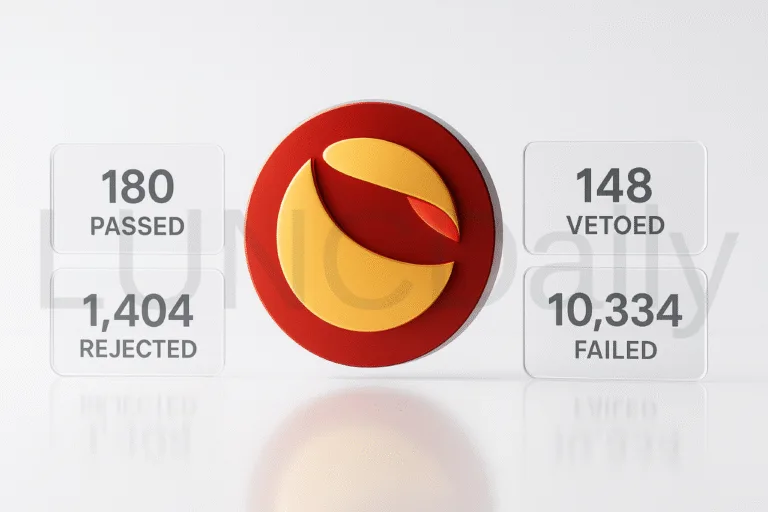
Did you know that since October 2021, the Terra Classic blockchain has recorded a total of 1,732 proposals? These proposals reflect the community’s efforts to shape the network through decentralized decision-making.

Through on-chain governance, members can submit ideas, suggest upgrades, and vote on changes that impact the ecosystem.

Breakdown of Terra Classic Proposals

● Passed: 180 proposals have gained majority support and successfully passed, leading to real changes on the network.

● Rejected: 1,404 proposals were rejected by the community, showing the importance of consensus and due diligence before submission.

● Vetoed: 148 proposals were vetoed, often due to being considered harmful, misleading, or spam.

● Failed: 10,334 proposals did not meet quorum or voting requirements, making them automatically invalid.

What This Means for the Terra Classic Community

The high number of failed and rejected proposals highlights both the openness of Terra Classic’s governance system and the challenges of building consensus in a decentralized ecosystem. While only a fraction of proposals pass, those that do often bring meaningful improvements to the network.

This level of participation reflects a strong and active community, even after the challenges Terra Classic has faced since the collapse of its algorithmic stablecoin. Governance continues to play a central role in shaping the blockchain’s direction, ensuring that decisions are made collectively rather than by a single authority.
OKX to Delist LUNC and USTC Trading Pairs on September 10, 2025

OKX, one of the leading global cryptocurrency exchanges, has announced it will delist several Terra Classic trading pairs. According to the official notice, the exchange will remove LUNC/USDT, LUNC/USD, and USTC/USDT pairs from its platform on September 10, 2025.

The delisting means that users will no longer be able to trade these pairs on OKX after the specified date. Traders holding positions in these pairs are advised to close or adjust them before the delisting takes effect to avoid disruptions.

OKX emphasized that the delisting decision is part of its routine evaluation of trading pairs to ensure market quality and compliance standards are maintained. Such actions are common in the industry when exchanges assess liquidity, trading activity, and overall demand.

The LUNC Relisting on Cetoex Rescheduled to September 8, 2025

0

The Terra Classic (LUNC) community has received an important update regarding the relisting of $LUNC on Cetoex. According to the latest announcement, the relisting has been rescheduled to September 8, 2025. Initially, the relisting was expected to take place on September 5, 2025, but the exchange has adjusted the timeline.

For the Terra Classic community, the relisting on Cetoex represents a key opportunity to expand liquidity and improve market accessibility. LUNC holders and traders will be able to engage with the token once the new date is in effect, marking another step forward in its journey of revival and adoption.

With September 8 now set as the confirmed date, the community looks forward to seeing how the relisting will influence trading activity and strengthen LUNC’s position in the broader crypto landscape.

Luna Classic Burn Update: 647.40 Million LUNC Removed in the Last 7 Days

0

In the past week, the Terra Classic (LUNC) community has successfully burned a total of 647.40 million LUNC tokens, worth approximately $38,339 at today’s price. This ongoing burn mechanism plays a crucial role in reducing the circulating supply of LUNC and supporting the long-term stability of the ecosystem.

The burn initiative is largely driven by community members, exchanges, and validators who commit to reducing excess supply. With every token burn, the circulating amount of LUNC becomes scarcer, which may positively impact its market performance over time.

As the burn momentum continues, the Terra Classic community remains focused on governance, staking, and development efforts aimed at rebuilding trust and utility within the ecosystem.

Luna Classic Staking APR Declines Slightly to 6.48 Percent

0

The annual percentage rate (APR) for Luna Classic staking has seen a minor decrease. In September 3, the APR stood at 6.52 percent, but as of today, it has dropped to 6.48 percent.

While the change appears small, even slight adjustments in staking rewards can influence validator participation and delegator decisions. A lower APR means that stakers may see reduced returns on their delegated tokens compared to the previous month.

This fluctuation is part of the normal dynamics within proof-of-stake networks, where factors such as total staked supply, validator performance, and network governance can influence reward rates.

For the Luna Classic community, monitoring APR movements remains essential, as staking incentives play a direct role in securing the blockchain and maintaining healthy validator participation.

Staked Report: LUNC Network Overview

0

The Terra Classic (LUNC) staking network continues to show stable participation from the community. According to the latest report, a significant portion of the total supply is actively staked, reflecting ongoing trust in the network’s governance and validator system.

As of the latest update:

● Total LUNC staked: 963,516,185,713 LUNC

● Percentage of total supply staked: 14.85%

● Value of staked LUNC at current price: $56,895,630

● Total delegators: 200,805

These figures highlight strong community involvement and demonstrate how staking continues to be an essential component of the Terra Classic ecosystem. By staking LUNC, delegators contribute to the security and stability of the network while also earning rewards for their participation.

The consistent staking ratio of nearly 15 percent of the circulating supply shows confidence in Terra Classic’s long-term sustainability. With over 200,000 delegators actively engaged, the network maintains a decentralized structure that distributes voting power and secures governance decisions.

Staking not only supports the network’s growth but also plays a vital role in strengthening its economic model, as the value of staked assets continues to align with overall market movements.

What Is an Unbonding on Terra Classic?

0

Many members of the Terra Classic community still ask what “unbonding” means when it comes to staking their LUNC tokens.

In simple terms, unbonding refers to the process of unstaking tokens that were previously delegated to a validator. When you choose to unbond, your tokens are placed in a locked state. During this period, you cannot transfer, sell, or use them, and you also stop earning staking rewards.
Once the unbonding process is complete, your tokens are released and become fully available again.

How Long Is the Unbonding Period on LUNC?
On Terra Classic, the unbonding period is 21 days. This means it takes three full weeks before your tokens are accessible after you undelegate them from a validator.

This parameter has been in place since the early design of the network to maintain stability and security. According to Terra’s documentation, the waiting time is intended to prevent sudden large-scale withdrawals that could impact validator performance and overall chain security.

Why Does the Unbonding Period Matter?
The unbonding period introduces a form of commitment for delegators. While this provides stronger network security, it also means token holders must plan ahead if they need liquidity.

As noted by Staking Rewards, the 21-day lock is considered a risk for investors who may need quick access to funds. A Reddit user summed it up well: “21-day unbonding period. Basically you will not receive rewards for 21 days after you undelegate.”

Key Takeaway

● Unbonding is the unstaking process of LUNC.

● It lasts 21 days, during which your tokens are locked.

● No rewards are earned during this period.

● Tokens are available again only after the waiting time ends.

For anyone staking LUNC, it is important to understand this rule so you can manage your tokens effectively and avoid surprises when planning to move or trade them.

Orbit Labs Confirms Successful Wasmd Unforking Upgrade on LUNC Testnet Rebel-2

Orbit Labs has officially confirmed that the Wasmd unforking proposal upgrade on the Luna Classic (LUNC) testnet, Rebel-2, has been successfully completed. Following the upgrade, the testnet is expected to function normally, restoring operations as they were before the process.

This upgrade marks an important step in maintaining the reliability and efficiency of the LUNC testnet environment.

Notice for Dapps Developers
Orbit Labs has issued an important notice for decentralized application (Dapps) developers. The upgrade includes an in-store migration designed to resolve contract key-prefix conflicts. Developers are strongly advised to test their CosmWasm-based applications to ensure smooth performance and compatibility after the migration.

This step is crucial for ensuring that deployed smart contracts and Dapps remain stable and continue to function correctly within the updated testnet framework.

The successful completion of this upgrade demonstrates the ongoing commitment to strengthening Luna Classic’s infrastructure and developer ecosystem.

Why Luna Classic Ranks 154 on CoinMarketCap but 244 on CoinGecko

0

Luna Classic (LUNC) continues to attract attention in the cryptocurrency space, with a market capitalization of approximately $323,255,825 as of today.

However, what surprises many investors is the difference in rankings across major data providers. On CoinMarketCap, Luna Classic holds the 154th position, while on CoinGecko, it is listed at 244.

This variation often confuses casual investors, but the explanation lies in how each platform calculates rankings. Data providers use different methodologies, which may include factors such as trading volume, liquidity, circulating supply, and the number of exchanges tracking the asset.

Because of these differences, the same token can appear in two very different positions across platforms, even though its market capitalization remains the same.

Despite the ranking gap, Luna Classic maintains a solid market presence, supported by its dedicated community and steady mid-cap valuation. For investors, the key takeaway is to look beyond rankings and focus on the fundamentals and long-term growth potential of the project.

CetoEX Exchange Confirms LUNC Relisting

0

The Terra Classic community has received an important update as CetoEX Exchange officially announced that it will relist LUNC on September 5. This development is seen as a positive step in bringing more liquidity and visibility to Luna Classic (LUNC).

The relisting comes with the support and assistance of the Juris team, who played a key role in making this possible. Their involvement highlights the growing collaboration between exchanges, technical partners, and the Terra Classic community to restore trust and strengthen the ecosystem.

For LUNC holders and traders, this relisting provides additional trading opportunities and reinforces the ongoing revival efforts. It also signals increasing confidence from exchanges in supporting Terra Classic’s long-term future.

As more platforms reintroduce LUNC to their listings, the community expects broader participation and improved access to global markets, which could further boost network activity and adoption.