LUNC and USTC on the Edge: Can New Proposals Revive the Market?
In recent posts, we broke down the analysis of LUNC and USTC price action, which shows a hard truth: both tokens remain static and continue to struggle at key resistance levels. Despite repeated attempts, momentum has not been strong enough to break out, leaving the market frustrated and directionless.
The hard truth: LUNC and USTC remain stuck in static price ranges, with resistance levels proving too strong to overcome.
This brings us to a bigger question: what is the real solution? Should we continue waiting for organic recovery, or do we need larger projects to drive change?
Over the past month, one major step has already been taken. The Market Module 2.0 proposal passed and development is currently ongoing in the testing phase. While not yet live, it represents a structural effort to rebuild confidence and utility within the Terra Classic ecosystem.
Now, attention has shifted to this week’s governance votes. Two new proposals are on the ballot:
Among these, it is clear that the USTD proposal has dominated community discussion in recent days. Supporters argue it could restore utility, attract investor interest, and bring fresh trading volume back to LUNC.
The big question: Should the community take a chance on USTD now, or remain patient and wait for recovery on its own?
If USTD passes and delivers on its vision, it could mark the turning point Terra Classic desperately needs. If it fails, LUNC and USTC may risk further stagnation — and fading relevance in the wider crypto market.
USTC (TerraClassicUSD) lost its peg long ago and is no longer a functioning stablecoin. Its price is now driven by speculation, community sentiment, token burns, developer initiatives, and regulatory developments.
Recent Developments
A recent sharp drop of nearly 46% highlights extreme volatility and fragile investor confidence.
Do Kwon’s guilty plea has revived concerns over governance, liabilities, and potential regulatory actions.
Tokenomics & Supply
Token burns are ongoing but remain modest relative to total supply. Liquidity is generally thin, which increases volatility and the risk of slippage during larger trades.
Risks
Unresolved legal and regulatory challenges.
Damaged reputation following Terra’s collapse, limiting institutional participation.
Persistent downside risk in response to negative headlines or weak market sentiment.
Potential Catalysts
Well-executed upgrades that enhance utility and governance.
Large-scale, visible token burns that reduce supply.
Improved broader market sentiment and altcoin performance.
Strong, consistent community and developer engagement.
Technical Analysis
Support & Resistance
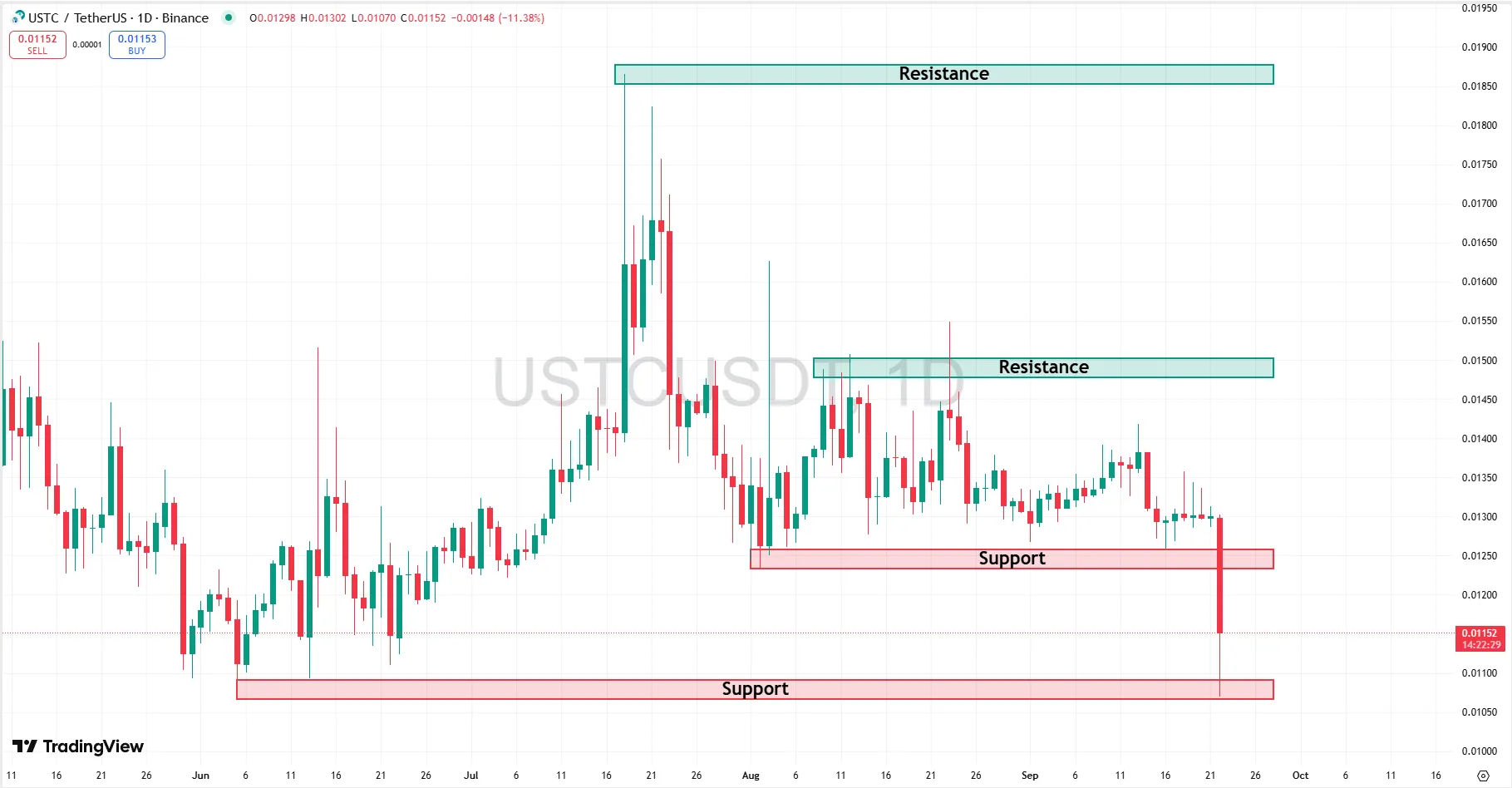
Immediate support lies between $0.0120–$0.0125, with a lower zone around $0.0105–$0.0110. Resistance levels are located near $0.0150 and $0.0185–$0.0190.
Breakdown & Momentum
Price recently broke below the $0.0125 support with strong selling pressure. Moving averages are positioned above current price levels, confirming a bearish structure. RSI shows oversold conditions, but without a confirmed bullish divergence. MACD and Stochastics remain negative.
Volume & Structure
Downward moves have been accompanied by higher volume, indicating strong selling conviction. The prior trading range between $0.0125 and $0.0150 has been broken, suggesting the potential for a new bearish leg toward the lower support zone.
Key Levels
Downside: $0.0110 is the next major support. A breakdown below this level could trigger deeper losses.
Upside: Bulls must reclaim $0.0125–$0.0130 to neutralize near-term weakness. A further push above $0.0150 would be required to shift momentum.
Scenarios & Outlook
Scenario
Description
Probability
Market Approach
Bearish Continuation
Further decline toward $0.0110 or lower.
High
Short rallies into resistance; manage risk with tight stops above $0.0130.
Relief Bounce
Oversold rebound toward $0.0130–$0.0145.
Moderate
Enter cautiously near support with clear reversal signals; target resistance levels.
Catalyst Reversal
Positive news sparks sustained bullish momentum.
Low to Moderate
Monitor governance updates, burn announcements, and upgrade results before positioning.
Market Sentiment
The broader crypto market remains cautious, and speculative assets like USTC face headwinds without strong narratives. Regulatory risks and reputation issues weigh heavily on sentiment, while liquidity constraints amplify volatility. Sustained improvement requires both credible technical progress and visible community commitment.
Conclusion
The short-to-medium term outlook for USTC remains bearish. The break below support with strong volume suggests sellers are in control. Price is likely to test lower support near $0.0110 unless a significant positive catalyst emerges.
Trading View:
For holders: consider risk management, partial reduction, or hedging until market stabilizes.
For traders: favor short setups on weak rallies; long setups only with clear reversal signals and disciplined risk control.
Monitor key catalysts: major token burns, utility-driven upgrades, and positive regulatory outcomes.
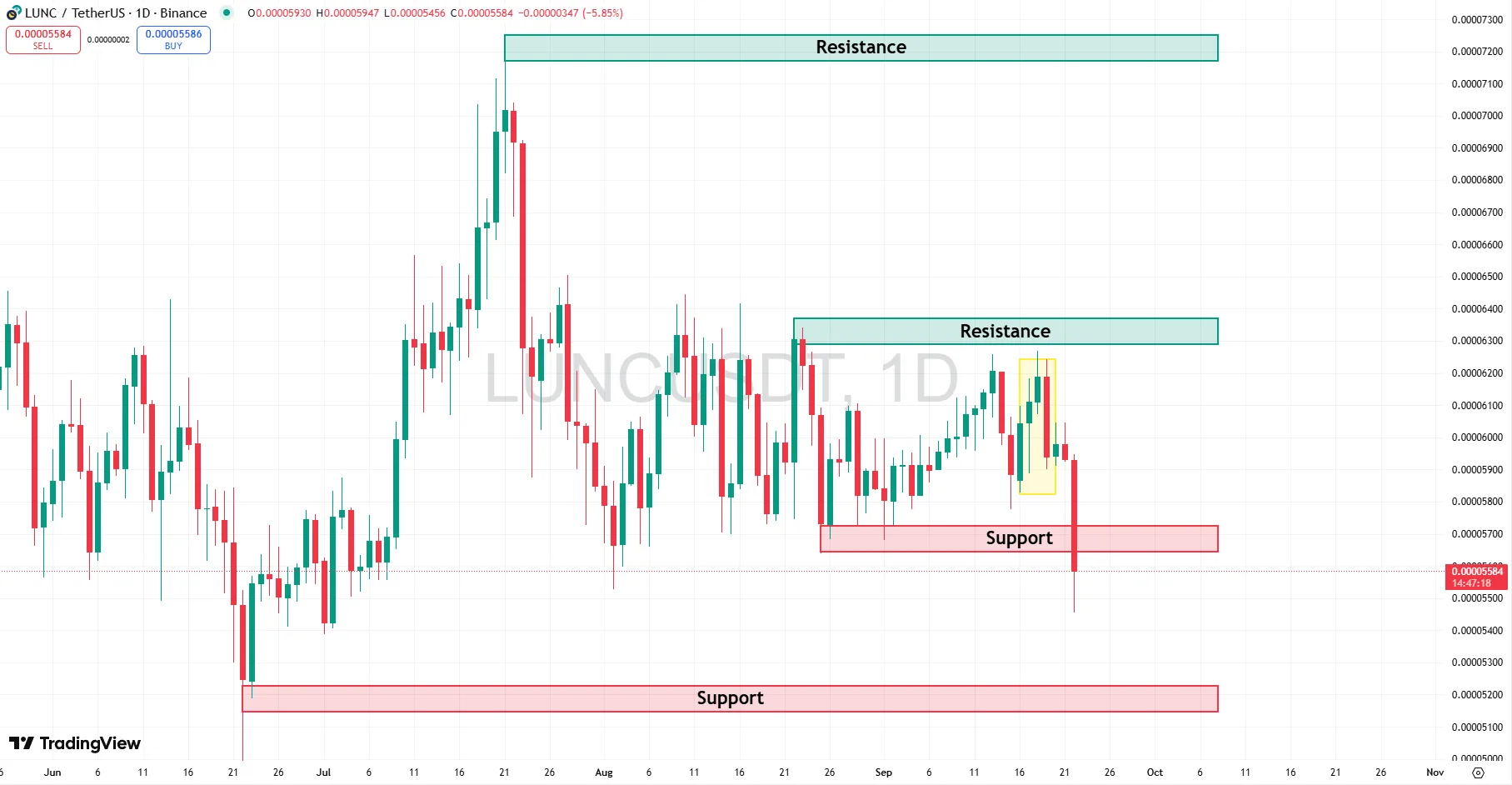
Resistance around 0.000062–0.000064 has capped multiple rallies. Near-term support at 0.000057–0.000058 was recently broken. The next significant support is around 0.000051–0.000052, aligning with historical lows.
Price Action
A failed breakout attempt into resistance led to a sharp rejection. The breakdown through support confirms bearish momentum. If pressure continues, LUNC could retest deeper support zones before stabilizing.
Market Structure
Multiple rejections at resistance suggest distribution. The decisive break of support points toward further downside unless a bullish reversal pattern or divergence emerges.
Key Levels
Support: 0.000051–0.000052
Resistance: 0.000057–0.000058, then 0.000062–0.000064
Downside risk: 0.000045–0.000048 if support fails
Fundamental Analysis
Supply and Tokenomics
LUNC has a circulating supply of approximately 5.5 trillion tokens. Binance has burned 74.3 billion LUNC from 2022 until today, demonstrating strong exchange support. However, relative to total supply, the impact remains modest. Long-term value depends on accelerating burns combined with stronger demand.
Project and Community
Terra Classic is fully community-driven after the collapse of Terra/UST. Governance proposals guide upgrades, including Cosmos SDK updates and a potential USTC repeg. While progress continues, on-chain activity and adoption remain limited, highlighting the need for expanded utility.
Market Sentiment
Investor sentiment is cautious. LUNC has lagged behind broader altcoin rebounds. Occasional bullish divergences appear, but sustained momentum requires clear catalysts. Broader regulatory and macroeconomic factors continue to weigh on the asset.
Outlook
Scenario
Conditions
Implications
Bearish
Break of 0.000051–0.000052 support with momentum
Targets 0.000045–0.000048 or lower
Bullish Reversal
Support holds, bullish signals appear, catalysts emerge
Dear #LUNCcommunity, coming to a conclusion on proposal #12192 (@RedlineDrifter USTD) has not been an easy task. The idea of the yield-bearing stable as a native token and protocol on the chain is appealing, the potential income for the chain is promising. But as well as this is a chance, it is a risk. A failure of a protocol launched on-chain has different implications than a failure of a protocol launched by the chain.
With paying for and thus owning a protocol, the chain inherits both the potentials and the risks. If adopted, the potential could be massive in terms of income for the chain and reducing $LUNC / $USTC supply, but major issues and/or failures would fall back on the chain as well. Given the decentralized nature, and that the chain is driven by all its contributors (including projects built on chain) during the past years, this includes potential effects on those projects in case of a negative event.
I think the idea itself seems solid and promising per se. It could be attracting niche users (and while niche sounds like only a few, the “pool” is big). It could bring badly needed income to the chain. Yet after all things considered, all discussions with RedlineDrifter of the past days reflected, I think the chain itself should not fund it from the Community Pool.
Although the project itself is drafted as decentralized as it can be (given the current technology available), it has some inherent semi-centralized components and areas of operation that are not easy to mitigate or “keep under control”. First, the bridging of funds is a concern. The main application would reside on Terra Classic, but most of the collateral would be off-chain (otherwise the yield-fetching would not work).
This means that not all users could withdraw their funds, or, if a lot of liquidity would be kept on chain, the yield would be significantly lower (less percentage in the liquidity pools earning fees). In case of any sort of bridging issues (on either side), the funds could be stuck for a short period of time, which could be a marketing disaster. Second, the semi-centralized components need multisig-wallets to work as at the current state they cannot be controlled by #TerraClassic governance directly (Akash does not support Interchain Accounts).
The past has shown that it can be a lengthy and controversial process to find and approve the necessary people for that (although it also can be quick, see liquidity provision of USDC). These parts of the protocol are fundamental to its inner workings, though. They will need regular attention of the multisig-holders. Third, although the executing company’s legal department judges the protocol “fine” in terms of regulations, we need to keep in mind that a different legal judgement would not only affect the protocol itself, in case that happened.
It would affect the chain itself, too. While the protocol would be decentralized, Circle (CCTP) and Teather are not. Fourth, I am not sure chain governance would be capable of running this kind of business or make the best decisions for the interest of the protocol as there might be several conflicts of priorities or interest. The “reaction speed” is also a concern in this context.
Point five is a question of philosophy. While a chain-owned protocol could benefit the chain directly, it also could compete with third-party protocols and potentially lower the attractiveness for builders, if the chain prefers its own products. This (the chain going for MEV) could go against the free-for-all idea where Terra Classic is just the “infrastructure”.
There are some more, rather minor items that would be too much for this text to add here. Just to repeat, I find the idea and concept appealing, and I would very likely invest in a credible project delivered on Terra Classic implementing just that, but I am hesitant to give a “consent” to the chain itself funding it because of the broader implications.
And to be clear, it would not matter if it would be done on L1 or L2, as soon as the CP/Chain pays for it, it is owned and as such deeply tied to the chain itself. This in turn means it would have implications on all projects building on this chain.
This conclusion has nothing to do with the individuals behind the concept/proposal, nor has it to do with the amount of funds that would be paid from the CP or the concept itself. Contrary, I’d love to see it become a reality as a non-chain-owned L2 project on this chain, maybe through a “governance token” launch, where the funding is paid to the development company, and where the gov token holders gain part of the fees later and govern the protocol as it is intended in the whitepaper (just that it’s chain governance there).
I say that knowing this would have some downsides (no chain-native token, no MM utilization, …) and would lead to less income for the chain than it being chain-owned. Still it could have positive side-effects on user inflow, liquidity and PR even in this case.
coming to a conclusion on proposal #12192 (@RedlineDrifter USTD) has not been an easy task. The idea of the yield-bearing stable as a native token and protocol on the chain is appealing, the potential income for the chain is promising. But as well as this is…
Validators in Terra Classic blockchain play a pivotal role in maintaining the network’s integrity, security, and functionality. As the original Terra chain rebranded after the 2022 fork, Terra Classic (LUNC) relies on a Delegated Proof-of-Stake (DPoS) consensus mechanism, where validators are essential nodes elected by token holders staking LUNC.
At their core, validators run full nodes that process and verify every transaction on the blockchain. They ensure transactions are legitimate, preventing double-spending or fraudulent activities. By broadcasting votes during consensus rounds, validators propose new blocks and vote on their validity, committing them to the chain once approved. This process upholds the decentralized nature of Terra Classic, distributing power among top validators based on staked amounts.
Beyond transaction validation, validators contribute to network security. They stake LUNC as collateral, facing slashing penalties for malicious behavior like downtime or double-signing, which incentivizes honest participation. This staking model not only secures the blockchain against attacks but also enables delegators—users who stake through validators—to earn rewards without running nodes themselves.
Validators also engage in governance, voting on proposals that shape the ecosystem, such as protocol upgrades, parameter changes, or community fund allocations. This democratic aspect allows the community to evolve Terra Classic responsively.
In summary, validators are the backbone of Terra Classic blockchain, blending technical duties with governance to foster a robust, user-driven network. For those interested in participating, staking with reputable validators can yield rewards while supporting the chain’s stability.
Staking Terra Luna Classic (LUNC) has emerged as a popular strategy in the cryptocurrency ecosystem, allowing participants to lock their tokens in support of the network while reaping personal gains. In proof-of-stake (PoS) systems like Terra Classic, staking involves delegating LUNC to validators who process transactions and maintain blockchain integrity. This dual-purpose mechanism creates a symbiotic relationship between individual users and the broader network, fostering growth and stability.
For users, the primary staking LUNC benefit is earning passive income through rewards. Platforms like Terra Station offer annual percentage yields (APYs) as high as 37.8%, significantly outperforming many traditional savings options. Other providers, such as DAIC Capital, provide up to 6% rewards, making it accessible for beginners. These rewards are distributed in LUNC or other tokens, allowing holders to grow their portfolios without active trading. Additionally, stakers gain governance rights, enabling them to vote on proposals that shape the network’s future, such as upgrades or token burns. This participatory element empowers users, turning staking into more than just a financial tool—it’s a way to influence the ecosystem directly.
On the network side, staking bolsters security by increasing the amount of locked tokens, making it costlier for malicious actors to launch attacks. Validators, incentivized by rewards, ensure efficient transaction verification and consensus, enhancing overall reliability. Higher staking participation also promotes decentralization, reducing reliance on a few dominant players and stabilizing the chain against volatility. For instance, initiatives to burn portions of rewards further reduce circulating supply, potentially increasing LUNC’s value over time.
In essence, staking LUNC creates a win-win scenario: users enjoy financial and governance perks, while the network gains robustness and longevity. As of 2025, with tools like Trust Wallet simplifying the process, more individuals are staking to contribute and profit. Whether you’re a seasoned investor or newcomer, understanding these staking LUNC benefits can guide smarter crypto decisions.
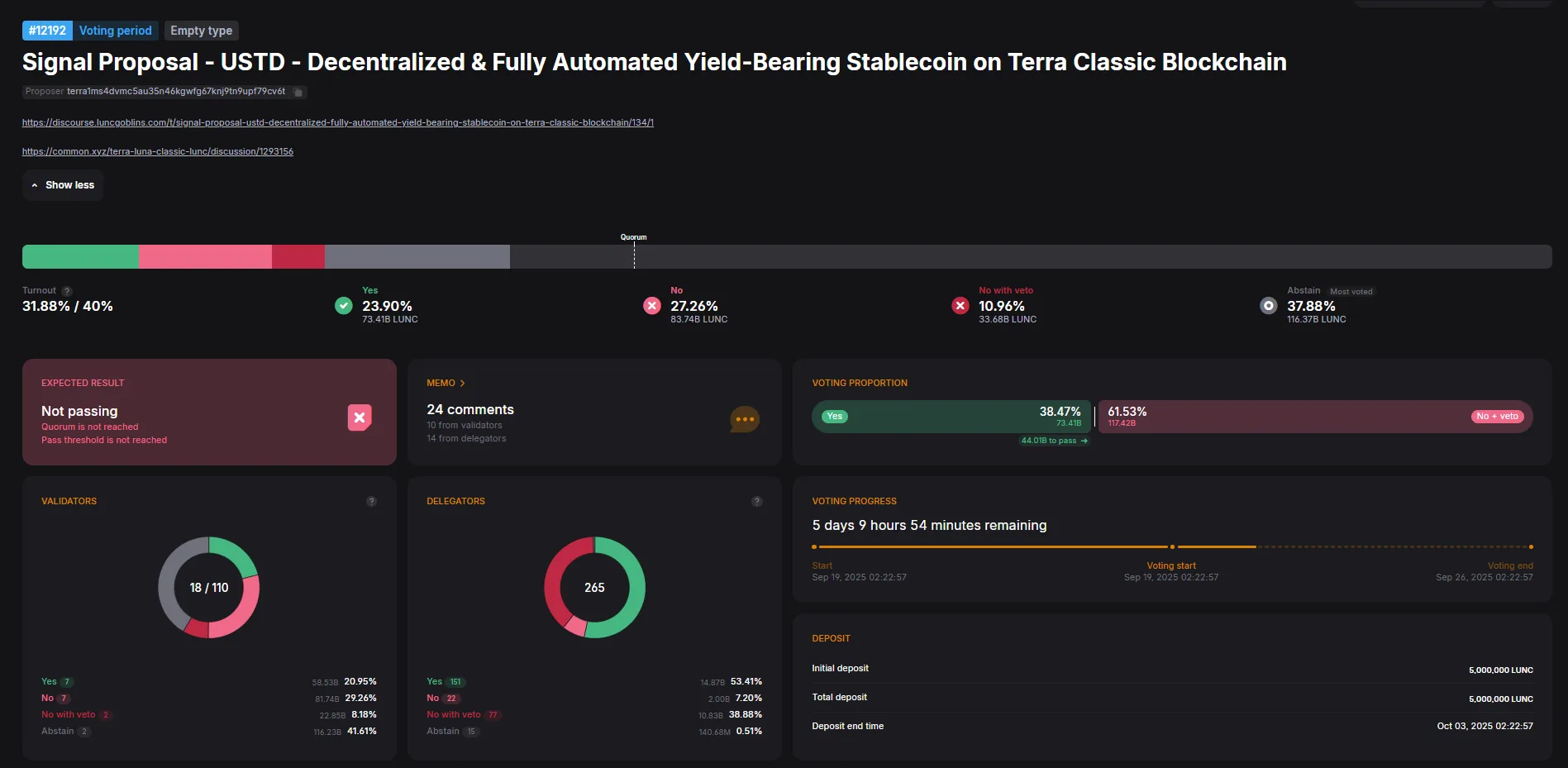
Proposal 12192, titled Signal Proposal — USTD Decentralized and Fully Automated Yield Bearing Stablecoin on Terra Classic Blockchain, is currently in the voting stage. The proposal seeks to introduce USTD as a decentralized, yield-bearing stablecoin for the Terra Classic network.
At this point, the proposal is not expected to pass. Turnout remains below quorum and the passing threshold has not been reached.
Status
At this point, the proposal is not expected to pass. Turnout remains below quorum and the passing threshold has not been reached.
Voting Results
Yes: 23.90% (73.41B LUNC)
No: 27.26% (83.74B LUNC)
No with veto: 10.96% (33.68B LUNC)
Abstain: 37.88% (116.37B LUNC)
Validator Participation
Only 18 of 110 validators have voted:
Yes: 7
No: 22
Abstain: 2
Delegator Participation
Yes: 151 (53.41%)
No: 22 (7.20%)
No with veto: 77 (38.88%)
Abstain: 15 (0.51%)
Timeline
Voting opened on September 19, 2025 and will close on September 26, 2025. Without a significant increase in turnout and stronger support for yes votes, the proposal is unlikely to pass.
Conclusion
The USTD proposal has not reached quorum and currently faces more opposition than support. Unless participation shifts dramatically, Proposal 12192 is expected to fail.
Ethereum and Solana Show Why Layer-2 Scaling Could Be Essential for LUNC
The global blockchain landscape is evolving as leading ecosystems like Ethereum and Solana explore different approaches to scaling. Ethereum has relied heavily on Layer-2 solutions that anchor back to the main chain, while Solana is beginning to introduce rollups and modular extensions despite its high Layer-1 throughput. For Terra Classic (LUNC), these trends provide valuable lessons on how to prepare for future growth.
What Layer-2 Really Means
Layer-2 solutions are not “off-chain” in the sense of being detached from the network. Instead, they are extensions of the base chain that process transactions more efficiently while still relying on Layer-1 for settlement and security. This design improves scalability without sacrificing trust.
Comparison of Ethereum, Solana, and LUNC
Feature / Metric
Ethereum + Layer-2s
Solana with Layer-2 / Rollup Movement
Implications for LUNC
Total Value Locked (TVL)
Ethereum’s Layer-2 ecosystem secures tens of billions in TVL, with combined figures exceeding $38 billion during recent reporting periods.
Solana’s base chain is highly performant, but new rollups are being introduced for specialized workloads.
LUNC could replicate this growth by developing its own scaling layers and liquidity incentives.
Growth in Transaction Volumes
Ethereum’s L2 networks have recorded surges in usage, with some periods showing more than 70% growth in transaction volume.
Solana’s exploration of rollups reflects recognition that even a fast base chain has limits as adoption expands.
LUNC risks bottlenecks if it remains purely L1. Layer-2 would allow more sustainable growth.
Interoperability / Bridges / Token Models
Projects like Coinbase’s Base have demonstrated the power of native tokens, bridges, and open infrastructure on Layer-2.
Solana is gradually adopting modular infrastructure, with new rollups aimed at expanding its ecosystem reach.
LUNC could benefit from bridges, native L2 tokens, and incentive schemes to strengthen adoption.
What This Means for LUNC
Terra Classic’s long-term scalability depends on learning from other ecosystems. Ethereum shows how anchoring activity to the main chain through Layer-2s creates exponential growth in value and adoption. Solana demonstrates that even the most performant Layer-1 designs eventually need modular extensions.
For LUNC, developing a strong Layer-2 ecosystem could attract liquidity, ease network congestion, and unlock new user experiences while maintaining security from the base chain. The next phase of adoption may require scaling beyond Layer-1 limits to remain competitive.
Terra Classic Proposal 12193 Could Unlock Nearly 1 Billion LUNC Through Legacy Contract Execution
Proposal 12193, titled Re-Enable Legacy Contract Query Execution, is now open for voting on the Terra Classic network.
The proposal seeks to restore support for legacy CosmWasm contract queries that were disrupted during the v2.1.0 upgrade. If approved, the patch will bring back previously broken functionality, allowing developers and users to continue interacting with older smart contracts that remain active in the ecosystem.
Key findings from a node level patch test show:
The patch allows transactions against these contracts to succeed again.
Pools currently contain large amounts of locked liquidity.
Example balances (rounded):
LUNC/USTC pool: ~700M LUNC, ~6M USTC
bLUNA/LUNC pool: ~150M LUNC
MIR/USTC pool: ~6M USTC
ASTRO/USTC pool: ~3.9M USTC
kUST/USTC pool: ~2.9M USTC
Across 465 identified Astroport contracts:
~27.4M USTC
~959M LUNC
Currently, these tokens are unreachable due to the broken execution path. This means traders cannot use those liquidity pools at all for native to native swaps, or can only execute transactions in one direction (cw20 ← native).
Re-enabling execution is expected to instantly reopen these pools, making the locked liquidity accessible again for trading and restoring normal market activity.
Community members and delegators are encouraged to review the full details and cast their votes before the voting period closes.
Terra Classic Faces Defining Moment as USTD Proposal #12192 Heads to Community Vote
The Terra Classic blockchain has entered a pivotal stage with Proposal #12192, officially titled “Signal Proposal – USTD – Decentralized & Fully Automated Yield-Bearing Stablecoin on Terra Classic Blockchain.” This governance proposal is now live for voting, giving the community a chance to shape the future of the network.
What is USTD?
USTD is a next-generation stablecoin built directly on the Terra Classic Layer 1 blockchain. Unlike previous iterations, USTD is designed as a fresh and fully collateralized stablecoin, pegged 1:1 to the US Dollar. Its collateral will come from fiat-backed stablecoins such as USDC and USDT, ensuring strong stability.
Beyond its peg mechanism, USTD introduces a unique feature: automated yield rewards. Holders will receive attractive returns through periodic airdrops, making USTD both a reliable stablecoin and an incentive-driven asset. An additional long-term vision tied to this project is the potential revitalization of USTC, Terra Classic’s original algorithmic stablecoin.
How Does Voting Work?
As a governance-driven blockchain, Terra Classic empowers its community to decide on proposals through validator voting. LUNC holders can either vote directly or rely on their chosen validators to cast votes on their behalf.
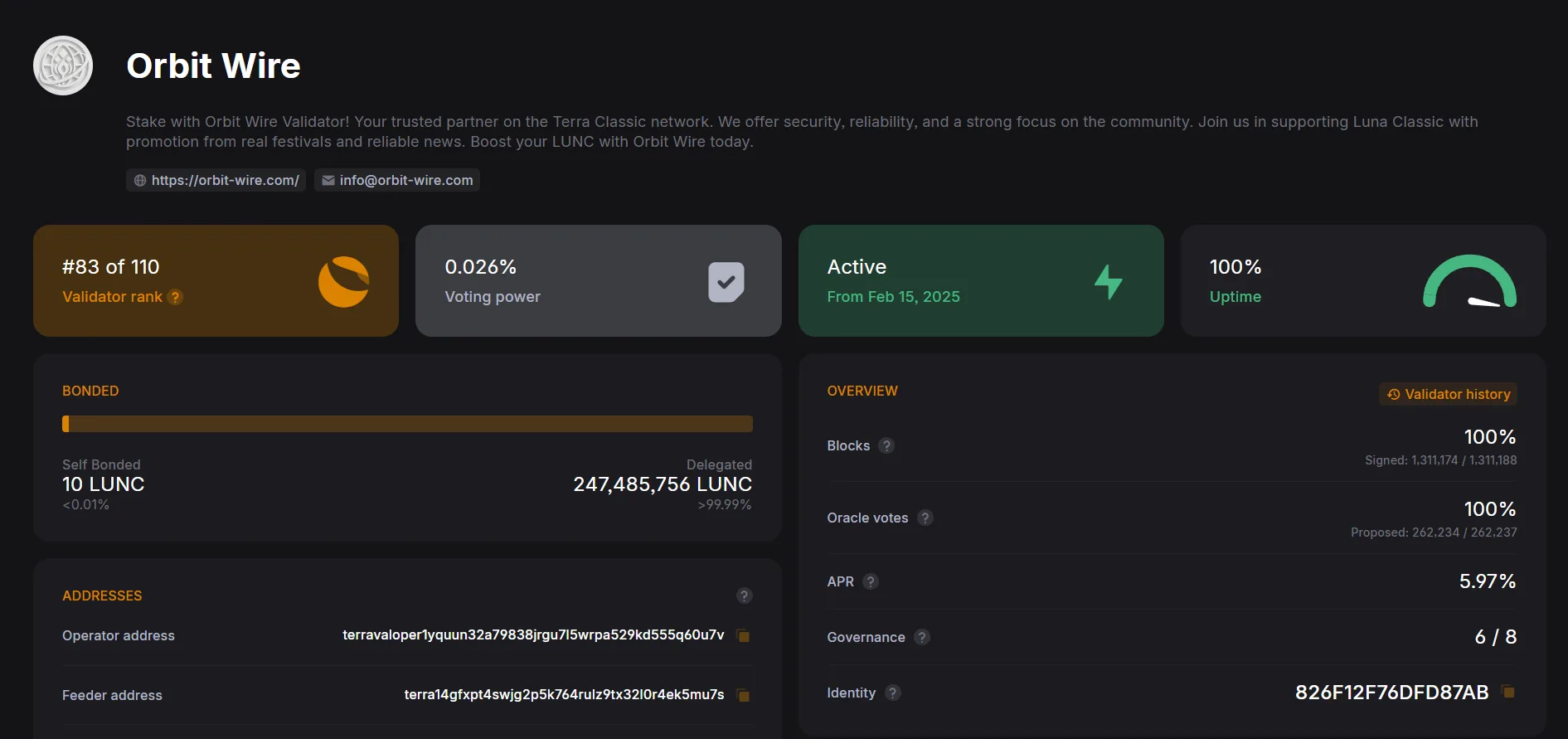
Orbit Wire Validator’s Position
Orbit Wire Validator awaits delegators’ input before voting on Proposal #12192
At this stage, Orbit Wire Validator has not yet voted on Proposal #12192. Instead, we are waiting for input from our delegators before casting our final decision. This ensures that our vote reflects the collective voice of our community.
If you are one of our delegators, you can share your opinion with us directly in our official group or privately with our admin.
Group: Orbit Wire Telegram
Admin: Contact Doncho MIOFF
Every vote shapes the direction of Terra Classic’s future. With USTD positioned as a potentially transformative stablecoin, the community’s decision will determine whether Terra Classic embraces this new model of stability and yield generation.
Now is the time for all Terra Classic participants to make their voices heard.