Home Blog Page 65

The CLARITY Act and Its Bright Future for Terra Luna Classic

Introduction

The Digital Asset Market Clarity Act of 2025 (CLARITY Act), passed by the U.S. House, is a game-changer for the cryptocurrency industry, delivering a clear and supportive regulatory framework.

At its core, the maturity clause paves the way for blockchain tokens to transition from securities to digital commodities under the Commodity Futures Trading Commission (CFTC), fostering innovation and investment.

For Lunc the native token of the vibrant Terra blockchain, this clause offers a golden opportunity to shine.

This article explores how the maturity clause positions Luna Classic for a promising future.

The Power of the Maturity Clause

The maturity clause sets clear, achievable criteria for a blockchain to be recognized as a “mature blockchain system”, allowing its tokens to be regulated as commodities with lighter oversight from the CFTC. Key requirements include:

  • Decentralization: No single entity or group can control the blockchain or hold 20% or more of the token supply, ensuring a community-driven ecosystem.
  • Functionality: The blockchain must be fully operational, publicly accessible, and capable of supporting transactions, governance, or other services.
  • Open-Source Code: Transparent, accessible code fosters trust and collaboration.
  • Certification Process: Issuers can submit a certification of maturity to the SEC, detailing governance, token utility, and decentralization. The SEC has 60 days to rebut or 120 days to request more information; otherwise, the blockchain is automatically deemed mature.
  • Time Limit: Projects have four years from their first token sale to achieve maturity, maintaining exemptions from securities laws.

Once certified as mature, tokens gain commodity status, unlocking opportunities for fundraising and market growth. Issuers can raise up to $75 million annually without SEC registration, provided they meet robust disclosure requirements (e.g., business plans, financials, and risks).

Why the Maturity Clause is a Win for Lunc ?

The maturity clause aligns perfectly with Lunc’s strengths, offering a clear path to success:

  1. Seizing Commodity Status:
    • Community-driven governance and decentralized structure make it well-suited to meet the maturity clause’s criteria. With no single entity dominating token ownership, Lunc is poised to achieve the 20% ownership threshold, securing commodity classification and reducing regulatory hurdles.
    • This status will enhance Lunc’s appeal to investors and developers, fueling growth and adoption.
  2. Regulatory Clarity Fuels Growth:
    • The CLARITY Act resolves the SEC-CFTC jurisdictional debate, providing Luna Classic with a stable, CFTC-regulated framework. This clarity is a catalyst for investor confidence, positioning LUNC as a trusted asset in the crypto market.
  3. Unlocking Fundraising Potential:
    • As a mature blockchain, Luna Classics developers could raise up to $75 million annually without SEC registration, funding cutting-edge DeFi applications and infrastructure upgrades. This influx of capital could attract institutional investors, amplifying Lunc’s market presence.
  4. Overcoming Challenges with Confidence:
    • While the 5.6 trillion token supply presents a challenge to meeting the 20% ownership criterion, Luna Classics proactive community is well-equipped to address this through strategic governance and token management.
    • The four-year maturity window provides ample time for Luna Classic to solidify its decentralized framework, ensuring compliance and avoiding stricter SEC oversight.

A Bright Future for Crypto

The CLARITY Act’s maturity clause sets a transformative precedent for the crypto industry:

  • Empowering Decentralization: It encourages projects like Luna Classic to embrace open-source, community-driven systems, driving innovation.
  • Balancing Growth and Trust: The $75 million fundraising exemption supports ambitious projects while ensuring transparency for investors.
  • Addressing Concerns: Critics note that tokens on non-mature blockchains may face regulatory uncertainty, but Lunc’s strong governance positions it to overcome such hurdles.

Luna Classics decentralized ethos and active community make it a standout candidate to thrive under the Act’s framework, setting the stage for long-term success.

Conclusion

The CLARITY Act’s maturity clause is a beacon of opportunity for Terra Luna Classic, aligning with its decentralized vision and community-driven innovation.

By achieving commodity status, LUNC can unlock lighter regulation, attract investment, and fuel ecosystem growth. With a clear regulatory path and a passionate community, LUNC is well-positioned to capitalize on the Act’s benefits.

As the SEC and CFTC finalize rulemaking within 360 days, LUNC stands ready to embrace a brighter future, solidifying its place as a leader in decentralized finance.
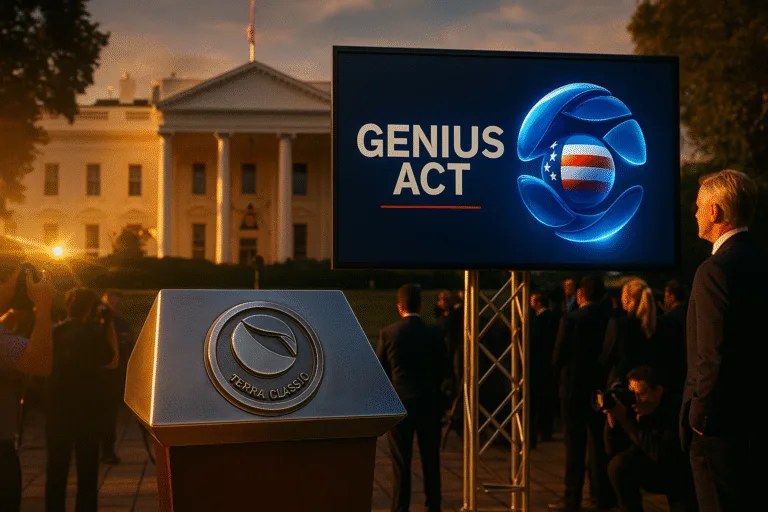
With new U.S. regulations now in place, TerraClassicUSD (USTC) and Terra Classic (LUNC) could be positioned for a major institutional revival.

A New Chapter for Crypto Regulation in the U.S.
In a landmark decision, the United States has officially passed the GENIUS Act, a new law requiring all payment stablecoins to be backed by U.S. dollars or short-term government securities. This development is part of a broader crypto reform effort, which includes other bills such as the CLARITY Act and measures limiting the use of Central Bank Digital Currencies (CBDCs).

Together, these laws are designed to provide long-awaited clarity for the digital asset industry, establishing legal definitions, creating oversight structures, and improving investor protection. Analysts are calling this a “regulatory leap” that could open the door for mainstream adoption of stablecoins and other blockchain-based financial products.

What This Means for USTC and LUNC
TerraClassicUSD (USTC) is a decentralized stablecoin that originally operated through an algorithmic model tied to LUNC (Terra Classic). Unlike traditional stablecoins backed 1:1 by fiat reserves, USTC maintained its peg through a burn and mint mechanism with LUNC—creating or destroying supply to keep its price stable.

This design failed in 2022, leading to the collapse of Terra’s original ecosystem. However, the community did not abandon the project. Instead, developers and contributors have continued to rebuild Terra Classic, focusing on restoring USTC’s value and improving its underlying model.

The GENIUS Act now brings a new opportunity. Although USTC is not currently backed by fiat or Treasuries, the law may allow for decentralized stablecoins to comply, if they can prove adequate reserves or implement improved mechanisms that meet transparency and safety standards.

Why USTC Could Still Become a Leading Stablecoin
Here’s why USTC, despite its history, could become a strong contender among future stablecoins:

1. Decentralization First
USTC is one of the few stablecoins not controlled by a private company. This aligns with the growing demand for financial systems that are open, community-driven, and censorship-resistant.

2. Community Resilience
The Terra Classic community remains one of the most active and organized in the crypto space. Proposals to re-collateralize USTC, reduce supply, and improve its algorithm have gained serious traction.

3. Regulatory Repositioning
The GENIUS Act doesn’t just shut out algorithmic models, it creates a path for them to evolve. If USTC integrates a hybrid reserve model with verifiable backing and improved controls, it could fit within the law’s requirements.

4. Strategic Link to LUNC
The value of USTC is deeply connected to LUNC. As LUNC strengthens through community development, utility use cases, and smart contract upgrades, it could provide stronger support for USTC’s stabilization mechanics.

5. Institutional Curiosity
Now that the regulatory environment is clearer, institutions may revisit algorithm-based models—especially those backed by large communities and open source governance. USTC could become a pioneer in this new category of compliant decentralized stablecoins.

Market Outlook and Strategic Focus
In the short term, USTC and LUNC are likely to see increased attention, especially as the U.S. Treasury and Federal Reserve begin to release technical guidance under the GENIUS Act. If the Terra Classic community can present a credible roadmap toward regulatory compliance—such as introducing partial fiat reserves or real-time auditing tools—USTC could re-enter the U.S. market as a legal, decentralized alternative to major stablecoins like USDC or USDT.

For LUNC, this also means renewed purpose. The token may evolve into the governance and economic layer for USTC, supporting smart contracts, collateral mechanisms, and decentralized treasury management.

Final Thoughts
The GENIUS Act is more than just a policy change—it marks the beginning of a new era in crypto finance. While many stablecoins will need to adjust or exit the market, USTC has a rare opportunity: to become a fully compliant, decentralized stablecoin built on the lessons of the past and the standards of the future.

With strong community backing, technical innovation, and a clear connection to Terra Classic’s long-term vision, USTC and LUNC could be at the center of the next generation of digital currency.

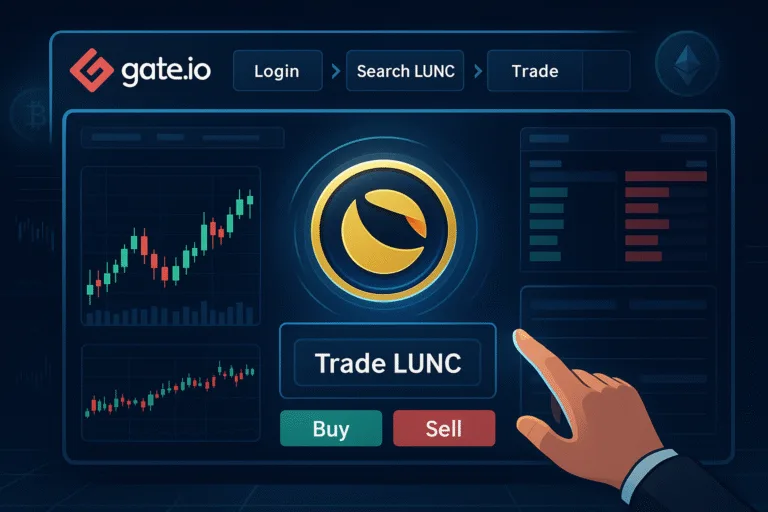
How to Trade LUNC on Gate.io: A Step-by-Step Guide

Trading Terra Classic (LUNC) on Gate.io is straightforward with the right steps. This guide outlines how to buy and sell LUNC on this leading cryptocurrency exchange.

Step 1: Create and Verify Your Account
Visit Gate.io (www.gate.io) and click “Sign Up” in the top right corner. Register using your email or phone number, set a secure password, and complete the Know Your Customer (KYC) verification by submitting valid ID documents. KYC ensures compliance and enhances account security.

Step 2: Deposit Funds
Log in to your Gate.io account. Navigate to “Wallet” and select “Deposit.” A popular method is to fund your account with Tether (USDT) via P2P trading or bank transfer. Alternatively, transfer crypto like Bitcoin or Ethereum from another wallet. Ensure funds are in your spot wallet before trading.

Step 3: Navigate to the Trading Interface
Hover over “Trade” on the top navigation bar and select “Spot.” In the market section, search for the LUNC/USDT trading pair. This opens the trading interface with price charts and the order book.

Step 4: Place a Trade
Choose between a limit order (set your desired price) or a market order (trade at the current price). Enter the amount of LUNC you want to buy or sell, then click “Buy” or “Sell” to execute the trade. Review the order details before confirming.

Step 5: Monitor and Manage Your Trades
Check your trade status in the “Order History” or “Wallet” section. For advanced options, Gate.io supports margin trading for LUNC with up to 3x leverage.

Final Note
Always conduct thorough research and practice risk management, as cryptocurrencies are volatile. For support, contact Gate.io’s Customer Support Team.

Why Coinbase Should List LUNC Now?

Terra Luna Classic (LUNC) is experiencing a remarkable surge, making it a prime candidate for listing on Coinbase, one of the largest cryptocurrency exchanges. With LUNC’s price climbing 4% in the last 24 hours to $0.000070 and a 9% increase over the past week, the momentum is undeniable. Here’s why Coinbase should act swiftly to list LUNC.

First, the “Coinbase Effect” is well-documented, often triggering significant price increases due to enhanced liquidity and visibility. A Messari study notes tokens can gain up to 91% in value post-listing, as seen with assets like Cardano (+36%) and Filecoin (6x). Listing LUNC could amplify its current upward trajectory, attracting new investors and boosting trading volume, which recently hit $21.52M daily.

Second, LUNC’s vibrant community is a driving force. The #CoinbaseListLUNC campaign has garnered significant traction on X, reflecting strong grassroots support. This active community, coupled with ongoing token burns—like Binance’s recent burn of 2.24B LUNC—reduces supply, potentially increasing value. Coinbase’s listing would validate these efforts, signaling confidence in LUNC’s recovery post-2022 crash.

Third, LUNC’s ecosystem is evolving. With a market cap of $391.87M and a proof-of-stake mechanism, it supports stablecoins pegged to various currencies, offering unique utility. Coinbase’s history of prioritizing innovative tokens aligns with LUNC’s potential for growth and stability.

Finally, listing LUNC now aligns with market trends. The crypto market is showing bullish signals, and Coinbase’s reluctance—possibly due to past controversies like the SEC lawsuit against Terraform Labs—may be outweighed by LUNC’s current performance and community backing. By listing LUNC, Coinbase can capitalize on its surge, enhance its platform’s appeal, and drive significant market impact.

Trump Signs Stablecoin Legislation: A Boost for USTC and LUNC

On July 18, 2025, President Donald Trump signed the GENIUS Act, a landmark law establishing a regulatory framework for dollar-pegged stablecoins, marking a pivotal moment for the cryptocurrency industry. This legislation, passed with bipartisan support in the House (308-122) and Senate, aims to legitimize stablecoins as a mainstream payment method by requiring issuers to back tokens with liquid assets like U.S. dollars or Treasury bills and disclose reserves monthly. This move could transform digital assets like TerraClassicUSD (USTC) and Luna Classic (LUNC), enhancing their potential for everyday use.

USTC, a stablecoin designed to maintain a 1:1 peg with the U.S. dollar, stands to benefit significantly. The GENIUS Act’s clear regulations could restore confidence in USTC, which faced challenges after its 2022 de-pegging crisis. By mandating transparent reserve management, the law may encourage exchanges to relist USTC, improving liquidity and accessibility for payments. This regulatory clarity could also attract retailers and consumers, enabling USTC to serve as a stable medium for transactions, potentially rivaling traditional payment systems.

LUNC, the governance token of the Terra Classic ecosystem, could see indirect benefits. As USTC gains traction under the new framework, increased demand for Terra’s ecosystem may drive LUNC’s utility and value, especially if new protocols leverage USTC for synthetic asset creation. However, challenges remain—posts on X suggest that USTC’s repegging efforts could face hurdles due to compliance with the new law, potentially risking delisting if not addressed.

The GENIUS Act positions the U.S. as a crypto leader, with Standard Chartered estimating the stablecoin market could reach $2 trillion by 2028. For USTC and LUNC, this legislation offers a path to mainstream adoption, provided they navigate regulatory demands effectively.

LUNC Breaks Out with 4.3 Percent Surge — Is This the Start of a Major Comeback?

LUNCDAILY | Market Analysis — July 21, 2025

Luna Classic (LUNC) is once again drawing attention across the crypto landscape, surging 4.3 percent in a notable upward movement that has pushed its price to $0.00007001 against TetherUS (USDT). This rally marks a clear bullish trend as market momentum picks up steam, signaling renewed interest and confidence from both retail and institutional investors.

Backed by a vibrant community and a growing number of ecosystem developments, LUNC has shown resilience after months of sideways movement. The visual trendline clearly demonstrates a sustained breakout, rising steadily through key resistance levels and forming what analysts recognize as a potential launchpad for higher valuations.

The low price entry remains one of the strongest advantages for LUNC. As it hovers in micro-cent territory, the upside potential is significant, especially for long-term holders and strategic buyers eyeing large volume positions ahead of possible ecosystem updates.

Investors are watching closely, with many now positioning themselves for the next leg up. Volume is increasing, social metrics are trending upward, and the momentum shows signs of broad-based support across exchanges.

Why LUNC? Why Now?

● Affordable entry point for high return potential

● Community-driven recovery with active builders

● Bullish technical signals breaking previous resistance

● Growing attention from trading communities and crypto media

As the market cap pushes higher and the technical setup matures, LUNC may be entering a phase where early positioning could prove highly profitable. If this rally sustains and fundamentals continue improving, LUNC could emerge as one of the top comeback stories of 2025.

Bottom Line: LUNC is no longer a forgotten token. It’s moving. It’s growing. And this surge may be just the beginning.

Stay updated with LUNCDaily, where the Terra Classic comeback is tracked, charted, and championed.

Whales Are Moving Millions Into Altcoins – Is This the Start of the Next Crypto Boom?

In the last few days, large crypto investors, often called “whales,” have started shifting significant amounts of money into several Ethereum-based tokens. These include PEPE, RTX, Lido DAO (LDO), and Aave (AAVE). This movement is catching attention across the market because it often signals the start of what traders call “altseason” – a period when altcoins, or cryptocurrencies other than Bitcoin, tend to rise sharply in price.

Why This Whale Activity Matters
Whales control huge sums of cryptocurrency and their moves often influence the market. When they begin buying large amounts of certain altcoins, it usually means they expect those assets to rise in value.

Recent reports show:

● PEPE whales added over one trillion tokens in the past month, which reduced the available supply on exchanges.

● LDO trading volume more than doubled within 24 hours, with millions of dollars bought by large investors.

● AAVE saw over 400,000 tokens accumulated by whales, many moving their holdings into secure, offline wallets.

● RTX, a newer cross-chain payment token, attracted over 16 million dollars in early whale-backed funding.

This is a pattern that has historically signaled the start of strong altcoin rallies, especially when paired with other indicators like the rise in Ethereum’s price.

The Role of Ethereum and Market Shifts
Ethereum recently climbed above 3,700 dollars, which is important because Ethereum’s growth often triggers rallies in other cryptocurrencies. At the same time, Bitcoin’s share of the overall crypto market, known as Bitcoin dominance, has dropped from around 65 percent to about 61 percent. This suggests that money is moving out of Bitcoin and into smaller coins, which is another classic sign of the start of altseason.

Why Terra Luna Classic (LUNC) Could Be the Next Big Mover
While most of the whale activity is focused on Ethereum tokens, Terra Luna Classic (LUNC) is beginning to show signs of life as well. Trading volume for LUNC jumped by nearly 50 percent in just 24 hours, climbing to more than 21 million dollars. Technical indicators, such as its moving averages crossing in a bullish formation, suggest that LUNC could be entering a strong upward trend.

In addition, ongoing token burns and efforts to restore USTC, the associated stablecoin, are reducing supply. This could help drive the price up if demand continues to rise. For new investors, this combination of whale interest in altcoins and LUNC’s improving fundamentals makes it a coin worth watching.

What This Means for Investors
For beginners, the takeaway is simple:

● Large investors are buying certain altcoins, which is often a signal of upcoming price movements.

● Ethereum’s strength and Bitcoin’s reduced dominance point toward the start of a broader altcoin rally.

● LUNC, while not yet the main focus of whales, is showing strong signs of recovery and could benefit as more money flows into the altcoin market.

If you are new to crypto, remember to research before investing, set limits for your trades, and avoid chasing sudden price spikes without a plan. Altseason can bring opportunities, but it can also lead to rapid market swings.

LUNC Candles Are Green and We Continue to Rise!

The #LUNC community has every reason to celebrate—green candles are lighting up the charts once again! With a steady uptrend and increasing momentum, LUNC (Terra Classic) is showing signs of a strong comeback. The recent surge in price is not just a lucky bounce—it’s a reflection of renewed investor confidence, growing support from the community, and consistent developments behind the scenes.

Over the past few weeks, we’ve seen more engagement across social platforms, more delegations to committed validators, and stronger community-led marketing efforts. These efforts are paying off as more traders and investors turn their attention back to LUNC. The green candles we’re witnessing are a direct result of these collective actions—and a bullish indicator that LUNC might be gearing up for a major breakout.

Volume is gradually increasing, indicating that buyers are stepping in with confidence. Technical analysis shows higher lows forming, a classic sign of market accumulation. As long as this momentum continues, LUNC could be poised to test key resistance levels and potentially flip them into support.

But this isn’t just about price. It’s about the spirit of the #LUNCCommunity, which has proven time and time again that it won’t give up. From being labeled a “dead coin,” LUNC is now back in the spotlight—with strong fundamentals and a clear long-term vision.

So, let’s keep pushing forward. Keep sharing the news, supporting developers, delegating to trusted validators, and spreading the word. The green candles are just the beginning. If this momentum continues, the road ahead for LUNC could be more exciting than ever.

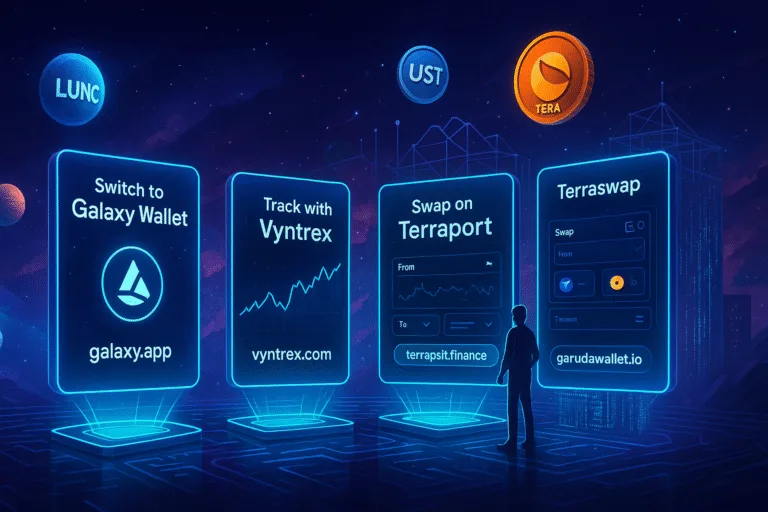
Upgrade Your Terra Experience: Use These Powerful Tools Instead

The Terra ecosystem is constantly evolving, and with it, new apps are stepping up to offer faster, more reliable, and community-driven alternatives. If you’re still using older platforms like Station or Coinhall, now is the perfect time to upgrade your toolkit.

🚀 Ditch Station – Use Galaxy Wallet Instead

Galaxy Wallet is a sleek, secure, and actively maintained wallet built for Terra and beyond. It offers multi-chain support, smooth UI, and advanced features for staking, governance, and more.

🔗 Download Galaxy Wallet: https://station.terraclassic.community/

📊 Instead of Coinhall – Try Vyntrex

Vyntrex is rapidly becoming the go-to platform for Terra analytics. It provides real-time data, price tracking, volume, and performance metrics across DEXs. It’s faster, lighter, and more intuitive than Coinhall.

🔗 Use Vyntrex here: https://vyntrex.io

🔁 Terraswap Update in Progress – Use Terraport or Garuda

Terraswap is in the process of crawling and updating its on-chain data. While it’s being rebuilt, you can still swap, provide liquidity, and explore the Terra DeFi space using other strong options:

  • Terraport offers reliable token swaps, liquidity pools, and community-led governance.
    🔗 Explore Terraport: https://www.terraport.finance
  • Garuda is another emerging DEX aggregator, bringing simplicity and speed to Terra swaps.
    🔗 Use Garuda: https://garuda-defi.org

🔧 As Terra rebuilds stronger than ever, it’s time for users to evolve too. Embrace these next-gen tools and stay ahead in the DeFi game!

The Crypto Laws That Could Change Everything: Why the Senate’s Next Move Matters for Investors

0

Major shifts are brewing in crypto regulation, and investors need to stay alert. This week, attention turns to the US Senate as it reviews two critical pieces of legislation: the CLARITY Act and the Anti CBDC Act. At the same time, international frameworks like PVARA are gaining momentum, signaling a new era of coordinated global regulation.

These developments could reshape how digital assets are treated across jurisdictions, directly affecting the future of crypto innovation, privacy, and market freedom.

What is the CLARITY Act?
The CLARITY for Payment Stablecoins Act, introduced earlier this year, aims to provide clear rules for stablecoin issuers and protect consumers. The bill is designed to define which federal agencies have authority over stablecoins and what kind of backing and disclosures are required. Analysts believe this act could encourage institutional participation in the stablecoin space by reducing legal uncertainty.

According to the latest Congressional records and reporting from CoinDesk and Bloomberg, the act is gaining bipartisan attention, although disagreements remain over how decentralized entities should be treated. Its progress in the Senate is seen as a critical test for broader crypto legislation.

What is the Anti CBDC Act?
Led by Senator Ted Cruz, the Anti Central Bank Digital Currency (CBDC) Act seeks to block the Federal Reserve from issuing a digital dollar. Supporters argue that a CBDC would give the government too much control over personal finances, while opponents say it could help the US remain competitive against countries like China, which has already launched its own digital yuan.

Recent comments from the Heritage Foundation and former officials at the Federal Reserve suggest growing concern that a US CBDC could erode privacy and reduce competition in the private crypto market.

The Senate’s stance on this act will reveal how much lawmakers value financial privacy versus central oversight.

Why PVARA Matters Globally
Beyond the US, the PVARA (Preserving Value and Regulating Assets Act) has been implemented in several non-US jurisdictions and could become a blueprint for international crypto regulation. The law aims to set global standards for token classification, risk disclosure, and investor protections.

Policy experts at the World Economic Forum and OECD note that PVARA’s implementation is already influencing regulatory discussions in Europe, Asia, and Latin America. If adopted widely, it could lead to a more consistent legal environment for crypto worldwide — but also more oversight and compliance burdens.

What Investors Should Watch
● Senate Hearings: The upcoming committee sessions on CLARITY and Anti CBDC are scheduled for late July. These could signal which direction US crypto regulation will take.

● Global Coordination: As PVARA spreads, expect coordinated actions from G20 countries, possibly including new reporting rules or international registries.

● Market Reaction: Crypto prices may respond quickly to any signs of legal clarity or restrictions. For example, a strong move toward banning CBDCs could boost decentralized privacy coins.

Final Thoughts
Crypto is entering a regulatory turning point. Whether these laws unlock the next wave of adoption or create new obstacles depends heavily on how they are written and enforced. As the US Senate debates the CLARITY and Anti CBDC Acts, and the world watches how PVARA takes hold, investors should prepare for both opportunities and challenges.

The coming weeks could set the tone for how crypto is governed for years to come.