TABLE OF CONTENTS:
1. Executive summary
2. Complete whitepaper
3. Proof-of-Concept Backtesting (Methodology, Results & Disclosure)
- 3.1. Why we built it
- 3.2. How it works (plain language)
- 3.3. Scope & coverage
- 3.4. Headline results (to date)*
- 3.5. Why we will publish results, not the tool
4. Rationale
- 4.1. Benefits for Terra Classic:
- 4.2. UST Protocol / USTD USPs:
5. Scope of work, timeline, budget and payment schedule
- Phase 1: Legal Opinion & Technical Specification
- Phase 2: Smart Contract Development Core Stablecoin
- Phase 3: Yield Return + Front/BackEnd
- Phase 4: Governance Layer
- Phase 5: Full Testnet QA
- Side phase
- Phase 6: Mainnet Launch & Support
6. Additional upcoming costs – smart-contract audit
7. Team & credentials
8. Transparency & communication
9. Proposal type
10. Voting options
CONTENT:
1. Executive summary
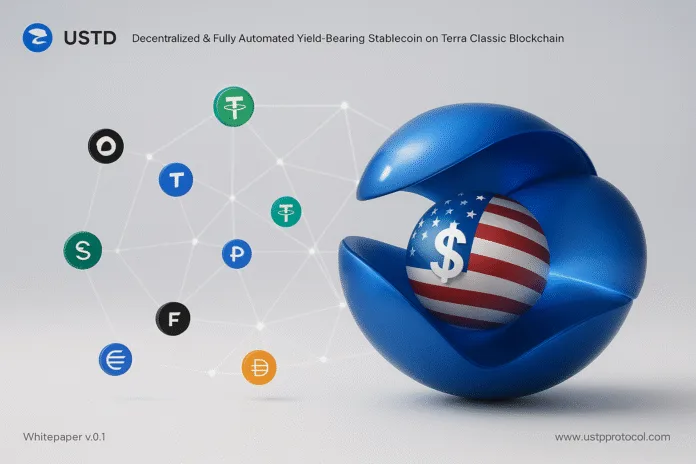
USTD is a next-generation stablecoin built directly on Terra Classic L1. Unlike previous attempts, USTD is conceived as a completely new stablecoin with an additional long-term side goal of revitalizing USTC. It is designed not only to preserve a 1:1 peg with the US Dollar by being fully collateralized by fiat-backed stablecoins (USDC/USDT) but also to reward its holders with attractive yields-all delivered automatically through periodic airdrops.
USTD leverages Terra Classic’s high throughput, low fees, and robust governance framework (which governs all Terra Classic protocols) to offer a secure, transparent, and efficient solution for both retail and institutional investors.
2. Complete whitepaper
www.ustprotocol.com This proposal therefore focuses on the decisions that must be signalled on-chain, while inviting Validators and community members to review and question any aspect of the project in the discussion thread before the vote.
3. Proof-of-Concept Backtesting (Methodology, Results & Disclosure)
3.1. Why we built it
Quoted APRs on AMMs (Uniswap v3/v4 and similar) are often pool-wide averages. They divide fees by total liquidity and ignore how concentrated-liquidity works—meaning they don’t reflect what an active LP can earn when liquidity is placed in the actual price range where trades happen. Our backtesting tool was created to measure what a defined strategy would have earned, not the headline average.
3.2. How it works (plain language)
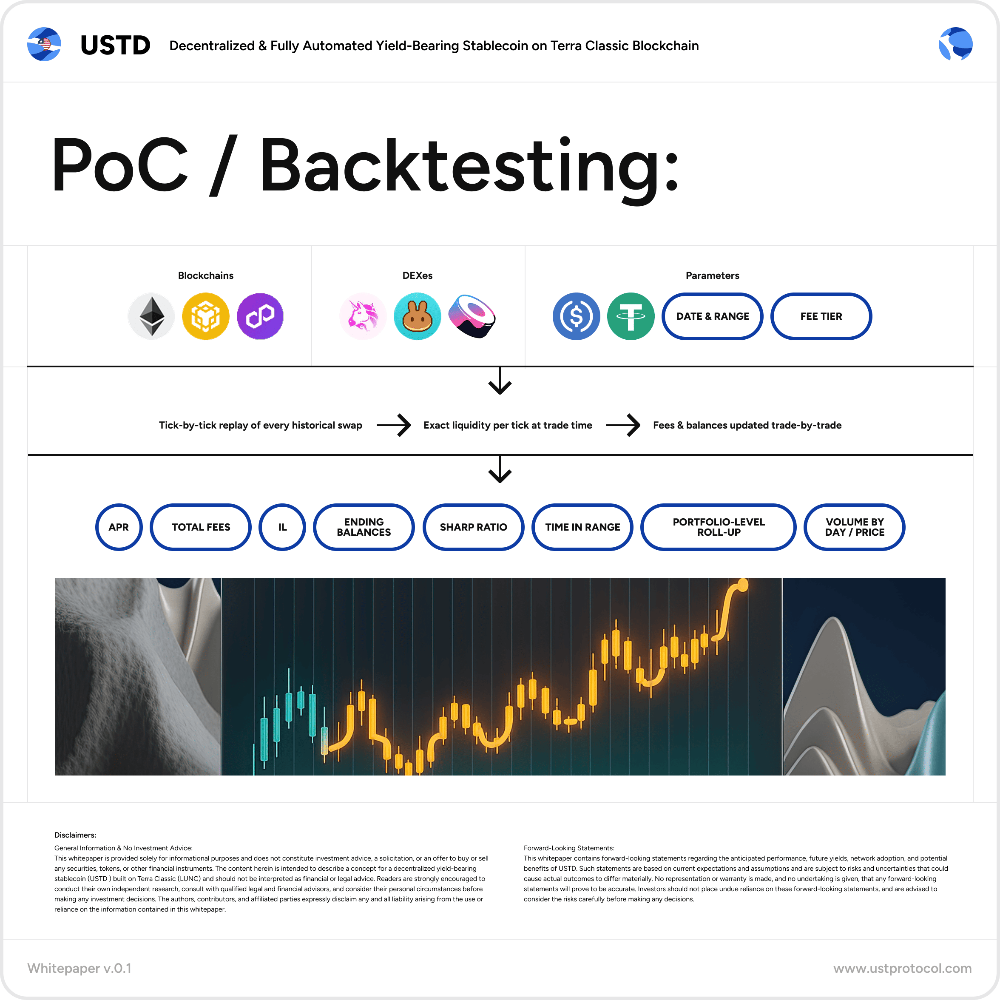
• The engine replays historical trades tick-by-tick, computing fees and position balances at each price tick, using the exact liquidity present in that tick at that time. This yields precise results for a chosen pair, fee tier, and price range—far beyond “average APR” estimates.
• You define inputs (chain, DEX, stablecoin pair, fee tier, start/end dates, and your price range). The tool then calculates total fees, APR, impermanent loss, Sharpe ratio, time-in-range, and a portfolio-level view if multiple positions are tested. It also visualizes price vs. your range, daily volume, and volume distribution by price to show where trades actually occurred. • Because stablecoin pairs move tightly, effective strategies typically use narrow ranges (few ticks); the tool confirms how “too wide” ranges bring APRs down toward pool averages.
3.3. Scope & coverage
Today the POC supports v2/v3 pools across major EVM chains/DEXes (e.g., Uniswap, PancakeSwap, SushiSwap).
v4 analysis follows the same logic but requires custom data indexing due to hooks and the lack of robust third-party datasets. We’ll add this once we complete our own indexers.
3.4. Headline results (to date)*
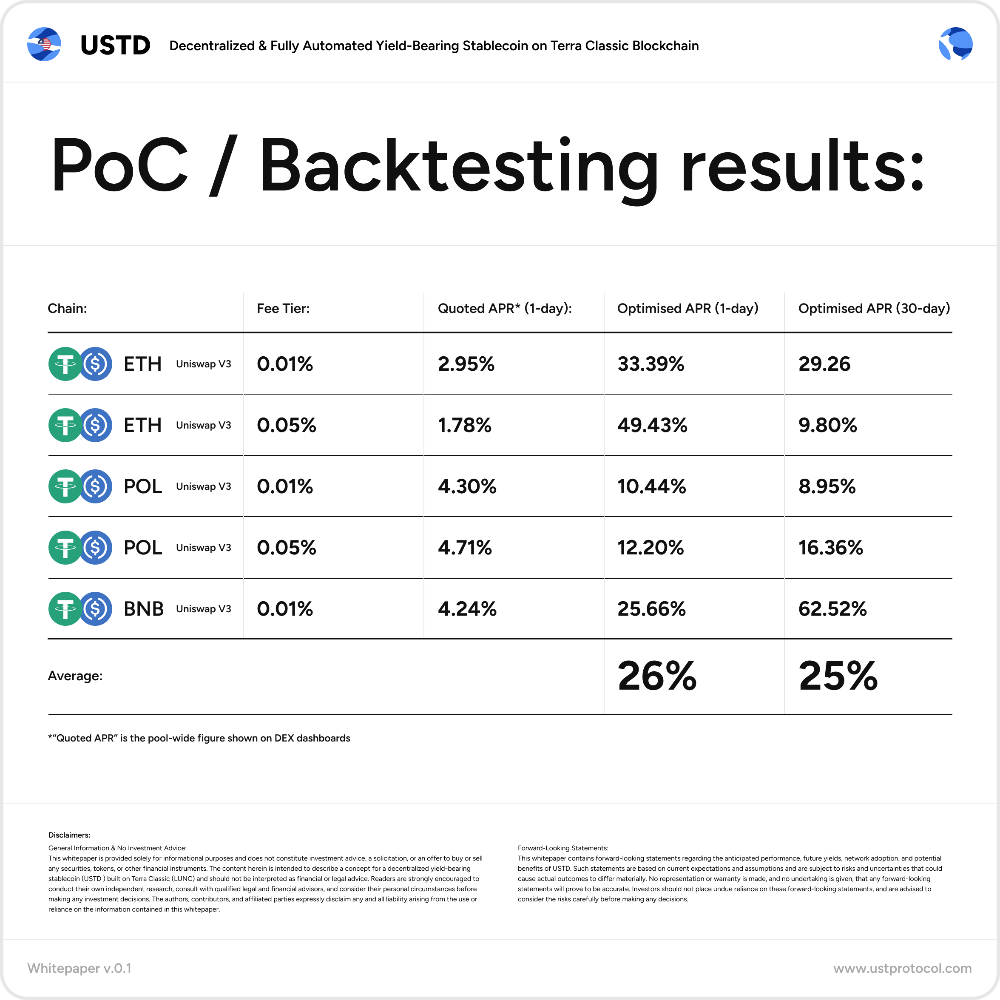
What these numbers tell us:
Why the jump is so large:
• Concentrated-liquidity edge. Uniswap v3 pools don’t reward idle capital. By narrowing our liquidity band to the exact price zone where trades occur, we earn a far larger share of fees than the average LP—turning low-single-digit “quoted” APRs into double-digit, sometimes 50 %+ annualised yields. • Stablecoins make it work. USDC/USDT rarely stray far from $1, so we can confidently park liquidity in tight ranges without constant rebalancing.
Fee-tier dynamics:
• Separate pools exist for 0.01 % and 0.05 % fees. Lower fees attract more volume (traders like cheap swaps), giving the 0.01 % pools higher absolute fees even though the rate is smaller. • For Ethereum the optimiser found a sweeter spot in the 0.01 % pool (29 % over 30 days), but for Polygon the 0.05 % pool outperformed on a 30-day basis (16 %). The engine picks whichever net-of-fee setup prints the best risk-adjusted return.
Cross-chain diversification:
• Results span three chains (Ethereum, Polygon, BNB) and two fee tiers each. Seeing the strategy work in multiple environments reduces the chance that performance is a fluke tied to one venue. • The standout 62 % 30-day APR on BNB reflects both high stablecoin turnover on that chain and temporarily under-deployed liquidity—an edge we expect to normalise but still illustrates upside when markets get busy.
Risk lens: Sharpe Ratio 3.29:
• A Sharpe above 3 is exceptional in traditional finance and rare in DeFi. It means the volatility of returns is modest relative to the gains produced. In plain English: we’re not taking wild swings to chase yield; most days the strategy ticks upward with few drawdowns. • Because the assets are dollar-pegged, impermanent loss stays minimal. The main risk is volume drying up, not token price collapse.
Consistency over longer windows:
• One-day spikes can be noisy; that’s why we focus on the 30-day column. Even after a whole month the optimiser still turned 2–5 % quoted APRs into 9–30 % on Ethereum/Polygon and 60 %+ on BNB. • Internal three-, six-, and twelve-month backtests (not shown here) confirm that the uplift persists across bull, bear, and sideways regimes, though the absolute number flexes with market activity.
Capacity & scalability:
• Scalability is only limited by the volume of the overall stablecoin markets. • Concentrated positions do not need huge TVL to capture fees, so UST-Protocol-sized allocations can fit comfortably without distorting returns. • If volume doubles, fee income roughly doubles too; if volume halves, we still outperform pool averages because the strategy occupies the highest performing ticks with the best volume to liquidity ratios.
*Reminder: Past performance is not a guarantee of future results; live returns will vary with trading volume, gas prices, and how often the strategy needs to rebalance. Still, these tests give a clear, data-backed picture of the edge UST Protocol can capture on stable-to-stable liquidity.
3.5. Why we published results, not the tool
Releasing the full engine would:
a.) let anyone replicate UST Protocol’s core strategy manually; b.) make it easier to clone the product elsewhere;
To protect protocol economics and tokenholder value, we’ll publish transparent, reproducible reports—without open-sourcing the optimizer and execution logic. (The optimizer includes genetic search, a mathematically “best possible” counterfactual, and indicator-assisted strategies; this is proprietary IP we will keep in-house.).
4. Rationale
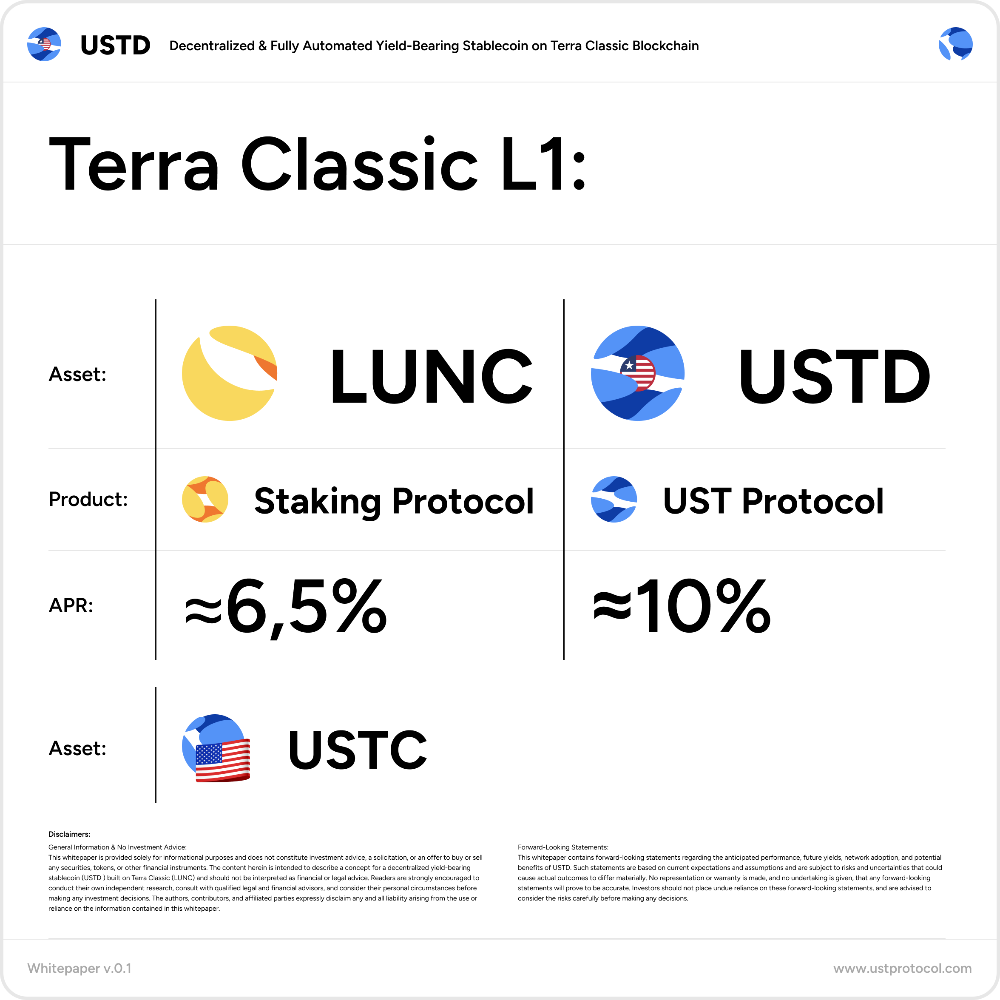
4.1. Benefits for Terra Classic:
Yield-financed Buy-Back & Burn:
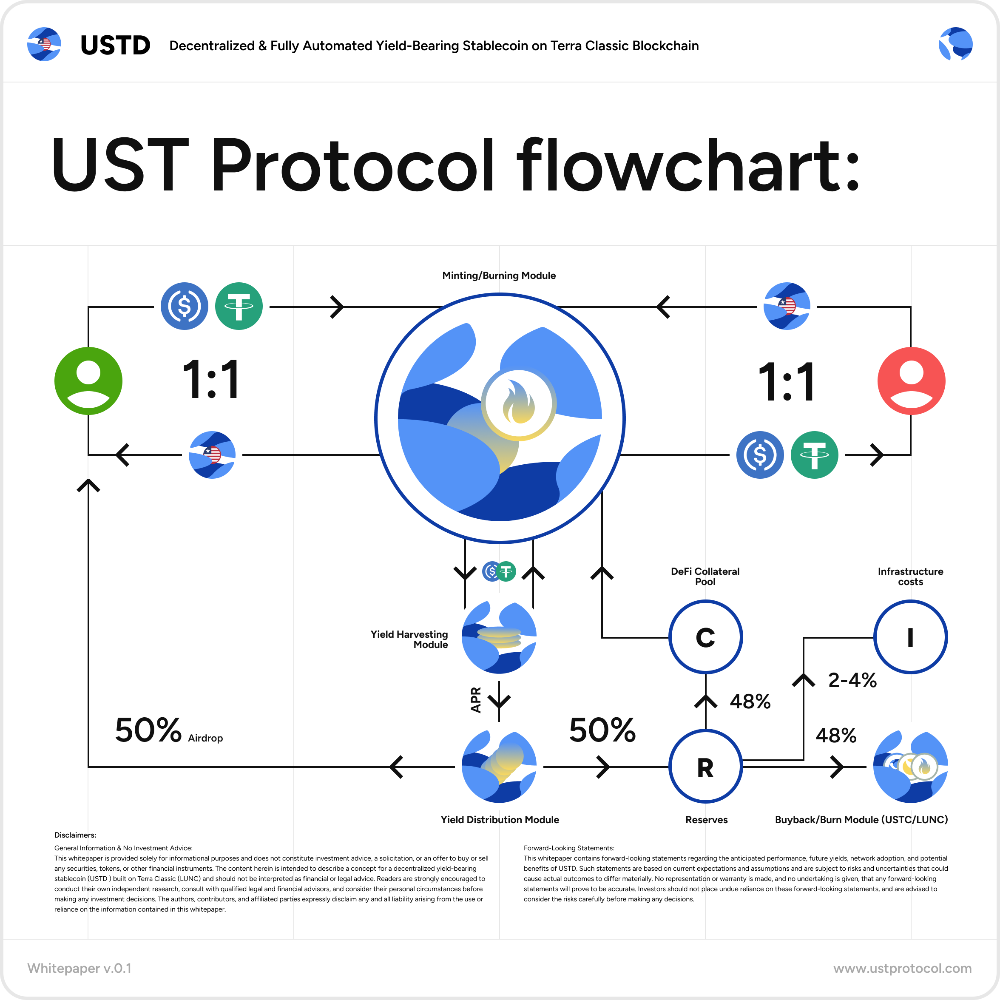
• Exactly 25 % of every weekly yield harvest is routed to a smart-contract auction that market-buys LUNC and USTC, then irreversibly burns the purchased tokens. • Every burn shrinks the “legacy debt” USTC and LUNC hole.
Gas-Token Demand:
• All USTD transfers pay gas in LUNC. Each new wallet that adopts USTD increases baseline gas consumption which means direct, steady fee income to stakers and validators.
Cross-Chain Capital Injection:
• Collateral enters via protocols such as: IBC, Thorchain and Circle CCTP as USDC/USDT → USTD. External dollars flow onto Terra Classic, raising TVL. This aspect will be finalized during development. • Higher TVL raises the “network value” denominator many analysts use for LUNC valuation. • Creates more liquidity for USTC exit ramps (via the buy-back pool). Dual-Income Narrative: • Validators could promote a two-yield story: stake LUNC for block rewards and hold USTD for passive stable yield. • Brings in users who previously ignored LUNC because it lacked a low-volatility return stream. • USTC holders can rotate into USTD via market swap, reducing distressed-asset overhang • Because USTD is always liquid and never locked, it can be rehypothecated in perps, lending markets, and options built on LUNC collateral..
Derivatives & Money-Markets:
• Every new derivative pair uses LUNC as margin or fee token, increasing utility.
4.2. UST Protocol / USTD USPs:
Stable & Yield-Bearing:
• Every USTD token is minted 1:1 against USDC/USDT, and the deposited collateral is deployed into low-risk, high-liquidity decentralized pools. Approximately 20% APR (on average) is generated from these pools. Approximately 50% of the yield generated is distributed directly to USTD holders as regular on-chain airdrops.
Automatic Yield Distribution:
• Unlike many yield-bearing protocols that require additional staking, UST Protocol automatically distributes yield via regular on-chain airdrops. Transition from USTC: • USTD is introduced as a completely new stablecoin designed to fill the space of the currently defunct USTC. This initiative is both a fresh start with enhanced security, transparency, yield mechanics and profit generation for Terra Classic, but also a long run tool to revive USTC. Integrated Governance: • USTD and UST Protocol is fully integrated into Terra Classic’s on-chain governance. All decisions, upgrades, and risk management measures affecting USTD and UST Protocol are managed by Terra Classic Governance, ensuring alignment with the broader ecosystem. Robust Security: • By being fully backed with regulated assets and operating on Terra Classic L1, USTD benefits from enhanced security and transparent reserve management. Compliance: • USTD’s focus on yield and collateral keeps it outside the heavy “payment stablecoin” regime of the U.S. GENIUS and STABLE Acts, sparing the project costly bank‑style licensing. In Europe, MiCA applies only if USTD is publicly offered, and the protocol can tap that market by appointing a dedicated reporting entity while preserving its decentralized design. Until then, USTD remains freely usable across global DeFi, giving holders a secure, transparent, and regulator‑resilient asset.
Market Opportunity:
• Amid a rapidly evolving stablecoin and DeFi landscape, USTD addresses current shortcomings—including centralization risks and low yield—thus positioning itself as a compelling solution for a broad spectrum of users.

5. Scope of work, timeline, budget and payment schedule
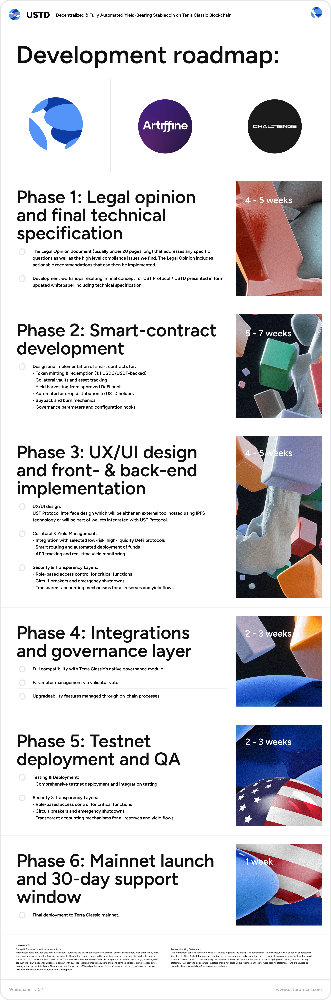
Phase 1: Legal Opinion & Technical Specification
Scope:
- Drafting of a comprehensive legal opinion (~20 pages) addressing regulatory compliance and legal questions surrounding the USTD Protocol.
- A final consolidated technical specification including updated protocol architecture, component diagrams, and protocol flow documentation.
Deliverables:
- Legal opinion document
- Final version of the technical specification (serves as development blueprint) Estimated duration (weeks): 4 – 5 Cost (USD): $58 700 Payment trigger: After publication of legal opinion and technical specification on www.ustprotocol.com
Phase 2: Smart Contract Development – Core Stablecoin
Scope:
- Development and deployment of smart contracts enabling the foundational USTD stablecoin logic.
Key Components:
- 1:1 USDC/USTD minting and redemption logic
- Collateral vaults and cross-chain tracking (with Terra Classic)
- Low-risk yield integrations with DeFi protocols
- Smart routing and automated fund deployment
- Emergency circuit breakers and access control
Deliverables:
- Core smart contracts deployed on testnet
- Covered by unit tests Estimated duration (weeks): 5 – 7 Cost (USD): $73 400 Payment trigger: After verified deployment of smart contracts with unit test coverage.
Phase 3: Yield Return + Front/Back-End
Scope – Implement services required to:
- Track and return yield to Terra Classic chain
- Distribute rewards to USTD holders
Key Components:
- APR tracking and yield monitoring
- Buyback, burn, and airdrop mechanisms
- Governance parameter hooks
- Backend and smart contract integration
- Transparent accounting flows
Deliverables:
- UX with live demo-ready frontend
- Working backend integrations
- Live airdrop & governance simulation
Estimated duration (weeks): 4 – 5 Cost (USD): $58 700 Payment trigger: After full front-end and backend demo is delivered and governance/airstream logic is functional.
Phase 4: Governance Layer
Scope:
- Add governance mechanisms and test upgrade path compatibility.
Key Components:
- Integration with Terra Classic’s native governance
- Parameter management via validator vote
- On-chain upgradability of protocol features Estimated duration (weeks): 2 – 3 Cost (USD): $29 300 Payment trigger After successful dry-run of a governance proposal (parameter update) and upgrade process tested on testnet. Phase 5: Full Testnet QA Scope:
- End-to-end deployment and comprehensive testing of all components.
Key Components:
- Testnet deployment with full validation
- QA test report: cases, results, integration checklist
- Re-verification of circuit breakers, accounting, emergency controls Estimated duration (weeks): 2 – 3 Cost (USD): $29 300 Payment trigger: Upon submission of QA/Testnet report with all cases executed and passed
Side phase
Between Phase 5 and Phase 6, we will submit a separate Signal Proposal to fund an external third-party audit based on the completed implementation.
Phase 6: Mainnet Launch & Support
Scope:
- Deployment of USTD Protocol on Terra Classic mainnet
- 30-day bugfix support window Estimated duration (weeks): 1 Cost (USD): $14 700 Payment trigger: After successful mainnet launch and completion of support period. Total: Estimated Duration: 17 – 24 weeks Cost (USD): $264,100 Payment model and PPJ compliance: All six tranches are requested post-completion. No advance payments are sought, in full alignment with Terra Classic’s “Pay-Per-Job” rule.
6. Additional upcoming costs – smart-contract audit
Before mainnet launch the entire UST Protocol / USTD codebase will undergo an independent, full-scope security audit by a leading specialist. The preferred providers are SolidProof or Oak Security, both of whom maintain strong reputations within Cosmos-based ecosystems. Requests for quotations will be issued once smart-contract development (Phase 2) and internal testing are finished, most likely immediately after the public testnet release (end of Phase 5). The exact fee will be defined in the auditors’ formal bid. Audit spend will be the seventh Community-Spend request.
7. Team & credentials
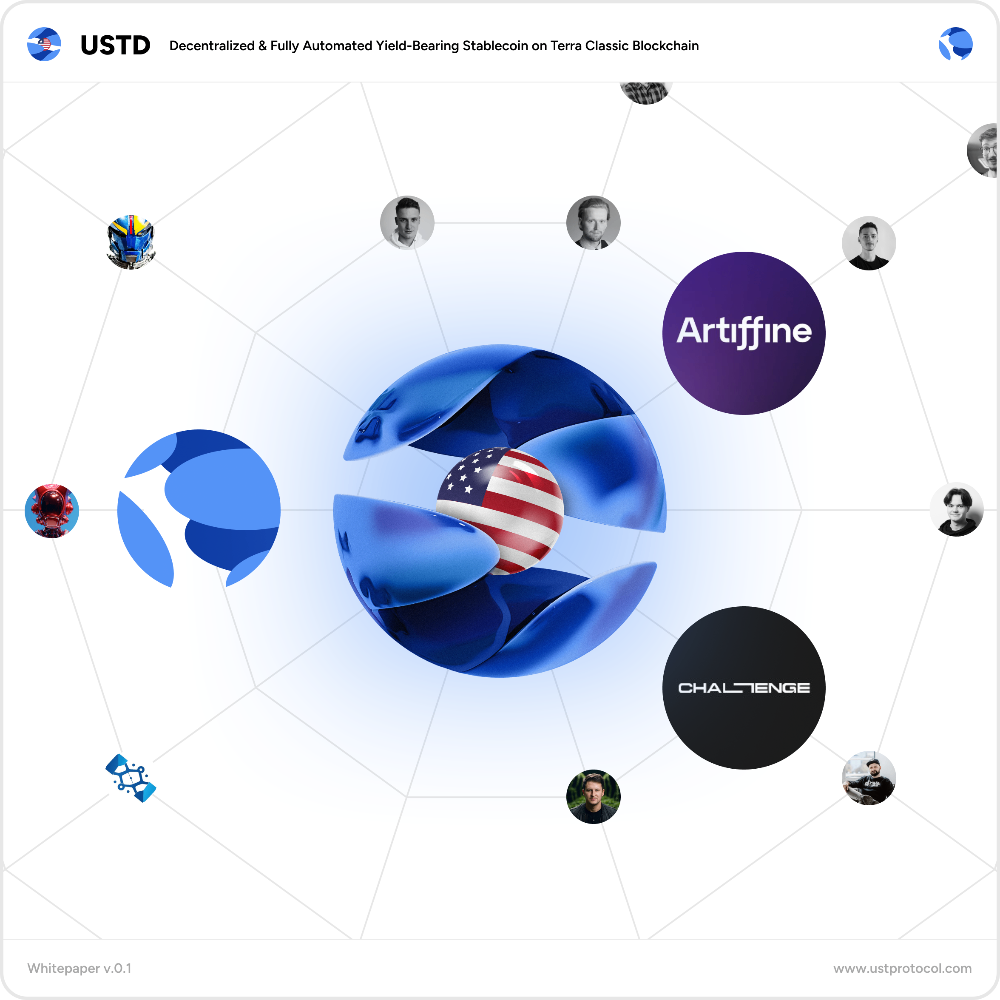
7.1. Product direction and project management:
RedlineDrifter (https://x.com/RedlineDrifter) REDniks
7.2. UX/UI design:
CHALLENGE Studio (www.challengestudio.pl) team led by Dawid Skinder (https://x.com/DawidSkinder) that will consist of 2 specialists:
- Lead Product/UX designer
- Senior UI designer
7.3. Protocol engineering:*
Artiffine team (https://www.artiffine.com) led by Vojtěch Rychnovský (https://x.com/vrychnovsky) that will consist of 5 specialists:
- Tech Lead
- Smart Contract developer
- Backend developer
- Front-end developer
- QA/Testing specialist
7.4. Legal / compliance:
JUDr. Jan Zibner, Ph.D. from Artiffine
7.5. Blockchain advisor:
StrathCole (https://x.com/ColeStrathclyde) – Strath is undertaking this on a completely unpaid and voluntary basis.He refused pay and is doing this as a charitable contribution for the community. *At least one senior smart-contract developer from Artiffine will complete the mandatory Terra Classic KYC process before the Phase 2 spend proposal is filed.
8. Transparency & communication
- Reports with work results published at least twice a month.
- Public project management using GitHub.
- End-of-phase AMAs hosted on the X / Twitter.
9. Proposal type
This is a Text / Signalling Proposal. A Yes vote authorises the team to carry out Phase 1 at their own expense and to return with a Community-Spend proposal only after that phase has been completed and delivered.
10. Voting options
YES - Signal support for developing UST Protocol / USTD under the milestone-based, post-payment model set out above. NO - Oppose progressing UST Protocol at this time. ABSTAIN - Record no opinion while counting towards quorum. NO WITH VETO – Consider the proposal malicious or spam.