
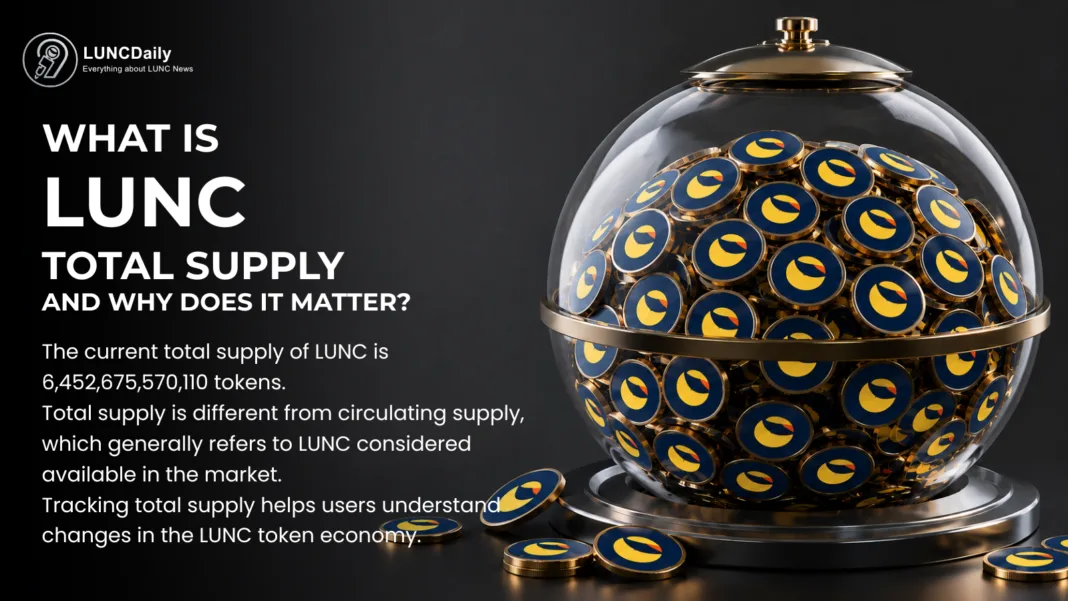


Understanding token supply is important when looking at the economics of any cryptocurrency. For Luna Classic (LUNC), total supply is one of the key metrics used to track how many tokens currently exist on the Terra Classic blockchain.
But what exactly does LUNC total supply mean, and how is it different from circulating supply?
What Is LUNC Total Supply?
LUNC total supply is the total number of LUNC tokens that exist on the Terra Classic blockchain.
This includes LUNC held by individual wallet addresses, tokens bonded or delegated with validators, and tokens held in blockchain module accounts.
In simple terms, total supply represents the complete amount of LUNC recorded across the Terra Classic network.
What Is the Current LUNC Total Supply?
The current total supply of LUNC is:
6,452,675,570,110 LUNC
This figure represents the total amount of LUNC currently recorded on the Terra Classic blockchain.
The total supply can change over time as tokens are permanently removed through burns or as changes to the blockchain affect how supply is recorded.
For the latest figure, users should always refer to current on chain data and the live LUNC Supply chart.
Why Does LUNC Total Supply Matter?
Total supply is an important part of understanding LUNC tokenomics.
The number of tokens in existence can influence how the market views the value and scarcity of a cryptocurrency. This is particularly relevant for LUNC because the Terra Classic community has continued to focus on reducing the token supply through burns.
When LUNC is burned, those tokens are permanently removed from circulation and can no longer be used or transferred.
However, token burns are only one part of the broader LUNC ecosystem. Network activity, demand, liquidity, utility, staking, and market conditions can also influence the long term outlook for LUNC.
LUNC Total Supply vs Circulating Supply
Total supply and circulating supply are two different metrics.
Total supply refers to the total amount of LUNC recorded on the blockchain, including tokens held in wallets, bonded with validators, and stored in module accounts.
Circulating supply generally refers to the amount of LUNC considered to be available in the market.
Because these measurements use different definitions, the circulating supply figure can be different from the total supply.
Understanding this difference is important when analyzing LUNC’s market capitalization and overall tokenomics.
How LUNC Burns Affect Supply
LUNC burns are designed to permanently remove tokens from the Terra Classic supply.
Once LUNC is sent to a burn address or otherwise removed through an approved burn mechanism, those tokens cannot return to the available supply.
Over time, continued burns can reduce the total number of LUNC tokens existing on the network.
However, the effect of burns should be considered in the context of the overall supply and the amount of tokens being removed. A reduction in supply does not automatically mean that the market price will increase.
Why Tracking LUNC Supply Is Important
Monitoring LUNC supply helps the community understand how the Terra Classic token economy is changing.
By tracking total supply alongside circulating supply, burned LUNC, staking activity, network usage, and other on chain metrics, users can get a clearer picture of the state of the Terra Classic ecosystem.
Supply data is particularly useful for following the long term impact of LUNC burn activity and changes in the network’s tokenomics.
Conclusion
LUNC total supply represents the complete amount of LUNC recorded on the Terra Classic blockchain.
The current LUNC total supply is 6,452,675,570,110 LUNC, including tokens held by wallet addresses, bonded with validators, and stored in module accounts.
Understanding total supply is important when evaluating LUNC tokenomics, but it should not be viewed in isolation. Circulating supply, burns, demand, network activity, liquidity, staking, and ecosystem development are also important factors when analyzing Terra Classic.
As the Terra Classic network continues to evolve, tracking these metrics can help provide a clearer understanding of the changing LUNC ecosystem.