



Why Aggregated Trading Platforms Are Changing On Chain Trading
On chain trading gives users direct access to decentralized markets without relying on traditional centralized exchanges. However, as the blockchain ecosystem continues to grow, traders often face a new challenge: liquidity is spread across different decentralized exchanges, liquidity pools, and blockchain networks.
Finding the right trading route can take time. Traders may need to compare multiple platforms, check different liquidity pools, and move between networks before completing a single trade.
This is where aggregated trading platforms can make on chain trading simpler and more efficient.
What Is an Aggregated Trading Platform?
An aggregated trading platform connects multiple liquidity sources through a single interface.
Instead of requiring users to manually search through different decentralized exchanges, an aggregator can examine available trading routes and liquidity sources to help identify suitable options for a transaction.
For example, if a trader wants to swap one token for another, the platform can look across supported liquidity sources and determine which available route may provide a better trading opportunity.
The goal is simple: give traders access to more liquidity without requiring them to manage every liquidity source individually.
Why Aggregated Trading Can Be Better for On Chain Traders
1. Access Multiple Liquidity Sources
Liquidity is one of the most important factors in decentralized trading.
A single decentralized exchange may not always have enough liquidity for a particular trading pair. This can result in higher price impact, especially when executing larger trades.
An aggregated platform can connect to multiple liquidity sources, giving traders access to a broader trading environment from one platform.
More available liquidity sources can give the routing system more options when finding a suitable path for a trade.
2. Reduce the Need to Check Multiple DEXs
Without an aggregator, traders may need to open several decentralized exchanges to compare prices.
This creates unnecessary steps.
Users need to check the trading pair, compare prices, review liquidity, calculate the expected output, and then decide which platform to use.
An aggregated trading platform brings these options together in one place.
Instead of manually checking multiple platforms, traders can use a single interface to access available liquidity and trading routes.
3. Find More Efficient Trading Routes
The trading pair you select is not always the only possible route for a swap.
For example, a direct swap between two assets may have limited liquidity. Another route could potentially use an intermediate asset to access deeper liquidity.
An aggregation system can evaluate different routes and select an available path based on factors such as liquidity, price, and trading costs.
This can make the trading process more efficient while reducing the amount of manual research required from the user.
4. Save Time
On chain trading should not require traders to constantly move between different platforms.
An aggregator simplifies the process by bringing multiple liquidity sources into one trading interface.
This is especially useful for active traders who regularly swap assets and need to compare available opportunities quickly.
Instead of spending time searching for liquidity, traders can focus more on their trading strategy.
5. A Better User Experience
One of the biggest challenges for new users entering decentralized finance is complexity.
There can be multiple DEXs, liquidity pools, networks, tokens, and trading routes to understand.
An aggregated platform can reduce some of this complexity by providing a single interface for accessing multiple liquidity sources.
This creates a more straightforward experience for both experienced traders and users who are still learning how on chain trading works.
Aggregation Becomes More Important as Blockchain Ecosystems Grow
The number of blockchain networks and decentralized applications continues to increase.
Each network can have its own decentralized exchanges, liquidity pools, and trading opportunities.
This creates more choice for users, but it also creates fragmentation.
Liquidity becomes distributed across different platforms instead of being available in one location.
Aggregation addresses this problem by connecting different liquidity sources through a unified trading experience.
For traders, the value is not simply having more platforms. The real advantage is having access to those platforms without needing to manage each one separately.
Introducing Orbit Wire
This is where Orbit Wire comes into the picture.
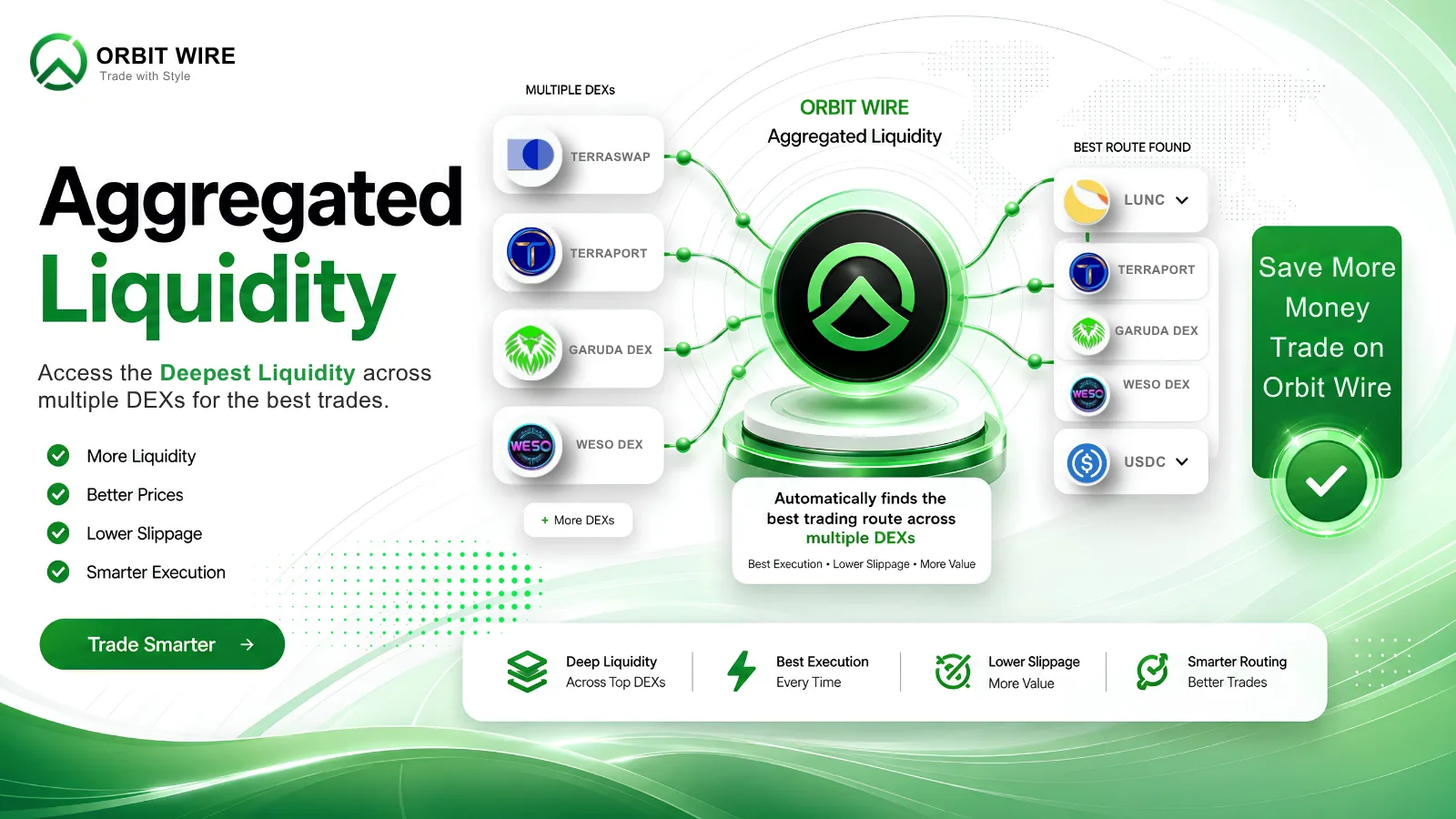
Orbit Wire is an aggregated trading platform designed to make on chain trading easier by bringing multiple blockchain trading environments into one platform.
Orbit Wire now supports LUNC Chain, Luna Chain, and Osmosis, allowing users to access trading opportunities across these ecosystems from a unified interface.
Instead of opening different platforms for different networks, users can use Orbit Wire to explore available trading opportunities across supported chains.
Trade Across LUNC Chain, Luna Chain and Osmosis
The addition of LUNC Chain, Luna Chain, and Osmosis gives Orbit Wire users access to multiple blockchain ecosystems from one platform.
For users who actively trade within these ecosystems, this can reduce the need to switch between different decentralized exchanges.
Whether you are trading assets within the LUNC ecosystem, exploring opportunities on Luna Chain, or accessing liquidity on Osmosis, Orbit Wire provides a single place to start your trade.
The objective is to make on chain trading more accessible while giving traders a broader view of available liquidity.
Smart Routing for Better Trading Opportunities
Orbit Wire also uses smart routing to help identify available trading paths.
Instead of expecting users to manually search through different liquidity sources, the platform can evaluate available routes and help identify suitable options for a trade.
This is particularly important when liquidity is distributed across multiple decentralized exchanges and pools.
By combining liquidity access with smart routing, Orbit Wire aims to make the trading process more efficient and easier to understand.
One Platform, Multiple Blockchain Ecosystems
The future of decentralized trading is unlikely to be limited to a single blockchain.
As more ecosystems develop their own applications and liquidity, traders will increasingly need tools that can connect these fragmented markets.
Aggregated trading platforms can play an important role in this development.
Rather than forcing users to choose between individual DEXs, aggregation provides a way to access multiple liquidity sources through one trading experience.
Orbit Wire is building toward this vision by connecting LUNC Chain, Luna Chain, and Osmosis in one platform.
For traders looking for a simpler way to access on chain markets, aggregation can provide a more convenient starting point.
Start Trading With Orbit Wire
On chain trading does not have to mean opening multiple DEXs and manually comparing every available option.
An aggregated trading platform can bring liquidity sources together, simplify route discovery, reduce unnecessary platform switching, and create a more efficient trading experience.
With support for LUNC Chain, Luna Chain, and Osmosis, Orbit Wire gives traders a unified platform for exploring trading opportunities across multiple blockchain ecosystems.
As decentralized markets continue to grow, having better access to fragmented liquidity will become increasingly important.
One platform. Multiple chains. Smarter access to on chain liquidity.
Explore Orbit Wire and discover a simpler way to trade across the growing multichain ecosystem.