
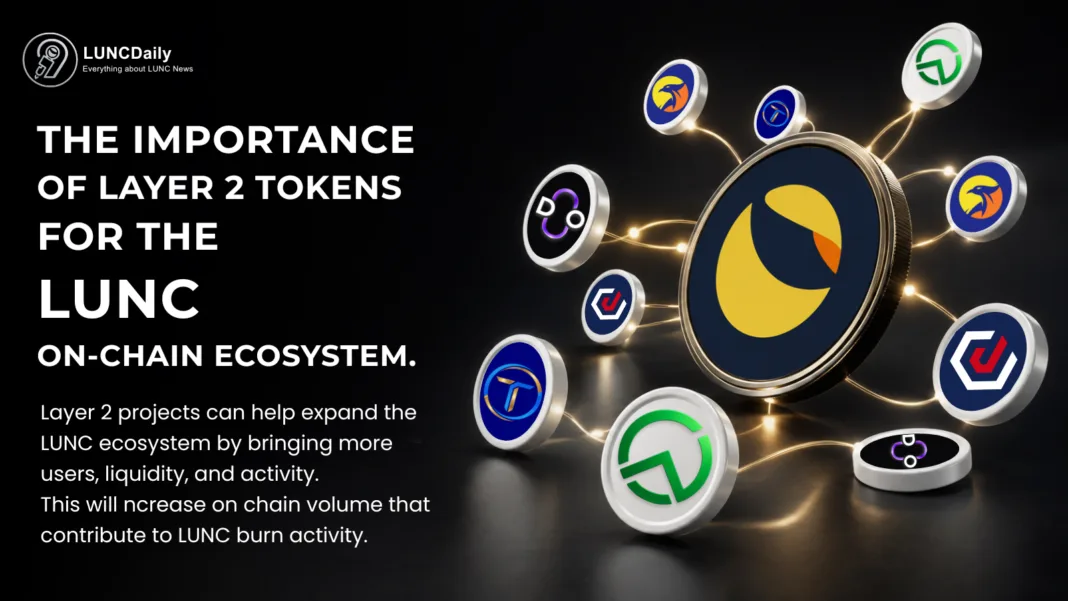

Layer 2 tokens can play an important role in expanding the Luna Classic ecosystem by bringing more liquidity, applications, users, and transaction activity to the network.
For LUNC, a stronger on chain economy is important because network activity can contribute to higher transaction volume and, depending on the applicable on chain mechanisms and transaction activity, potentially increase the amount of LUNC burned.
Rather than focusing only on the supply side, the growth of Layer 2 ecosystems can help create more reasons for users to interact with the LUNC blockchain.
What Is a Layer 2 Token?
A Layer 2 token is a token associated with a project or application that operates on top of a base blockchain.
In the LUNC ecosystem, Layer 2 projects can provide additional use cases while still relying on the LUNC blockchain for transactions and settlement.
These projects can include decentralized exchanges, lending platforms, games, NFT applications, payment systems, launchpads, and other decentralized applications.
Each new application can bring additional users and economic activity to the network.
Why Layer 2 Tokens Are Important for LUNC
The value of a blockchain ecosystem is not determined only by the price of its native token.
A healthy ecosystem also needs users, liquidity, applications, developers, and consistent on chain activity.
Layer 2 projects can contribute to each of these areas.
1. Layer 2 Projects Can Add More Liquidity
Liquidity is one of the most important elements of a blockchain economy.
When more Layer 2 projects introduce tokens, trading pairs, decentralized exchanges, and liquidity pools, more capital can enter the LUNC ecosystem.
For example, a Layer 2 token can create a trading pair with LUNC and attract liquidity providers.
This can make it easier for users to trade between LUNC and other assets without leaving the ecosystem.
More liquidity can also help improve trading efficiency and create more opportunities for decentralized finance applications.
2. Layer 2 Tokens Can Increase On Chain Volume
Liquidity alone is not enough.
A blockchain also needs users who actively interact with its applications.
Layer 2 projects can generate transactions through token swaps, transfers, staking, liquidity provision, decentralized applications, and other activities.
This can increase the amount of economic activity taking place on the LUNC blockchain.
For example, when users trade a Layer 2 token through an application built around the LUNC ecosystem, the activity can generate additional blockchain transactions.
More applications and more users can therefore contribute to higher on chain activity.
3. Higher Activity Can Support LUNC Burn Activity
One of the most important aspects of the LUNC ecosystem is its burn mechanism.
LUNC burns are influenced by activity and mechanisms that route a portion of eligible transaction fees toward burning.
This means ecosystem growth can be important for the long term burn process.
If Layer 2 projects attract more users and generate more eligible transactions, the resulting increase in on chain activity can potentially contribute to higher LUNC burn activity.
However, higher transaction volume does not automatically mean a specific amount of LUNC will be burned. The actual burn depends on the applicable network rules, transaction types, fees, and burn mechanisms.
The key point is that a larger and more active ecosystem creates more opportunities for economic activity to contribute to the burn process.
4. Layer 2 Tokens Create More Use Cases for LUNC
A blockchain becomes more useful when users have more reasons to use it.
Layer 2 projects can expand the number of applications available within the LUNC ecosystem.
Users could potentially use the network for trading, DeFi, gaming, NFTs, payments, staking, and other applications.
These use cases can create demand for blockchain transactions.
Instead of LUNC being used primarily as a token for holding or trading, a growing ecosystem can make LUNC part of a wider on chain economy.
5. Layer 2 Projects Can Attract New Users
New applications can also introduce the LUNC ecosystem to users who may not have interacted with the blockchain before.
A user might initially discover LUNC through a Layer 2 token, decentralized application, game, or DeFi platform.
Once users enter the ecosystem, they may interact with other applications and assets on the network.
This creates a network effect where one successful project can potentially help introduce users to other parts of the ecosystem.
6. Layer 2 Tokens Can Strengthen the On Chain Economy
A strong blockchain economy needs multiple participants.
Token holders, traders, liquidity providers, developers, validators, applications, and users all contribute to the ecosystem.
Layer 2 projects can connect these participants through new products and applications.
More projects can mean more tokens.
More tokens can create more trading pairs.
More applications can create more transactions.
More transactions can create more network activity.
And greater network activity can create more opportunities for LUNC to participate in the economic activity of the ecosystem.
Layer 2 Growth Is About More Than Token Price
It is important to separate ecosystem growth from short term token price speculation.
A Layer 2 token should not be viewed only as an asset that could increase in price.
Its greater value to the LUNC ecosystem comes from the activity and utility that it can create.
A successful Layer 2 project can bring users, liquidity, applications, developers, and transactions to the network.
These factors can be more important for long term ecosystem development than short term price movements.
A Larger Ecosystem Can Create a Positive Cycle
The development of Layer 2 projects can potentially create a positive cycle for LUNC.
New projects can attract users.
More users can generate more transactions.
More transactions can increase on chain activity.
Higher activity can support greater economic activity and, where applicable, contribute to LUNC burns.
At the same time, successful applications can attract more developers and liquidity providers.
This can encourage the creation of additional applications and services.
Over time, the goal is to build an ecosystem where users have genuine reasons to remain active on the LUNC blockchain.
Why Layer 2 Development Matters for the Future of LUNC
LUNC needs more than supply reduction to build a sustainable long term ecosystem.
Burning tokens can reduce supply, but ecosystem activity can help create the economic demand and utility that make the network more valuable.
Layer 2 projects provide one potential path toward that growth.
By adding liquidity, applications, users, and transaction activity, Layer 2 ecosystems can help transform the LUNC blockchain into a more active and diverse on chain economy.
The relationship is straightforward.
More useful applications can attract more users.
More users can generate more activity.
More activity can generate more eligible transactions.
And more eligible transactions can potentially contribute to greater LUNC burn activity under the network’s existing mechanisms.
Conclusion
Layer 2 tokens can be an important part of the future growth of the LUNC ecosystem.
Their importance is not simply because they introduce new tokens. Their real value comes from the activity and utility they can bring to the blockchain.
By creating additional liquidity, trading opportunities, decentralized applications, users, and on chain transactions, Layer 2 projects can help expand the LUNC economy.
For LUNC, ecosystem growth and supply reduction can work together.
Burns address the supply side, while increased utility and on chain activity can strengthen the demand and economic activity side.
A larger Layer 2 ecosystem therefore has the potential to make the LUNC blockchain more active, useful, and economically sustainable over the long term.