Home Blog Page 12

Over 440,000 USTC Burned in Just 16 Days Signals Strong Terra Classic Community Activity

0

Over 440,000 USTC Burned in Just 16 Days Signals Strong Terra Classic Community Activity

The Terra Classic ecosystem continues to show steady progress in its supply reduction efforts.
Over the last 16 days of January, more than 440,000 USTC have been permanently removed from
circulation through on chain burn activity.

According to the latest burn recap, a total of 448,423 USTC was burned between January 1 and
January 16. This consistent burn activity highlights ongoing participation from traders and
community members who are contributing to long term supply reduction.

Burning tokens reduces the circulating supply, which is widely viewed as a positive mechanism
for strengthening the Terra Classic ecosystem. While daily burn amounts fluctuate, the overall
trend shows sustained engagement rather than isolated events.

Several days recorded notably higher burn volumes, including January 2, January 9, and
January 10. January 10 alone accounted for more than 115,000 USTC burned, making it the strongest
single day during this period.

USTC Daily Burn Breakdown

Month Date USTC Burned
January 1 33,407
January 2 93,158
January 3 15,065
January 4 7,253
January 5 15,637
January 6 7,618
January 7 9,758
January 8 33,196
January 9 58,758
January 10 115,023
January 11 8,474
January 12 7,387
January 13 18,707
January 14 6,542
January 15 9,397
January 16 9,043
Total 448,423

What This Means for Terra Classic

The steady pace of USTC burns suggests that on chain activity continues to support ecosystem
goals. Rather than relying on one time events, consistent daily burns help reinforce confidence
in long term recovery strategies.

As Terra Classic development and infrastructure improvements continue, sustained burn
participation remains an important metric for community engagement and network health.

If this trend continues, future months may show even stronger cumulative burn figures as
adoption and on chain utility grow.

LUNC Burn Activity Slows as Only 191 Million LUNC Burned in the Last 7 Days

0

The Terra Classic LUNC burn rate continues to show a noticeable slowdown, with recent data confirming a sharp decline in daily and weekly burn activity.

Over the last seven days, only 191 million LUNC has been burned. This marks a significant drop compared to earlier periods, as daily burns have struggled to exceed 50 million LUNC per day for more than eight consecutive days.

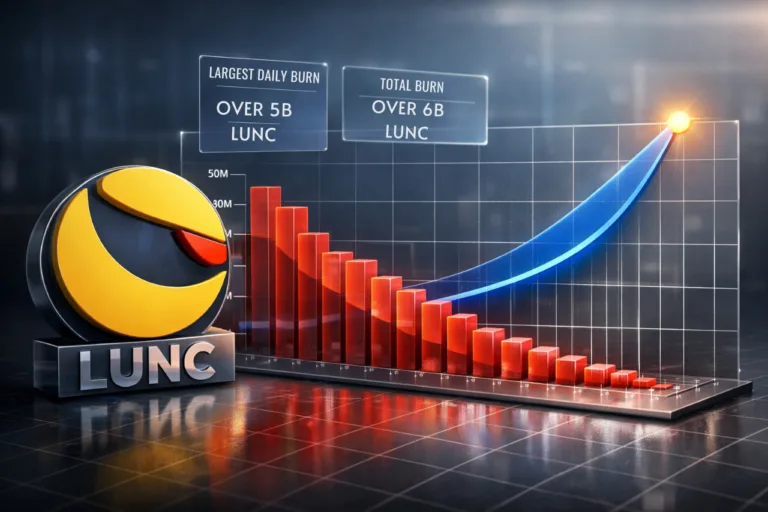
Despite this slowdown, the total amount of LUNC burned so far this month has surpassed 6 billion tokens. However, it is important to note that more than 5 billion LUNC of this total came from Binance monthly burn events, rather than ongoing on chain activity.

This trend highlights a growing reliance on centralized exchange burns, while organic on chain burns continue to weaken. Without major contributors like Binance, the current burn rate would be significantly lower.

Daily LUNC Burn Recap

Month Date LUNC Burned
January 1 5,367,757,097
January 2 36,700,121
January 3 194,515,792
January 4 59,068,461
January 5 22,184,507
January 6 55,976,794
January 7 58,298,205
January 8 85,060,487
January 9 22,167,180
January 10 22,949,053
January 11 34,617,148
January 12 33,911,987
January 13 18,745,561
January 14 35,139,054
January 15 16,451,097
January 16 29,576,801

Total burn in the last seven days
191,390,701 LUNC

Total burn for the month so far
6,093,119,345 LUNC

What This Means for Terra Classic

The declining daily burn rate suggests reduced on chain trading activity and fewer automated burn mechanisms contributing consistently. While large periodic burns from Binance provide temporary boosts, they do not reflect sustained network driven deflation.

For the Terra Classic ecosystem, this reinforces the importance of increasing real usage, on chain volume, and utility driven burn models if long term supply reduction goals are to remain achievable.

SDK 53 Progress Update in January and What It Means for the Luna Classic Network

In January, Orbit Labs shared important development updates regarding the Terra Classic blockchain with the successful testing of the Cosmos SDK v53 upgrade. This update represents a major technical milestone that prepares the network for future improvements while prioritizing stability and security.

January 11 SDK 53 Update

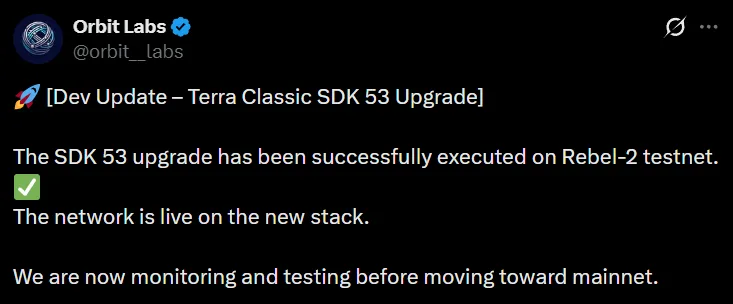
On January 11, Orbit Labs announced that the SDK 53 upgrade was successfully executed on the Rebel 2 testnet. Following the upgrade, the testnet went live on the new software stack and entered an active monitoring and testing phase.

Testing on a testnet is a critical step for any blockchain upgrade. It allows developers to safely identify bugs, performance issues, or compatibility problems without risking real assets. The successful deployment and live operation of Rebel 2 indicate that the new SDK version is functioning as expected so far.

The ongoing monitoring phase serves as a final safety measure. Developers are closely observing network behavior to ensure stability before proposing any move toward mainnet deployment. This approach helps reduce risk for validators, developers, and users across the Terra Classic ecosystem.

Overall, this testnet success marked a positive technical step forward and demonstrated readiness for a future mainnet upgrade.

January 13 SDK 53 Update

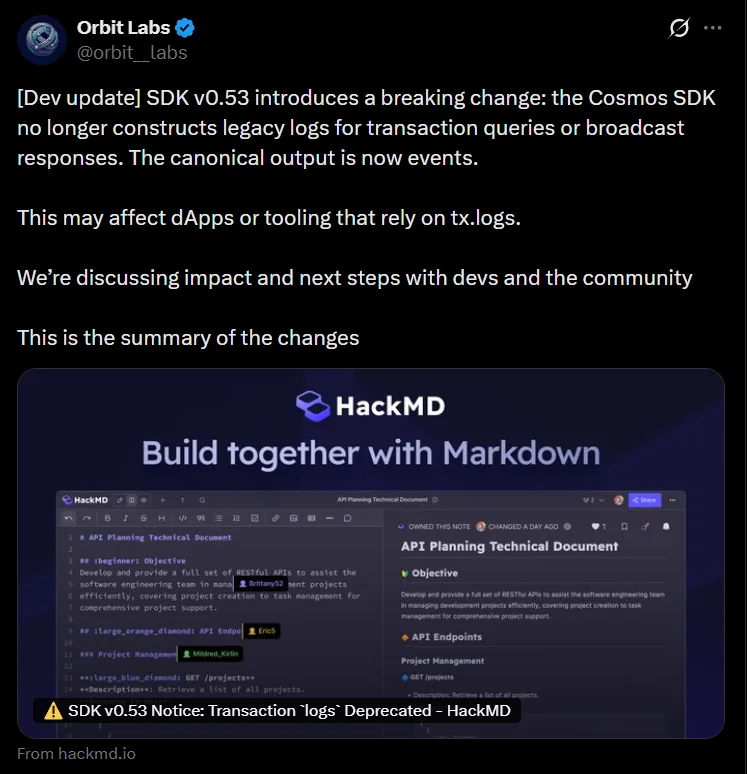
On January 13, Orbit Labs followed up with an important developer update highlighting a breaking change introduced by Cosmos SDK v53. This change affects how transaction data is returned by the blockchain.

With SDK v53, the Cosmos SDK no longer constructs legacy transaction logs. Instead, events are now the official and canonical output for transaction results. This applies to both transaction broadcasts and transaction queries.

This change is part of the broader ABCI 2.0 upgrade and affects all Cosmos SDK based blockchains, including Terra Classic and its related tooling.

What Changed in Simple Terms

Before SDK v53, many applications relied on transaction logs such as tx.logs and raw_log to read transaction results. These logs contained event data but were built using legacy structures.

After SDK v53, the SDK no longer creates these legacy logs. The only official and supported output is transaction events.

Applications that require message level details must now reconstruct them on the client side using event data.

What Did Not Change

Smart contracts continue to emit events as before. Events remain indexed and searchable across the network. Block explorers and indexers that already rely on events are not affected. Modern libraries such as CosmJS already follow this event based approach.

The blockchain still provides full transaction information, but in a cleaner and more structured format.

Who Is Affected

Older decentralized applications or tools that rely directly on tx.logs or raw_log may require updates. Legacy scripts or indexers not adapted for event parsing may also be impacted.

Applications already using events, modern explorers, and tools built on current Cosmos standards are not affected.

Why This Change Matters

Using events as the canonical output improves reliability and consistency across the ecosystem. It aligns Terra Classic with modern Cosmos SDK standards, reduces legacy behavior, and improves long term maintainability for developers.

What Happens Next

Orbit Labs, developers, and the Terra Classic community are reviewing the ecosystem impact of this change. Discussions are ongoing to determine whether a temporary compatibility layer is needed to support older tools during the transition.

Conclusion

The January SDK 53 updates represent a strong and positive step for Terra Classic. The successful testnet deployment confirms technical readiness, while the shift from legacy logs to structured events signals a move toward a more modern, reliable, and future proof blockchain infrastructure.

Although some older tools may require updates, the network itself remains fully functional and improved in clarity, stability, and long term sustainability. SDK 53 positions Terra Classic for safer upgrades, a better developer experience, and stronger ecosystem growth as it moves closer to mainnet deployment.

Classic DEX Development Proposal on Voting Stage

Classic DEX Development Proposal Enters Voting Stage on Terra Classic

A proposal to develop Classic DEX on the Terra Classic blockchain has officially entered the governance voting stage. If approved by the community, Boosty Labs will be responsible for building and delivering the decentralized exchange according to the outlined specifications.

Classic DEX is designed as a community owned decentralized exchange built directly on Terra Classic, with the primary goal of generating real trading activity while permanently reducing the supply of LUNC and USTC through an on chain burn mechanism.

What Is Classic DEX

Classic DEX is a non KYC decentralized exchange that supports both spot trading and perpetual futures. The platform is built natively on Terra Classic and settles all trades using native LUNC or USTC rather than wrapped or external assets.

Once launched, full operational control of Classic DEX will be transferred to the Terra Classic community through Agora governance. There are no private owners, no token pre mines, and no exclusive profit sharing arrangements.

Core Objective

The core objective of Classic DEX is to create a sustainable and self reinforcing economic model for the Terra Classic ecosystem.

  • Increased trading activity generates higher fee revenue
  • Trading fees are used to burn LUNC and USTC
  • Reduced supply supports long term ecosystem value
  • Improved incentives encourage continued trading activity

This approach focuses on utility and volume driven growth rather than inflation or new token emissions.

Key Features Explained

Multi Chain Liquidity With Native Settlement

Classic DEX aggregates liquidity from major blockchain ecosystems including Ethereum, BSC, Polygon, and Solana through integrations with 1inch and Jupiter. Although liquidity is sourced externally, all trades are settled back into native LUNC or USTC on the Terra Classic blockchain.

Spot and Perpetual Trading

The platform supports both traditional spot trading and leveraged perpetual futures. Integrated systems handle funding rates, margin requirements, and automatic liquidations, providing functionality similar to professional trading platforms.

Dual Burn Engine Fee Model

Trading fees are distributed evenly across four predefined allocations.

  • Twenty five percent is used to buy and burn LUNC
  • Twenty five percent is used to buy and burn USTC
  • Twenty five percent rewards liquidity providers
  • Twenty five percent funds trader incentives and referrals

All burns are permanent and fully verifiable on chain.

LUNC and USTC Only Collateral

Only LUNC and USTC can be used as collateral on Classic DEX. This design ensures that trading activity directly supports the Terra Classic ecosystem and avoids value dilution from external assets.

Incentives and Reward Mechanisms

Trader Cashback System

Traders receive cashback rewards based on how they utilize LUNC or USTC on the platform. Higher incentives are provided for USTC usage, with additional rewards available for users who lock USTC for defined periods.

No new tokens are minted. All rewards are sourced exclusively from trading fees.

USTC Parking Modes

  • Flexible mode with a short withdrawal delay and lower rewards
  • Twenty one day locked mode offering the highest reward rate

Referral Program

Users who refer new traders earn ten percent of their referral’s trading fees. Additional bonuses apply when referred users lock USTC for the longer parking period.

Liquidity and Price Quality

Classic DEX uses an advanced liquidity routing system that evaluates multiple sources before executing a trade.

  • Native order books
  • Liquidity pools
  • Professional market makers
  • 1inch for EVM based chains
  • Jupiter for Solana

The system automatically selects the best available price, applies slippage protection, and ensures all settlements remain in LUNC or USTC.

Technology Overview

Classic DEX is built using Cosmos SDK and Tendermint, with backend development in Go and supporting smart contracts in CosmWasm. The frontend is developed with React and integrates TradingView charts.

Wallet support includes Keplr and Leap. Infrastructure deployment utilizes Docker, Kubernetes, and Terraform, supported by a full monitoring and analytics stack.

Governance and Transparency

The proposal specifies no team pre mines and no hidden profit mechanisms. All source code is open source, and full ownership of the platform is intended to be transferred to the community.

Governance decisions are managed through Agora, with regular public development updates throughout the build process.

Development Timeline

The proposed development timeline is six months.

  • Core DEX and spot trading functionality
  • Fee distribution and burn engine implementation
  • Perpetual futures and liquidation systems
  • Frontend trading interface
  • Multi chain liquidity integrations
  • Final testing and mainnet launch

Development Team

If the proposal is approved, Boosty Labs will be responsible for building Classic DEX. The team consists of senior Cosmos SDK engineers, frontend and UX designers, DevOps and QA specialists, and experienced project management personnel.

Budget Summary

The total proposed budget is two hundred thirty five thousand dollars, paid entirely in LUNC. The LUNC amount is calculated using fair market pricing, with transparent adjustments if significant price movements occur.

Post launch maintenance is expected to be funded through DEX trading fees rather than additional community funding.

Summary

Classic DEX is designed to be community controlled, fee driven rather than inflation based, and focused on permanently reducing the supply of LUNC and USTC. If approved by governance, the project aims to transform trading activity into long term value for the Terra Classic ecosystem.


LUNC Price Tests Key Support as Market Awaits Direction

LUNC Price Tests Key Support on the 4 Hour Chart as Market Awaits Direction

Luna Classic is currently trading at an important technical level on the 4 hour timeframe. Price action shows that LUNC has entered a consolidation phase after failing to continue its previous bullish momentum. At this stage, the market is not in a strong trend and is instead moving within a defined range.

Market Structure Overview

On the 4-hour timeframe, LUNC is currently moving in a range-bound market.

This means price is not trending strongly upward or downward but is instead moving between clearly defined support and resistance zones. For beginners, this type of market indicates that buyers and sellers are in balance, and price is waiting for confirmation before choosing a direction.

After reaching a recent local high, selling pressure increased and pushed price lower. However, the decline has been controlled rather than aggressive, suggesting the absence of panic selling. This behavior often appears when the market is waiting for a new catalyst.

Key Support Zone

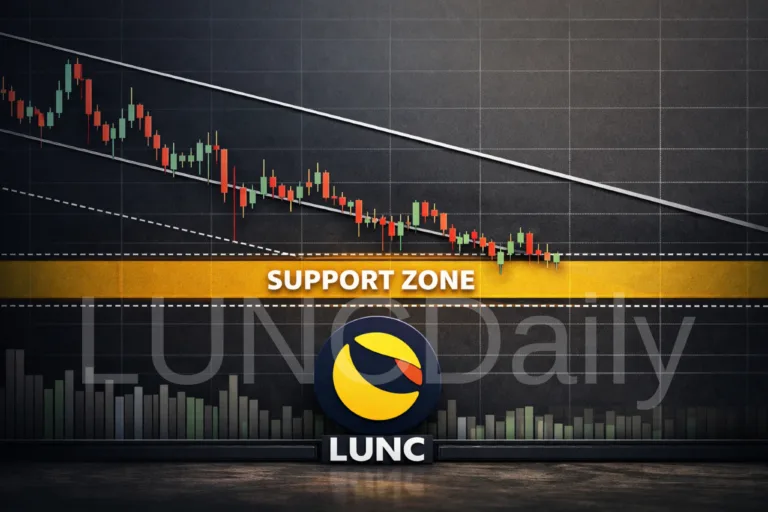
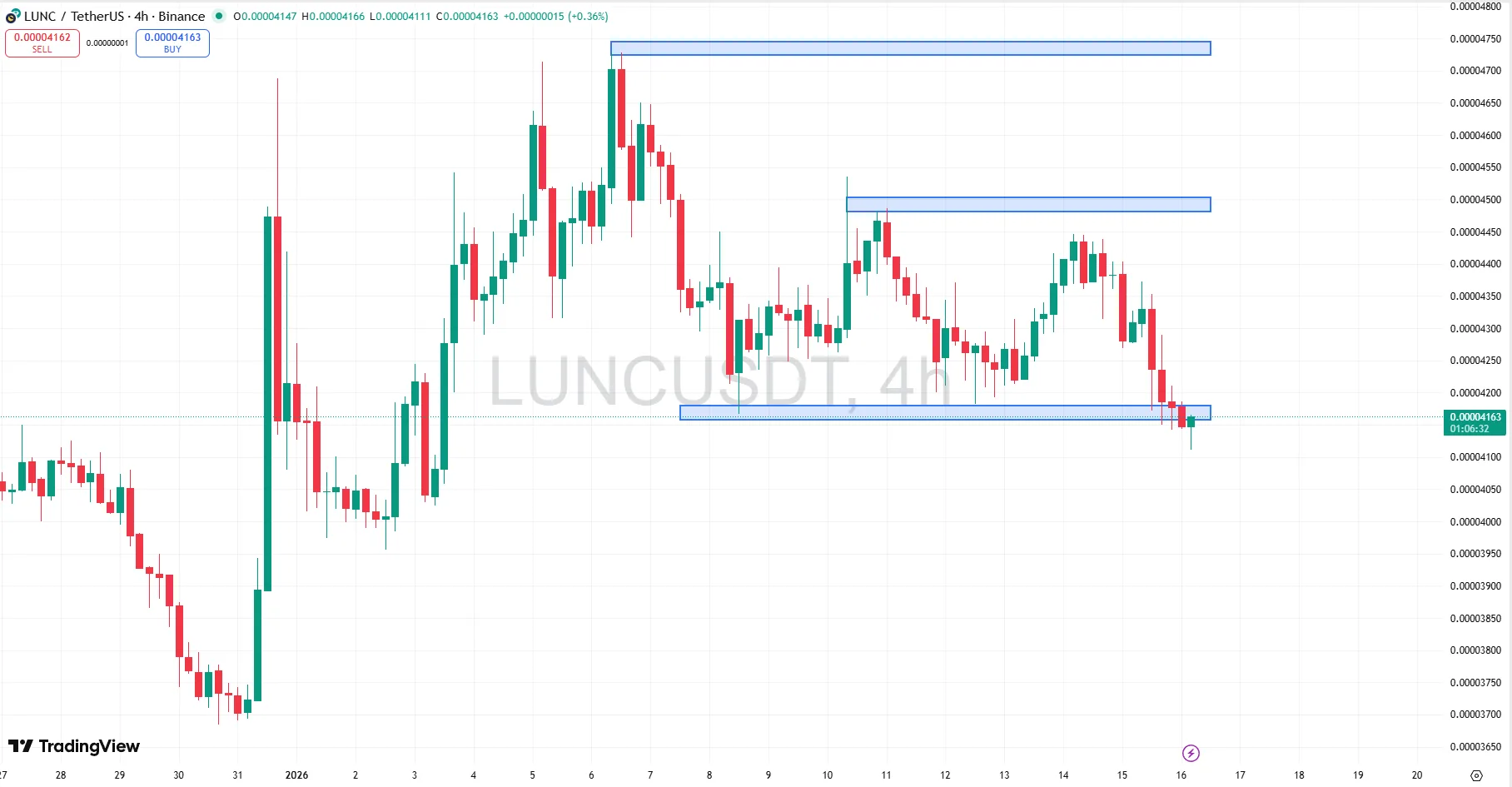
The most important level to watch is the support area between 0.0000410 and 0.0000420. This zone has acted as a strong technical floor, with price reacting to it multiple times in the past.

Recent candles near this area show smaller bodies, which typically signals that selling pressure is weakening. If buyers continue to defend this zone, a short term bounce becomes possible.

Key Resistance Zones

Above the current price, two resistance areas stand out clearly.

The first resistance zone is located around 0.0000445 to 0.0000450. This level has previously limited upward movement.

The major resistance zone sits between 0.0000470 and 0.0000480. This area represents strong historical selling pressure and would require strong momentum and volume to break.

Possible Price Scenarios

If the support zone holds, LUNC may attempt a recovery move toward the first resistance level. Confirmation would come from strong bullish candles closing above support.

If the support fails and price closes decisively below the support zone, further downside becomes more likely. In this scenario, patience is required while the market forms a new base.

Trading Perspective

From a professional trading perspective, this is not a market for chasing price. Range-bound conditions favor traders who wait for clear reactions at support or resistance.

Risk management remains critical, as false breakouts are common in sideways markets.

Conclusion

LUNC is currently at a decision point on the 4 hour chart. The next major move will depend on whether buyers can successfully defend the current support zone or if sellers regain control.

Staying disciplined and waiting for confirmation remains the most effective approach in the current market structure.

Luna Classic Enters Consolidation as Bitcoin Dominance Pressures Altcoins

On the four hour timeframe, Luna Classic is currently moving within a sideways range following a strong price movement earlier this month. This type of price action is known as consolidation. It means buyers and sellers are temporarily balanced, and the market is waiting for a clear direction.

Over the last twenty four hours, LUNC has dropped by more than two percent, even as Bitcoin briefly surged to around ninety six thousand dollars. For beginners, this situation can be confusing, but it is a very common market behavior.

When Bitcoin rises sharply, it often absorbs most of the available liquidity in the crypto market. As capital flows into Bitcoin, many altcoins weaken or move sideways. Luna Classic is currently experiencing this effect, as Bitcoin dominance increases and altcoin momentum slows.

Key Levels on the Chart

Resistance zones are areas where price has previously failed to move higher and selling pressure becomes strong.

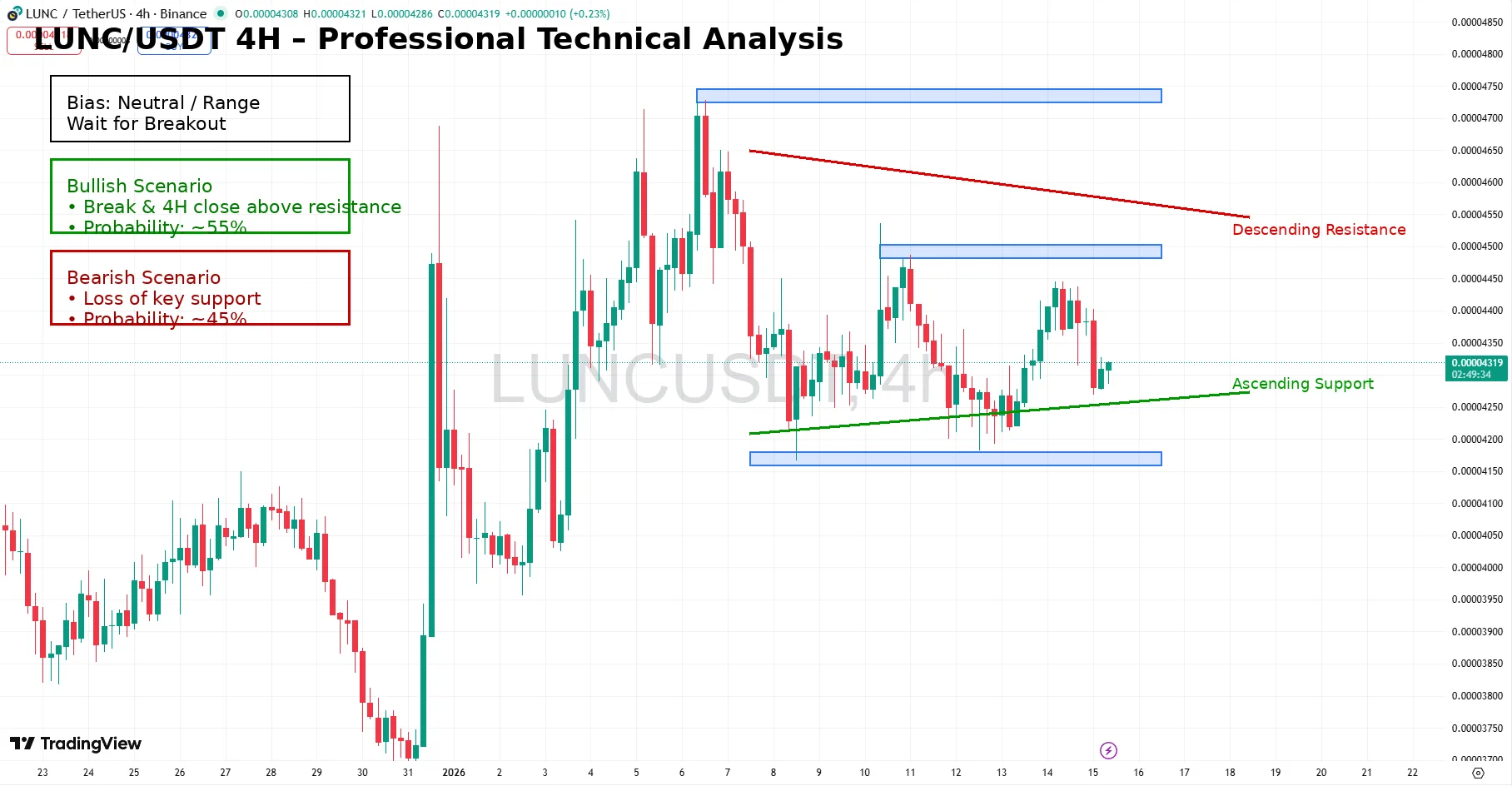
The upper resistance is located around 0.0000470 to 0.0000480. A secondary resistance level sits near 0.0000450.

Each time LUNC approaches these zones, sellers enter the market and push price lower. This behavior shows that buyers are not yet strong enough to sustain a breakout at higher levels.

The main support zone is located near 0.0000415 to 0.0000420. This area represents a level where buyers have consistently defended price.

So far, this support is holding. As long as LUNC remains above this range, a deeper decline is not confirmed.

Current Market Structure

At present, LUNC is forming lower highs while maintaining the same support level. This pattern signals weak momentum rather than a strong uptrend.

Buyers are cautious and hesitant to push price higher. Sellers remain active near resistance levels. The broader market is waiting for clearer direction from Bitcoin.

This price behavior confirms that Luna Classic is in a consolidation phase rather than a breakout phase.

What Beginners Should Understand

LUNC is not experiencing a crash, but it also lacks the strength needed for a sustained rally. A rising Bitcoin price does not always mean altcoins will move higher at the same time.

Altcoins often react later, after Bitcoin stabilizes or cools down. Sideways markets are normal and require patience and discipline.

Simple Scenarios Ahead

In a bullish scenario, a strong break and close above 0.0000450 could open the door for a retest of the higher resistance zone between 0.0000470 and 0.0000480.

In a bearish scenario, a breakdown below the 0.0000415 support level would indicate that sellers are gaining control and could push price lower.

Conclusion

Luna Classic is currently range bound and underperforming Bitcoin, a pattern commonly seen during periods of rising Bitcoin dominance. This is a waiting phase rather than a chasing phase.

For beginners, the key lesson is clear. Do not force trades in sideways markets. Allow price to confirm direction before taking action. Patience is not just a mindset, it is a trading skill.

Luna Classic Staking Ratio Drops 0.8% Since January 1 Until Today

Luna Classic Staking Ratio Declines in Early January

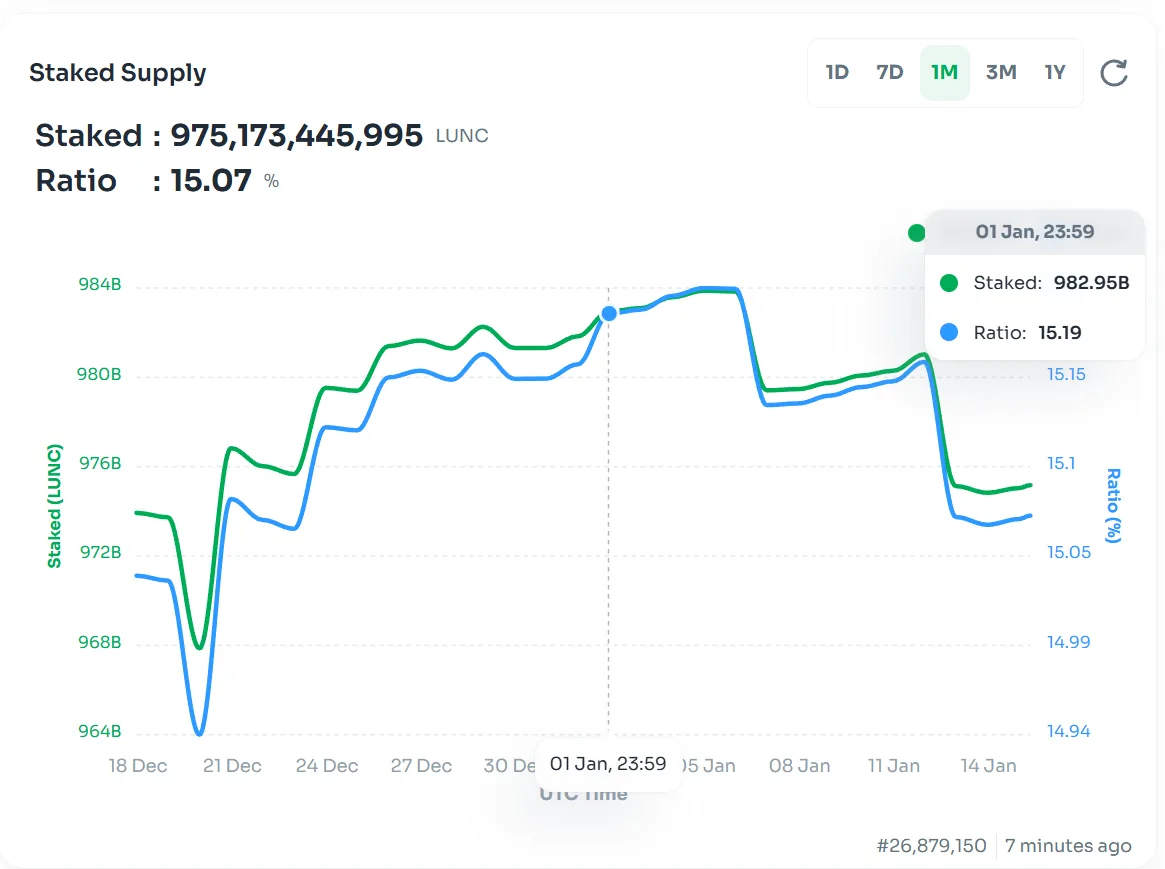
The Luna Classic network has recorded a noticeable decline in its staking metrics during the first half of January. Data shows that the total amount of staked LUNC has decreased by approximately 0.8 percent since the start of the month.

On January 1, the total staked supply stood at 982.95 billion LUNC. As of today, the staked amount has fallen to 975.17 billion LUNC. This represents a reduction of around 7.78 billion LUNC removed from staking over this period.

Understanding the Staking Drop

A decline in staked supply typically indicates that some holders have chosen to unstake their tokens. This can happen for several reasons, including profit taking, short term trading opportunities, or shifting capital to other on chain activities.

Despite the decrease, the staking ratio remains above 15 percent, which still reflects strong participation from the Luna Classic community. The network continues to maintain a large portion of its circulating supply locked in staking.

Impact on the Luna Classic Network

Staking plays a crucial role in securing the Luna Classic blockchain and supporting validator operations. A short term decline of 0.8 percent does not pose a direct risk to network stability, but it is an important metric to monitor.

If staking levels continue to decline over a longer period, it could signal reduced confidence or changing market behavior. On the other hand, a stabilization or recovery in staked supply would suggest renewed long term commitment from holders.

What Comes Next

The current staking data highlights the importance of on chain activity and network incentives. Future changes in trading volume, governance proposals, and ecosystem development may influence whether staked LUNC increases or continues to decline.

For now, the Luna Classic network remains actively supported by its community, even as short term staking fluctuations reflect broader market dynamics.

Luna Classic Burn Rate Slows

Luna Classic Burn Rate Slows as Daily LUNC Burns Drop Below 50 Million per Day in Last 6 Days

The Luna Classic network has recorded a noticeable slowdown in its burn rate during January, raising concerns among community members who closely track LUNC supply reduction.

Over the past six days, daily LUNC burns have consistently failed to surpass 50 million tokens. This marks a significant decline compared to earlier periods when higher trading activity and large burn events contributed to stronger daily reductions.

The situation worsened on January 13, when the network recorded its weakest daily burn of the month. In a full 24 hour period, only 18.7 million LUNC tokens were burned. This figure stands out as the lowest daily burn recorded so far in January.

While the total monthly burn remains substantial due to a massive burn on January 1 by Binance, recent data shows that ongoing daily burn performance is heavily dependent on sustained on chain activity rather than isolated large transactions.

Lower daily burn numbers generally indicate reduced transaction volume across the network. This does not signal the end of the burn mechanism, but it does highlight the importance of increasing real usage, trading activity, and ecosystem participation to restore stronger burn momentum.

Daily LUNC Burn Breakdown

Month Date LUNC Burned
January 1 5,367,757,097
January 2 36,700,121
January 3 194,515,792
January 4 59,068,461
January 5 22,184,507
January 6 55,976,794
January 7 58,298,205
January 8 85,060,487
January 9 22,167,180
January 10 22,949,053
January 11 34,617,148
January 12 33,911,987
January 13 18,745,561
January 14 35,139,054
Total 6,047,091,447

What This Means for Luna Classic

The data clearly shows that while large one time burns can significantly boost total figures, long term supply reduction depends on consistent daily activity. Without higher on chain volume, daily burns are likely to remain low.

For the Luna Classic ecosystem, improving utility, increasing transactions, and encouraging broader participation remain key factors in accelerating future LUNC burns and supporting long term network sustainability.

Luna Classic Price Rises as Bitcoin Rally Lifts the Market

Luna Classic 4 Hour Chart Analysis Explained Simply

Big Picture Overview

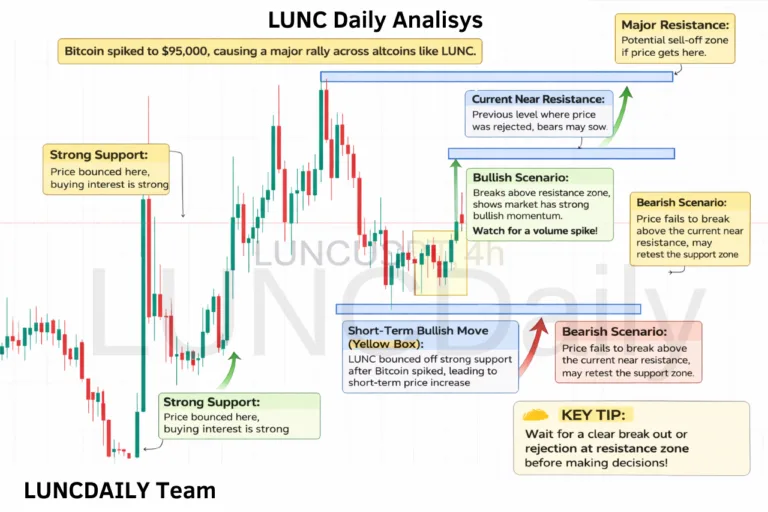
Luna Classic has gained more than 3 percent in the last 24 hours. This price increase did not happen in isolation. Bitcoin surged to around 95,000, which boosted overall market confidence and pushed capital into altcoins, including LUNC.

When Bitcoin moves strongly, altcoins often react in the same direction. The current LUNC price action is technically healthy and follows a clear bounce from support.

Understanding the Key Levels on the Chart

Strong Support and Resistance Zones

The chart highlights several important price zones where LUNC previously reacted.

The lower blue zone represents strong support. Price moved down into this area, buyers entered the market, and LUNC bounced higher. This shows strong buying interest.

The middle blue zone acts as near term resistance. Price was rejected here before, which means sellers may appear again if price revisits this level.

The top blue zone is major resistance. If price reaches this area, selling pressure is likely unless there is a strong increase in trading volume.

Short Term Bullish Momentum

The yellow highlighted area shows a short term bullish move.

After touching support, buyers stepped in and pushed price higher. Candles began forming higher levels, signaling a shift in short term momentum from bearish to bullish.

This move should be viewed as a relief rally rather than a confirmed long term trend reversal.

Market Structure Explained for Beginners

At the moment, LUNC remains inside a broader price range.

  • Price is forming higher lows, which is a positive sign
  • LUNC is still trading below major resistance levels

In simple terms, buyers are active, but sellers have not fully lost control yet.

Why Bitcoin Is Driving This Move

Bitcoin’s move to 95,000 played a key role in this rally.

  • It increased confidence across the crypto market
  • It triggered algorithmic and momentum based buying
  • It created short term upside pressure on altcoins

If Bitcoin holds above its breakout zone, LUNC has room to continue higher. If Bitcoin pulls back sharply, LUNC will likely follow with a correction.

Possible Scenarios Going Forward

Bullish Scenario

  • LUNC holds above the lower support zone
  • Price breaks and closes above the near resistance area
  • Momentum builds toward the upper resistance zone

Bearish Scenario

  • Price fails to break resistance
  • Selling pressure increases
  • LUNC retests the support zone again

Both outcomes are normal market behavior and should not be viewed as panic signals.

Key Guidance for New Traders

  • Avoid chasing price after strong green candles
  • Focus on support and resistance instead of emotions
  • Always pay attention to Bitcoin’s direction
  • Range bound markets reward patience and discipline

Final Market Insight

The current move in Luna Classic is healthy and technically sound. Price is responding well to broader market strength, but real confirmation only comes after a clean break above resistance with strong volume.

Smart trading is about structure and timing, not speed.

Only 18M LUNC Burned in One Day? A Reality Check on Influencer Claims

0

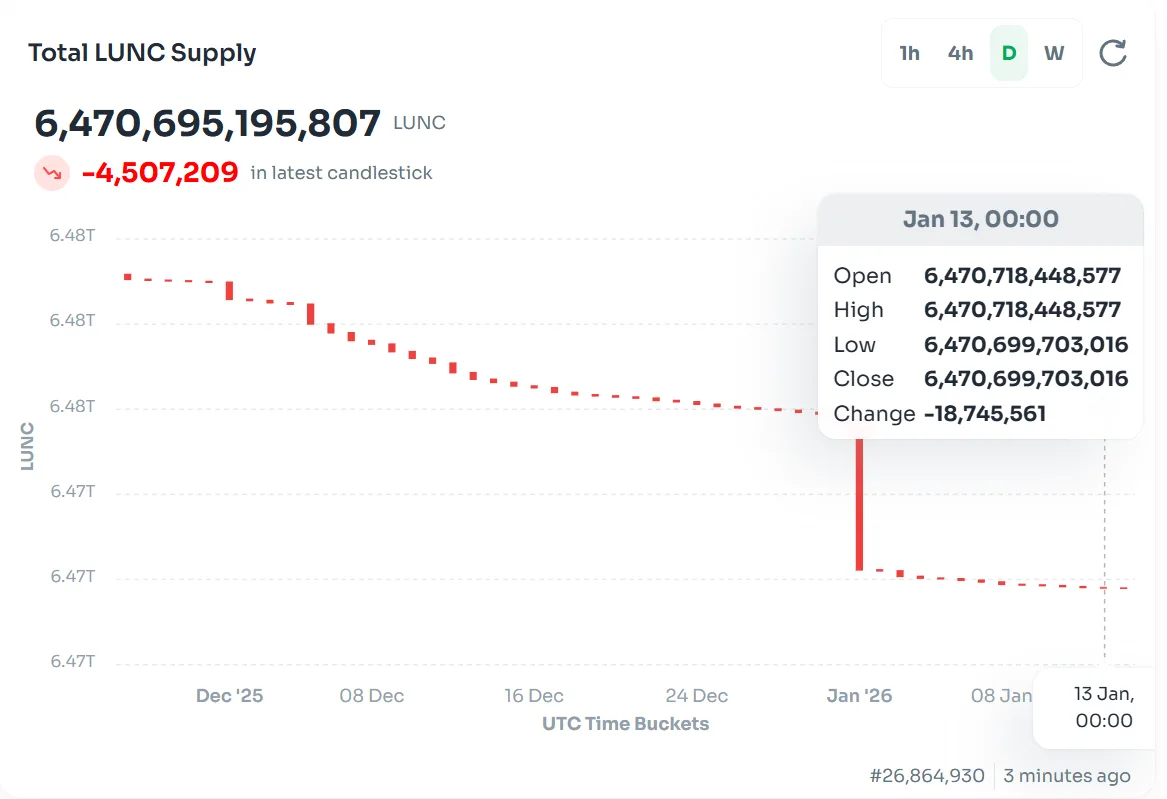
On January 13, the Luna Classic network recorded one of its weakest burn performances of the month.


In a full 24 hour period, only 18 million LUNC tokens were burned. This figure marks the lowest daily burn recorded so far in January and raises serious concerns for the community.

What makes this situation more concerning is timing. This low burn did not occur on a weekend when market activity is usually slower. It happened on a weekday, when the crypto market is typically active and transaction volume is expected to be higher.

The reason behind this sharp decline is not complex. The LUNC burn mechanism is directly tied to on chain transaction volume. Every on chain transaction includes a burn tax. When activity on the blockchain slows down, the burn rate naturally declines.

On January 13, on chain volume was extremely low. As a result, the burn generated from network activity fell to just 18 million LUNC. This is not a failure of the burn mechanism itself. It is a clear signal that the network is not being used enough.

For the LUNC community to fully understand the burn process, one principle must be clear. Burns do not come from hope or external promises. They come from real usage of the blockchain.

Applications, smart contracts, decentralized finance platforms, and payment flows on layer one and layer two all contribute to on chain volume. When builders create tools that people actually use, transactions increase. When transactions increase, burns follow.

Without on chain usage, burn numbers will remain weak regardless of market sentiment.

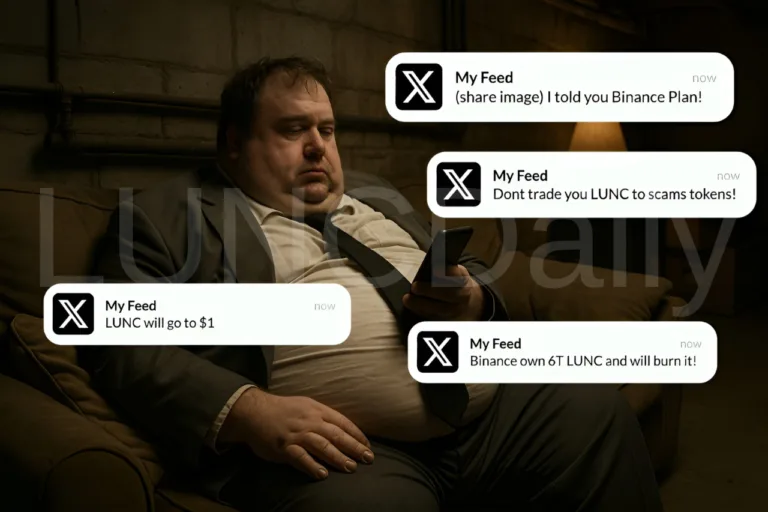
This low burn day should serve as a wake up call. For a long time, parts of the community have been influenced by voices that do not fully understand how blockchain economics work. Some influencers continue to dismiss layer two builders while promoting unrealistic expectations such as massive external burns removing most of the supply overnight.

Wallet screenshots and speculative narratives do not improve the network. They do not increase transactions. They do not burn tokens.

The community benefits most from following contributors who understand blockchain mechanics and actively work to increase real LUNC usage.

If the goal is long term success for Luna Classic, the focus must shift toward education and participation. Understanding how the LUNC blockchain functions is essential. Supporting builders who increase on chain activity is far more valuable than chasing unrealistic burn fantasies.

The January 13 burn data is not just a number. It is a reminder that real progress comes from real usage. If the community wants stronger burns, the path forward is clear. Build more. Use the chain more. Learn how the system truly works.