The March LUNC burn report confirms that a total of 1,732,076,296 LUNC was permanently removed from circulation during the month. This ongoing burn activity reflects continued efforts to reduce supply within the Terra Classic ecosystem.
The largest single day contribution occurred on March 1, driven primarily by Binance as part of its monthly LUNC burn program.
Binance Contribution
On March 1, Binance burned 858,230,264 LUNC, accounting for the majority of the total burn recorded on that day. This burn is part of Binance’s ongoing initiative, where a portion of trading fees is used to remove LUNC from circulation.
This contribution represents a significant share of the total monthly burn and highlights Binance’s continued involvement in supporting the Terra Classic ecosystem.
Daily LUNC Burn Data (March)
Date
LUNC Burn
March 1
893,838,598
March 2
20,150,519
March 3
28,273,814
March 4
86,426,717
March 5
25,557,466
March 6
20,131,764
March 7
23,569,133
March 8
12,580,442
March 9
25,561,534
March 10
17,562,991
March 11
45,688,509
March 12
26,446,204
March 13
32,944,907
March 14
19,548,720
March 15
19,410,340
March 16
35,053,415
March 17
39,473,724
March 18
38,024,806
March 19
17,461,316
March 20
30,345,515
March 21
42,292,808
March 22
11,248,758
March 23
17,862,491
March 24
26,375,550
March 25
22,932,085
March 26
22,106,419
March 27
38,184,956
March 28
30,114,011
March 29
22,696,277
March 30
15,463,549
March 31
24,748,958
Total
1,732,076,296
Summary
March recorded consistent daily burn activity, with contributions coming from various sources across the Terra Classic network. The total burn of over 1.73 billion LUNC highlights continued participation in reducing circulating supply.
Binance’s monthly burn remains a key driver, with its March 1 contribution forming the largest portion of the total burn for the month.
As burn activity continues, these figures provide a clear snapshot of ongoing supply reduction efforts within the LUNC ecosystem.
April 5 Could Mark a Major Milestone for the Terra Classic LUNC Community with Core v4.0.0 Upgrade
The Terra Classic community is approaching an important moment as the Core v4.0.0 mainnet upgrade is expected to take place around April 5. This upgrade follows an extended period of testing and preparation aimed at ensuring network stability and readiness.
Over the past two months, Core v4.0.0 has been running on testnet, where validators and dApp providers have worked together to test multiple release versions. During this period, the network has remained stable, providing confidence in the upgrade’s readiness for mainnet deployment.
The Orbit Labs team is now moving into the final preparation phase. The expected upgrade timeline aligns with exchange pre notification requirements, which are necessary to ensure a smooth transition across platforms that support Terra Classic.
Project owners across the ecosystem are being encouraged to review their deployments on testnet and report any issues as soon as possible. Early identification of potential problems will help minimize risks ahead of the mainnet launch.
At the same time, Orbit Labs is preparing supporting documentation and coordinating upgrade steps with key participants. These efforts are focused on delivering a smooth and well organized transition when Core v4.0.0 goes live on the mainnet.
As the expected date approaches, April 5 stands out as a potentially significant milestone for the Terra Classic LUNC ecosystem, marking the next step in its ongoing development.
LUNC Maintains Strong Support From the World’s Largest Exchange
Terra Classic LUNC continues to show resilience as it remains supported by Binance, the largest cryptocurrency exchange in the world. Despite ongoing criticism labeling LUNC as a declining project, recent developments suggest continued institutional backing.
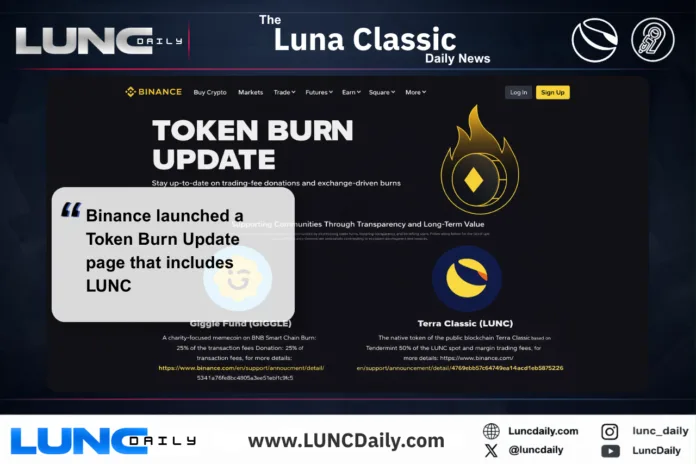
Binance has launched a dedicated Token Burn Update page on its platform, designed to track token burn activity with full transparency. Notably, only a limited number of tokens are featured on this page, including Giggle and LUNC. This selective inclusion highlights the importance of LUNC within Binance’s ecosystem.
Historically, Binance has primarily focused its burn mechanisms on its native token BNB. LUNC stands out as one of the very few external tokens that receive consistent burn support from the exchange. This positions LUNC alongside a highly exclusive group, reinforcing its relevance in the broader market.
The Token Burn Update page consolidates monthly burn activity, where Binance allocates 50 percent of LUNC trading fees toward token burns. In the January to February 2026 cycle, approximately 858 million LUNC were removed from circulation, valued at around 32000 dollars. This brings the cumulative total close to 83 billion LUNC burned, with an estimated value of 12 million dollars.
Community response has been positive, with many members highlighting the continued involvement of Binance leadership and long term support extending into 2026. This comes as total ecosystem burns have surpassed 441 billion LUNC since May 2022, reflecting sustained on chain activity.
At the time of writing, LUNC is trading near 0.000038 dollars, with a market capitalization of approximately 207 million dollars. The inclusion of LUNC on Binance’s official burn tracking page serves as a clear signal of ongoing support, reinforcing confidence within the Terra Classic community.
With transparent reporting and consistent burn activity, LUNC continues to demonstrate that it remains an active and supported asset within the cryptocurrency ecosystem.
Terra Classic LUNC has recorded a total burn of 1,707,327,338 tokens over the past 30 days, based on daily burn data throughout March. This reflects ongoing on chain activity within the ecosystem, with consistent contributions recorded across the month.
The largest single day burn occurred on March 1, reaching 893,838,598 LUNC. Following this spike, daily burn activity continued at a steady pace, with most days recording tens of millions of tokens removed from circulation.
Throughout the remainder of the month, burn volumes remained consistent, generally ranging between 11 million and 45 million LUNC per day. This pattern highlights sustained participation in the burn mechanism over time.
Below is the full breakdown of daily LUNC burns for the 30 day period:
Month
Date
LUNC Burn
March
1
893,838,598.00
March
2
20,150,519.00
March
3
28,273,814.00
March
4
86,426,717.00
March
5
25,557,466.00
March
6
20,131,764.00
March
7
23,569,133.00
March
8
12,580,442.00
March
9
25,561,534.00
March
10
17,562,991.00
March
11
45,688,509.00
March
12
26,446,204.00
March
13
32,944,907.00
March
14
19,548,720.00
March
15
19,410,340.00
March
16
35,053,415.00
March
17
39,473,724.00
March
18
38,024,806.00
March
19
17,461,316.00
March
20
30,345,515.00
March
21
42,292,808.00
March
22
11,248,758.00
March
23
17,862,491.00
March
24
26,375,550.00
March
25
22,932,085.00
March
26
22,106,419.00
March
27
38,184,956.00
March
28
30,114,011.00
March
29
22,696,277.00
March
30
15,463,549.00
Total
1,707,327,338.00
The data shows that while a significant portion of the total burn occurred at the beginning of the month, daily contributions continued steadily across the remaining period. This ongoing activity reflects consistent engagement with the Terra Classic burn mechanism over the last 30 days.
Market Volatility Hits LUNC as Geopolitical Tensions Intensify
The Terra Classic token LUNC has recorded a decline of 5.4 percent over the past three days, reflecting increased volatility across the broader cryptocurrency market. This movement comes as Bitcoin dropped to the 65000 level, triggering a wider pullback among altcoins.
As an altcoin, LUNC tends to follow the overall direction of Bitcoin. When Bitcoin experiences downward pressure, market confidence often weakens, leading to reduced buying activity and increased selling across smaller assets. This correlation explains why LUNC mirrored the recent decline.
The primary driver behind this market movement is rising geopolitical tension. On Friday, March 27, escalation in the conflict involving the United States, Israel, and Iran created uncertainty in global financial markets. Such developments often lead investors to shift away from risk assets.
Bitcoin, despite being viewed by some as a hedge, still behaves like a risk asset during periods of global instability. When uncertainty increases, institutional and retail investors may reduce exposure to volatile assets and move capital into safer options such as cash or government bonds. This results in selling pressure on Bitcoin.
As Bitcoin declines, the impact extends to altcoins like LUNC. Altcoins generally carry higher risk and lower liquidity compared to Bitcoin, making them more sensitive to market sentiment. When Bitcoin falls, altcoins often experience larger percentage declines as traders exit positions more aggressively.
In the short term, LUNC price action is likely to remain closely tied to Bitcoin performance and broader macroeconomic developments. Any continued escalation in geopolitical tensions may sustain volatility, while stabilization in global conditions could help restore market confidence.
Investors are advised to monitor both geopolitical developments and Bitcoin price trends, as these remain key factors influencing LUNC and the wider cryptocurrency market.
The Terra Classic ecosystem has recorded a total burn of 758731 USTC over the past 29 days. This consistent burn activity reflects ongoing efforts to reduce circulating supply and support long term ecosystem stability.
The burn data shows a steady flow of daily contributions, with several notable spikes that significantly increased the total. The largest burn occurred on March 5, when 350200 USTC was removed from circulation, making it the most impactful single day during this period.
Another notable increase was recorded on March 23, with 79303 USTC burned. March 16 also saw a higher than average burn of 59297 USTC, contributing to the overall upward total.
Outside of these peak days, the burn activity remained consistent, with smaller daily contributions helping maintain steady progress. This pattern highlights a combination of large scale burns and continuous smaller efforts from the community and ecosystem participants.
Daily USTC Burn Breakdown
Month
Date
USTC Burn
March
1
14070
March
2
16396
March
3
7786
March
4
6869
March
5
350200
March
6
4234
March
7
19059
March
8
4777
March
9
16551
March
10
14732
March
11
35089
March
12
7598
March
13
2490
March
14
10701
March
15
3746
March
16
59297
March
17
11923
March
18
6039
March
19
5710
March
20
11770
March
21
14602
March
22
10603
March
23
79303
March
24
8280
March
25
5913
March
26
5011
March
27
8399
March
28
10662
Total
758731
Conclusion
The total burn of 758731 USTC over 29 days demonstrates sustained activity within the Terra Classic ecosystem. While a few large transactions played a major role, the consistent daily burns highlight ongoing participation in reducing supply.
This steady reduction remains an important part of the broader effort to strengthen the ecosystem and improve long term fundamentals.
Nearly 1.7 Billion LUNC Burned in the Last 29 Days
Over the past 29 days, a total of 1,691,863,789 LUNC has been permanently removed from circulation. This burn activity reflects ongoing on chain transactions and contributions from various sources within the Terra Classic ecosystem.
The largest single day burn occurred on March 1, with 893,838,598 LUNC removed. The remaining days show consistent burn activity, with daily amounts varying based on network usage and transaction volume.
Below is the complete daily breakdown of LUNC burned throughout March.
Daily LUNC Burn Data
Month
Date
LUNC Burn
March
1
893,838,598.00
March
2
20,150,519.00
March
3
28,273,814.00
March
4
86,426,717.00
March
5
25,557,466.00
March
6
20,131,764.00
March
7
23,569,133.00
March
8
12,580,442.00
March
9
25,561,534.00
March
10
17,562,991.00
March
11
45,688,509.00
March
12
26,446,204.00
March
13
32,944,907.00
March
14
19,548,720.00
March
15
19,410,340.00
March
16
35,053,415.00
March
17
39,473,724.00
March
18
38,024,806.00
March
19
17,461,316.00
March
20
30,345,515.00
March
21
42,292,808.00
March
22
11,248,758.00
March
23
17,862,491.00
March
24
26,375,550.00
March
25
22,932,085.00
March
26
22,106,419.00
March
27
38,184,956.00
March
28
30,114,011.00
March
29
22,696,277.00
Total
1,691,863,789.00
Summary
The data shows a total burn of nearly 1.7 billion LUNC within 29 days. Burn activity peaked at the beginning of the month and continued at varying levels throughout March, reflecting ongoing network usage and transaction activity within the ecosystem.
Why LUNC Governance Needs Improvement and What the Community Can Do Next
Introduction
The current governance system of Terra Classic, commonly known as LUNC, is not functioning at its full potential. Many community members have noticed recurring issues whenever new proposals are introduced. Instead of constructive discussion, debates often become unhealthy, with emotional reactions, veto decisions, and even unprofessional comments.
This situation raises an important question. Why does this keep happening, and what can be done to improve it?
Understanding the Current LUNC Governance System
To understand the problem, it is important to first look at how the governance process works.
The system is simple and consists of three main steps:
A proposal is shared on the community forum for discussion
The proposal enters the initial deposit stage
The proposal moves to the voting stage
While this structure may work well for some blockchain ecosystems, LUNC operates differently. It is a fully community driven network with no central leadership such as a CEO or executive team. Validators and community participants play the main role in decision making.
Where the Problems Begin
In theory, a decentralized governance model sounds ideal. In practice, it creates several challenges.
Not all validators or participants have a background in crypto development, economics, or leadership. This creates a gap between perception and actual expertise. Some individuals may appear confident in their opinions but may lack the technical or strategic understanding required to evaluate proposals effectively.
This often leads to:
Miscommunication and misunderstanding of proposals
Emotional or unprofessional responses during discussions
Decisions influenced more by perception than by solid analysis
Over time, this environment has discouraged serious builders from staying in the ecosystem. Whether the community agrees or not, this has been one of the factors affecting LUNC’s ability to attract long term developers and large investors. As a result, price movement remains weak and heavily influenced by external factors such as Bitcoin.
A New Approach to Governance
Improving governance does not require abandoning decentralization. Instead, it requires better structure and communication.
Here is a proposed approach to strengthen the system:
1. Proposal Submission on Discourse
The process begins as usual with a proposal shared on the forum.
2. Mandatory Community Conference
Before moving forward, the proposer participates in an official online conference. This becomes a required step in governance.
This allows:
Real time discussion
Direct questions and answers
Immediate feedback from the community
It also ensures that proposers remain accountable and actively engaged.
3. Proposal Refinement
After the discussion, the proposer updates the proposal based on feedback and agreements reached during the conference.
4. Voting Stage
The improved proposal is then submitted for on chain voting.
5. Community Education During Voting
While voting is ongoing, the proposer hosts public sessions on platforms such as X or other channels to explain the proposal. Validators should also communicate clearly with their delegators.
This creates a more informed community and encourages responsible voting.
Why This Change Matters
Some may argue that parts of this process already exist. However, the key issue is consistency. When these steps are not formalized, participation becomes optional and inconsistent.
By making these steps official, the governance system can achieve:
Better communication
Higher quality proposals
More professional discussions
Stronger trust within the community
Conclusion
The goal of this discussion is not to criticize individuals but to highlight areas where the system can improve. LUNC governance is powerful because it is community driven, but that also means responsibility is shared by everyone.
If the current system continues without improvement, the same issues will persist. However, with a more structured and professional approach, LUNC can create a healthier environment for builders, investors, and long term growth.
Constructive input is essential for progress. If this perspective resonates or challenges your view, that is part of the process.
More than 1.6 billion Terra Classic LUNC tokens have been burned over the first 26 days of March. The total recorded burn reached 1,600,868,545 LUNC, reflecting ongoing supply reduction efforts within the network.
The largest single day burn occurred on March 1, with 893,838,598 LUNC removed from circulation. This accounts for a significant portion of the total monthly burn.
Most of the burn activity during this period came from Binance through its monthly LUNC burn program, rather than consistent daily on chain activity.
Daily LUNC Burn Data
Month
Date
LUNC Burn
March
1
893,838,598
March
2
20,150,519
March
3
28,273,814
March
4
86,426,717
March
5
25,557,466
March
6
20,131,764
March
7
23,569,133
March
8
12,580,442
March
9
25,561,534
March
10
17,562,991
March
11
45,688,509
March
12
26,446,204
March
13
32,944,907
March
14
19,548,720
March
15
19,410,340
March
16
35,053,415
March
17
39,473,724
March
18
38,024,806
March
19
17,461,316
March
20
30,345,515
March
21
42,292,808
March
22
11,248,758
March
23
17,862,491
March
24
26,375,550
March
25
22,932,085
March
26
22,106,419
Total
1,600,868,545
The data shows that daily burn activity outside of the March 1 event remained relatively moderate. This indicates that a large portion of the monthly burn total was driven by scheduled exchange based burns rather than steady organic network usage.
Binance continues to play a central role in the current burn mechanism, contributing the majority of LUNC removed from circulation during this period.
LUNC Price Stalls as Bitcoin Moves Sideways Between 68K and 72K
Market Overview
In the last five days, LUNC has moved in a sideways pattern, reflecting broader uncertainty across the crypto market. The main driver behind this behavior is Bitcoin, which is currently consolidating between the 68000 and 72000 price range.
When Bitcoin enters a range bound phase, most altcoins including LUNC tend to lose directional momentum. This results in reduced volatility, lower trading volume, and a lack of strong trend development.
Chart Analysis
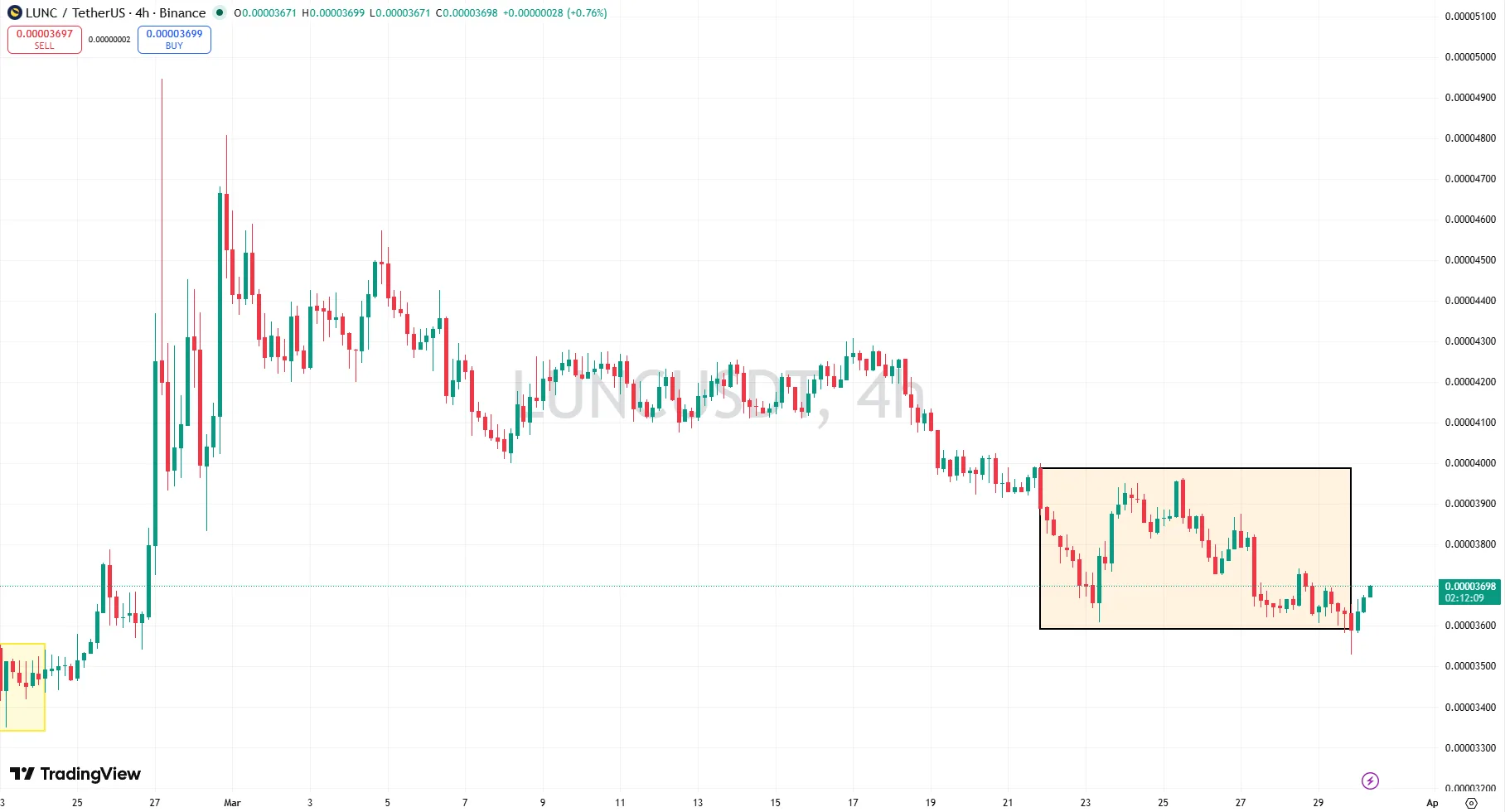
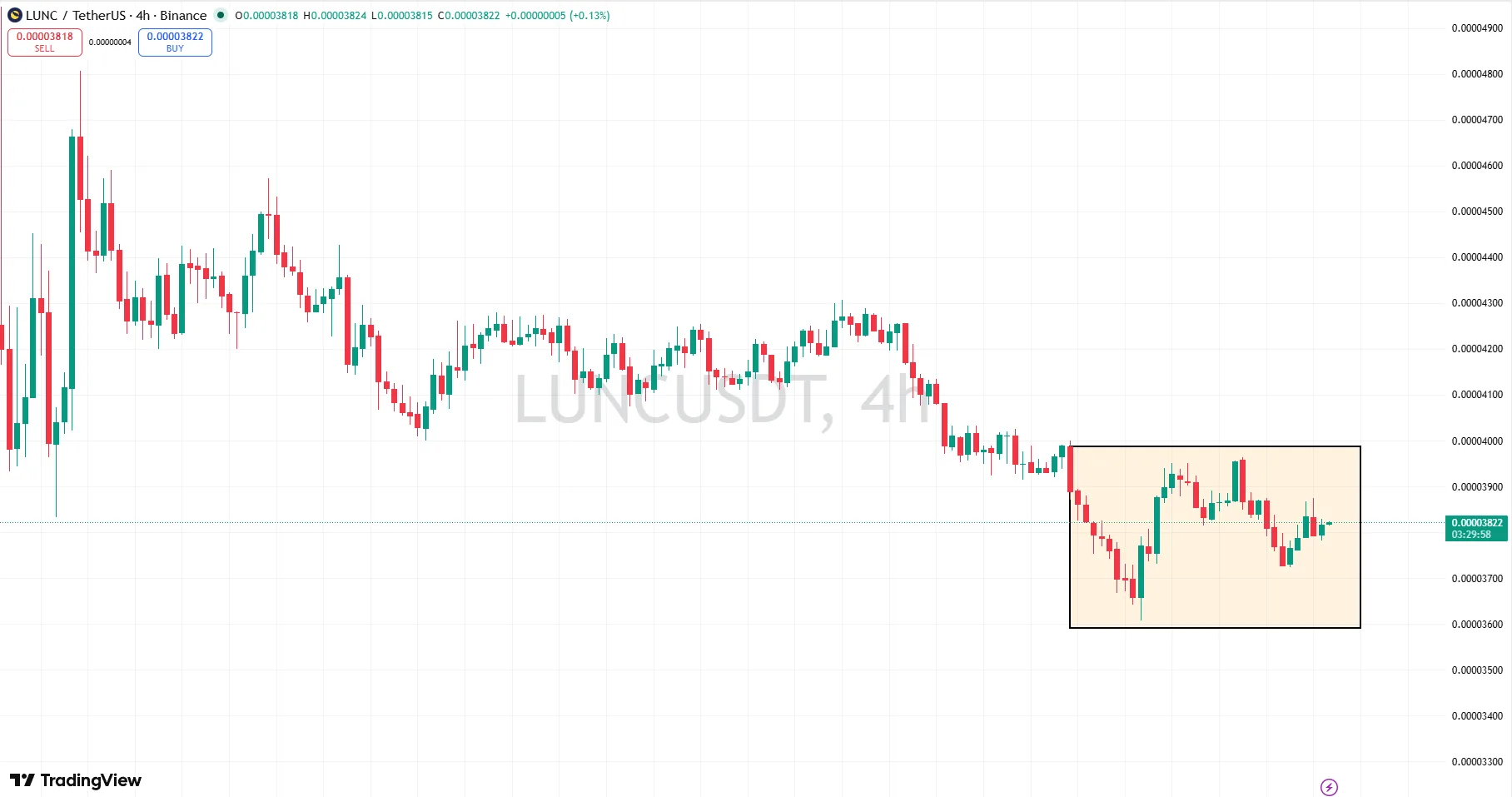
Based on the 4 hour LUNCUSDT chart, the market structure shows a clear short term downtrend followed by consolidation.
LUNC experienced a gradual decline before entering a tight range
Price action is now moving horizontally inside a defined support and resistance zone
The highlighted box shows consolidation between approximately 0.000036 and 0.000039
Candles inside this range indicate indecision with both buyers and sellers lacking dominance
This type of structure is commonly referred to as accumulation or distribution, depending on the broader trend context.
Key Levels to Watch
Support zone: 0.000036
This level has been tested multiple times and is acting as a short term floor.
Resistance zone: 0.000039 to 0.000040
Price has repeatedly failed to break above this area, confirming strong selling pressure.
A breakout above resistance could signal short term bullish momentum, while a breakdown below support may lead to further downside continuation.
Why Bitcoin Matters
Bitcoin remains the dominant force in the crypto market. Its current sideways movement between 68000 and 72000 creates uncertainty for traders.
This directly impacts LUNC in several ways:
Reduced speculative interest in altcoins
Lower trading volume across the market
Delayed trend formation
Increased correlation with Bitcoin price movements
Until Bitcoin breaks out of its range, LUNC is likely to remain in a consolidation phase.
Market Outlook
Bullish scenario:
A Bitcoin breakout above 72000 could push LUNC above 0.000040 and start a recovery trend.
Bearish scenario:
A Bitcoin drop below 68000 may lead to LUNC breaking below 0.000036 and continuing its downtrend.
Conclusion
LUNC is currently in a consolidation phase driven by Bitcoin market uncertainty. The price is ranging within a tight zone, showing no clear direction in the short term.
Traders should focus on key support and resistance levels while closely monitoring Bitcoin, as it will determine the next major move for LUNC.