Nearly One Million USTC Burned in Just Thirteen Days
The Terra Classic community has continued its steady effort to reduce the supply of USTC. In the first thirteen days of November, almost one million USTC was removed from circulation. This shows that burn activity remains strong and consistent across the network.
Below is the record of USTC burn activity from November 1 to November 13:
Date
USTC Burn
November 1
16.784
November 2
21.155
November 3
35.884
November 4
33.414
November 5
20.066
November 6
159.089
November 7
49.063
November 8
11.890
November 9
25.819
November 10
113.195
November 11
169.638
November 12
18.428
November 13
77.754
The total burn across this period reached 752.179 USTC. While the number is just under one million, it shows a clear upward trend as the community continues to reduce supply and support the growth of the Terra Classic ecosystem.
Sustained burn activity remains an important strategy to restore confidence and bring long term value to the network.
Proposal #12201 : Public Inquiry into Binance’s Custody of Terraform Labs Remaining LUNC and USTC Holdings Formerly UST & LUNA
Introduction
After Terraform Labs collapsed in 2022, many questions appeared about what happened to their LUNC and USTC tokens. A community proposal has been made to verify and disclose the remaining Terraform Labs tokens held on Binance and to ensure these tokens are burned as required by the court. The proposal aims to bring transparency, confirm compliance with the Final Judgment, and protect the Terra Classic network. If executed, it could lead to the destruction of a significant portion of the USTC supply, potentially up to half. This article explains the situation in simple terms and why the proposal is safe.
What Happened to TFL Tokens on Binance
Terraform Labs sent large amounts of USTC and smaller amounts of LUNC to Binance using deposit memos.
A deposit memo is a code that tells Binance which account the money belongs to. Even though many users send tokens to the same Binance address, the memo keeps each account separate.
This means tokens from other users or investors are not affected. Only the tokens that match Terraform Labs deposit memos are part of this proposal.
Why Transparency is Important
The court case SEC versus Terraform Labs requires all Terraform-related tokens to be burned or made permanently inaccessible. Most on-chain tokens have already been burned. However, some tokens on Binance have not been confirmed as burned.
The proposal does not ask Binance to show all user funds. It only asks Binance to show the status of tokens that belong to Terraform Labs according to the court order.
How CEX Wallets Work
Centralized exchanges like Binance use shared addresses for deposits. The memo tells Binance which user account should receive the deposit.
For example, two different users could send tokens to the same address but with different memos. This keeps their funds separate.
Because Terraform Labs transactions have unique memos, it is easy for Binance to separate TFL tokens from other users. Retail users’ funds are not affected.
Why the Proposal is Safe
It does not accuse Binance of wrongdoing.
It does not touch any retail or investor funds.
It asks only for compliance with the existing court order.
It is fully aligned with legal requirements and blockchain data.
It supports transparency and trust in the Terra Classic community.
Even though Binance controls the deposit address, the unique memos allow them to identify the TFL tokens accurately without affecting other users.
Benefits of the Proposal
Confirms that Terraform Labs tokens are burned according to the court ruling.
Reduces uncertainty in the Terra Classic network.
Protects Binance from legal or operational risks by helping them follow the law.
Strengthens trust and credibility in the community.
Transparency and compliance are standard practice in blockchain and finance. This proposal helps maintain a healthy and trustworthy network.
Conclusion
The community proposal to verify and disclose Terraform Labs LUNC and USTC on Binance is safe and important. It does not involve any retail users. It follows the court ruling and ensures that remaining Terraform Labs tokens are properly burned.
If executed, this proposal could destroy up to half of the USTC supply, increasing transparency, protecting the Terra Classic network, and strengthening trust in both the community and Binance.
References
SEC v. Terraform Labs Final Judgment
Verified blockchain transaction data linking TFL wallets to Binance deposit memos
Terra Classic community proposals and burn records
Crypto Market Falls Again as LUNC Drops 8 Percent in the Last 24 Hours
The crypto market is facing another tough moment. Prices across many coins are falling and investor confidence is weakening.
In the last 24 hours, Terra Classic or LUNC has fallen by 8 percent. This drop happens during a wider market decline that is affecting many major assets.
Bitcoin has also fallen and is now near the 95000 dollar level. When Bitcoin drops, the rest of the market often follows.
At the same time, liquidations in the market have reached 1.3 billion dollars. Around 1.2 billion dollars of this came from long positions. This shows many traders were expecting prices to rise, but the sudden drop forced their positions to close and pushed the market down even more.
Why this is happening
Investors are unsure about future interest rate cuts. When interest rates stay high, people avoid risky assets like crypto.
Many traders were too confident in a rebound. When prices fell, their long positions were liquidated and this created more downward pressure.
Important support levels broke on many charts. When support breaks, prices often continue to fall.
Overall confidence is low. More traders are moving to safer positions and waiting for a clearer signal of recovery.
What this means for LUNC
The wider market drop puts extra pressure on LUNC. Lower liquidity and more fear can make price swings stronger. The large number of liquidations also shows the market may still be unstable.
What to watch next
Watch if Bitcoin can stay above the 95000 to 100000 dollar zone. Also watch interest rate news, liquidation activity, and any new updates from the Terra Classic ecosystem.
Conclusion
The crypto market is in a difficult phase. LUNC has dropped 8 percent in one day and pressure remains high across the market. While some investors may see this as a chance to buy, the current conditions require caution. It is important to monitor key levels and stay updated on market news.
This article is for information only and is not financial advice.
Is Altcoin Season Really Coming? LUNC Price Falls 37.3% in 3 Months
In the last three months, the crypto market has gone through a tough time. Many coins have lost value, and Luna Classic (LUNC) is one of them. The price of LUNC has fallen by 37.3% during this period.
This drop is not only happening to LUNC. Many other coins are also down, some even more. It makes many people wonder if the next altcoin season will really come soon or not.
Here is a simple look at LUNC’s price changes:
Period
Change
7 Days
-2.9%
14 Days
-3.3%
30 Days
-17.8%
The numbers show that LUNC has been slowly going down over time. The market is still weak, and traders are being careful before making big moves.
Some people believe the market will recover soon, especially if Bitcoin starts to rise again. Others think it may take longer before we see the next big wave of altcoin growth.
For now, the best approach is to watch the market closely and stay patient while waiting for stronger signs of recovery.
Luna Classic Staking Slowly Recovers Toward 15 Percent
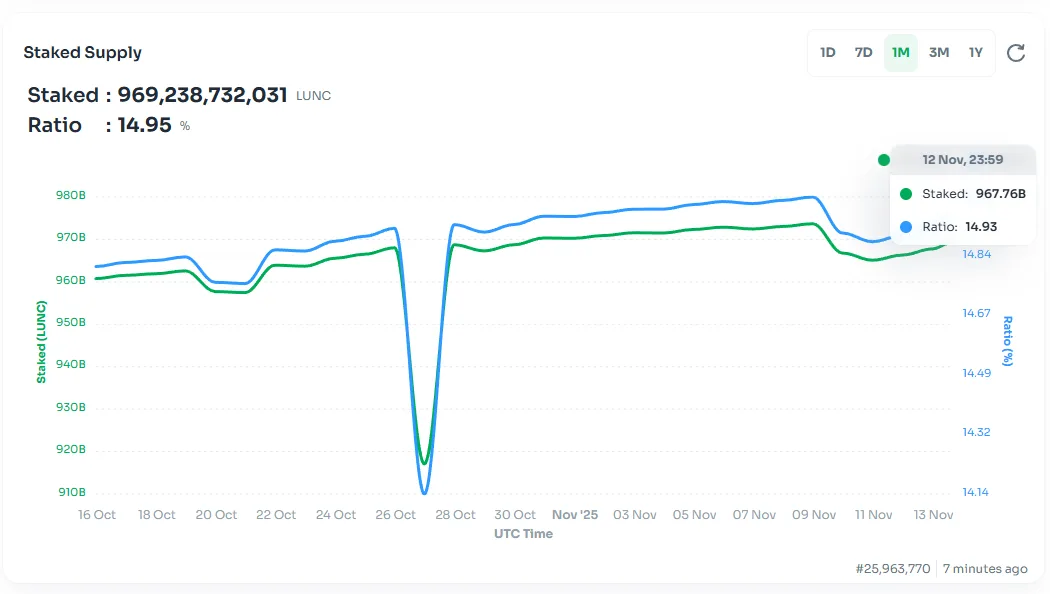
After a decline on November 9 and November 10, the Luna Classic (LUNC) staking ratio has begun a steady recovery. Recent activity shows growing participation from holders and an improving share of tokens locked for network security and governance.
In the past 24 hours, around 1.7 billion LUNC have been newly staked, increasing the total staked amount to 969 billion LUNC. This brings the overall staking ratio to 14.95 percent, just 0.5 percent away from reaching the 15 percent mark once more.
The gradual return of staked tokens suggests renewed confidence among network participants. A higher staking ratio can improve validator stability and strengthen on-chain governance as more tokens are committed to securing the network.
Community members and observers will be watching whether this upward trend continues and whether the staking ratio surpasses the 15 percent threshold in the coming days. Such a move may influence staking rewards dynamics and validator behavior across the ecosystem.
LUNC Oracle Pool Falls Nearly 40 Percent in One Year
The Terra Classic Oracle Pool, which helps fund validator rewards, has dropped sharply over the past year. Both LUNC and USTC balances are down, indicating weaker network activity and fewer staking rewards.
LUNC Change
One Year Ago: 93.1 billion Today: 56.4 billion Change: 36.7 billion decrease Percentage: Approximately 39.4 percent decrease
USTC Change
One Year Ago: 316.9 million Today: 185.9 million Change: 131.0 million decrease Percentage: Approximately 41.3 percent decrease
Total Oracle Pool (LUNC + USTC)
One Year Ago: 93.4169 billion Today: 56.5859 billion Change: 36.831 billion decrease Percentage: Approximately 39.4 percent decrease
Summary Table
Asset
One Year Ago
Today
Change
Drop %
LUNC
93.1 B
56.4 B
-36.7 B
39.42%
USTC
316.9 M
185.9 M
-131.0 M
41.35%
Total Pool
93.4169 B
56.5859 B
-36.831 B
39.43%
The continued decrease in the Oracle Pool shows lower staking incentives and smaller reward distributions across the network. Monitoring this trend remains important for understanding the health of the Terra Classic ecosystem.
This proposal seeks approval to deploy the Hyperlane protocol on the Terra Classic (LUNC) blockchain, enabling decentralized cross-chain bridges with Ethereum (ETH), Binance Smart Chain (BSC), and Solana (SOL).
The project also includes the customization of a Hyperlane Warp UI, fully compatible with CW20 tokens from the Terra Classic ecosystem.
Deployment will begin immediately after this proposal is approved, and payment will only be made after full deployment and verification in production.
Motivation
Currently, official bridges such as Wormhole have discontinued infrastructure support for Terra Classic. As a result, native coins (LUNC and USTC) and CW20 tokens have lost the ability to move across blockchains.
This left Terra Classic isolated within its own liquidity bubble, restricted to local DEXs and unable to access wider global markets.
Hyperlane offers a modular, decentralized, and community-controlled interoperability protocol. Its infrastructure — validators, relayers, and configuration — is fully owned by the community, eliminating any dependency on third-party providers.
Why Hyperlane
Hyperlane enables secure cross-chain communication, token transfers, and smart contract calls between blockchains — all without intermediaries.
Hyperlane is already connected to 130+ major chains and has processed over $10B+ in bridged assets, securely validating over 10,000 cross-chain asset transfer messages daily. This makes Hyperlane a proven, reliable, and industry-recognized interoperability solution.
Key Benefits
Fully decentralized infrastructure operated by the community
Integration with Ethereum, BSC, and Solana
Expanded global liquidity for CW20 tokens
Support for native assets like LUNC and USTC, and CW20 tokens such as Juris, Sele, Terra, WESO, and Cookie
Access to Global Liquidity
With Hyperlane, CW20 tokens can be wrapped and listed on major DEXs:
Network
Potential DEXs
Ethereum
Uniswap, Curve, Balancer
BSC
PancakeSwap, Thena, Biswap
Solana
Jupiter, Raydium, Orca
This integration will allow Terra Classic assets to reach global markets, breaking the liquidity bubble currently limited to the network’s internal DEXs.
Validators and Participation
A quorum of four validators has already been formed to validate the Hyperlane deployment voluntarily, without any monthly compensation. These validators are:
Vegas Node
StrathCole
Highstakes.ch
LUNA Classic DAO
This quorum provides the minimum validator requirement to start the decentralized bridge operation. If any validator becomes inactive, the community may vote to replace them, ensuring continuous and reliable operation.
KYC and Security
To deploy wrapped versions of LUNC and USTC on Ethereum, BSC, and Solana, the project will undergo KYC verification through SolidProof — a well-known blockchain audit and verification provider.
Additionally, multi-signature accounts will be established for bridge contract management, ensuring decentralization and transparency.
The proposed multisig signatories are:
The proposer (Igor Veras)
The four validators listed above
Two developers from the L1 core team
This configuration ensures that all critical actions involving bridge management and wrapped assets are transparent, secure, and community-aligned.
Note: Since the KYC process may take additional time, a separate payment proposal will be submitted only after the KYC verification is completed. For Layer 2 (L2) deployments, KYC is not mandatory, but it is being performed to reinforce community trust and avoid future discussions about the legitimacy and safety of wrapped LUNC and USTC assets.
Technical Overview
Implementation includes the following steps:
Deploy core Hyperlane contracts — Mailbox, Interchain Gas Paymaster (IGP), ValidatorAnnounce, and ISMs
Configure four independent validators (already established)
Set up relayers to handle cross-chain message delivery
Develop and customize the Warp UI for Terra Classic integration
Publish complete documentation covering installation, validator configuration, and warp creation
Even with full documentation, Warp creation and customization require advanced technical knowledge and should be managed by experienced developers.
Minimum Infrastructure Requirements
Based on Hyperlane’s official documentation:
2 vCPUs
2–4 GB RAM
4 GB Storage
Each validator must maintain a KMS (Key Management Service) for private key protection.
Warp UI Customization
A custom fork of the official Hyperlane Warp UI will be developed to support Terra Classic:
Accurate CW20 token balance tracking (via Cosmos SDK)
Automatic approval using transfer_from
Smooth visual integration between Terra Classic and other networks
A modern, open-source, and transparent interface accessible to all users
Full documentation will be provided, enabling other developers to:
Deploy their own Warp UIs
Maintain or extend existing ones
Future Network Expansions
The initial deployment will include Ethereum, BSC, and Solana. Future proposals may extend bridge connectivity to other networks supported by Hyperlane, including:
Full deployment of contracts, validators, and relayers
$9,000
Warp UI (Fork)
CW20 integration, customization, and documentation
$3,000
Total Initial Cost:$12,000
Timeline
Phase
Description
Duration
Status
Research & Testing
Over 3 months of local development and testing
Completed
Deployment
Contracts, validators, and relayers setup
30 days
Pending
Warp UI
Interface integration and customization
Parallel to deployment
Pending
Payment Conditions
Payment will only occur after full production deployment and public verification by the community. A separate payment proposal will be created after KYC completion.
Risks and Responsibility
Hyperlane is an open-source, community-maintained protocol
The proposer acts as the developer and deployer, not the protocol owner
Bugs or vulnerabilities in Hyperlane’s core code are outside the proposer’s control
Deployment will strictly follow official documentation and recommended best practices
Expected Impact
Restores interoperability lost after Wormhole discontinuation
Establishes a community-owned decentralized bridge
Expands Terra Classic’s liquidity reach into major DeFi ecosystems
Increases visibility and adoption of LUNC, USTC, and CW20 tokens
Strengthens innovation, resilience, and autonomy of the Terra Classic network
Conclusion
The Hyperlane integration marks a key milestone toward restoring interoperability and liquidity for Terra Classic. With a community-operated infrastructure, the network gains true independence and sustainability.
A modest $12,000 budget and a 30-day deployment will position Terra Classic back into the global multichain ecosystem, fully controlled by its community.
Author
Igor Veras / Technical Team Timeline: 30 days Total Budget: $12,000 Payment: Upon production deployment and community verification KYC: Solidproof (In progress)
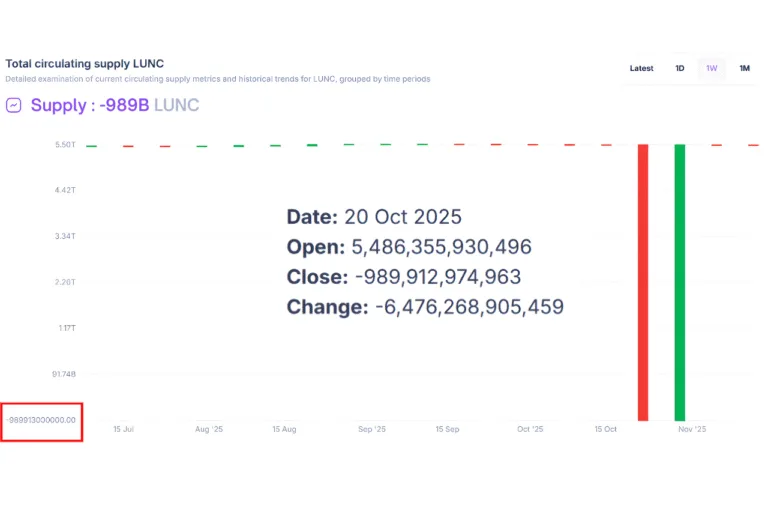
Data Showing 6.4 Trillion LUNC Burn Changes on LUNC Tech as Supply Now Appears Below Zero
A strange update has appeared on the LUNC Tech platform, where the weekly chart that previously showed a 6.4 trillion LUNC burn now displays data suggesting the total supply is below zero.
This inconsistency has drawn attention from the Terra Classic community, with many questioning whether it is a system glitch
or a reporting error.
Initial Data from October 20
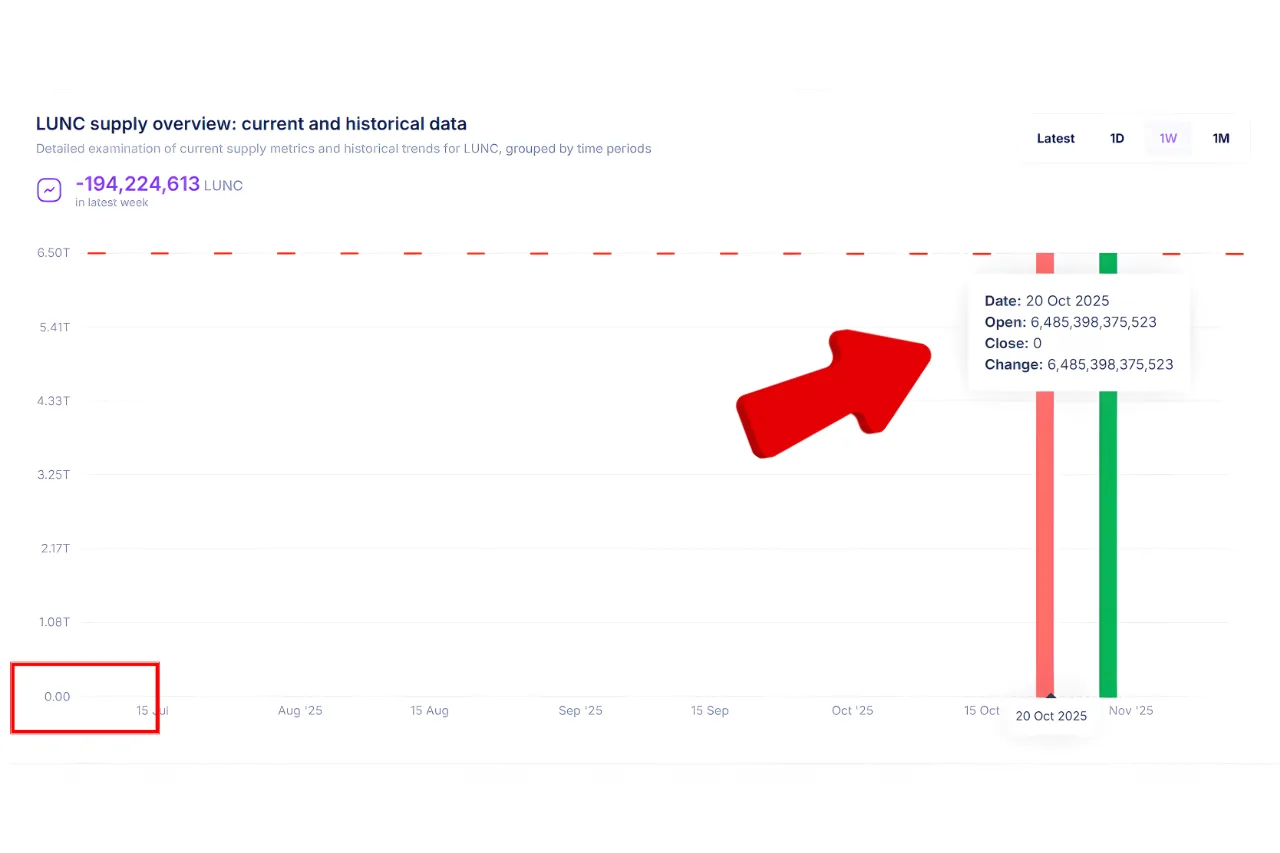
When checking the weekly chart for October 20, the data initially displayed:
LUNC Tech chart showing 6.4 trillion LUNC burned and zero remaining supply.
Open: 6.4T LUNC
Close: 0 LUNC
Change: -6.4T LUNC
According to this chart, it appeared that 6.4 trillion LUNC were burned within that week,
bringing the total supply to zero.
Updated Chart Data
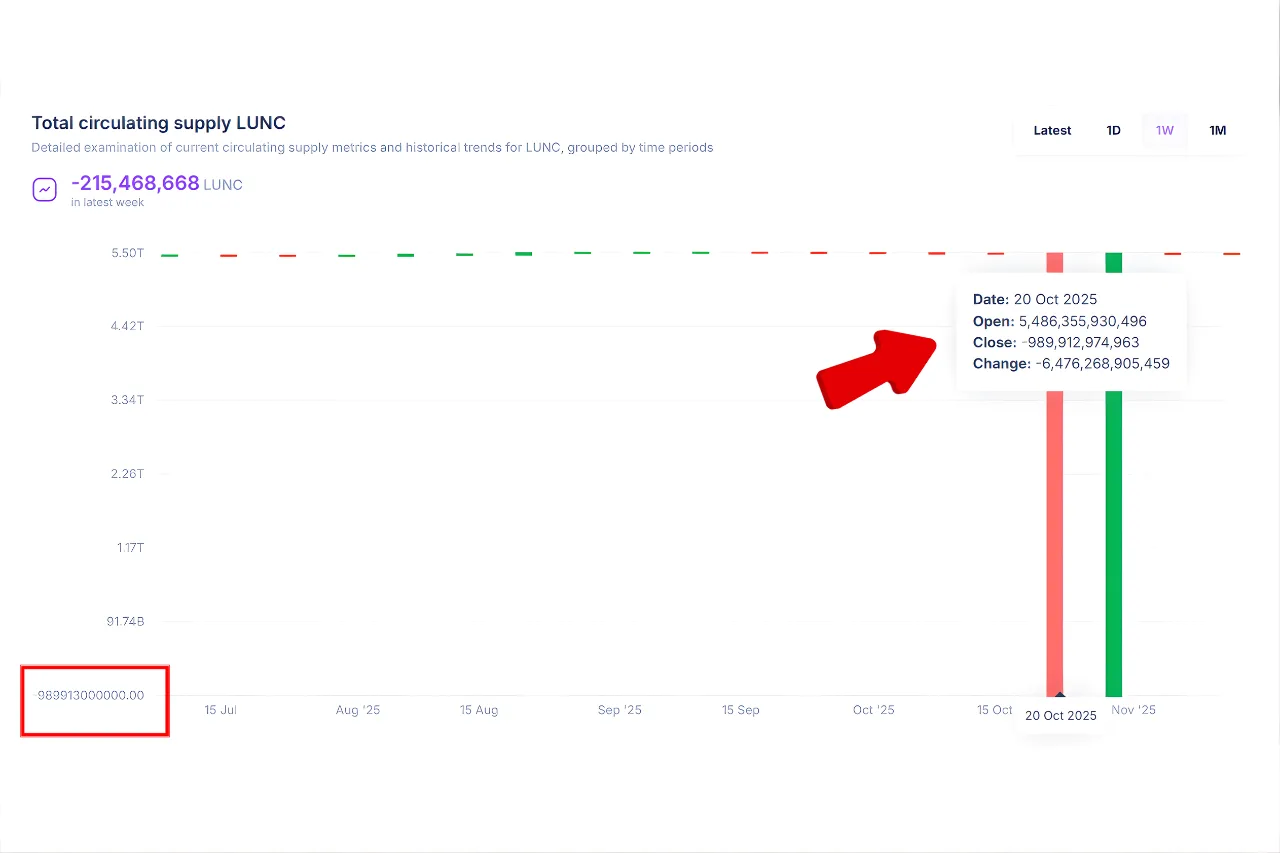
However, when the same chart was rechecked today, the numbers had changed significantly:
Updated chart showing inconsistent data with negative LUNC supply values.
Open: 5.4T LUNC
Close: -989B LUNC
Change: -6.4T LUNC
This means the platform now shows a negative LUNC supply, which is technically impossible.
The inconsistency has caused confusion, as both sets of data came from the same platform and represent the same week.
Key Concerns
Inconsistent Data: The same platform is showing different values for the same week, only a day apart.
Negative Supply: A supply below zero is not possible, suggesting a potential glitch or data miscalculation.
These findings raise doubts about whether the chart reflects accurate on-chain data or if it was affected by a technical issue.
Regardless, the changes have already sparked discussions across the community, as the “6.4T burn” figure could significantly
impact market sentiment.
If any community members have alternative data sources or insights regarding this issue, please share your perspective.
The Terra Classic community has successfully burned over 670,000 USTC in the first 12 days of November 2025. This steady burn rate demonstrates the ongoing effort to reduce the circulating supply of the stablecoin and support the long term repeg vision.
Despite the total being subject to change as November 12 is not yet complete, the current figure highlights the community’s growing commitment to the project recovery strategy.
USTC Burn Recap
Month
Date
USTC Burned
November
1
16,784
November
2
21,155
November
3
35,884
November
4
33,414
November
5
20,066
November
6
159,089
November
7
49,063
November
8
11,890
November
9
25,819
November
10
113,195
November
11
169,638
November
12
15,565
Total
671,562
Note: November 12 data is still being updated.
The consistent burn of USTC each day shows active participation from the Terra Classic community and supporting platforms in bringing balance back to the ecosystem. As more initiatives align toward USTC repeg and ecosystem revitalization, the token long term outlook continues to strengthen.
Nearly 2.4 Billion LUNC Burned in November 2025 And Counting
The Terra Classic community continues its strong momentum in November 2025, with almost 2.4 billion LUNC already burned this month, and the month is not over yet.
According to community data, daily burn volumes have been consistent since November 1. The largest single day burn occurred on November 1, reaching 672 million LUNC. Other days have shown steady contributions from validators, exchanges, and the community, reflecting ongoing commitment to reducing the total supply.
November Burn Summary
Date
LUNC Burned
November 1
672,483,780
November 2
30,795,957
November 3
505,476,172
November 4
259,292,102
November 5
220,329,764
November 6
228,837,914
November 7
182,946,514
November 8
15,488,977
November 9
30,022,743
November 10
137,746,118
November 11
71,098,812
November 12
45,378,586
Total
2,399,897,439
Note: November 12 is still ongoing, and the total is expected to rise.
The steady burn rate shows the Terra Classic community’s long term effort to restore the ecosystem through consistent token burns. As more proposals and partnerships emerge, the network’s tokenomics continue to evolve, pushing LUNC closer toward its deflationary goals.

 Note: Since the KYC process may take additional time, a separate payment proposal will be submitted only after the KYC verification is completed.
 Total Initial Cost: $12,000
 Completed
 Pending