Home Blog Page 3

LUNC 1.5% On Chain Tax Explained: Does It Apply When Sending LUNC to or From an Exchange?

0

LUNC 1.5% On Chain Tax Explained: Does It Apply When Sending LUNC to or From an Exchange?

Understanding the 1.5% LUNC On Chain Tax

The 1.5% tax on the Terra Classic blockchain can be confusing, especially when LUNC is transferred between personal wallets and centralized exchanges.

The easiest way to understand it is to remember one simple rule:

The tax is related to on chain transactions, not simply whether an exchange is involved.

This means the important question is not whether LUNC is being sent to or from an exchange. The important question is whether the transaction is processed on the LUNC blockchain and is subject to the network tax.

What Happens When LUNC Is Sent From One Wallet to Another?

When LUNC is sent from one personal wallet to another, the transaction is processed on the Terra Classic blockchain.

Because it is an on chain transaction, the applicable 1.5% tax can be deducted according to the network’s tax mechanism.

For example, if you send 1,000,000 LUNC, a 1.5% tax would equal 15,000 LUNC.

The basic calculation is:

1,000,000 LUNC × 1.5% = 15,000 LUNC

The remaining amount would be approximately 985,000 LUNC, before considering any other applicable fees.

What Happens When LUNC Is Sent From a Wallet to an Exchange?

Now consider a user sending LUNC from a personal wallet to a centralized exchange.

For example:

Personal LUNC wallet → Exchange wallet

Although the destination is an exchange, the transfer still needs to be processed on the Terra Classic blockchain.

Therefore, the transaction can be subject to the applicable 1.5% on chain tax.

The fact that the destination is an exchange does not automatically make the transaction off chain.

What Happens When LUNC Is Sent From an Exchange to a Wallet?

The situation is slightly more complicated when LUNC is withdrawn from an exchange.

For example:

Exchange → Personal LUNC wallet

If the exchange processes the withdrawal by broadcasting an actual LUNC transaction on the Terra Classic blockchain, the transaction can be subject to the network tax.

However, users also need to consider the exchange’s own withdrawal fee and how the exchange handles the network tax.

This means the amount received in a personal wallet may depend on both the blockchain transaction and the exchange’s withdrawal policies.

What About Trading LUNC Inside an Exchange?

This is where the difference between on chain and off chain becomes especially important.

Suppose two users trade LUNC on a centralized exchange.

The trade may happen entirely within the exchange’s internal system.

For example:

User A → Exchange database → User B

No LUNC necessarily needs to move between blockchain addresses for every individual trade.

Because the trade is handled internally by the exchange rather than being recorded as an individual transaction on the Terra Classic blockchain, the 1.5% blockchain tax does not automatically apply to that internal trade.

On Chain vs Off Chain

The easiest way to understand the difference is to separate blockchain transactions from internal exchange activity.

Activity On Chain? 1.5% Tax
Wallet to wallet transfer Yes Applicable
Wallet to exchange deposit Yes Applicable
Exchange to wallet withdrawal Yes, when broadcast on chain Can apply
Trading inside a centralized exchange Usually no Not an on chain tax
Internal transfer between exchange users Usually no Not an on chain tax

The exact amount received or deducted can still depend on the exchange’s own policies and transaction handling.

Why This Difference Matters for LUNC

Understanding this distinction is important when discussing the LUNC tax and its effect on the ecosystem.

The 1.5% tax is associated with activity that is processed through the Terra Classic blockchain. It is not a general 1.5% fee charged every time someone buys, sells, or transfers LUNC inside a centralized exchange.

For example, buying LUNC on a centralized exchange does not necessarily create an on chain transaction.

However, withdrawing those LUNC to a personal wallet creates a blockchain transaction.

This is why the same LUNC can move between an exchange and the blockchain without every exchange trade necessarily triggering the on chain tax.

The Simple Rule

If you want to remember only one thing, remember this:

On chain transaction = the network tax can apply.

Internal exchange transaction = the blockchain tax does not automatically apply.

So, sending LUNC from a personal wallet to an exchange is an on chain transaction.

Sending LUNC from an exchange to a personal wallet is also an on chain transaction when the exchange broadcasts the withdrawal to the Terra Classic blockchain.

But trading LUNC inside a centralized exchange is generally an off chain activity and does not itself trigger the Terra Classic on chain tax.

Final Thoughts

The 1.5% LUNC tax should be understood as a blockchain level mechanism rather than a general tax on every LUNC transaction.

The key difference is whether LUNC activity is actually being processed on the Terra Classic blockchain.

This distinction makes it much easier to understand why transfers between personal wallets and exchanges can involve the on chain tax, while trades conducted entirely within a centralized exchange generally do not.
$19 Million LUNC Trading Volume Did Not Increase the Daily Burn Rate. Here Is Why

0

LUNC trading volume recently reached approximately $19 million in a single day. While this figure may look significant, it did not have a noticeable impact on the daily LUNC burn rate.

This has caused confusion among some members of the Terra Classic community, especially when they see large LUNC trading volume figures reported by platforms such as CoinGecko or CoinMarketCap.

The main reason is simple: not all LUNC trading volume happens on chain.

Understanding the difference between on chain and off chain volume is important when estimating how much LUNC can be burned through the network’s transaction tax.

What Is Off Chain Volume?

Most of the trading volume reported by cryptocurrency market data platforms comes from centralized exchanges.

When a user buys or sells LUNC on a centralized exchange, the trade is usually recorded internally by the exchange. The transaction does not necessarily happen directly on the Terra Classic blockchain.

This is known as off chain volume.

For example, if an exchange reports $19 million in LUNC trading volume, that does not mean $19 million was transferred through the Terra Classic blockchain.

Therefore, the full $19 million is not subject to the Terra Classic on chain tax.

What Is On Chain Volume?

On chain volume refers to transactions that actually take place on the Terra Classic blockchain.

This can include transactions such as decentralized exchange swaps, transfers and other activities that are processed directly by the network.

These transactions are subject to the applicable on chain tax.

For LUNC, the current on chain tax is 1.5%. Based on the current tax distribution, 1.2% is directed toward the community pool and burn related mechanisms, while the remaining portion is allocated according to the network’s tax parameters.

The important point is that the tax applies to eligible on chain transactions, not the total trading volume reported across centralized exchanges.

Why $19 Million Did Not Produce a Large Burn

The confusion comes from assuming that the reported $19 million trading volume is entirely on chain.

For example, if $19 million of trading activity occurred directly on chain and was fully subject to a 1.5% tax, the potential tax generated would be approximately $285,000.

However, if most of that $19 million came from centralized exchanges, that trading activity would not generate the same on chain tax.

This explains why a large volume number on CoinGecko or CoinMarketCap can exist alongside a relatively low daily LUNC burn rate.

The two numbers measure different types of activity.

Trading Volume and Burn Volume Are Not the Same

It is important to separate market trading volume from on chain taxable volume.

Market data platforms can show the combined trading activity reported by multiple exchanges. This figure can be useful for understanding market activity and liquidity, but it should not be treated as the amount of LUNC transaction volume subject to the on chain tax.

The LUNC burn rate is influenced by actual taxable activity occurring on the blockchain.

This means a day with $19 million in reported LUNC trading volume can produce a relatively small burn if only a limited portion of that activity occurs on chain.

The Key Difference

The simplest way to understand it is:

Off chain volume: Trading activity processed internally by centralized exchanges. It is included in reported market volume but does not directly generate the Terra Classic on chain tax.

On chain volume: Transactions processed directly by the Terra Classic blockchain. Eligible transactions are subject to the on chain tax and can contribute to LUNC burns.

Therefore, looking only at the total LUNC trading volume does not provide an accurate estimate of the daily burn.

What Should the LUNC Community Watch?

If the goal is to understand whether trading activity can increase the LUNC burn rate, the community should pay closer attention to on chain activity rather than relying only on the total volume reported by market data platforms.

Higher on chain usage can create more taxable transactions, which can contribute to higher burn activity.

Centralized exchange volume can still be important for liquidity, adoption and market activity, but it should not be directly converted into expected LUNC burns.

Conclusion

The approximately $19 million in LUNC trading volume did not significantly increase the daily burn rate because reported trading volume and taxable on chain volume are not the same thing.

A large portion of trading can occur off chain through centralized exchanges, while only transactions processed on the Terra Classic blockchain are subject to the network’s on chain tax.

For this reason, $19 million in reported LUNC volume does not mean $19 million was taxed at 1.5%.

To understand the potential impact on LUNC burns, the more important metric is actual on chain volume and network activity.

LUNC On Chain vs Off Chain: Understanding How Luna Classic Transactions Work

0

LUNC On Chain vs Off Chain: Understanding How Luna Classic Transactions Work

For people new to Luna Classic, terms such as on chain and off chain can be confusing. Both describe activity involving LUNC, but they happen in very different ways.

The easiest way to understand the difference is this:

On chain activity happens directly on the Terra Classic blockchain. Off chain activity happens outside the blockchain, usually within centralized platforms such as cryptocurrency exchanges.

Understanding this difference is important because not every LUNC transaction you see on an exchange is recorded as an individual transaction on the Terra Classic blockchain.

What Is LUNC On Chain?

LUNC on chain refers to activity that is recorded directly on the Terra Classic blockchain.

When a user sends LUNC from one Terra Classic wallet to another, the transaction is processed by the network and recorded in a blockchain block.

For example, imagine Alice sends 1 million LUNC from her Terra Classic wallet to Bob’s wallet.

The process looks like this:

Alice’s wallet → Terra Classic network → Validators → Blockchain → Bob’s wallet

The transaction becomes part of the blockchain’s permanent record.

Users can also verify on chain activity through blockchain data, including transaction details, wallet balances and other network information.

Examples of LUNC On Chain Activity

Common examples include:

  • Sending LUNC between Terra Classic wallets
  • Receiving LUNC into a wallet
  • Staking or delegating LUNC
  • Unstaking or redelegating LUNC
  • Swapping assets through an on chain decentralized exchange
  • Paying blockchain transaction fees
  • Burning LUNC through an on chain transaction
  • Interacting with supported smart contracts

These activities create blockchain transactions that can be independently verified.

What Is LUNC Off Chain?

LUNC off chain refers to activity that happens outside the Terra Classic blockchain.

A common example is trading LUNC on a centralized exchange.

When you buy LUNC on a centralized exchange, you may see your LUNC balance increase inside your exchange account. However, this does not necessarily mean that an individual LUNC transaction was immediately recorded on the Terra Classic blockchain.

The exchange can maintain an internal database that records how much LUNC each customer owns.

For example, imagine Alice buys 1 million LUNC on an exchange.

The exchange may simply update its internal records:

Alice’s exchange balance: 0 LUNC → 1 million LUNC

That balance change can happen without a separate Terra Classic blockchain transaction.

This is why exchange trading volume and blockchain transaction activity are not the same thing.

A Simple Example

Consider two users, Alice and Bob.

On Chain

Alice has 1 million LUNC in her Terra Classic wallet and sends it directly to Bob.

The transaction is broadcast to the Terra Classic network and processed by validators.

The transaction is recorded on the blockchain.

This is on chain activity.

Off Chain

Alice and Bob both have accounts on the same centralized exchange.

Alice sells 1 million LUNC to Bob.

The exchange can update its internal database to reflect the trade.

No LUNC necessarily needs to move between Alice’s and Bob’s blockchain addresses at that moment.

This is off chain activity.

The exchange may later process deposits or withdrawals through the blockchain, but the internal trade itself can remain off chain.

Why Centralized Exchanges Use Off Chain Transactions

Centralized exchanges handle a large number of trades every day. Recording every internal trade directly on the blockchain would require a blockchain transaction for each trade and could create unnecessary network costs and delays.

Instead, exchanges generally maintain internal accounting systems for customer balances and trades.

When users deposit or withdraw LUNC, the exchange interacts with the blockchain.

For example:

Deposit

User’s wallet → Terra Classic blockchain → Exchange wallet

Internal exchange trade

User A balance → Exchange database → User B balance

Withdrawal

Exchange wallet → Terra Classic blockchain → User’s wallet

This explains why an exchange can process many trades without every individual trade appearing as a separate Terra Classic blockchain transaction.

On Chain LUNC vs Off Chain LUNC

The key difference is where the activity is recorded.

Feature On Chain Off Chain
Where it happens Terra Classic blockchain Outside the blockchain
Blockchain transaction Yes Not necessarily
Publicly verifiable on chain Yes Usually not directly
Example Wallet to wallet transfer Internal exchange trade
Network fees Usually applies Usually no blockchain fee for each internal trade
Validators involved Yes No for the internal activity
Blockchain record Yes No direct record for the internal transaction

Why This Matters for LUNC

The distinction between on chain and off chain activity is especially important when analyzing the LUNC ecosystem.

For example, an exchange may report a large amount of LUNC trading volume. That volume shows trading activity on the platform, but it does not mean the same amount of LUNC was transferred across the Terra Classic blockchain.

On the other hand, blockchain data shows activity that actually interacts with the Terra Classic network.

This makes on chain data useful when looking at things such as wallet transfers, staking activity, burns and other blockchain transactions.

On Chain Does Not Mean the Same as Exchange Activity

One common mistake among new crypto users is assuming that every LUNC movement shown on an exchange represents movement on the blockchain.

That is not always the case.

An exchange can hold LUNC in its own wallets while maintaining separate internal balances for thousands or millions of customers.

For example, an exchange could hold 100 billion LUNC in its blockchain wallets while its internal system records different balances for many customers.

Those customer balances do not necessarily correspond to separate blockchain addresses.

The actual blockchain activity happens when funds move between the exchange and the blockchain.

What Happens When You Withdraw LUNC?

A withdrawal is different from an internal exchange trade.

Suppose you buy LUNC on an exchange and later withdraw it to your personal Terra Classic wallet.

The exchange must send LUNC from one of its blockchain addresses to your wallet.

That creates an on chain transaction.

The simplified process is:

Exchange → Terra Classic blockchain → Your wallet

Once the transaction is confirmed, you can verify it using blockchain data.

The same principle applies when you deposit LUNC from your personal wallet into an exchange.

Why On Chain Data Is Important

On chain data provides a transparent view of activity recorded on the blockchain.

Users can investigate transactions, wallet activity, staking and other network information without relying entirely on an exchange’s internal records.

For LUNC users, this can be useful when analyzing:

  • LUNC burns
  • Wallet transfers
  • Staking activity
  • Validator activity
  • On chain trading
  • Blockchain fees
  • Network activity

Why Off Chain Activity Is Still Important

Off chain activity is not necessarily less important.

Centralized exchanges provide liquidity and allow users to trade LUNC without every trade needing to be settled directly on the Terra Classic blockchain.

Off chain trading can therefore represent significant market activity even when the number of corresponding blockchain transactions is much smaller.

The important point is to understand what the data actually represents.

Exchange trading volume is not the same as LUNC on chain transaction volume.

The Easiest Way to Remember the Difference

Think of the Terra Classic blockchain as a public accounting book.

When something happens on chain, the transaction is written into that accounting book and can be verified through the network.

When something happens off chain, the activity is recorded somewhere outside that blockchain, such as an exchange’s internal database.

The exchange can later move assets onto or off the blockchain when users make deposits and withdrawals.

Final Thoughts

Understanding the difference between LUNC on chain and off chain activity makes it easier to interpret Terra Classic data.

On chain LUNC activity is recorded directly on the Terra Classic blockchain and can be verified through blockchain data.

Off chain LUNC activity happens outside the blockchain, such as internal trading and balance updates on centralized exchanges.

Both are important parts of the LUNC ecosystem, but they represent different types of activity.

For anyone tracking LUNC burns, staking, wallet movements, network usage or trading activity, knowing whether the data is on chain or off chain is essential for understanding what is actually happening with the token.

LUNC Price Surges Over 8% Before Pulling Back

0

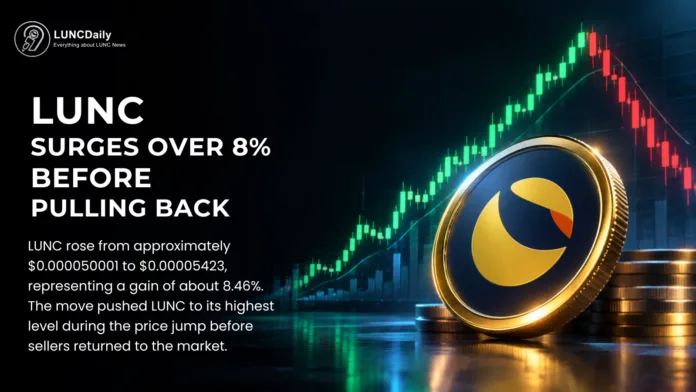
The LUNC price experienced a sharp move yesterday, briefly climbing more than 8% before giving back part of its gains.

LUNC rose from approximately $0.000050001 to $0.00005423, representing a gain of about 8.46%. The move pushed LUNC to its highest level during the price jump before sellers returned to the market.

Today, LUNC has pulled back to around $0.000051, showing that the token was unable to maintain the full gain from yesterday’s move.

Market data also shows elevated activity around the move. Investing.com recorded LUNC reaching a daily high of approximately $0.0000540 on August 11, while the token closed the day near $0.0000516.

CoinGecko currently shows LUNC trading around $0.0000506 to $0.0000511, depending on the latest market update, with recent trading activity remaining active.

LUNC Price Remains Volatile

The recent move highlights the volatility surrounding LUNC. Although the token gained more than 8% during the latest surge, the subsequent pullback shows that buyers have not yet been able to sustain the higher price level.

For now, traders and investors will be watching whether LUNC can stabilize around the $0.000051 area or make another attempt to move toward the recent $0.000054 level.

The latest price movement does not necessarily indicate a sustained trend. LUNC can continue to experience significant short term price changes as market demand and trading activity develop.

Luna Classic Daily Burn Rate Falls Below 100 Million LUNC per Day.

0

Luna Classic Daily Burn Rate Is Decreasing

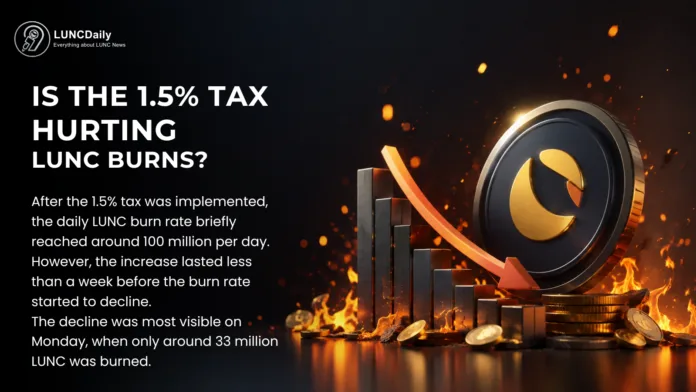
The Luna Classic daily burn rate has started to decline after briefly reaching around 100 million LUNC burned per day following the implementation of the 1.5% tax on the LUNC chain.

A few days after the 1.5% tax was implemented, the daily burn rate reached approximately 100 million LUNC for several days. This development attracted attention from the Luna Classic community, as higher daily burns can contribute to reducing the overall LUNC supply over time.

However, the higher burn rate did not last long. Less than a week later, daily LUNC burns began to decrease.

During the last four days, the daily burn amount has remained below 100 million LUNC. This shows that the initial increase in burn activity has not yet been sustained.

The decline became more noticeable on Monday, when only around 33 million LUNC was burned in a single day.

The recent numbers highlight an important challenge for the Luna Classic ecosystem. While the 1.5% tax can increase the amount of LUNC removed from circulation, the actual daily burn depends on activity and transactions taking place on the chain.

For the Luna Classic community, maintaining stronger on chain activity will be important if the network wants to achieve a consistently higher daily burn rate.

The recent decline does not change the purpose of the 1.5% tax, but it shows that a higher burn rate may require sustained activity rather than a short term increase after implementation.

Around $1.45 Million Worth of LUNC Is Locked With Jailed Validators

0

Around $1.45 Million Worth of LUNC Is Locked With Jailed Validators

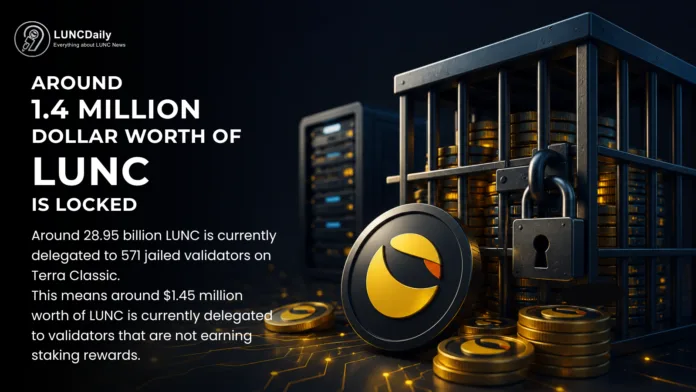
A significant amount of LUNC is currently delegated to jailed validators on the Terra Classic blockchain. Approximately 28.95 billion LUNC, worth around $1.45 million, is currently held with validators that are inactive or jailed.

The LUNC is spread across 571 jailed validators. These validators are currently unable to participate normally in the network’s validation process because they have been placed in a jailed status.

LUNC With Jailed Validators Does Not Earn Staking Rewards

When LUNC is delegated to a jailed validator, the delegated tokens do not earn staking rewards while the validator remains jailed.

This means delegators may have LUNC locked in staking without receiving the expected staking rewards during the period the validator is inactive.

For LUNC holders who stake their tokens, monitoring validator status is therefore important. Choosing an active and reliable validator can help ensure that delegated LUNC continues to participate in staking and remains eligible for rewards.

Why Validator Status Matters

Validator performance is an important part of LUNC staking. If a validator becomes jailed, delegators should review their options and consider whether their LUNC should be redelegated to an active validator.

The current figure of 28.95 billion LUNC across 571 jailed validators highlights how much capital can become inactive when tokens remain delegated to validators that are no longer operating normally.

For LUNC stakers, regularly checking validator status can help avoid leaving delegated tokens without staking rewards for an extended period.

Luna Classic Community Looks Toward Recovery as Burns and Partnerships Expand

0

The Luna Classic community continues to focus on strengthening the Terra Classic ecosystem as LUNC remains near recent lows while several developments support its long term recovery efforts.

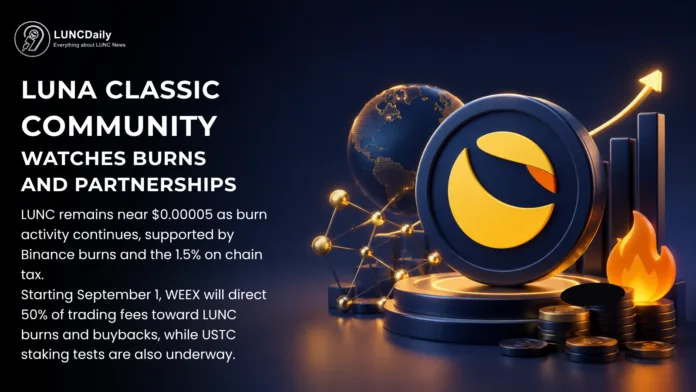
As of mid August 2026, LUNC is trading near $0.00005, with a market capitalization of approximately $277 million and daily trading volume around $10 million. While the token remains well below its historical highs, the market has held relatively steady above recent lows.

LUNC Burns Remain a Key Focus

One of the main factors supporting the Luna Classic ecosystem is the continued reduction of LUNC supply through burns.

The network uses a 1.5% on chain tax, with a portion of the collected tax contributing to the broader burn mechanism. This creates a way for on chain activity to contribute to the reduction of the LUNC supply over time.

Binance also continues its regular LUNC burn program, making the exchange an important contributor to the ongoing supply reduction effort.

However, the impact of burns on the market price remains limited so far. LUNC still has a large supply, meaning that significant reductions in supply may require sustained activity over a longer period before their effect becomes more visible.

WEEX Partnership Adds Another Burn Mechanism

Another development attracting attention from the Luna Classic community is the upcoming WEEX partnership.

Starting September 1, WEEX is expected to allocate 50% of LUNC spot and margin trading fees toward monthly LUNC burns and buybacks.

The initiative could provide an additional source of LUNC supply reduction while also connecting burn activity with trading volume on the exchange.

Higher trading activity would therefore have the potential to increase the amount of LUNC directed toward the burn mechanism.

USTC Staking Tests Continue

USTC staking tests are also underway as part of broader efforts to improve the Terra Classic ecosystem.

These tests are focused on developing additional utility and supporting network stability. While the development remains in the testing stage, it represents another area of activity within the ecosystem.

The progress of USTC related developments will remain an important factor for the community as Terra Classic continues working on network improvements.

Community Optimism Remains Strong

Despite the challenges facing LUNC, community interest remains active.

Some optimistic discussions highlight the token’s previous price movements and speculate about possible future targets. These expectations continue to attract attention, although future price performance cannot be guaranteed.

At the same time, skeptics argue that the current burn rate alone has not been enough to significantly change LUNC’s market price.

The key challenge remains the relationship between supply reduction, trading volume, liquidity, and market demand. Burns can reduce supply, but stronger market demand and higher trading activity may also be required for a sustained price recovery.

What Could Support Luna Classic Recovery?

Several factors could influence the future direction of LUNC.

Continued LUNC burns could gradually reduce the total supply. New partnerships such as the upcoming WEEX initiative could add another source of burn activity. Meanwhile, ongoing development and USTC staking tests could contribute to broader ecosystem activity.

However, these developments do not guarantee a price increase.

For Luna Classic to achieve a meaningful recovery, the ecosystem would likely need continued development alongside stronger usage, liquidity, trading activity, and sustained community participation.

For now, the Luna Classic community remains focused on reducing supply, expanding partnerships, and developing the Terra Classic ecosystem. The effectiveness of these efforts will depend on how successfully they translate into greater network activity and demand over time.

Why Layer 2 Tokens Matter for the LUNC On Chain Economy

0

Layer 2 tokens can play an important role in expanding the Luna Classic ecosystem by bringing more liquidity, applications, users, and transaction activity to the network.

For LUNC, a stronger on chain economy is important because network activity can contribute to higher transaction volume and, depending on the applicable on chain mechanisms and transaction activity, potentially increase the amount of LUNC burned.

Rather than focusing only on the supply side, the growth of Layer 2 ecosystems can help create more reasons for users to interact with the LUNC blockchain.

What Is a Layer 2 Token?

A Layer 2 token is a token associated with a project or application that operates on top of a base blockchain.

In the LUNC ecosystem, Layer 2 projects can provide additional use cases while still relying on the LUNC blockchain for transactions and settlement.

These projects can include decentralized exchanges, lending platforms, games, NFT applications, payment systems, launchpads, and other decentralized applications.

Each new application can bring additional users and economic activity to the network.

Why Layer 2 Tokens Are Important for LUNC

The value of a blockchain ecosystem is not determined only by the price of its native token.

A healthy ecosystem also needs users, liquidity, applications, developers, and consistent on chain activity.

Layer 2 projects can contribute to each of these areas.

1. Layer 2 Projects Can Add More Liquidity

Liquidity is one of the most important elements of a blockchain economy.

When more Layer 2 projects introduce tokens, trading pairs, decentralized exchanges, and liquidity pools, more capital can enter the LUNC ecosystem.

For example, a Layer 2 token can create a trading pair with LUNC and attract liquidity providers.

This can make it easier for users to trade between LUNC and other assets without leaving the ecosystem.

More liquidity can also help improve trading efficiency and create more opportunities for decentralized finance applications.

2. Layer 2 Tokens Can Increase On Chain Volume

Liquidity alone is not enough.

A blockchain also needs users who actively interact with its applications.

Layer 2 projects can generate transactions through token swaps, transfers, staking, liquidity provision, decentralized applications, and other activities.

This can increase the amount of economic activity taking place on the LUNC blockchain.

For example, when users trade a Layer 2 token through an application built around the LUNC ecosystem, the activity can generate additional blockchain transactions.

More applications and more users can therefore contribute to higher on chain activity.

3. Higher Activity Can Support LUNC Burn Activity

One of the most important aspects of the LUNC ecosystem is its burn mechanism.

LUNC burns are influenced by activity and mechanisms that route a portion of eligible transaction fees toward burning.

This means ecosystem growth can be important for the long term burn process.

If Layer 2 projects attract more users and generate more eligible transactions, the resulting increase in on chain activity can potentially contribute to higher LUNC burn activity.

However, higher transaction volume does not automatically mean a specific amount of LUNC will be burned. The actual burn depends on the applicable network rules, transaction types, fees, and burn mechanisms.

The key point is that a larger and more active ecosystem creates more opportunities for economic activity to contribute to the burn process.

4. Layer 2 Tokens Create More Use Cases for LUNC

A blockchain becomes more useful when users have more reasons to use it.

Layer 2 projects can expand the number of applications available within the LUNC ecosystem.

Users could potentially use the network for trading, DeFi, gaming, NFTs, payments, staking, and other applications.

These use cases can create demand for blockchain transactions.

Instead of LUNC being used primarily as a token for holding or trading, a growing ecosystem can make LUNC part of a wider on chain economy.

5. Layer 2 Projects Can Attract New Users

New applications can also introduce the LUNC ecosystem to users who may not have interacted with the blockchain before.

A user might initially discover LUNC through a Layer 2 token, decentralized application, game, or DeFi platform.

Once users enter the ecosystem, they may interact with other applications and assets on the network.

This creates a network effect where one successful project can potentially help introduce users to other parts of the ecosystem.

6. Layer 2 Tokens Can Strengthen the On Chain Economy

A strong blockchain economy needs multiple participants.

Token holders, traders, liquidity providers, developers, validators, applications, and users all contribute to the ecosystem.

Layer 2 projects can connect these participants through new products and applications.

More projects can mean more tokens.

More tokens can create more trading pairs.

More applications can create more transactions.

More transactions can create more network activity.

And greater network activity can create more opportunities for LUNC to participate in the economic activity of the ecosystem.

Layer 2 Growth Is About More Than Token Price

It is important to separate ecosystem growth from short term token price speculation.

A Layer 2 token should not be viewed only as an asset that could increase in price.

Its greater value to the LUNC ecosystem comes from the activity and utility that it can create.

A successful Layer 2 project can bring users, liquidity, applications, developers, and transactions to the network.

These factors can be more important for long term ecosystem development than short term price movements.

A Larger Ecosystem Can Create a Positive Cycle

The development of Layer 2 projects can potentially create a positive cycle for LUNC.

New projects can attract users.

More users can generate more transactions.

More transactions can increase on chain activity.

Higher activity can support greater economic activity and, where applicable, contribute to LUNC burns.

At the same time, successful applications can attract more developers and liquidity providers.

This can encourage the creation of additional applications and services.

Over time, the goal is to build an ecosystem where users have genuine reasons to remain active on the LUNC blockchain.

Why Layer 2 Development Matters for the Future of LUNC

LUNC needs more than supply reduction to build a sustainable long term ecosystem.

Burning tokens can reduce supply, but ecosystem activity can help create the economic demand and utility that make the network more valuable.

Layer 2 projects provide one potential path toward that growth.

By adding liquidity, applications, users, and transaction activity, Layer 2 ecosystems can help transform the LUNC blockchain into a more active and diverse on chain economy.

The relationship is straightforward.

More useful applications can attract more users.

More users can generate more activity.

More activity can generate more eligible transactions.

And more eligible transactions can potentially contribute to greater LUNC burn activity under the network’s existing mechanisms.

Conclusion

Layer 2 tokens can be an important part of the future growth of the LUNC ecosystem.

Their importance is not simply because they introduce new tokens. Their real value comes from the activity and utility they can bring to the blockchain.

By creating additional liquidity, trading opportunities, decentralized applications, users, and on chain transactions, Layer 2 projects can help expand the LUNC economy.

For LUNC, ecosystem growth and supply reduction can work together.

Burns address the supply side, while increased utility and on chain activity can strengthen the demand and economic activity side.

A larger Layer 2 ecosystem therefore has the potential to make the LUNC blockchain more active, useful, and economically sustainable over the long term.

What Is LUNC Total Supply and Why Does It Matter?

0

Understanding token supply is important when looking at the economics of any cryptocurrency. For Luna Classic (LUNC), total supply is one of the key metrics used to track how many tokens currently exist on the Terra Classic blockchain.

But what exactly does LUNC total supply mean, and how is it different from circulating supply?

What Is LUNC Total Supply?

LUNC total supply is the total number of LUNC tokens that exist on the Terra Classic blockchain.

This includes LUNC held by individual wallet addresses, tokens bonded or delegated with validators, and tokens held in blockchain module accounts.

In simple terms, total supply represents the complete amount of LUNC recorded across the Terra Classic network.

What Is the Current LUNC Total Supply?

The current total supply of LUNC is:

6,452,675,570,110 LUNC

This figure represents the total amount of LUNC currently recorded on the Terra Classic blockchain.

The total supply can change over time as tokens are permanently removed through burns or as changes to the blockchain affect how supply is recorded.

For the latest figure, users should always refer to current on chain data and the live LUNC Supply chart.

Why Does LUNC Total Supply Matter?

Total supply is an important part of understanding LUNC tokenomics.

The number of tokens in existence can influence how the market views the value and scarcity of a cryptocurrency. This is particularly relevant for LUNC because the Terra Classic community has continued to focus on reducing the token supply through burns.

When LUNC is burned, those tokens are permanently removed from circulation and can no longer be used or transferred.

However, token burns are only one part of the broader LUNC ecosystem. Network activity, demand, liquidity, utility, staking, and market conditions can also influence the long term outlook for LUNC.

LUNC Total Supply vs Circulating Supply

Total supply and circulating supply are two different metrics.

Total supply refers to the total amount of LUNC recorded on the blockchain, including tokens held in wallets, bonded with validators, and stored in module accounts.

Circulating supply generally refers to the amount of LUNC considered to be available in the market.

Because these measurements use different definitions, the circulating supply figure can be different from the total supply.

Understanding this difference is important when analyzing LUNC’s market capitalization and overall tokenomics.

How LUNC Burns Affect Supply

LUNC burns are designed to permanently remove tokens from the Terra Classic supply.

Once LUNC is sent to a burn address or otherwise removed through an approved burn mechanism, those tokens cannot return to the available supply.

Over time, continued burns can reduce the total number of LUNC tokens existing on the network.

However, the effect of burns should be considered in the context of the overall supply and the amount of tokens being removed. A reduction in supply does not automatically mean that the market price will increase.

Why Tracking LUNC Supply Is Important

Monitoring LUNC supply helps the community understand how the Terra Classic token economy is changing.

By tracking total supply alongside circulating supply, burned LUNC, staking activity, network usage, and other on chain metrics, users can get a clearer picture of the state of the Terra Classic ecosystem.

Supply data is particularly useful for following the long term impact of LUNC burn activity and changes in the network’s tokenomics.

Conclusion

LUNC total supply represents the complete amount of LUNC recorded on the Terra Classic blockchain.

The current LUNC total supply is 6,452,675,570,110 LUNC, including tokens held by wallet addresses, bonded with validators, and stored in module accounts.

Understanding total supply is important when evaluating LUNC tokenomics, but it should not be viewed in isolation. Circulating supply, burns, demand, network activity, liquidity, staking, and ecosystem development are also important factors when analyzing Terra Classic.

As the Terra Classic network continues to evolve, tracking these metrics can help provide a clearer understanding of the changing LUNC ecosystem.

Why Aggregated Trading Platforms Are Changing On-Chain Trading

0

Why Aggregated Trading Platforms Are Changing On Chain Trading

On chain trading gives users direct access to decentralized markets without relying on traditional centralized exchanges. However, as the blockchain ecosystem continues to grow, traders often face a new challenge: liquidity is spread across different decentralized exchanges, liquidity pools, and blockchain networks.

Finding the right trading route can take time. Traders may need to compare multiple platforms, check different liquidity pools, and move between networks before completing a single trade.

This is where aggregated trading platforms can make on chain trading simpler and more efficient.

What Is an Aggregated Trading Platform?

An aggregated trading platform connects multiple liquidity sources through a single interface.

Instead of requiring users to manually search through different decentralized exchanges, an aggregator can examine available trading routes and liquidity sources to help identify suitable options for a transaction.

For example, if a trader wants to swap one token for another, the platform can look across supported liquidity sources and determine which available route may provide a better trading opportunity.

The goal is simple: give traders access to more liquidity without requiring them to manage every liquidity source individually.

Why Aggregated Trading Can Be Better for On Chain Traders

1. Access Multiple Liquidity Sources

Liquidity is one of the most important factors in decentralized trading.

A single decentralized exchange may not always have enough liquidity for a particular trading pair. This can result in higher price impact, especially when executing larger trades.

An aggregated platform can connect to multiple liquidity sources, giving traders access to a broader trading environment from one platform.

More available liquidity sources can give the routing system more options when finding a suitable path for a trade.

2. Reduce the Need to Check Multiple DEXs

Without an aggregator, traders may need to open several decentralized exchanges to compare prices.

This creates unnecessary steps.

Users need to check the trading pair, compare prices, review liquidity, calculate the expected output, and then decide which platform to use.

An aggregated trading platform brings these options together in one place.

Instead of manually checking multiple platforms, traders can use a single interface to access available liquidity and trading routes.

3. Find More Efficient Trading Routes

The trading pair you select is not always the only possible route for a swap.

For example, a direct swap between two assets may have limited liquidity. Another route could potentially use an intermediate asset to access deeper liquidity.

An aggregation system can evaluate different routes and select an available path based on factors such as liquidity, price, and trading costs.

This can make the trading process more efficient while reducing the amount of manual research required from the user.

4. Save Time

On chain trading should not require traders to constantly move between different platforms.

An aggregator simplifies the process by bringing multiple liquidity sources into one trading interface.

This is especially useful for active traders who regularly swap assets and need to compare available opportunities quickly.

Instead of spending time searching for liquidity, traders can focus more on their trading strategy.

5. A Better User Experience

One of the biggest challenges for new users entering decentralized finance is complexity.

There can be multiple DEXs, liquidity pools, networks, tokens, and trading routes to understand.

An aggregated platform can reduce some of this complexity by providing a single interface for accessing multiple liquidity sources.

This creates a more straightforward experience for both experienced traders and users who are still learning how on chain trading works.

Aggregation Becomes More Important as Blockchain Ecosystems Grow

The number of blockchain networks and decentralized applications continues to increase.

Each network can have its own decentralized exchanges, liquidity pools, and trading opportunities.

This creates more choice for users, but it also creates fragmentation.

Liquidity becomes distributed across different platforms instead of being available in one location.

Aggregation addresses this problem by connecting different liquidity sources through a unified trading experience.

For traders, the value is not simply having more platforms. The real advantage is having access to those platforms without needing to manage each one separately.

Introducing Orbit Wire

This is where Orbit Wire comes into the picture.

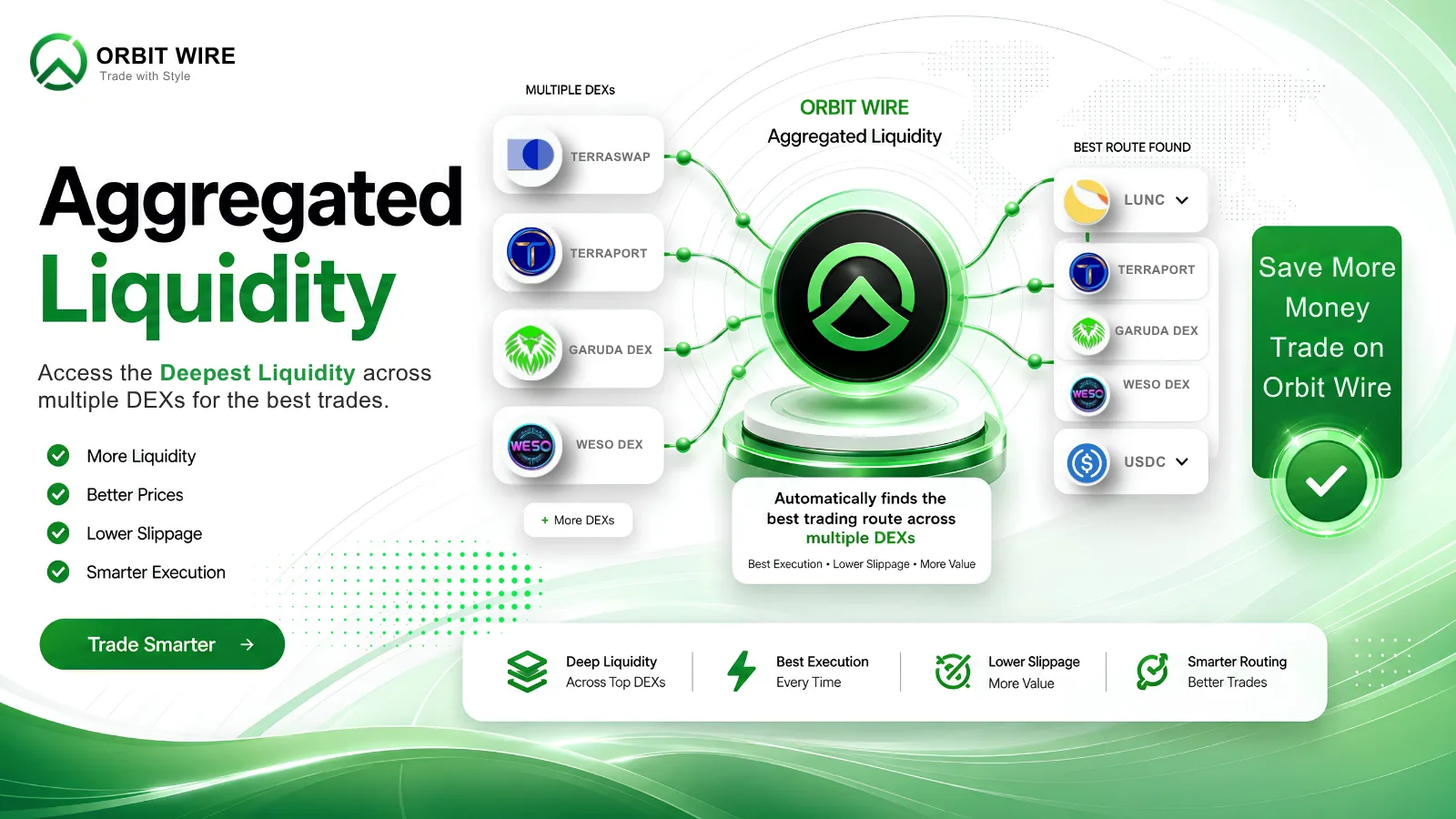
Orbit Wire is an aggregated trading platform designed to make on chain trading easier by bringing multiple blockchain trading environments into one platform.

Orbit Wire now supports LUNC Chain, Luna Chain, and Osmosis, allowing users to access trading opportunities across these ecosystems from a unified interface.

Instead of opening different platforms for different networks, users can use Orbit Wire to explore available trading opportunities across supported chains.

Trade Across LUNC Chain, Luna Chain and Osmosis

The addition of LUNC Chain, Luna Chain, and Osmosis gives Orbit Wire users access to multiple blockchain ecosystems from one platform.

For users who actively trade within these ecosystems, this can reduce the need to switch between different decentralized exchanges.

Whether you are trading assets within the LUNC ecosystem, exploring opportunities on Luna Chain, or accessing liquidity on Osmosis, Orbit Wire provides a single place to start your trade.

The objective is to make on chain trading more accessible while giving traders a broader view of available liquidity.

Smart Routing for Better Trading Opportunities

Orbit Wire also uses smart routing to help identify available trading paths.

Instead of expecting users to manually search through different liquidity sources, the platform can evaluate available routes and help identify suitable options for a trade.

This is particularly important when liquidity is distributed across multiple decentralized exchanges and pools.

By combining liquidity access with smart routing, Orbit Wire aims to make the trading process more efficient and easier to understand.

One Platform, Multiple Blockchain Ecosystems

The future of decentralized trading is unlikely to be limited to a single blockchain.

As more ecosystems develop their own applications and liquidity, traders will increasingly need tools that can connect these fragmented markets.

Aggregated trading platforms can play an important role in this development.

Rather than forcing users to choose between individual DEXs, aggregation provides a way to access multiple liquidity sources through one trading experience.

Orbit Wire is building toward this vision by connecting LUNC Chain, Luna Chain, and Osmosis in one platform.

For traders looking for a simpler way to access on chain markets, aggregation can provide a more convenient starting point.

Start Trading With Orbit Wire

On chain trading does not have to mean opening multiple DEXs and manually comparing every available option.

An aggregated trading platform can bring liquidity sources together, simplify route discovery, reduce unnecessary platform switching, and create a more efficient trading experience.

With support for LUNC Chain, Luna Chain, and Osmosis, Orbit Wire gives traders a unified platform for exploring trading opportunities across multiple blockchain ecosystems.

As decentralized markets continue to grow, having better access to fragmented liquidity will become increasingly important.

One platform. Multiple chains. Smarter access to on chain liquidity.

Explore Orbit Wire and discover a simpler way to trade across the growing multichain ecosystem.