
Home Blog Page 41

USTC Price at Critical Level: Can Bulls Defend the $0.011 Support?

0

USTC Price at Critical Level: Can Bulls Defend the $0.011 Support?

TerraClassicUSD (USTC) has once again reached a crucial price zone as traders closely monitor whether the token can maintain its support or face further downside pressure.

Current Market Situation
USTC price chart analysis
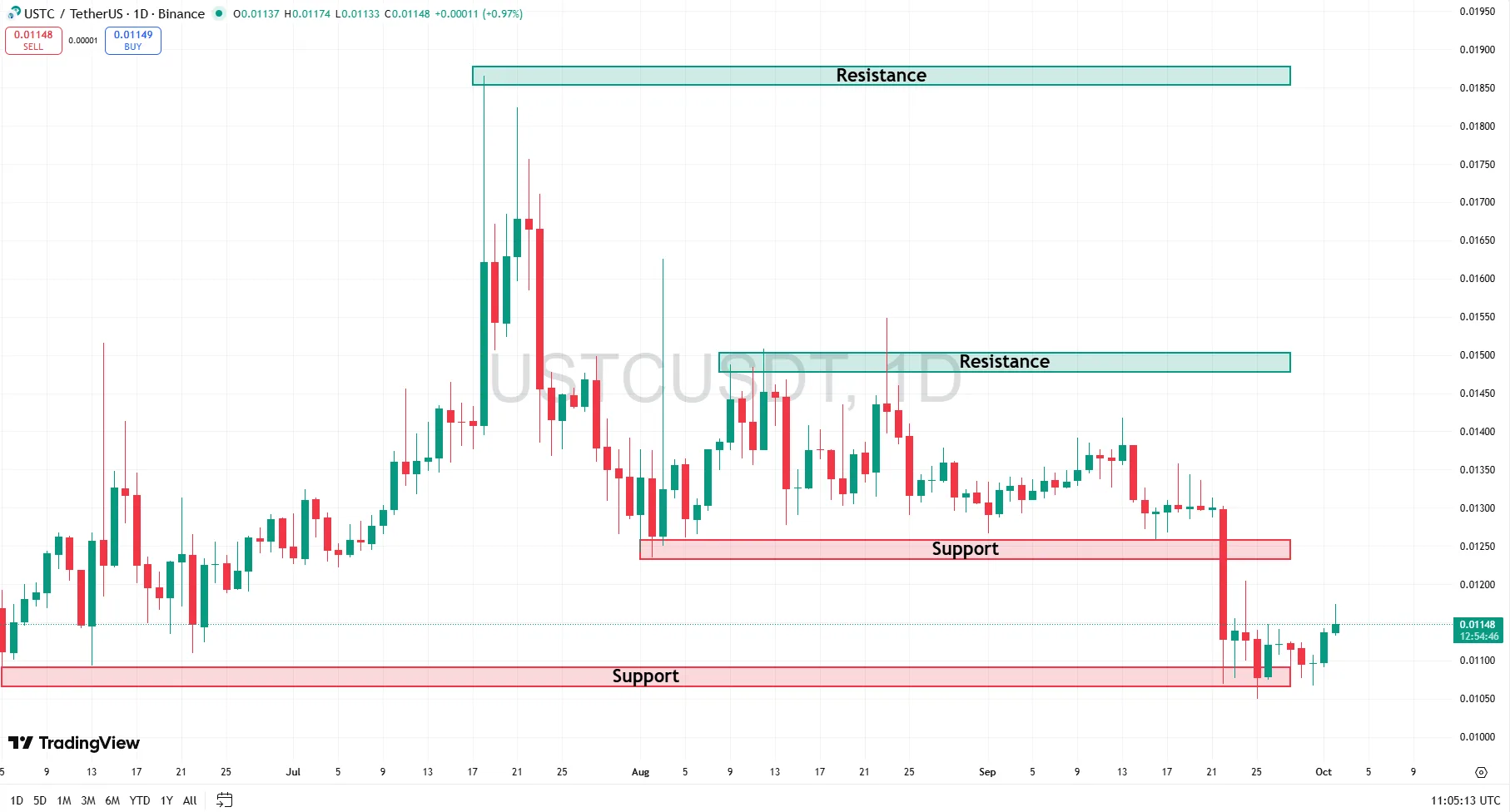
USTC daily chart highlighting key support and resistance zones.

The daily chart shows that USTC has been consolidating between $0.010 and $0.015 since early August. This range has created strong levels of support and resistance that continue to shape market sentiment.

Support Zones to Watch

  • $0.01100 – $0.01120: This area has acted as a key defense for buyers. Each time the price tested this zone, buying pressure emerged, preventing further decline.
  • $0.01020 – $0.01040: This deeper support zone represents the last stronghold before risk increases significantly. A breakdown here could push the token to revisit multi-month lows.

Resistance Levels Ahead

  • $0.01230 – $0.01270: The nearest resistance where sellers remain active. A breakout here would suggest short-term strength.
  • $0.01450 – $0.01500: A decisive level that has rejected multiple rallies. Bulls need to overcome this to confirm a potential trend reversal.
  • $0.01850 – $0.01900: The major resistance and the previous high. Breaking this barrier would open the path toward $0.020 and beyond.

Outlook

For now, USTC remains in a range-bound pattern. Traders may find opportunities by buying near support and taking profits near resistance until a clear breakout occurs.

Bullish case: Closing above $0.01270 with strong volume could fuel a move toward $0.01450 and $0.01500.

Bearish case: Losing the $0.01100 support could trigger a drop toward $0.01020. A breakdown here may lead to sharper declines.

Conclusion

USTC is standing at a decisive moment. Bulls must defend the $0.011 zone to keep recovery hopes alive. A confirmed breakout above $0.015 would change the broader outlook, but failure to hold support could shift momentum back to the bears.

Terra Classic Price Action Hints at Breakout — Is $0.000071 Next?

0

LUNC on the Edge: Can Terra Classic Break Resistance for a Big Rally?

Terra Classic (LUNC) is approaching a decisive moment. After bouncing from critical support, the token is testing resistance zones that could determine its next big move. Traders are watching closely to see whether bulls can push the price higher or if bears will take control again.

Current Price Action

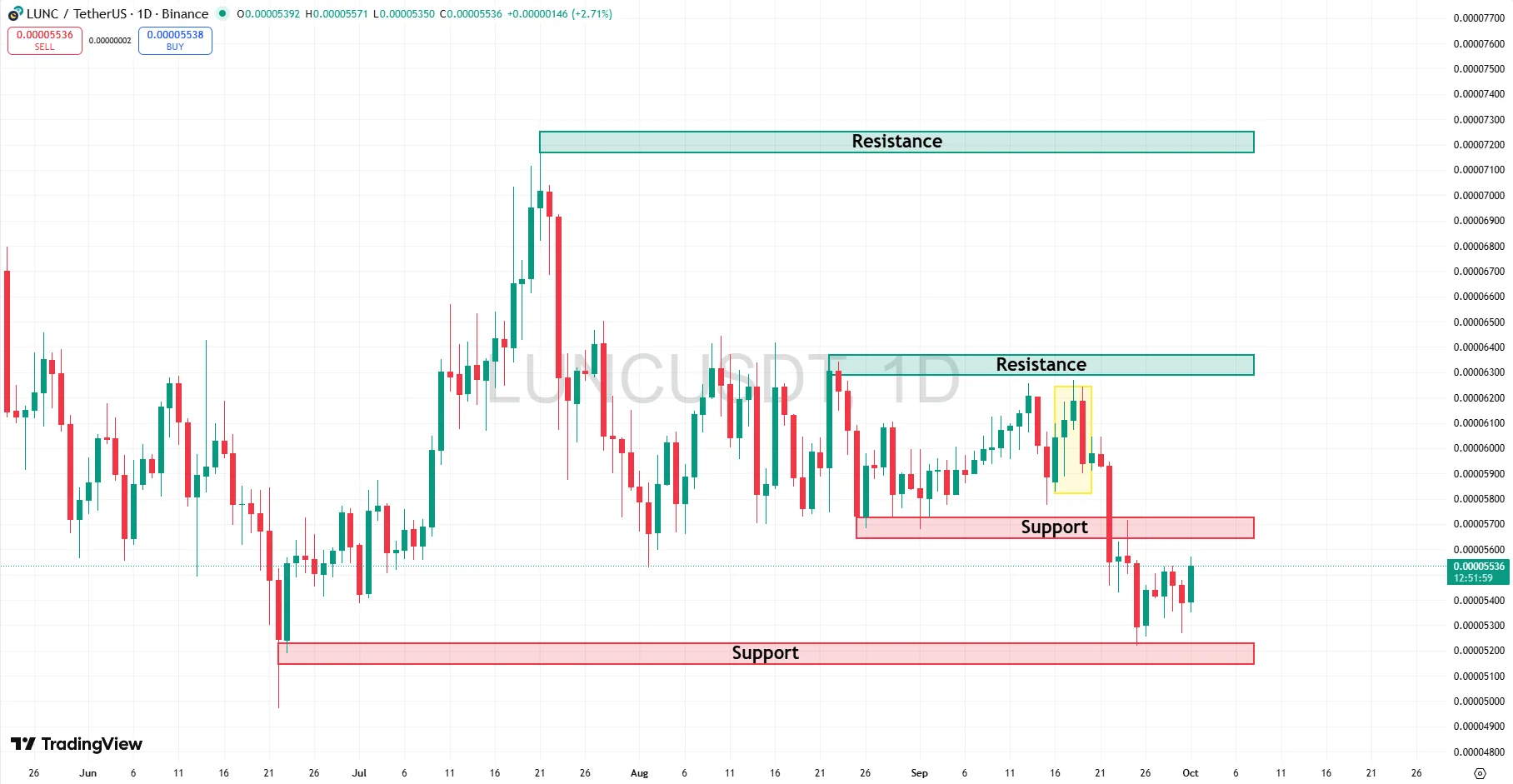
LUNC daily price chart
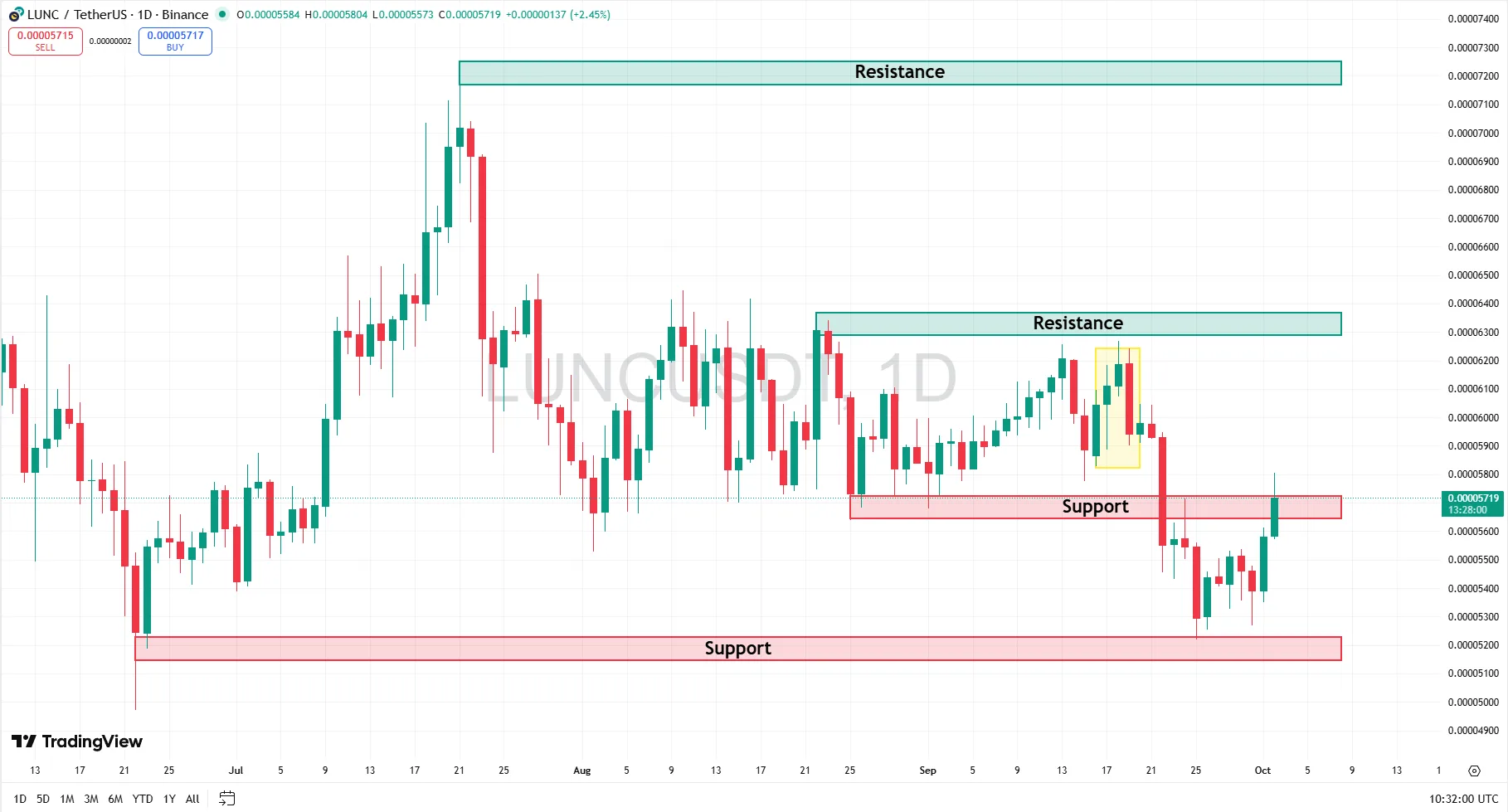
LUNC daily price action showing recent bounce from support and approach to resistance.

At the time of writing, LUNC is trading around 0.00005719. The recent rebound from the 0.00005200 – 0.00005300 support level shows that buyers remain active, but the token now faces a key resistance hurdle.

Support Levels

Immediate Support: 0.00005200 – 0.00005300
Major Support: 0.00004900 – 0.00005000

If these levels fail, the market could see a deeper pullback, signaling weakness among buyers.

Resistance Levels

Immediate Resistance: 0.00005800 – 0.00006000
Secondary Resistance: 0.00006300 – 0.00006400
Major Resistance: 0.00007100 – 0.00007300

A breakout above 0.00006000 would signal strength and open the door for higher targets.

Market Outlook

Bullish Scenario: A confirmed daily close above 0.00006000 may push LUNC toward 0.00006400, with potential to test 0.00007100.
Bearish Scenario: A breakdown below 0.00005200 could send the token back to the 0.00005000 support zone.
Neutral Scenario: LUNC may continue consolidating between 0.00005200 – 0.00006400 until a clear breakout happens.

Final Thoughts

LUNC is on the edge of a crucial breakout. If buyers manage to push through resistance, Terra Classic could see a strong rally. For now, the 0.00006000 level remains the most important threshold for traders to watch.

Can Terra Classic (LUNC) Hold the Line Before a Breakout?

0

Can Terra Classic (LUNC) Hold the Line Before a Breakout?

Terra Classic (LUNC) is once again at a critical level as traders watch whether the token can hold its support or break into a new upward trend.

LUNC chart showing support and resistance zones

On the daily chart, LUNC has established two important support zones. The first lies between $0.000054 and $0.000056, where the market is currently consolidating. A deeper and stronger support sits around $0.000048 to $0.000051, which has already been tested several times this year.

Resistance is equally clear. The nearest ceiling is between $0.000062 and $0.000064, where LUNC was rejected in September. Above that, a major resistance can be found at $0.000072 to $0.000073, the peak levels reached in July.

The broader trend shows a series of lower highs and lower lows, a sign of bearish pressure. However, the recent bounce from the $0.000053 area suggests that buyers are still active at key levels. If LUNC manages to close and hold above $0.000056, a rally towards $0.000062 is likely, with the possibility of testing the $0.000072 resistance if momentum builds.

On the other hand, if the current support breaks, the token could fall back to retest the $0.000048 level. A failure there would signal a deeper correction.

For now, Terra Classic remains in a consolidation phase. Traders and investors should watch how price reacts at the $0.000054 to $0.000056 support zone. A decisive move in either direction will determine whether the next chapter for LUNC is a recovery or further decline.

Will Terra Classic (LUNC) Ever Reach $0.001? A Realistic Outlook

0

Will Terra Classic (LUNC) Reach $0.001? A Realistic Outlook

Since the collapse of the original Terra ecosystem, one of the most debated questions has been: can Terra Classic (LUNC) reach $0.001 again? With trillions of tokens in circulation, hundreds of billions already burned, and shifting market sentiment, the answer requires a realistic look at supply, burns, staking, and overall conditions.

Current Supply and Market Cap

Circulating supply is around 5.4 trillion LUNC. At $0.001, the market cap would need to be $5.4 billion. While this is achievable in crypto terms, it would require both stronger demand and larger-scale burns.

Burn Progress

Since 2022, more than 420.55 billion LUNC have been burned, equal to about 7.8% of supply. Although this is a significant milestone, further reductions will require sustained and faster burn activity to meaningfully impact price levels.

Staking and Utility

Staking currently stands at 14–15%, though rewards have been declining. Staking reduces circulating supply, but long-term value depends on utility such as:

  • Decentralized finance (DeFi)
  • Payments and settlements
  • Gaming and NFTs

USTC and Ecosystem Revival

LUNC’s prospects are closely linked to USTC, its depegged stablecoin. A successful revival of USTC or the launch of new applications could increase demand. Without ecosystem growth, burns alone are unlikely to sustain a price recovery.

Market Conditions

LUNC performance depends heavily on broader crypto trends:

  • Bull cycles could push LUNC toward $0.001 with higher speculative demand.
  • Bear markets would limit growth regardless of burns or staking.

Scenario Analysis

Scenario Timeline Key Conditions Probability
Best Case 2026–2027 300B–500B burns yearly, strong staking, Bitcoin above $100K 25%
Base Case 2028–2030 50B–100B burns yearly, moderate adoption 50%
Worst Case Never Weak burns, low adoption, poor market cycle 25%

Supply Needed for $0.001

Market Cap Supply Target Reduction Needed Estimated Price
$2B 2T -63% Requires major burns
$5B 5T -7% Achievable with moderate burns
$10B 10T None About $0.002
$20B 20T None About $0.0037

Conclusion

Reaching $0.001 is possible but challenging. It will require:

  1. Accelerated burns beyond the 420.55B already completed
  2. Real-world utility through DeFi, payments, or USTC revival
  3. A favorable crypto market cycle

Without these factors, LUNC could remain in the $0.00005–$0.0002 range. With sustained effort, community support, and ecosystem growth, $0.001 remains within reach.

Binance Burns 356 Million LUNC in Latest Monthly Program, Total Reaches 74.67 Billion

Binance Burns 356 Million LUNC in Latest Monthly Program, Total Reaches 74.67 Billion

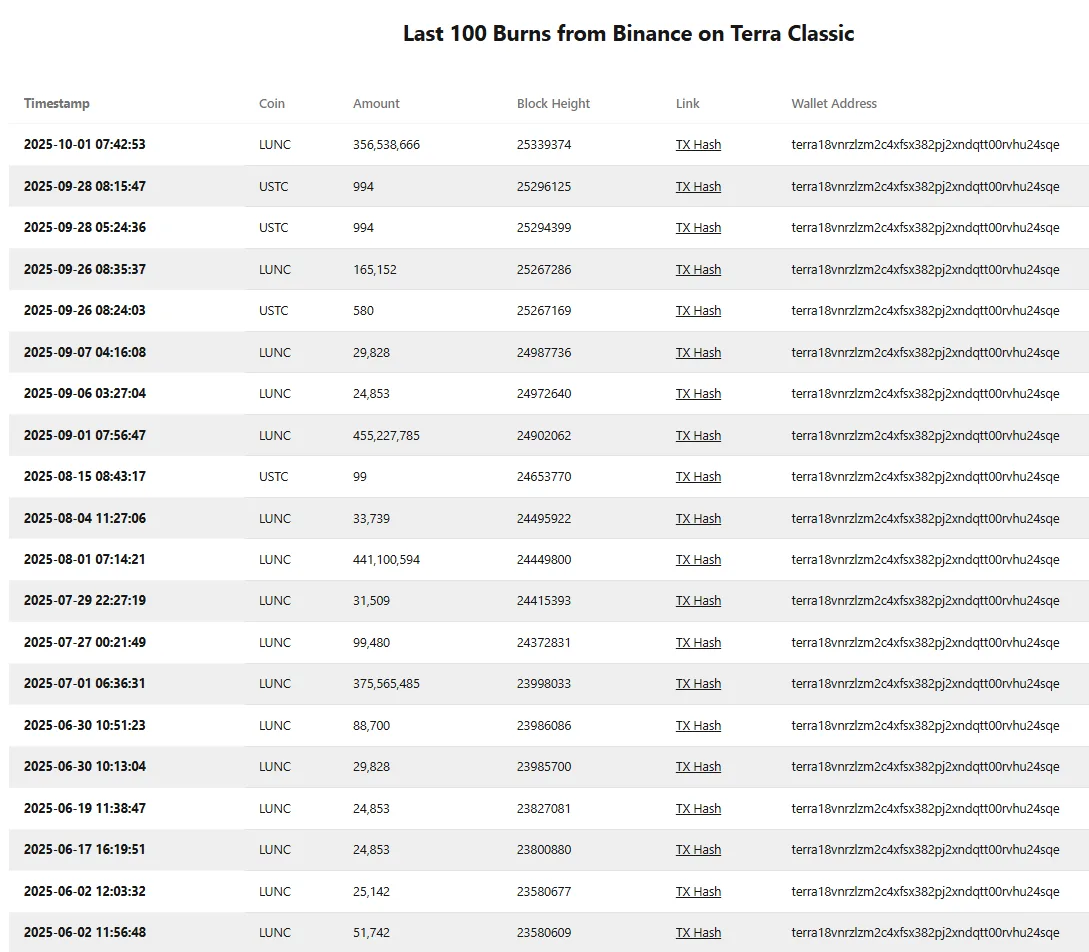
Binance has carried out another round of Terra Classic LUNC token burns, removing 356 million LUNC from circulation today. This burn is part of Binance’s ongoing monthly program that supports the Terra Classic community and reduces the token supply.

Last Burns from Binance on Terra Classic
Binance continues to lead the Terra Classic LUNC burn initiative.

Since the program began in 2022, Binance has burned a total of 74.67 billion LUNC. This makes the exchange the largest single contributor to the LUNC burn initiative and highlights its continued commitment to the network.

The Binance burn program has become an important part of the Terra Classic ecosystem. By regularly removing tokens from circulation, the program contributes to supply reduction and may help promote greater market stability over time.

Community members and market observers view these burns as a positive sign of ongoing support from major exchanges. As burns continue each month, many in the Terra Classic community remain hopeful about the long term effects on the token and the wider network.

Terra Classic Staking Ratio Slips to 14.65% as APR Falls to 5.98%

0

Terra Classic Staking Ratio Slips to 14.65% as APR Falls to 5.98%

The Terra Classic network has seen a gradual decrease in staking activity, with the staking ratio now at 14.65%. This marks a lower level compared to previous months.

At the same time, the staking Annual Percentage Rate (APR) has moved to 5.98%. For stakers, this means rewards are slightly lower than before and may influence individual strategies.

Despite these adjustments, Terra Classic continues to be supported by an active community and ongoing development efforts. Staking remains an important part of securing the network and enabling governance participation.

For investors and community members, these changes highlight the importance of staying informed and monitoring how staking trends evolve over time.

Terra Classic Oracle Pool Shrinks by 39B LUNC in One Year — Is the Reward System at Risk?

0

Terra Classic Oracle Pool Shrinks by 39B LUNC in One Year — Is the Reward System at Risk?

The Terra Classic Oracle Pool has continued its downward trend over the past year, showing a significant decline that could impact the network’s sustainability.

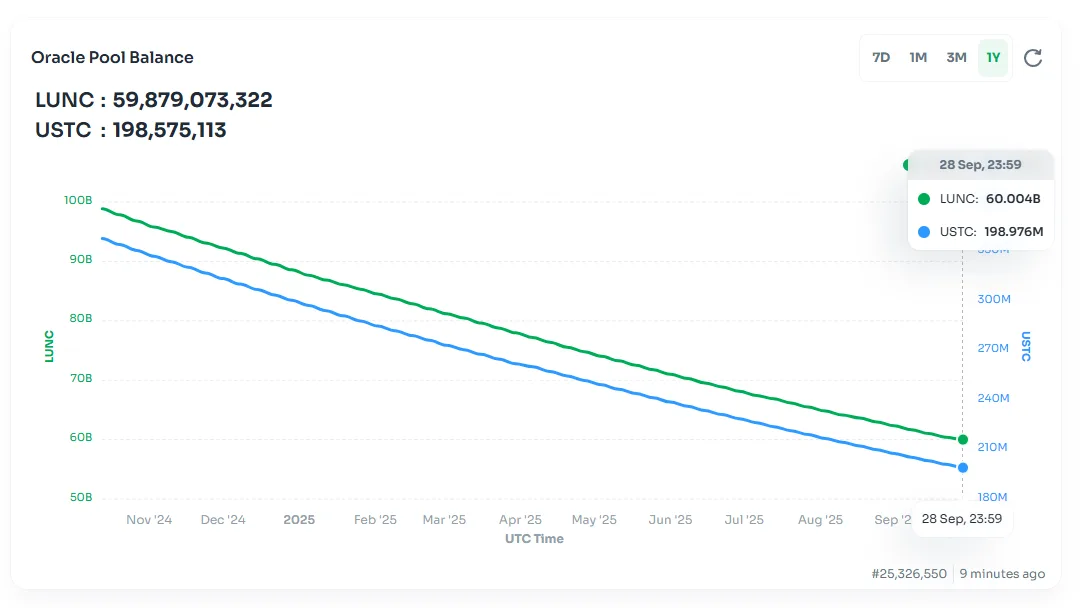
Chart showing Terra Classic Oracle Pool balance decline from 98.8B LUNC to 59.8B LUNC and 337.9M USTC to 198.5M USTC over one year
Oracle Pool balances: LUNC decreased from 98.8B to 59.8B over 12 months; USTC decreased from 337.9M to 198.5M.

According to the latest data, the pool has fallen from 98.8 billion LUNC to 59.8 billion LUNC, and from 337.9 million USTC to 198.5 million USTC within just twelve months. This represents a sharp reduction in the reserves that fund staking rewards and validator incentives.

The Oracle Pool is a core component of the Terra Classic ecosystem. It funds validator and delegator rewards while supporting network stability. With balances steadily decreasing, concerns are growing about how long the current reward model can be maintained without changes to token flow or new revenue sources.

The decline is primarily driven by ongoing emissions and routine reward distributions. Over time, these outflows reduce the pool unless offset by inflows such as new fees, burns, or other replenishment mechanisms. Without intervention, validators and delegators may face lower rewards, which could reduce participation and weaken network security.

For stakeholders, the central question is whether Terra Classic can adopt sustainable measures that preserve incentives and secure the network for the long term, or whether the depletion trend will continue into 2026 and beyond.

Terra Classic Burns 3.2 Billion LUNC in September — Can It Reach 3.5 Billion?

0

Terra Classic Burns 3.2 Billion LUNC in September — Can It Reach 3.5 Billion?

As September comes to a close, the Terra Classic community has recorded meaningful progress in its token burn campaign. Over the past 30 days more than 3.2 billion LUNC have been removed from circulation, reflecting sustained community effort to reduce supply and support long term recovery.

The central question now is whether the burn total can reach the 3.5 billion milestone before the month ends. Achieving this target would underscore the community’s determination and could bolster confidence in Terra Classic’s path forward.

Validators, community members, and supporting platforms have all contributed to the burn momentum. While crossing 3.5 billion would be a notable achievement, the progress already recorded in September demonstrates a renewed sense of purpose within the ecosystem.

Looking ahead to October, attention will turn to whether this pace can be sustained and what impact a sustained burn program might have on LUNC’s market dynamics and long term outlook.

🍪 Cookie Powers LUNC’s Path Into the Metaverse

In the evolving Terra Classic ecosystem, one token is quietly becoming the backbone of both on-chain activity and the metaverse future: Cookie.

Cookie isn’t just another meme coin—it’s a utility engine. With more than 30 active trading pools, the token is integrated deep into the network’s liquidity infrastructure. Every transaction triggers a 0.50% burn tax, steadily shrinking supply while strengthening the long-term value of $LUNC.

But the innovation doesn’t stop there. Cookie introduces a gamified twist through the Cookie Furnace at cookie-verse.io. (https://cookie-verse.io/) Here, holders can burn their Cookies to mint Baked Tokens—a scarce, value-backed asset that doubles as a store of value inside the CookieVerse economy.

This burn-to-earn model links three critical threads:

  1. Deflationary pressure on Cookie itself.
  2. Direct contribution to the $LUNC burn wallet.
  3. Metaverse integration, where Baked Tokens can act as a cornerstone currency.

As the Luncverse metaverse prepares for launch, Cookie stands at the intersection of DeFi mechanics and immersive utility. It turns simple transactions into real economic impact, and with every Cookie burned, both $LUNC and the coming virtual world get stronger.

Stablecoin Market Could Reach $4.3 Trillion by 2030: What It Means for LUNC

0

The global stablecoin market is expanding at a pace far beyond earlier predictions. A new report from Citi projects that stablecoin issuance could climb to $1.9 trillion in a base scenario and as much as $4.3 trillion in an optimistic scenario by 2030.

According to the report published on Thursday (September 25, 2025), the issuance of stablecoins has already increased from $200 billion at the start of 2025 to $280 billion. This sharp rise prompted Citi to revise its previous forecast of $1.6 trillion in the base case and $3.7 trillion in the optimistic case.

Transactions Could Reach Hundreds of Trillions

If stablecoins circulate with the same velocity as fiat currencies, they could support annual transactions of up to $100 trillion in the base case and as high as $200 trillion in the optimistic case by 2030. Citi describes this as blockchain’s “ChatGPT moment,” where digital-native companies accelerate real-world adoption.

Yet, stablecoins are not expected to be the only drivers of on-chain finance. Tokenized bank deposits could potentially reach even larger transaction volumes, propelled by corporate demand for regulatory clarity, real-time settlements, and integrated compliance. Citi projects that bank-issued tokens could surpass $100 trillion in transaction volume by the end of the decade, even if only a fraction of traditional finance moves on-chain.

The Dominance of the US Dollar and Emerging Hubs

The study underlines the continuing role of the US dollar as the dominant currency, with most on-chain transactions denominated in dollars, thereby reinforcing demand for US government bonds. However, hubs like Hong Kong and the United Arab Emirates are emerging as testbeds for digital asset innovation and adoption.

Implications for Terra Classic (LUNC)

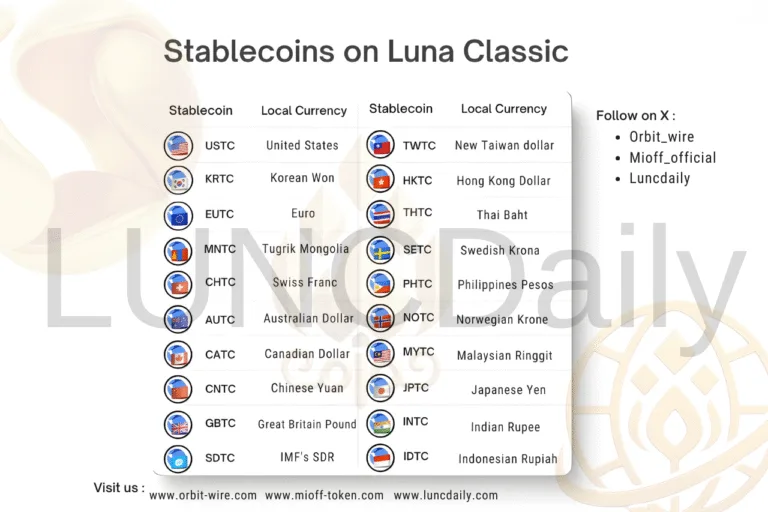
The findings provide important context for ecosystems like Terra Classic (LUNC), which already supports more than 20 different stablecoins.

As the stablecoin market expands toward the multi-trillion-dollar range, networks with existing stablecoin infrastructure such as LUNC could be well-positioned to capture some of this growth. Potential benefits include higher transaction volumes, deeper liquidity, and greater developer activity.

Yet, the opportunity also comes with a challenge: with this massive potential, could LUNC become an active part of the new on-chain financial system—or risk being left behind? The answer may depend on how the community continues to innovate, attract partnerships, and maintain trust within the ecosystem.