Introduction
Everyone is talking about cryptocurrency, blockchain, and Web3, but very few truly understand the key principle that makes it all possible. That principle is decentralization. If you want to understand why crypto is more than just digital money or why companies and governments are exploring blockchain, you need to start here. This article breaks down decentralization in simple terms for anyone new to the space.
What Is Decentralization?
Decentralization means that control and decision-making do not rest in the hands of a single authority. Instead, power is distributed across a network of participants. In the context of cryptocurrency and blockchain, it means no single person, company, or government controls the system.
Traditional systems, like banks or tech companies, are centralized. They make the rules, store your data, and control your access. In a decentralized system, rules are enforced by code, data is stored across many computers, and no single party can shut the system down or change it without consensus.
A Simple Analogy
Think of the difference between a library and Wikipedia. A library has a few people who decide which books go on the shelves. It is centralized. Wikipedia is open to thousands of contributors who edit, update, and maintain content together. That is a decentralized approach. No one person controls Wikipedia, yet it continues to grow and improve because of collective input.
Why Decentralization Matters
Control and Ownership
In decentralized systems like Bitcoin or Ethereum, you own your assets directly. There is no bank or company that can freeze your account or take your funds.
Censorship Resistance
No single entity can block you from participating. In centralized platforms, your account can be banned or limited. In decentralized platforms, everyone has equal access.
Transparency
All transactions and rules are public. Anyone can audit the system at any time. This builds trust and accountability.
Security
Decentralized networks are harder to hack or shut down because they are spread across thousands of computers. There is no single point of failure.
Examples in the Real World
Bitcoin
A global, decentralized currency not controlled by any government or central bank.
Ethereum
A decentralized platform where developers build applications without relying on big tech platforms.
Decentralized Finance (DeFi)
Banking and financial services that run on smart contracts instead of traditional institutions.
File Storage
Services like IPFS or Arweave allow users to store data across a decentralized network rather than relying on one company’s server.
Is It Perfect?
Decentralization also comes with trade-offs. It can be slower, more complex, and harder to regulate. Updates and decisions take longer because they require consensus across many participants. However, these are often the necessary costs of freedom, transparency, and resilience.
Final Thoughts
Decentralization is not just a technical idea. It is a shift in how we organize trust, power, and systems in the digital world. It removes gatekeepers, empowers users, and creates networks that anyone can join and help maintain.
If you are serious about understanding crypto or blockchain, decentralization is the concept you cannot afford to ignore. It is the foundation of the entire movement and the reason why these technologies are so revolutionary.
Introduction
Cryptocurrency has rapidly become one of the most talked-about innovations in finance and technology. From Bitcoin headlines to stories of millionaires made overnight, crypto seems to be everywhere. But what exactly is cryptocurrency, and why is it generating so much attention? This guide will explain it in simple, professional language to help you understand the foundation of this digital revolution.
What Is Cryptocurrency?
Cryptocurrency is a form of digital or virtual money that exists entirely online. Unlike traditional currencies such as the US dollar or the euro, it is not issued or controlled by a central government or bank. Instead, cryptocurrencies operate on a technology called blockchain, which ensures security, transparency, and decentralization.
In essence, cryptocurrency is a digital asset designed to work as a medium of exchange, where individual coin ownership records are stored on a secure and distributed database.
How Does It Work?
At the core of every cryptocurrency is the blockchain. A blockchain is a type of digital ledger made up of blocks of information. Each block contains a list of transactions and is securely linked to the previous block, forming a chain. This system is maintained by a network of computers, often referred to as nodes, which work together to validate and record transactions.
Because of its decentralized nature, no single person or organization has full control over the blockchain. This makes it resistant to manipulation, censorship, and fraud.
Popular Cryptocurrencies
There are thousands of cryptocurrencies available today, but here are a few of the most well-known:
Bitcoin (BTC): The first and most widely recognized cryptocurrency, launched in 2009. It is often referred to as digital gold.
Ethereum (ETH): More than just a currency, Ethereum allows developers to build smart contracts and decentralized applications on its platform.
Stablecoins (such as USDT or USDC): These are cryptocurrencies tied to traditional currencies like the US dollar to reduce price volatility.
Why Are People Using It?
People are drawn to cryptocurrency for a variety of reasons:
Decentralization: No central authority controls the currency, which can provide more freedom and privacy.
Security: Transactions are encrypted and recorded on a blockchain, making them nearly impossible to alter.
Global Accessibility: Anyone with an internet connection can send and receive cryptocurrency, regardless of location or banking status.
Potential for Growth: Many investors see cryptocurrency as a new asset class with high growth potential, despite its risks.
Is It Safe?
While blockchain technology is secure, the crypto world is not without risks. Scams, phishing attacks, and poor security practices can lead to losses. It is essential to understand how wallets work, how to secure your private keys, and how to avoid fraudulent schemes. Beginners are encouraged to start slowly, do thorough research, and never invest more than they can afford to lose.
Final Thoughts
Cryptocurrency is changing how the world views money, finance, and even the internet. Whether you are curious about investing, interested in the technology, or just want to understand what everyone is talking about, learning the basics of crypto is a smart move.
The earlier you understand the fundamentals, the better prepared you will be for the future of digital finance.
This proposal explores the introduction of a staking mechanism for USTC on-chain, modeled after the existing LUNC staking system, to reduce circulating supply, stabilize the price, and support for Market Module 2 (MM2) implementation.
Utilizing USTC “Zombie” Pools
We propose leveraging abandoned USTC pools, starting with the following pool:
This pool contains 15 million USTC paired with a defunct project (C2X), which migrated to a new chain and was delisted from all centralized exchanges (CEXs). The project team provided a migration portal for holders to swap tokens, and officially terminated the C2X-USTC LP staking program on Terra Classic. Relevant details:
If this proposal advances, a window will be provided for any remaining holders to swap their CTX tokens for USTC or remove any residual liquidity from the pool.
Staking Goal and APR
The goal is to stake at least 532 million USTC on-chain, removing it from circulation, with an estimated APR of 1.4%. This would provide sufficient rewards for approximately two years. Additional “dead” pools can be utilized in the future to sustain the system.
Proposed Solution
Governance and Rewards
The USTC staking mechanism will not grant governance voting power, only APR rewards.
To incentivize validators to run a USTC price feeder (required for Market Module 2), rewards will only be distributed to USTC stakers if their validator operates a USTC price feeder, “similar” to the LUNC staking system.
Motivation
Reducing Circulating Supply
Currently, Binance accounts for ~29% of USTC’s daily trading volume (~200 million USTC), with total daily volume across all exchanges at ~400 million USTC. Staking 532 million USTC would remove approximately 8.8% of the circulating supply, significantly reducing available tokens in the market.
Price Stabilization
Reducing the circulating supply could stabilize and potentially increase the USTC price. Additionally, as the LUNC staking system rewards both LUNC and USTC, a higher USTC price would increase the dollar value of staking rewards, encouraging more LUNC staking. This could create a snowball effect, reducing the circulating supply of both LUNC and USTC, further supporting price stability across the Terra Classic ecosystem.
Preparation for Market Module 2
The staking system would incentivize validators to run USTC price feeders, facilitating the testing and implementation of Market Module 2.
Implementation Steps
Develop test a staking mechanism for USTC on-chain.
Create a USTC price feeder (to be addressed in a separate MM2 proposal).
Audit & Implementation
Community Feedback
This is a signal proposal to gauge community sentiment regarding the USTC staking system. If the community supports this initiative, a detailed technical proposal will follow.
Please provide feedback to help shape the future of this proposal and the Terra Classic ecosystem.
In the first half of 2025, cryptocurrency thefts reached a record $2.1 billion, according to a report by TRM Labs. This is the highest amount ever recorded for a six-month period in crypto history. Most of these losses came from direct attacks on crypto infrastructure, not smart contracts.
The most common attack methods included stolen private keys, fake website interfaces, and phishing. These are harder to detect and often result in larger losses. TRM Labs confirmed that attacks on wallets and centralized platforms were far more damaging than previous smart contract bugs.
What makes this even more serious is the involvement of state-sponsored hackers. Groups linked to North Korea were behind over 70 percent of the stolen funds. One of the biggest cases was the $1.5 billion hack of Bybit in February, which was blamed on the Lazarus Group. Another example includes a June attack on an Iranian exchange by hackers reportedly linked to Israel.
This trend shows a major shift. Cryptocurrency is no longer just a target for individual criminals but is now being used in global cyber conflicts. These attacks are well-planned, fast, and increasingly difficult to stop.
The rise in theft highlights the need for better personal and platform-level security. Users are advised to store most assets offline, avoid clicking unknown links, and never share seed phrases. TRM Labs also called on the industry to improve threat detection and response systems.
The message is clear. As the crypto market grows, so does the risk. Do not wait until it is too late. Stay informed and take action to protect your assets.
Luna Classic or LUNC has one of the most passionate communities in the crypto world. After the major crash in 2022, many investors are asking the same question. Can LUNC really go back up to one dollar?
The short answer is yes, but it will take a lot of work, time, and coordination. This article explains how it can happen using professional market analysis in a way that is clear for new investors.
Understanding the One Dollar Goal
Let us start with basic math. The price of a token is calculated by dividing its total market value by the number of tokens available. This is called market cap.
Today, there are more than five trillion LUNC tokens in circulation. If each token was worth one dollar, the total market cap would be over five trillion dollars. That is more than the entire crypto market combined. So with the current supply, one dollar is not realistic.
But what if the total supply drops?
If the LUNC community can reduce the total supply to 100 billion tokens, then a one dollar price would only require a 100 billion dollar market cap. This is similar to what Ethereum and Binance Coin have achieved in the past.
So the key is supply. The fewer tokens there are, the easier it is for each one to be worth more.
The Role of Burning Tokens
Burning means permanently removing tokens from circulation. The LUNC community has already burned over 100 billion tokens, with help from Binance and on-chain taxes. But that is just the beginning.
To reach the goal of 100 billion total supply, more than 98 percent of the current tokens must be burned. This would take years, unless the burn rate increases significantly.
For example, if the community burns 50 billion tokens every month, it would still take over seven years to reduce the supply enough for the one dollar target. However, faster burns and stronger support from exchanges and apps could speed this up.
Why Utility Matters
Burning tokens alone is not enough. LUNC also needs real demand from users, developers, and applications.
Right now, developers are rebuilding the Terra Classic ecosystem. This includes DeFi platforms, Layer 2, and more. These tools create demand for LUNC and keep users active on the network.
When people use the network, more tokens are used and more transaction fees are collected. Some of these fees are also burned, which helps reduce supply even further.
A strong and useful ecosystem increases demand. This supports higher prices and makes the one dollar target more realistic.
What About the Market Cap?
If LUNC can reduce its total supply to 100 billion tokens, then a one dollar price means a 100 billion dollar market cap. This is a high target but not impossible. In the past, both Ethereum and Binance Coin reached this level. So LUNC can too, if the chain grows and gains trust again.
To justify a 100 billion market cap, LUNC must have:
1. Real and active users
2. Strong developer activity
3. Positive media attention
4. Exchange support
5. Clear legal direction
Final Analysis
Luna Classic reaching one dollar is not a dream. It is a long-term goal that requires:
1. Reducing the token supply to around 100 billion
2. Growing the ecosystem with real use cases
3. Keeping the community united and focused
4. Attracting new users and developers
5. Building partnerships and staying transparent
This will not happen overnight. But with continued effort, smart planning, and strong support, one dollar is possible over the next few years.
If you’re exploring the world of blockchain and Luna Classic (LUNC), you’ve probably heard the terms “Layer 1” and “Layer 2.” But what do they really mean, and how do they affect the future of Terra Classic?
Let’s break it down in simple terms.
What is Layer 1?
Layer 1 is the base blockchain network. It handles everything: security, data, and transactions. Examples of Layer 1 blockchains include Bitcoin, Ethereum, and Terra Classic.
Since Luna Classic is a Layer 1 blockchain, it has its own independent infrastructure and consensus mechanism (Tendermint Proof-of-Stake). It processes transactions directly on its chain without needing another network to support it.
That means when you send LUNC, interact with smart contracts, or build dApps, it all happens directly on the Terra Classic chain.
What Is Layer 2
Layer 2 is built on top of Layer 1. It is still on-chain and part of the Luna Classic network. The goal of Layer 2 is to make the system better by offering more features. This includes faster services, extra tools, or custom platforms.
Some examples of Layer 2 projects in Luna Classic are: Juris, Selenium, MIOFF, WESO and FRG.
These projects are not separate blockchains. They use the power of Luna Classic and DeFi like Terraswap, Terraport, Garuda, or Vyntrex. All actions happen on the Luna Classic chain.
Why This Is Important
Understanding Layer 1 and Layer 2 helps you see how the Luna Classic system works:
1. Layer 1 is the engine
2. Layer 2 adds upgrades on top
3. Both are on the same blockchain
4. All activity stays on-chain and transparent
As the Luna Classic community grows, more Layer 2 projects will help make LUNC more useful in the real world.
Final Words
Luna Classic has a strong base with Layer 1 and is now building exciting apps on Layer 2. This is great news for users, developers, and long-term holders.
If you want to explore DeFi, start with apps like Terraswap or Terraport. If you want more advanced use cases, keep an eye on Layer 2 projects.
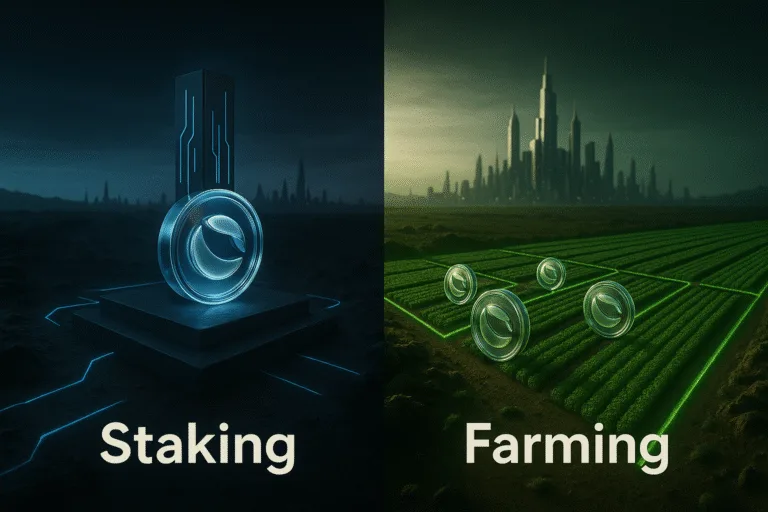
In the world of crypto, two popular ways to earn passive income are staking and farming. They both let you grow your tokens over time, but they work in different ways. Understanding the difference can help you make smarter decisions and avoid risks.
What Is Staking?
Staking is when you lock your crypto tokens in a blockchain network to help keep it running. In return, you earn rewards. This is most common in proof-of-stake blockchains like Terra Classic, Ethereum 2.0, and Cosmos.
When you stake your tokens:
1. You are helping secure the network
2. You earn a fixed or variable reward
3. You can usually un-stake after a short waiting time
Example: On Terra Classic, staking LUNC with a validator can give you steady rewards over time.
What Is Farming?
Farming, also known as yield farming or liquidity farming, is when you deposit tokens into a DeFi (decentralized finance) platform, usually into a liquidity pool. You earn rewards from trading fees and bonus tokens.
When you farm:
1. You provide liquidity to a token pair (for example, LUNC and USDC)
2. You earn rewards based on how much your tokens are used
3. You take on more risk, including impermanent loss
Example: You can farm by adding LUNC and USDC to a DeFi platform and earn a percentage of trading fees and extra tokens.
Which One Should You Choose?
1. Choose staking if you want a safer and simpler way to earn.
2. Choose farming if you understand DeFi and are willing to take more risk for higher rewards.
You can also combine both: stake some tokens for safety and farm with others for growth.
A net-deflation engine that can open without hyperminting, throttles itself as supply shrinks, and cannot be trick-printed through stale prices.
This is based on the original “Terra Classic Market-Module 2.0” draft, but incorporates mechanisms to avoid the mint/burn, which caused concerns among several community members.
If you want a short non-technical summary, please head over to Appendix 1 (Summary) and Appendix 2 (Q/A).
1 Context & goals
2022 taught two hard lessons:
Unlimited capacity kills – raising base_pool and shortening pool_recovery_period (PRP) let traders mint faster than the market absorbed, destroying LUNC.
Hard $1 peg is lethal – valuing UST at $1 while it traded at pennies forced hyper-inflation.
Today ( 25 June 2025 ) we sit on approx. 6.50 T LUNC and 6 B USTC; burns are just ≈ 1.3 B LUNC / month (0.02 %). The community wants the market module (MM) back as soon as possible to restore utility and fee flow — but will only accept continuous net supply decline.
2 How the market module historically minted
2.1 base_pool — the “virtual SDR reserve”
When you swap USTC → LUNC (or vice versa), the module pretends you are interacting with a virtual SDR pool. The actual calculation involves:
Converting the USTC amount to its SDR value using current oracle prices
Determining how much LUNC to mint such that the virtual constant-product curve stays balanced
Updating the SDR “debt” created by the swap
Simplified speaking, when you swap USTC → LUNC the module poses as an SDR/LUNC AMM whose one side is a virtual pool of size base_pool:
A larger base_pool lets a single swap give more LUNC before the price moves.
2.2 PRP — the refill timer
After a swap, the module remembers an SDR deficit d (how much the virtual SDR pool is drained). At every block it “refills” a fixed fraction:
d_next = d_current × ( 1 − 1 / PRP )
Each block restores 1/PRP of the deficit. So:
Short PRP → fast refill → can print again minutes later
Long PRP → slow refill → must wait hours or days
The total swap capacity per day (if traders drain it fully each time) is approximately:
swap_cap_day ≈ 2 × base_pool / ( PRP / 14 400 ) (14 400 ≈ blocks per day on Terra Classic).
This formula is derived from how much SDR can be depleted and refilled per day while keeping swaps feasible.
3 Non-minting approach (epoch-based)
Currently the burn tax on-chain is split 10% to the Community Pool, 10% to the Oracle Pool and 80% to burn. To avoid any minting of tokens, it is proposed to redirect 60% to a temporary “market module liquidity” pool. While this reduces the immediate burn from the tax to 20%, additional burns will still happen each 30-day epoch (see below).
At the first block H₀ of every 30-day epoch, for each token separately (USTC and LUNC):
Each token (USTC and LUNC) that reached the market module liquidity pool is moved to a distinct swap pool for the Market Module. This is the amount of that token available for users to swap.
This is the equivalent of 75% of last month’s tax burns of each token.
Instead of using minting and burning when swapping through the Market Module, tokens are just taken from and added to this pool.
At the start of the next 30-day epoch, all remainders in the pools are burnt.
4 Adaptive base_pool & PRP for the epoch
We want bursts when volatility spikes, but we must still fit under the monthly allowance.
4.1 Pick a burst factor
Default F = 0.07 → at most 10 % of the current liquidity pool balance can be used in a single day.
60.4 M > 60 M, so F, not the PRP clamp, is the active brake.
5 Live price input & anti-manipulation guards
Component
Rule
Price vote period
5 blocks ≈ 30 s
USTC price
price_uusd(USTC) = voting-power-weighted median this period
Quorum auto-kill
If either asset has price votes from < 50 % VP for 25 blocks → MM.enabled=false until quorum is restored
TWAP sanity clamp
Each swap fails if peg price differs > 10 % from a 45-block Oracle-TWAP (fed by the same oracles)
Stable→stable route
Hard-disabled in code (ErrStableSwapDisabled)
6 Absolute brakes & governance
⅔ super-majority can close MM any time
7 Burns
At the end of the 30-day epoch, all remainders in the pool are burnt. Depending on the swap behavior of users, this can be similar to the burns that would have happened without this approach, or more leaning to one of the two tokens (see summary Appendix 1).
8 Scenarios
8.1 Bull-but-boring (utility returns)
Example showing separate calculations for both tokens:
LUNC in Normal Growth Scenario
LUNC tax proceeds reach 2 B / month by epoch 3, USTC proceeds reach 560 K / month.
PRP still > 3 days, base_pool limited by allowance.
Scenario a.) Users swap equally back and forth between LUNC and USTC
Epoch
LUNC Tax
USTC Tax
Pool LUNC before
Pool USTC before
Pool LUNC after
Pool USTC after
1
1.3 B
360 K
720 M
216 K
720 M
216 K
2
1.6 B
450 K
840 M
270 K
840 M
270 K
3
2.0 B
560 K
1.20 B
336 K
1.20 B
336 K
Burned
2.76B
822 K
In this scenario, the same amounts of LUNC and USTC are burnt as without the MM open.
Scenario b.) Users swap mainly (80%) from USTC to LUNC, assumed price for simplicity: 200 LUNC/USTC (in reality, this price would fluctuate).
Epoch
LUNC Tax
USTC Tax
Pool LUNC before
Pool USTC before
Pool LUNC after
Pool USTC after
1
1.3 B
360 K
720 M
216 K
144 M
3.1 M
2
1.6 B
450 K
840 M
270 K
168 M
3.63 M
3
2.0 B
560 K
1.20 B
336 K
240 M
5.14 M
Burned
552 M
11.87 M
In this scenario, 2.2 B LUNC less would be burnt than without the MM open. In turn, 11 M USTC more would be burnt.
Scenario c.) Users swap mainly (80%) from LUNC to USTC, assumed price for simplicity: 200 LUNC/USTC (in reality, this price would fluctuate).
Epoch
LUNC Tax
USTC Tax
Pool LUNC before
Pool USTC before
Pool LUNC after
Pool USTC after
1
1.3 B
360 K
720 M
216 K
754.5 M
43.2 K
2
1.6 B
450 K
840 M
270 K
882 M
54 K
3
2.0 B
560 K
1.20 B
336 K
1.254 B
67.2 K
Burned
2.89 B
164.4 K
In this scenario, 130 M LUNC more would be burnt than without the MM open. In turn, 660 K USTC less would be burnt.
8.2 Flash-crash & oracle outage
USTC dumps to $0.004 (80 LUNC/USTC); two top validators offline.
After 30 s quorum < 50 % → MM shuts.
Tax proceeds collapse for both tokens in the next epoch.
LUNC in Crisis Scenario
LUNC tax proceeds collapse to 0.2 B/month.
USTC tax proceeds collapse to 56 K/month
Scenario a.) Users swap equally back and forth between LUNC and USTC
Epoch
LUNC Tax
USTC Tax
Pool LUNC before
Pool USTC before
Pool LUNC after
Pool USTC after
1
0.2 B
56 K
120 M
33.6 K
120 M
33.6 K
2
0.2 B*
56 K
120 M
33.6 K
120 M
33.6 K
3
0.2 B
56 K
120 M
33.6 K
120 M
33.6 K
Burned
360 M
100.8 K
In this scenario, the same amounts of LUNC and USTC are burnt as without the MM open.
(*) MM is halted mid of this epoch due to an oracle outage and not resumed. No further swaps happen from that point on
Scenario b.) Users swap mainly (80%) from USTC to LUNC, assumed price for simplicity: 80 LUNC/USTC (as defined in crash scenario).
Epoch
LUNC Tax
USTC Tax
Pool LUNC before
Pool USTC before
Pool LUNC after
Pool USTC after
1
0.2 B
56 K
120 M
33.6 K
24 M
1.2 M
2
0.2 B*
56 K
120 M
33.6 K
48 M
900 M
3
0.2 B
56 K
120 M
33.6 K
120 M
33.6 K
Burned
192 M
2.13 M
In this scenario, 150 M LUNC less would be burnt than without the MM open. In turn, 2 M USTC more would be burnt.
(*) MM is halted mid of this epoch due to an oracle outage and not resumed. No further swaps happen from that point on.
Scenario c.) Users swap mainly (80%) from USTC to LUNC, assumed price for simplicity: 80 LUNC/USTC (as defined in crash scenario).
We are leaving out this scenario as it would be unlikely that people swap from LUNC to USTC in an assumed price crash of USTC.
Even in disaster the float keeps shrinking for both tokens independently.
9 Spread-fee policy for MM swaps
Condition
Fee applied
Notes
MM disabled (no swaps)
—
No fee, no burn; route is inert.
MM enabled & allowance > 0
0.35 % of notional
Collected in the output asset (LUNC on USTC→LUNC swaps, USTC on LUNC→USTC).
Allowance exhausted (epoch cap hit)
—
Swap is refused; no fee, no burn.
Rationale
Feasible level – 0.35 % is low enough to keep arbitrage profitable against typical CEX spreads (≈ 0.10 – 0.25 %) yet still recovers oracle and keeper costs.
No double taxation – The chain-wide 0.50 % burn tax does not apply to these in-module swaps; the spread fee replaces it.
Accounting – Fees are routed 50% to burn and 50% to the Oracle Pool
Stable-to-stable path – Disabled entirely (§ 4.4), so the fee only ever applies to LUNC ↔ USTC trades.
10 Oracle module compatibility
Reactivating the MM with dynamic pricing requires updates to the current oracle infrastructure:
USTC price feed – USTC must be added to the oracle vote set. The MM currently assumes a fixed $1 price; this logic must be removed and replaced with real-time price input from validators.
Feeder provider expansion – The existing feeder supports limited sources. To ensure accurate and manipulation-resistant pricing, additional data providers (e.g., multiple CEXs, aggregators) must be integrated.
Validator onboarding – All validators must be guided through updating their oracle feeder binaries and configs to support USTC. Documentation and rollout coordination will be required to avoid quorum drops.
(Optional) Feeder overhaul – A full rewrite of the feeder binary is not strictly required, but strongly recommended. The current feeder is outdated and lacks support for modern APIs, fallback logic, and proper error handling.
These changes must be deployed before the MM reopens. Without them, price input will be invalid or absent, triggering the automatic shutdown mechanisms.
11 Roadmap
Code merge for testnet & review – ≈ 500-1000 Lines of Code (pool logic, adaptive knobs, kill-switch).
Public testnet – inject price spikes, quorum drops, 10× burn bursts.
Mainnet upgrade (two-step)
Deploy module inactive
Activate at next epoch boundary after pool filled during the epoch
90-day post-mortem – change 60 % redirection or F only by hard fork (chain upgrade).
12 What we gain
Immediate reopening – traders can arbitrage on day 1.
Guaranteed deflation – supply must still fall every epoch of 30 days.
Elastic throttle – as supply contracts, refill slows and pool shrinks.
Oracle-safe – 30 s lag can’t inflate; 75 s lag kills the module.
Oracle-Pool refill – spread fees from the market module are redirected to the Oracle Pool for future rewards (50%)
Burns – 50% of the spread fee are burnt
13 Voluntary burns
At this point in time, a big part of burnt supply originates from voluntary burns (coins sent to the on-chain burn module – terra1…anxu).
These funds should be excluded from the calculation of the 30 day epoch burns to avoid losing burn support of entities like Binance and community members. This will tighten the possible available tokens. It should be considered to extend the pools if necessary, but this would need to be discussed with affected entities once the general concept has been implemented and tested.
14 Important notes
The tax burn amount for the coming months cannot be predicted, so the impact on the MM plan is based on assumptions. Parameters and mechanisms can and should be adjusted during the public testnet phase, and it is important to thoroughly test the impact and mechanisms on the testnet before considering a mainnet release.
This is a signalling proposal that governance and the community want to see this approach implemented. The implementation will be a voluntary effort/contribution of StrathCole, thus there are no fixed deadlines. An alternative option is that a paid team decides to step forward and quote for the work and gets governance approval. This could eventually speed up the implementation timeline.
15 Risks
The risk of hyperinflation is mitigated by using only funds redirected to a distinct pool from the tax proceeds of the previous period. This leaves the MM minting disabled.
The main risks of this implementations are:
reduced burns of either LUNC or USTC (not both) in case the swapping is only used very rarely and one-sided
community disappointment to unmet expectations
Appendix 1: Non-Tech summary
To summarize the idea in non-technical terms, we can describe it as follows:
Important: This is NOT a repeg proposal and NOT treating USTC as a stable asset.
We will implement safeguards to the market module, so it does not mint for swaps. We acknowledge that this deviates from the original concept of the MM. 60% of the burn tax proceeds (NOT manual burns by wallets) are redirected to the MM swap pool for the next period.
The price of USTC will be reported by the chain oracle and no longer be fixed at $1 internally. This allows swapping at the real market value, giving the correct amount or LUNC for USTC and vice versa.
When swapping USTC to LUNC, LUNC is provided from the MM pool and the user gives USTC to the pool in turn. When swapping LUNC to USTC, USTC is given out from the pool and LUNC is provided back by the user. This is not exactly how the market module worked initially (mint and burn), but keeps the logic for calculations. The minting is replaced by utilizing a prefilled pool.
The fee of each swap (which is not including the tax, but 0.35% spread fee) will be distributed 50%:50% between burns and the Oracle Pool.
Incentives to use the MM to swap could be arbitrage options between CEX prices, DEX prices and the Market Module. This occurs because the on chain price of the oracle is only updated each 30 seconds, which means it lags behind CEX prices often. DEX prices also often deviate among each other and CEXes which offers further potential arbitrage.
Furthermore, using the MM to swap might be an incentive to users that want to cause burns of one side (either LUNC or USTC) through their swaps (see mechanisms about the monthly pool burns).
Most of the risks are mitigated by safeguards. But there is still a risk of community disappointment if they expect an effect of these measures beyond what is achieved. Also it is possible that the burns would be lower than expected, in case users solely use the MM to swap USTC to LUNC until the pool is exhausted, but this would in turn have the benefit of increased burns of USTC.
Appendix 2: Questions and answers
Q: Can this cause further LUNC hyperinflation? A: No. Minting is avoided in swaps, the available LUNC is limited to the amount in the pool, based on the tax proceeds of the previous period.
Q: Is this re-pegging USTC? A: No. USTC is a speculative asset and this idea treats it like that. It is valued at market price for the swaps.
Q: What about Binance burns? They stopped burning when we minted previously. A: We avoid minting with this approach completely. While we initially have lower burns when we redirect parts of the tax to the swap pool, all remaining balances of the pool are burnt at the period’s end.
Q: What is the “MM swap pool”? A: It is the amount of LUNC and USTC that is allowed to be used in swaps during a period. The actual swapped amount can be higher, because the balance is increased again by swaps to the other side.
Q: ??? Can I have an example? A: Sure: Imagine 1 USTC is worth 200 LUNC. During the previous period we had 667M LUNC tax proceeds. At a 60% rate, this would fill the MM swap pool with 400M LUNC for the next period. So if now 2,000,000 USTC are swapped to LUNC through the MM, this would give the user 400M LUNC from the pool in turn, effectively disabling further swaps in that direction. But if swaps now happen from LUNC to USTC (e.g. 100M LUNC for 500,000 USTC) then these 100M LUNC would again be available for swapping.
Q: But wouldn’t that lower burns significantly overall, if that much is redirected to the pool? A: No. All remaining balances in the pool would be burnt at the start of the next epoch. It depends on the swap behavior if more LUNC is burnt and less USTC or more USTC and less LUNC.
Q: But isn’t that pointless then? A: No, each swap incurs a fee of 0,35% which is distributed to burn (50%) and Oracle Pool (50%). The more swaps, so the more often the swaps happens, the more fees are generated.
Q: Okay, but what amount of swaps can we expect? Wouldn’t everyone only swap their USTC rewards to LUNC? A: That could happen, but even then it would in turn lower the USTC supply. But when you look at the LUNC/USTC ratio during the past months, you realize that the value fluctuated mostly between 190 and 230 LUNC per USTC. This suggests that people use both directions on trades.
Q: Right, what volume can we expect then? A: That is very hard to estimate and will depend on the on chain volume and also on arbitrage. The LUNC/USTC pairs on our DEXes had a volume of approximately 120-130k USD a month recently. Assuming this would be split equally between the DEXes and the MM, this would lead to a MM volume of maybe 30-40k USD worth.
Q: But you said USTC is valued at market value. How would arbitrage be possible? A: The oracle prices on chain are reported every 30 seconds. Especially during high volatility, CEX prices can fluctuate quite quickly. Also DEX prices have shown significant volatility during past months, which might offer arbitrage options with the MM. It is not guaranteed though.
Q: What are the major risks? And how are they mitigated? A: As said, the risk of hyperinflation is mitigated by very strict boundaries and limits. The risk of technical mistakes in the implementation shall be mitigated by thorough review and, if the community is willing to pay, a code audit (which would be recommended). In the unlikely case of a major flaw, 33.4% of validators could “emergency-halt” the chain for a hotfix. This is not expected to be necessary.
The likeliest risk is too high expectations which can then lead to disappointment.
Another risk is losing a portion of the LUNC burns in case the MM would only be used one-way (USTC->LUNC). The equivalent of USTC then would be burnt in excess.
Q: Who is developing it? Is it ready? What is the timeline? A: I (StrathCole) am offering to develop this voluntarily. As I do this in my free time, there is no fixed timeline possible. I expect the pure implementation (without the testing) to take 2-3 weeks. There is always the option that a team can quote for the work and get approval by the community to implement this instead.
Q: If you do it voluntarily, why do you need a proposal? A: Because I cannot spend the time of development without a signalling proposal that shows this approach as shown is wanted by the community/governance. There have been a lot of reservations against opening the Market Module. So approval for this is a prerequisite for me personally to start development work on it.
Q: How long will the tests take? A: That is not foreseeable. As this is a critical part of the blockchain, we need to stress-test this approach in all possible ways. This includes simulated price manipulation, oracle feeder outages, price volatility, swap volume, etc. The more helping hands will take part in the testing and verification the better.
Q: As review/audit was mentioned, this is not free work? A: No. The team that would quote for a review, or the audit company offering an audit would certainly request funds for that.
Q: What if we want to use the MM in its original form later? A: The changes will be designed to be as minimal as possible in terms of changing from mint/burn to the pool approach. Reverting this for a later use of the MM including the mint/burn mechanism is possible.
To address the ongoing issue of centralized voting power within the Terra Classic network, which currently has a Nakamoto index of 5, this proposal introduces a new rule to the staking module: a 2.5% voting power cap on validators. This cap prevents validators with more than 2.5% voting power from receiving new delegations or redelegations, encouraging a more equitable distribution of voting power, increasing the Nakamoto index to a target of 14, and fostering greater decentralization and validator equal profitability.
Background & Problem Statement
Terra Classic prides itself on being a fully decentralized blockchain, where governance decisions are made through community consensus. However, the current Nakamoto index of 5 indicates that just five validators could potentially veto proposals or exert significant control over the chain. While historical data suggests no malicious intent from the top validators, this low index undermines the chain’s decentralization ethos and introduces risks.
Additionally, the concentration of voting power among the top validators creates profitability challenges for smaller validators. Only the top 10 validators can consistently cover the operational costs of running a node, leading to reduced motivation for others to participate actively. This centralization fosters internal conflicts and discourages validators from championing Terra Classic’s growth.
Key issues include:
Centralized Control: A Nakamoto index of 5 indicates that five validators can dominate governance, contradicting Terra Classic’s decentralization principles.
Validator Profitability: Smaller validators struggle to remain profitable, reducing their incentive to maintain nodes or advocate for the network.
Community Dynamics: Centralization fuels internal disputes, hindering collaborative efforts to build and promote Terra Classic.
Proposal & Example
This proposal introduces a simple yet effective rule to the staking module: Validators with more than 2.5% of the total voting power cannot receive new delegations or redelegations. This cap ensures that voting power is gradually redistributed to smaller validators, increasing the Nakamoto index and enhancing network fairness.
Example Scenario
Validator A: Currently holds 3% voting power. Under the proposed rule, Validator A cannot receive new delegations or redelegations until their voting power falls below 2.5%.
Validator B: Holds 2% voting power. This validator can continue to receive delegations, attracting new stakers and increasing their voting power up to the 2.5% cap.
Outcome: Over time, validators with lower voting power gain more stake, reducing the dominance of top validators and increasing the Nakamoto index.
The goal is to raise the Nakamoto index from 5 to 14 within a reasonable timeframe, making Terra Classic more decentralized and resilient.
Mechanics of the Mechanism
The proposed rule will be implemented as follows:
Voting Power Cap: Any validator exceeding 2.5% of the total voting power will be ineligible to receive new delegations or redelegations.
Monitoring and Enforcement: The staking module will check each validator’s voting power at the end of each epoch. If a validator exceeds 2.5% ( prev. cap 20%), new delegations and redelegations will be blocked.
Grace Period: Upon implementation, validators above 2.5% will retain their current stake but cannot receive additional delegations or redelegations until their voting power falls below the threshold .
Governance Adjustments: The 2.5% cap can be adjusted via governance proposals to reflect network conditions, validator feedback, or decentralization goals.
This mechanism requires minimal changes to the staking module .
Advantages
Enhanced Decentralization: By limiting the voting power of dominant validators, the proposal encourages a broader distribution of stake, increasing the Nakamoto index.
Improved equal Validator Profitability: Smaller validators gain access to more delegations, improving their financial sustainability and motivation to participate.
Network Security: A higher Nakamoto index reduces the risk of coordinated attacks or governance manipulation.
Community Unity: Fairer stake distribution mitigates internal conflicts, fostering collaboration among validators and community members.
Simplicity: The 2.5% cap is straightforward to implement and understand, minimizing technical complexity.
Future Adjustments
The 2.5% voting power cap can be fine-tuned through governance based on:
The current Nakamoto index and decentralization metrics.
Feedback from validators and delegators.
Network growth and staking participation rates.
Regular evaluations will ensure the cap remains effective and aligned with Terra Classic’s goals.
Conclusion
The proposed 2.5% voting power cap addresses Terra Classic’s centralization challenges by redistributing voting power, increasing the Nakamoto index, and improving validator eqaul profitability. This mechanism aligns with the community’s decentralization ethos, enhances network security, and fosters a more collaborative ecosystem. By implementing this rule, Terra Classic can solidify its position as a truly decentralized blockchain.
Cast Your Vote Now
Yes: Support the 2.5% voting power cap proposal.
No: Oppose the proposal.
Note on Implementation
Implementing the voting power cap requires modifications to the staking module at the L1 level. While this entails development effort, the changes are relatively straightforward and can leverage existing governance and staking frameworks.
The long legal case of Do Kwon is finally coming to an end. Many people are asking what this means for Luna Classic or LUNC. Some think it could be the start of something big. And they might be right.
Here is what could happen once the case is over and why it could be very good for Luna Classic.
1. Luna Classic Will Be Free From the Past
Right now, many people still connect Luna Classic with Do Kwon. But in reality, Luna Classic is now fully controlled by its own community. Do Kwon has no role in it anymore.
Once the court case ends, the media and investors may finally stop talking about the past. This could help Luna Classic build a new reputation. That is important for getting more support and trust.
2. Bigger Crypto Exchanges Might Pay Attention Again
Some big exchanges have avoided Luna Classic because of the legal problems. Once the case is closed, that risk goes away.
This means exchanges might start promoting Luna Classic again. It could lead to new listings or more support. That would bring more trading volume and more new users.
3. The Community Can Focus Fully on Building
The Luna Classic community has already created many tools like staking, apps, and tokens. But these updates are often ignored because of the drama around the court case.
When that drama is gone, more people will start to notice the real work happening on the chain. Developers and validators can grow the ecosystem faster and stronger.
4. Investors Might Feel Safe to Come Back
Many people are waiting for a clear sign that it is safe to invest in LUNC. The end of the case could be that moment.
If the price stays strong and the project keeps growing, more investors will return. This could bring fresh energy and even push the price higher over time.
5. The Media Will Tell a New Story
Right now, most news stories talk about the crash and Do Kwon. But when the case ends, the story can change.
People may start to see Luna Classic as a survivor. A project that lost everything and came back because of a strong community. That new story could attract more attention in a good way.
Final Thought
The end of Do Kwon’s case will not solve everything. But it will remove a big weight from Luna Classic. After that, the community can grow without distractions. More people will start to take Luna Classic seriously again.
This could be the moment LUNC finally begins a new chapter. If the community stays active and the builders keep building, the future could be brighter than ever.