Home Blog Page 78

Terra Classic at a Crossroads: Why Activating the Market Module at Layer 1 Is Critical Now

Terra Classic is facing a pivotal moment—one that threatens the very foundation of our Proof-of-Stake (PoS) ecosystem. At the center of this growing crisis is the oracle pool, which has been steadily depleting over time. This pool is responsible for funding staking rewards across the network. As it continues to dry up, the economic incentives for validators and delegators diminish. Without immediate intervention, we face a downward spiral of reduced network security, weakening participation, and an overall loss of competitiveness in the broader crypto ecosystem.

Currently, staking rewards on Terra Classic are becoming less attractive—so much so that we are approaching, or even falling below, the returns offered by low-risk capital staking alternatives. This is dangerous territory. If users can achieve better yields elsewhere with less volatility and risk, we can expect an exodus of capital and validator support. In PoS chains, that’s a fatal flaw.

This is precisely why now is the time to activate the Market Module at Layer 1.

Why the Market Module Matters

The Market Module was once a core component of the Terra ecosystem, enabling users to swap between $LUNC and $USTC, while also supporting deflationary mechanisms through arbitrage and supply-demand dynamics. Since the depeg, the module has been disabled or non-operational. But today, reactivating it at Layer 1 is not just a restoration—it’s a necessity for long-term sustainability.

At Layer 1, the Market Module can:

  • Enable on-chain minting and burning of $USTC via $LUNC, and vice versa, based on market dynamics.
  • Reintroduce arbitrage opportunities that help stabilize the ecosystem and reward users.
  • Create organic deflationary pressure on both $LUNC and $USTC, reducing supply while restoring utility.
  • Support the oracle pool via transaction fees and usage incentives, helping replenish the pool and sustain staking rewards.

The Deflationary Path Forward

One of the main criticisms of the current Terra Classic economic model is the lack of consistent deflationary pressure. While burns are occurring, they are sporadic and reliant on manual governance or centralized initiatives. A functioning Market Module at Layer 1 changes that by building deflation directly into the chain’s core logic.

Every swap and arbitrage operation can help reduce total supply, reward participants, and restore a functional economic cycle. Instead of hoping for external catalysts, we empower the chain itself to become a dynamic, self-sustaining system.

Time Is Running Out

The situation is urgent. If the oracle pool continues to deplete at its current rate, we could soon face a situation where staking rewards are nearly nonexistent. This would drive away validators, reduce network decentralization, and further erode trust in the ecosystem. Once that happens, the cost of recovery will be far higher—if it’s even possible at all.

We must act before the damage becomes irreversible.

Activating the Market Module at Layer 1 is a concrete, actionable proposal. It’s not theoretical. The code can be restored. The economics are sound. And the community support is growing. This is not about going back to the past—it’s about reclaiming control over our future.

A Call to Action

The Terra Classic community has shown resilience time and time again. We’ve weathered storms, rebuilt infrastructure, and reestablished governance. But this time, our challenge is technical and economic. We must take decisive, forward-looking steps to protect what we’ve built.

Let’s not wait until our chain becomes irrelevant in a competitive staking environment. Let’s implement smart, efficient mechanisms now—before it’s too late.

Activate the Market Module at Layer 1. Restore staking viability. Reignite deflation. Revive Terra Classic.


Terra Classic Market-Module 2.0

A net-deflation engine that can reopen now, throttles itself as supply shrinks, and cannot be trick-printed through stale prices.


Context & Goals

2022 taught two hard lessons:

  • Unlimited capacity kills – raising base_pool and shortening pool_recovery_period (PRP) let traders mint faster than the market absorbed, destroying LUNC.
  • Hard $1 peg is lethal – valuing UST at $1 while it traded at pennies forced hyper-inflation.

Today (28 May 2025) we sit on:

  • 6.50T LUNC
  • 6B USTC
  • Burns are ≈ 1.3B LUNC/month (0.02%)

The community wants the Market Module (MM) back as soon as possible to restore utility and fee flow — but will only accept continuous net supply decline.


How the Market Module Actually Mints

2.1 base_pool — the “virtual SDR reserve”

When you swap USTC → LUNC (or vice versa), the module simulates a virtual SDR pool. It does:

  • Converts USTC to SDR using oracle price
  • Balances the virtual constant-product AMM
  • Updates SDR “debt” from the swap

Formula (simplified):

ΔLUNC_out ≈ ( SDR_spent / SDR_pool_after ) × LUNC_pool_before

larger base_pool lets a single swap mint more LUNC before the price shifts.


2.2 PRP — the Refill Timer

After a swap, a deficit d is remembered.

Each block: d_next = d_current × (1 − 1 / PRP)

  • Short PRP → fast refill → can mint again soon
  • Long PRP → slow refill → minting delayed

Daily Mint Capacity:

mint_cap_day ≈ 2 × base_pool / (PRP / 14,400)

(14,400 ≈ blocks per day on Terra Classic)


Net-Deflation Rule (Hard, Epoch-Based)

At the first block H₀ of every 30-day epoch:

taxburn_30d_token = Σ burns of token [H₀−30d , H₀−1] allowance_token = min(taxburn_30d_token × 0.80 , 100,000 SDR)

Each token (USTC and LUNC) has:

  • Independent mint limit
  • 80% of tax burns re-mintable
  • 100k SDR max cap per token

Once allowance_remaining_token hits 0, minting stops until the next epoch.


Adaptive base_pool & PRP for the Epoch

4.1 Pick a Burst Factor

Default F = 0.07 → Max 7% of allowance printed per day

desired_daily_cap = allowance × F


4.2 Solve for base_pool

base_pool_raw = desired_daily_cap × PRP / (2 × 14,400)


4.3 Supply-Scaled PRP

PRP = max(14,400, 14,400 × (S / 1T))

Example:
6.5T supply → PRP ≈ 93,600 blocks (6.5 days)


4.4 Final Clamps

base_pool = min(base_pool_raw, 0.00010 × mcap_in_SDR, 5,000,000 SDR)


Example for the First Epoch (Today)

ItemValue
burns_30d (B₀)1.3B LUNC
allowance = 0.8 × B₀1.04B LUNC ≈ 81k SDR
PRP (6.5T supply)93,600 blocks
desired_daily_cap (F=0.1)0.104B LUNC
base_pool_raw≈ 8.3k SDR
base_pool after clamps8.3k SDR
theoretical mint/day≈ 32M LUNC (2.6k SDR)

Since 32M < 104M, the PRP clamp is the active brake, not the burst factor F.


Live Price Input & Anti-Manipulation Guards

ComponentRule
Price vote period5 blocks ≈ 30s
USTC priceprice_uusd(USTC) = voting-power-weighted median this period
Quorum auto-killIf <50% VP for 25 blocks → MM.enabled = false until 5 periods OK
TWAP sanity clampSwap fails if peg price differs >10% from 45-block CEX TWAP
Stable→stable routeHard-disabled in code (ErrStableSwapDisabled)

Absolute Brakes & Governance

  • ⅔ super-majority can close the Market Module (MM) at any time.
  • Caps cannot be raised via governance.
  • MM is inherently capped by:  – 30-day burn stats  – Base pool clamps  – Oracle enforcement

Scenarios

7.1 Bull-but-Boring (Utility Returns)

LUNC in Normal Growth Scenario

LUNC burns double to 2B/month by epoch 3.   PRP still >3 days, base_pool limited by allowance.

EpochBurnsAllowanceMint (≤)Net ΔSupply
11.3B1.04B0.78B–0.52B6.4995T
21.6B1.28B1.02B–0.58B6.4989T
32.0B1.60B1.24B–0.76B6.4981T

Total LUNC deflation after 3 epochs: 1.9B (0.03%)

USTC in Normal Growth Scenario

EpochBurnsAllowanceMint (≤)Net ΔSupply
150M40M30M–20M5.98B
275M60M48M–27M5.95B
3100M80M64M–36M5.91B

Total USTC deflation after 3 epochs: 83M (1.38%)


7.2 Flash-Crash & Oracle Outage

Event:

USTC dumps to $0.004; two top validators go offline.   Quorum falls below 50% for 30s → MM shuts automatically.

Burns collapse during the next epochs.

LUNC in Crisis

EpochBurnsAllowanceMintNet Δ
crash0.2B0.16B0–0.20B
+30d0.2B0.16B≤0.16B–0.04B
+60d0.2B0.16B≤0.16B–0.04B

USTC in Crisis

EpochBurnsAllowanceMintNet Δ
crash10M8M0–10M
+30d10M8M≤8M–2M
+60d10M8M≤8M–2M

(*) Oracle kill-switch triggered → inflation = 0

Even in a disaster, deflation continues for both tokens.


Spread-Fee Policy for MM Swaps

ConditionFeeNotes
MM disabledNo swap, no fee, no burn
MM enabled & allowance > 00.35% of notionalCollected in output asset (LUNC or USTC)
Allowance exhaustedSwap refused
  • 0.35% keeps arbitrage profitable  
  • No double tax – replaces the 0.5% chain burn tax  
  • Fee split: 50% burn, 50% Oracle Pool

Oracle Module Compatibility

To reactivate MM with live pricing:

  • ✅ Add USTC to the oracle vote set  
  • ✅ Remove $1 peg assumption  
  • ✅ Add more CEX/aggregator price feeds  
  • ✅ Validators must update feeders  
  • ⚠️ Feeder binary rewrite is recommended    – Support modern APIs    – Add fallback logic    – Improve error handling

These changes must be deployed before reopening MM. Otherwise, price input will be invalid → MM disabled.


Roadmap

  • 🔧 Code merge & audit (~500–1,000 LOC)
  • 🧪 Public testnet with simulated price spikes, quorum drops, burn bursts
  • 🚀 Mainnet upgrade (two-step):  – Deploy MM in inactive mode  – Activate at next epoch boundary post-burn stats verification
  • 📊 Dashboards/API:  – Show taxburn_30d  – Show allowance_remaining
  • 📅 90-day post-mortem:  – Adjust 80% coefficient or Fonly via hard fork

What We Gain

  • ✅ Immediate reopening — utility & arbitrage from day 1  
  • 📉 Guaranteed deflation — must shrink supply every epoch  
  • 🧠 Oracle-safe — 30s lag = okay, 75s lag = MM shutdown  
  • 🔁 Elastic throttle — refill slows as supply shrinks  
  • 🔥 Spread fees:  – 50% burn  – 50% to Oracle Pool

The printer is leashed to yesterday’s bonfire — and the leash gets shorter as the fire dies out.


Voluntary Burns

At present, voluntary burns (e.g., Binance, user burns to burn module terra1...anxu) are a large portion of total burns.

Proposal:   Exclude voluntary burns from taxburn_30dcalculation to:

  • Keep voluntary burners engaged  
  • Avoid reducing minting capacity unnecessarily

Any allowance increase should be discussed after testing and deployment.


Important Notes

  • Burn data cannot be predicted
  • MM behavior depends on assumptions and must be tested
  • Adjustments to parameters like F and the 80% ratio should be done on testnet first

StrahCole ✰

Vegas

LEARN MORE

MIOFF Festival Bringing Luna Classic to a Real-World Audience, The Tour Begin on June 19

The MIOFF Festival Tour officially begins on June 19, and this year, it is putting Luna Classic front and center. This is not just a festival. It is a live event where music, culture, and MIOFF bring blockchain come together to create real impact.

MIOFF is using its festival power to push Luna Classic into the real world. With hundreds of people expected at each event, this is a golden chance to show what Luna Classic is all about. While most crypto stays online, MIOFF is taking LUNC directly to the crowd.

This move is not just for the crypto fans. MIOFF wants to reach people who have never touched digital assets before. By bringing Luna Classic into a fun and exciting environment, the festival makes it easy for new users to learn, explore, and get involved.

New people mean new money, new ideas, and stronger community growth. That is what MIOFF is aiming for. This tour is more than just promotion. It is a real step toward adoption and awareness.

If you are looking for a project that is taking bold steps, Luna Classic at the MIOFF Festival is one to watch. The stage is set, the crowd is ready, and LUNC is about to shine like never before.

Regulatory Shifts: Crypto-Friendly U.S. and LUNC’s Opportunities

Recent U.S. regulatory developments signal a crypto-friendly shift under the Trump administration, creating opportunities for Terra Classic (LUNC). On May 29, 2025, the SEC dismissed its lawsuit against Binance, accused of inflating trading volumes and mishandling funds. This dismissal, filed with prejudice, reflects a broader policy pivot, with new SEC Chair Paul Atkins halting enforcement actions against firms like Coinbase. Binance’s victory boosts market confidence, benefiting platforms listing LUNC.

Simultaneously, California’s Assembly unanimously passed a bill (68-0) allowing state payments in Bitcoin and other digital currencies, awaiting Senate approval. If enacted, this could mainstream crypto use in a major economy, potentially including altcoins like LUNC if its community advocates for inclusion.

LUNC, the original Terra token post-2022 UST collapse, could capitalize on these changes. The Binance ruling enhances trading confidence, increasing LUNC liquidity. California’s bill could drive demand if LUNC integrates into payment systems or DeFi protocols like Astroport. The community’s burn tax, reducing LUNC’s 6.8 trillion supply, may accelerate with higher transaction volumes, potentially boosting value. A permissive U.S. stance could also attract global investors, enhancing LUNC’s visibility.

However, LUNC faces challenges: its crash stigma, high supply, and competition from Bitcoin and stablecoins like USD1. Senate approval of California’s bill is uncertain amid political concerns. To succeed, LUNC’s community must enhance governance, develop use cases, and leverage DeFi.

These regulatory tailwinds offer LUNC a chance to rebuild. By aligning with mainstream adoption trends and strengthening its ecosystem, LUNC could transform from a troubled asset into a revitalized player in a crypto-friendly U.S. market, provided it overcomes its historical and competitive hurdles.

Welcome to Hexxagon: Secure, Scalable Node Hosting with LUNC Integration

Welcome to Hexxagon, your trusted partner in secure, reliable managed node hosting and staking solutions. Whether you’re a blockchain developer, investor, or enthusiast, we are here to support your journey into the decentralized future with cutting-edge infrastructure, transparent pricing, and exceptional customer service.

At Hexxagon, we pride ourselves on delivering 99.0% uptime, ensuring your blockchain nodes are always operational and secure. Our industry-leading security protocols and scalable infrastructure are built to grow alongside your project. From startups to large-scale operations, we offer flexible solutions tailored to your specific needs.

One of our core innovations is the integration and support for Terra Classic (LUNC) — a growing force in the blockchain world. As the LUNC ecosystem rebuilds and garners increasing community support, Hexxagon stands at the forefront by offering managed LUNC node hosting and staking services. Our platform empowers users to stake LUNC securely, earn rewards, and actively contribute to the network’s decentralization, all while benefiting from our reliable and transparent hosting environment.

We understand that in the blockchain world, trust and support matter. That’s why Hexxagon maintains a customer-first philosophy, offering dedicated support to ensure your operations run smoothly, whether you’re managing a validator node or staking your LUNC tokens.

By choosing Hexxagon, you’re not just accessing premium hosting — you’re joining a network that values decentralization, security, and innovation. With our expert team and future-ready technology, you can focus on building and growing your blockchain vision with confidence.

Stake your LUNC with Hexxagon and be a part of a trusted platform that supports your ambitions and contributes to a stronger, decentralized future. Let’s shape the blockchain revolution—together.

LUNC Now Listed on Cosmostation Wallet!

Great news for the Terra Classic (LUNC) community—starting today, LUNC is officially listed on the Cosmostation Wallet! This development marks another significant milestone in LUNC’s journey to regain relevance and utility within the blockchain ecosystem.

Cosmostation Wallet is a trusted and widely used multi-chain wallet, particularly well-integrated with the Cosmos ecosystem. Its support for LUNC opens the door to improved accessibility, enhanced staking capabilities, and a broader user base. With Cosmostation’s secure and intuitive interface, both existing holders and new investors can now store, manage, and delegate their LUNC assets with ease.

The listing also signals growing confidence in LUNC’s revival path following the Terra ecosystem’s well-known challenges. By expanding wallet support and integrations, the LUNC community continues its mission to restore value, strengthen infrastructure, and enable broader adoption. Integration with a respected platform like Cosmostation reinforces LUNC’s commitment to transparency, decentralization, and community-driven development.

Users can now benefit from Cosmostation’s governance features, real-time analytics, and validator delegation options—all of which contribute to a more participatory ecosystem. Additionally, this listing aligns with broader strategic efforts to reintroduce LUNC into mainstream use cases across DeFi, staking, and payments.

Whether you’re a long-term supporter or a newcomer exploring opportunities in the Terra Classic network, this update offers a more seamless and secure experience in managing your LUNC assets.

Stay tuned as more updates roll out and LUNC continues its comeback journey. The future looks promising, and today’s Cosmostation Wallet listing is just one step toward many exciting milestones ahead!

BLVLabs Work Report (Proposal #12161: Enabling Wallet Whitelisting)

Dear LUNC Community,

We at BLV Labs are pleased to share that we have completed our work on improving the second proposal. The results of our efforts are demonstrated below:

Summary:

This proposal aims to introduce a whitelist mechanism that allows the community to flexibly manage tax-free whitelist addresses. By implementing this, exchanges and key stakeholders or any partners can be exempted from tax through one-way transactions like Coininn or two-way like Binance.

Proposal #12161: https://station.terraclassic.community/proposal/columbus-5/12161

Result:

Testnet Report on rebel-2 LUNC:https://docs.google.com/spreadsheets/d/18QI4z0HS_UGxWPgZMKeKvvzBY3MGrtSjqhobP6N1OMA/edit?usp=sharing

Report on the TaxExemption Modulehttps://hackmd.io/@b5PzZtmhSPGXn6o0jmZqYg/ByxscPmfll

BlvLabs code has been merged on Github from the branch :blv/whitelist_wallet https://github.com/classic-terra/core/releases/tag/v3.5.0-rc.0

Technical document:  https://github.com/BLV-Labs/whitelist-wallet/blob/blv/whitelist_wallet/x/taxexemption/README.md

As we have completed all the tasks outlined in our second proposal, we are submitting this community spending proposal to request compensation for the work delivered.

Future plan

As this second proposal has been fully completed, we (BLV Labs) are committed to continuing our contributions to the chain.

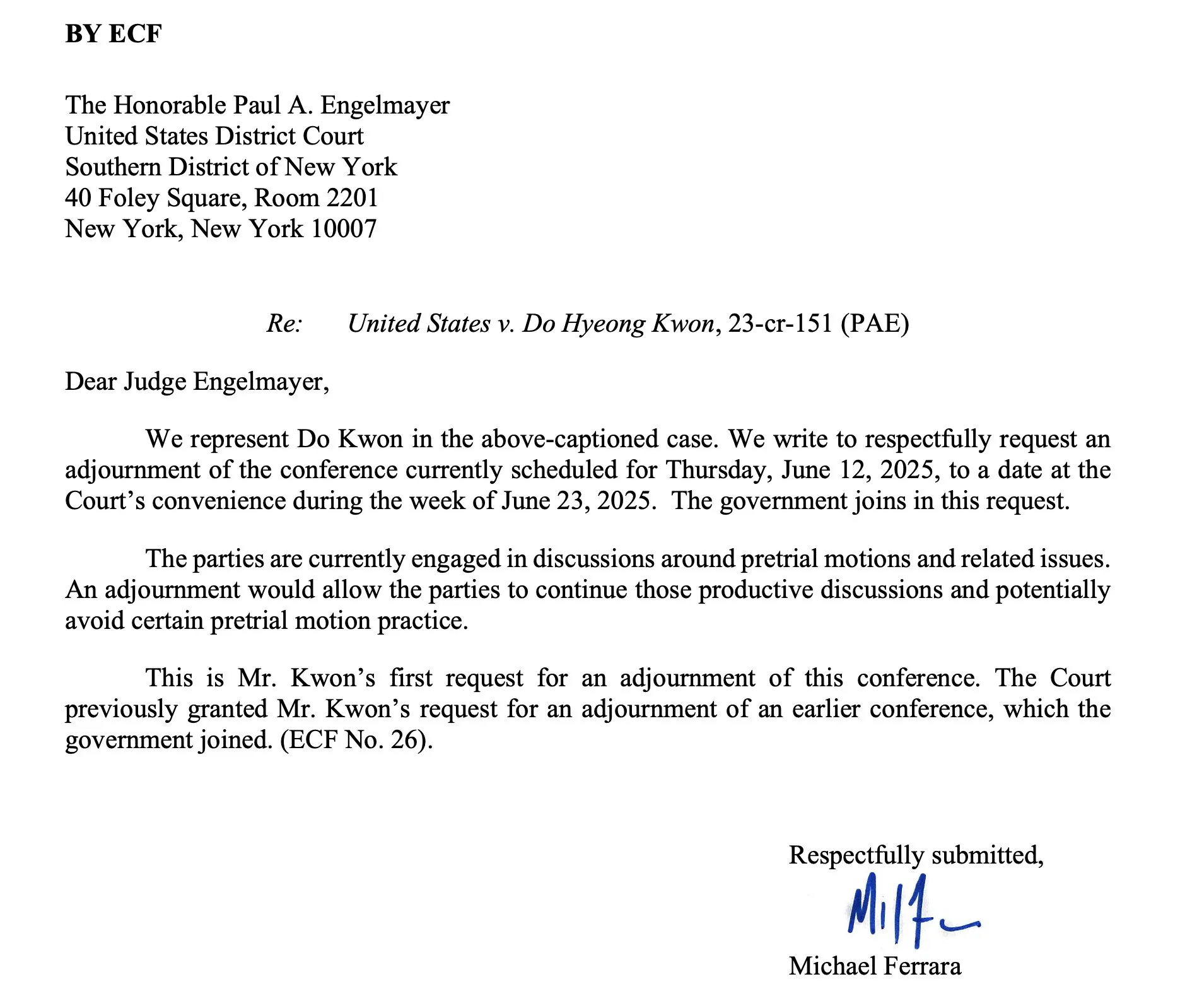
Do Kwon’s Defense Seeks Delay of Next Court Conference After Prosecutor’s Exit

In a notable development, attorneys representing Do Kwon, the embattled co‑founder of Terraform Labs, have formally requested that the next court‑scheduled status conference be postponed. This motion arrives just weeks after the lead federal prosecutor handling the case abruptly stepped down, injecting fresh uncertainty into the proceedings.

Kwon, who was extradited in December 2024 to face U.S. charges including securities fraud, commodities fraud, wire fraud, and related conspiracies, stands accused of orchestrating a massive crypto‑asset fraud that wiped out approximately $40 billion in investor value  . His pre‑trial conference—originally set for mid‑June—has now been put into question, as his legal team contends that the U.S. Attorney’s Office is undergoing key internal changes.

Central to their request is the recent resignation of Jared Lenow, the deputy prosecutor who had led the case in the Southern District of New York. According to court filings, the defense argued that Lenow played an integral role in trial preparation and that his exit disrupts continuity. The attorneys maintain that without his direct involvement, rescheduling is necessary to maintain fairness and due process. While their filing did not disclose Lenow’s reasons for stepping down, it underscores the significant impact his departure could have on witnesses, discovery timelines, and overall case strategy.

Kwon’s trial has already faced multiple delays; initially slated for January 2026, it was pushed to February 17, 2026, amid scheduling conflicts related to extensive evidence review  . Prosecutors have consistently affirmed that recent shifts in Department of Justice policy—particularly guidelines narrowing crypto enforcement jurisdiction—will not affect their prosecution strategy  .

If the court grants the defense’s motion to delay, the next status conference may be rescheduled later this summer. Otherwise, courtroom activity is expected to resume as planned, putting renewed focus on DOJ leadership changes and procedural adherence ahead of the high‑stakes trial.

Paws and Protocols: Cat Wif Hat Joins the Terra Classic Revival

In the fast-evolving world of crypto, community-driven projects continue to spark interest and inspire innovation. One such rising star is Cat Wif Hat, a whimsical yet purposeful meme coin that has recently launched on the Terra Classic (LUNC) blockchain — blending internet culture with blockchain utility.

Cat Wif Hat isn’t just another meme token. With its adorable feline mascot donning a signature hat, it captures the charm of meme coins like Dogecoin and Shiba Inu, while offering a unique twist: a commitment to revitalizing the Terra Classic ecosystem. By launching on LUNC, the project aims to bring new attention, energy, and liquidity to the once-beleaguered chain.

The Terra Classic blockchain, which faced a major collapse in 2022, has since seen a resurgence fueled by loyal community support and grassroots development. Cat Wif Hat sees this as a prime opportunity — a playground for innovation and a platform where underdog projects can truly shine.

Built with transparency and community engagement at its core, Cat Wif Hat plans to incorporate staking, NFT integrations, and utility features that go beyond memes. The developers emphasize decentralization, fun, and long-term sustainability. Their roadmap includes partnerships, cross-chain expansion, and educational initiatives to attract new users to Terra Classic.

Early adopters have already begun rallying behind the project, sharing memes and spreading the word across Twitter, Reddit, and Telegram. It’s this viral enthusiasm, paired with strategic intent, that could make Cat Wif Hat a surprise standout in the meme coin space.

Whether you’re a LUNC loyalist, a meme coin enthusiast, or just a fan of internet cats, Cat Wif Hat is worth keeping an eye on. Because sometimes, all it takes is a cat with a hat to change the game.

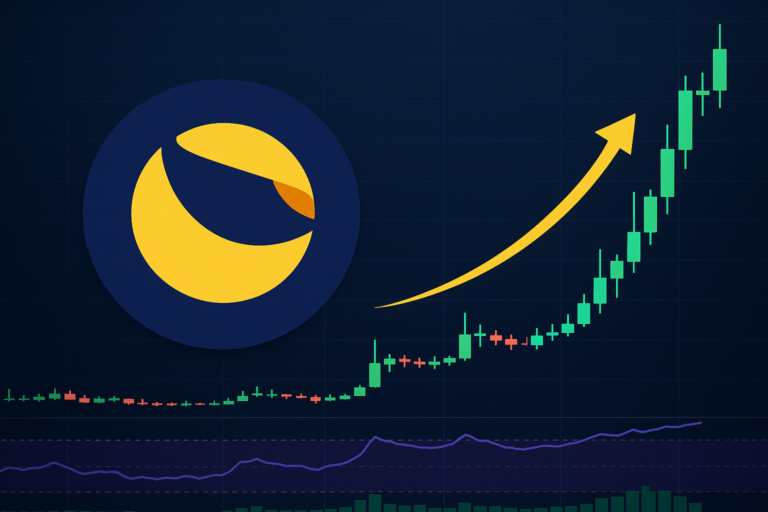
Terra Luna Classic Consolidates in Bullish Falling Wedge Pattern

Terra Luna Classic (LUNC) is currently consolidating within a classic falling wedge formation on the daily timeframe, a pattern widely regarded as a bullish signal in technical analysis. This setup typically suggests that bearish momentum is weakening, and a reversal or breakout to the upside may be on the horizon.

The falling wedge is characterized by descending trendlines that gradually converge, indicating a tightening of price action. As buyers and sellers battle for control, the decreasing volume often hints at an impending breakout. For Terra Luna Classic, this pattern has been developing for several weeks, and price action is now approaching the apex of the wedge.

A breakout above the wedge resistance, particularly if it coincides with a move above the daily 100-day moving average (MA 100), could serve as a strong confirmation of bullish momentum. This would signal that buyers have regained control, potentially sparking a significant rally.

If this bullish breakout is confirmed, analysts and traders are eyeing a potential price target of $0.000125, a level that could be reached swiftly due to the accumulation of buying pressure. Such a move would not only validate the falling wedge formation but also mark a strong recovery for LUNC in the short to mid-term.

As always, traders should remain cautious and watch for volume confirmation and potential retests of the breakout zone to avoid false signals. However, with market sentiment gradually improving and the technical setup aligning, Terra Luna Classic is positioning itself for a potentially explosive move.

📈 Keep an eye on resistance levels and the MA 100 for confirmation, as the next few trading sessions could be critical. A successful breakout could reignite investor confidence and bring renewed attention to the LUNC ecosystem.