Home Blog Page 79

Updated Proposal: Terra Classic SDK & Wasm Upgrade

0

Terra Classic Upgrade
Document / ANTIER SOLUTIONS

Updated Proposal: Terra Classic SDK & Wasm Upgrade

Executive Summary

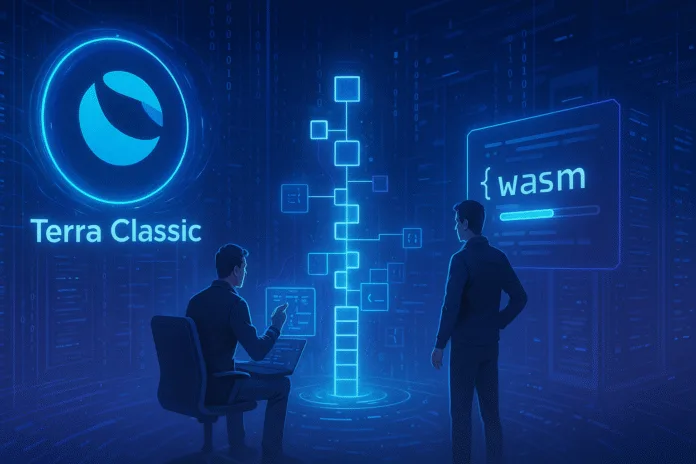
This proposal outlines a secure, backward-compatible upgrade of Terra Classic’s core infrastructure to Cosmos SDK v0.50.13 and Wasm Module v0.53.2, addressing unresolved issues from the v0.47 upgrade, enhancing security, and ensuring long-term sustainability. The upgrade is contingent on Orbit Labs’ unforking completion and includes fixes for technical debt, mitigation of breaking changes, and developer-focused improvements. The proposal ensures full backward compatibility for existing dApps.

Technical Specifications & Implications

1. Cosmos SDK Upgrade

Current: v0.47.17

Proposed: v0.50.13

Rationale: Upgrading to v0.50+ (“v50.13”) brings modern consensus through ABCI++, a modular and maintainable architecture, more robust storage, hardened permission logic, governance-led configuration, and developer-friendly tooling—setting Terra Classic on a stronger, future-proof path.

Changes:
x/params module updates (requires migration to new governance-driven parameters).
x/authz and x/feegrant updates (impacts dApps using delegation/allowances).
Custom module adjustments (e.g., Oracle, Market, Staking) due to SDK refactoring.

Terra Classic Considerations:
Ensures full backward compatibility with existing chain features and functionalities.

2. Wasm Module & Virtual Machine

Current: v0.46.0 / wasmvm v1.5.8

Proposed: v0.53.2 / wasmvm v2.1.4

dApp Impact:
-Existing CosmWasm contracts remain functional.

-Contracts will adhere to the latest standards while maintaining backward compatibility with existing constraints.

-Terra Classic Custom Wasm Bindings Compatibility:

Custom bindings for oracle, tax, and market modules will be maintained.

3. IBC-GO

IBC-GO: v7.4.0 → v8.7.0

Preserves cross-chain compatibility without introducing IBC-breaking changes.

Performance enhancements, optimizing relayer performance and reducing transaction latency.

Future-proofing, ensuring compatibility with upcoming Cosmos chains adopting IBC v8.7.0.

4. Terra Classic Custom Modules & Upgrade Plan

Terra Classic’s custom modules require careful handling during this upgrade:

Oracle Module: Manages exchange rate feeds for stablecoins. Requires compatibility testing with the new SDK structure to ensure validator price submissions remain accurate.

Market Module: Facilitates stablecoin swaps. Needs parameter validation and optimization for performance under the new SDK execution model.

Treasury Module: Governs economic policies, including tax rates. Must be preserved with no loss of functionality and tested under new governance-driven parameters.
All the other customization that has been done in different modules like staking, slashing, mint etc., will also be upgraded.

Upgrade Strategy:

Detailed Unit Testing & Refactoring:

Conduct unit tests on Oracle, Market, and Treasury modules to verify proper functionality under the new SDK.

Identify areas needing refactoring to align with SDK v0.50.13.

Backward Compatibility Layer Implementation:

Develop temporary compatibility shims for x/treasury and x/market modules to avoid dApp disruptions.

Ensure that existing governance parameters remain unchanged during the upgrade
.
Why This Upgrade?

  1. Terra Classic-Specific Research

Unforking Synergy:

Orbit Labs’ unforking removes Terra-original patches, allowing seamless SDK v0.50 integration.

2. Risk Mitigation

Backward Compatibility Layer:

Temporary shims for deprecated modules to prevent dApp disruption.

Security Measures:

The security vulnerabilities identified by Oak Security in the audit of Cosmos SDK v0.47 will be resolved by integrating the corresponding fixes from v0.50.

Workflow & Timeline

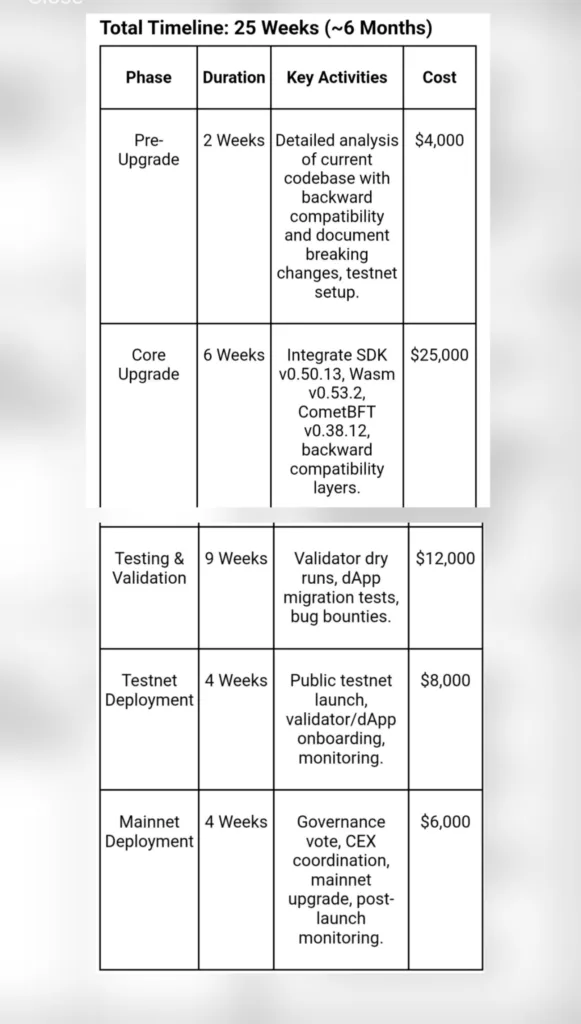
Phase 1: Pre-Upgrade Preparation (2 Weeks)

Tasks: Detailed analysis of current codebase, backward compatibility and documentation, testnet setup.

Phase 2: Core Upgrade Execution (5 Weeks)

Tasks:
SDK v0.50.13 integration.

Wasm Module v0.53.2 update.

Custom module migration for Terra Classic’s unique features.

Ensuring CosmWasm 1.0-1.5 contracts remain functional.

Ensuring full support and compatibility for existing CW‑0.16 contracts on chain, while also enabling forward compatibility with CW‑1.0–1.5—so there’s no risk to current deployments and we’re future-ready.

Phase 3: Progressive Upgrades, Testing & Validation (9 Weeks)

Tasks:
Setup the chain on version that supports 0.16 contracts,instantiate those contracts and then upgrade the chain progressively to v0.50.13 followed by mock testing.

Security audits, validator dry runs, dApp migration tests, bug bounties.

We stay with App v1 for this upgrade to minimize migration complexity. We’re planning to evaluate App v2/depinject migration in a future phase once we’ve stabilized on v0.50

Phase 4: Testnet Deployment (4 Weeks)

Tasks:
Public testnet launch, validator/dApp onboarding, monitoring.

Phase 5: Mainnet Deployment (4 Weeks)

Tasks: Governance vote, CEX coordination, mainnet upgrade, post-launch monitoring.

****Strathcole helped overlook the upgrades details and also he fixed the SDK 47 bug reported by Allnodes

  • this Document is the Original Form they i get. After some questions – who do this. – ANTIER SOLUTIONS would doing the UPGRADE
MORE HERE

Crypto Market Suddenly Drops Today: Five simple reasons every new investor must know

0

Quick take for beginners :

1. Prices ran up fast recently and traders are taking profit.

2. Altcoins are falling harder than Bitcoin.

3. Bitcoin exchange traded funds just saw money flow out.

4. Regulators are still unsure about altcoin ETFs, which scares the market.

5. Too much leverage means forced selling when prices slip.

What is happening right now
Bitcoin is trading around 118 thousand dollars, a little lower on the day, after failing several times to stay above 120 thousand dollars. Ether is weaker, and many big altcoins like XRP, Solana and Dogecoin are down by several percent today. Altcoins led the rally in recent weeks, so they are also leading the pullback.

The five simple reasons :
1. Profit taking after a huge rally
Bitcoin hit a record area near 123 thousand dollars last week. After big runs, traders lock in gains. That selling pressure pushes prices down and drags the rest of the market with it.
2. Altcoins are correcting harder
Ether fell a few percent and coins like XRP, Solana and Dogecoin dropped even more. When risk appetite cools, money usually leaves the smaller coins first.
3. ETF money is slipping out
Spot Bitcoin ETFs in the United States recorded about 86 million dollars of net outflows on July 23. When big funds take money out, it pressures prices and sentiment.
4. Ongoing regulatory uncertainty
The Securities and Exchange Commission paused the conversion of a Bitwise crypto index fund into an ETF. That pause tells investors regulators are still cautious about anything beyond Bitcoin and Ether, which cools excitement for many altcoins.
5. Leverage and liquidations
Many traders use borrowed money. When prices dip, their positions can be forced to close, which pushes prices down further in a chain reaction. Analysts say the market lacked a fresh positive catalyst, so leveraged positions were vulnerable.

Macro and news noise that adds to the pressure
Risk off moves from global trade worries and policy uncertainty are making investors more cautious with speculative assets. Some traders are also waiting for more details on upcoming policy reports and the full impact of new United States crypto laws like the GENIUS Act.

What to watch next :
1. Can Bitcoin finally hold above 120 thousand dollars

2. Do ETF flows turn positive again

3. Any clear green light or red light from regulators on altcoin ETFs

4. Liquidation data and funding rates that show whether leverage is shrinking

How a newbie can think about it
Big rallies almost always come with pullbacks. This is normal.

1. Focus on your time horizon. If you are investing for the long term, decide your buy and sell plan in advance so you are not forced to react emotionally on days like this.

2. Learn the basics of risk management. Never overuse leverage.

3. Diversify. Do not put everything into one small cap altcoin that can fall much faster than Bitcoin.

South Korea’s FSS Signals Caution on Crypto ETFs, LUNC’s Potential Shines

0

South Korea’s Financial Supervisory Service (FSS) recently issued verbal guidance urging local asset managers to limit exposure to crypto-related stocks, such as Coinbase and MicroStrategy, in exchange-traded funds (ETFs). This directive, rooted in a 2017 policy banning institutional investment in virtual assets, reflects the FSS’s cautious stance amid a rapidly evolving global crypto landscape. Despite South Korea’s vibrant crypto market, with 18.25 million investors, regulators aim to curb systemic risks tied to the volatility of crypto-linked equities, prioritizing investor protection and financial stability. The move has sparked debate, as local ETFs face stricter rules while retail investors access U.S.-listed crypto ETFs, highlighting regulatory inconsistencies.

Amid this cautious approach, Terra Classic (LUNC) presents a unique opportunity in South Korea’s crypto market. LUNC, the native token of the Terra blockchain post its 2022 collapse, has been revitalized through community-driven efforts to stabilize and enhance its ecosystem. South Korea, a hub for crypto adoption, could see LUNC benefit from this regulatory shift. As ETFs face restrictions, investors may turn to direct crypto investments, favoring tokens like LUNC with strong community backing and potential for recovery. LUNC’s ongoing developments, such as staking and governance upgrades, align with South Korea’s tech-savvy investor base, eager for innovative projects.

Furthermore, President Lee Jae-myung’s pro-crypto policies, including plans to legalize spot crypto ETFs by late 2025, signal a gradual easing of restrictions. LUNC could capitalize on this shift, offering a low-cost, high-potential investment for retail traders. By leveraging South Korea’s active crypto trading culture, LUNC stands to gain traction, positioning itself as a resilient player in a market navigating regulatory caution and innovation.

Binance Coin Surges Past $800, LUNC Poised to Benefit

0

Binance Coin (BNB) has achieved a historic milestone, surging past $800 for the first time and reaching a new all-time high of $804.70 on July 23, 2025. This rally propelled BNB’s market capitalization to $111 billion, overtaking Solana (SOL) at $110 billion, reclaiming the fifth spot among cryptocurrencies. The surge, driven by strong demand in the derivatives market and Binance Smart Chain’s (BSC) recovery, with a Total Value Locked (TVL) of $6.77 billion, highlights BNB’s robust ecosystem. However, this development also casts a spotlight on Terra Classic (LUNC), which stands to benefit significantly from BNB’s momentum.

LUNC, the native token of the Terra Classic blockchain, thrives on its community-driven revival efforts post the 2022 Terra collapse. Unlike Solana, which has faced network outages, LUNC’s ecosystem focuses on stability and decentralization. The BNB surge boosts BSC’s visibility, where LUNC is actively traded, potentially increasing its liquidity and investor interest. LUNC’s community governance, with proposals like tax burns reducing token supply, enhances its deflationary appeal, contrasting Solana’s inflationary model. LUNC’s low transaction fees and growing DeFi integrations make it a compelling alternative for developers seeking cost-effective solutions compared to Solana’s higher operational costs.

While Solana excels in transaction speed, LUNC’s resilience, with a market cap of $0.5 billion and trading volume up 20% recently, underscores its potential. BNB’s rally could funnel capital into BSC-based projects, including LUNC, driving its adoption. LUNC’s community focus and deflationary mechanics position it as a stronger long-term investment compared to Solana, leveraging BSC’s growth to reclaim market relevance.

LUNC Layer 2 Explodes in Popularity as MIOFF Becomes the Most Trending Token on the Market Today

0

LUNC Layer 2 projects are heating up fast and one name is leading the charge. MIOFF has just become the most trending token in the market, turning heads across the LUNC layer 2 landscape with two trading pools surging over 80 percent in a single day.

The numbers are impossible to ignore. One pool jumped by an astonishing 85.76 percent while the second followed closely at 81.39 percent. This dual breakout has not only propelled MIOFF to the top of today’s gainers list but also sparked a wave of investor interest rarely seen in this segment of the Terra Classic ecosystem.

Backed by growing demand for Layer 2 utility, strong community traction and a buzz from new investor on festival side, MIOFF is capturing attention at every level. Market watchers now see it as a flagship token for the entertainment and festival-driven future of LUNC.

The LUNC Layer 2 narrative is evolving and MIOFF appears to be leading a fresh wave of opportunity. As momentum builds and capital flows into the token, many are wondering if this is just the beginning.

Early movers are already locking in positions. The question is, will you be one of them?

Just 892B LUNC Still Staked — Are Holders Preparing for a Breakout?

0

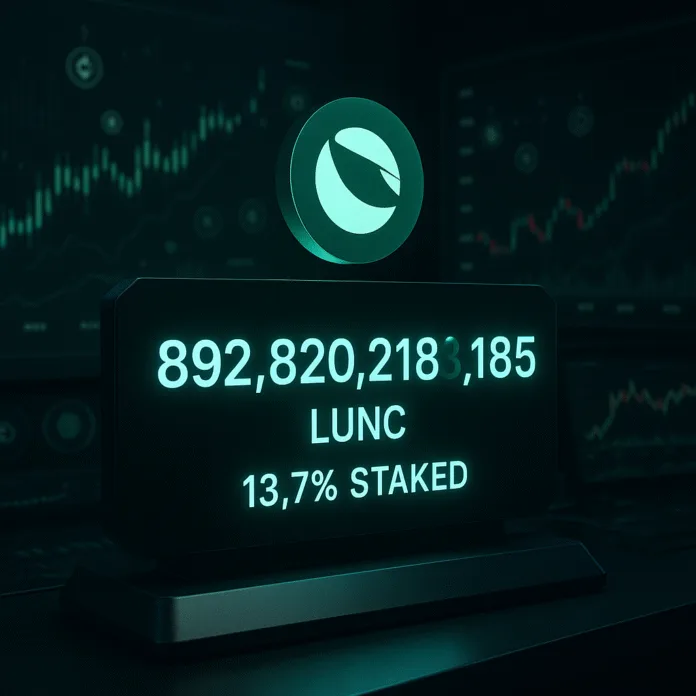
As the Terra Classic (LUNC) ecosystem continues its revival, staking metrics are drawing major attention from the community. Recent data reveals that only 892,820,218,185 LUNC tokens remain actively staked, representing just 13.7% of the total supply.

This sharp drop in the staking ratio raises several questions:

● Are users anticipating major liquidity events?

● Is there a strategic shift toward trading instead of holding?

● Or could it be a sign of preparation for future proposals and upgrades?

With a total LUNC supply exceeding 6.5 trillion tokens, the remaining 13.7% staked marks a significant decrease from previous levels. Historically, a higher staking ratio has been seen as a sign of community confidence and long-term commitment to the network. A lower ratio, however, may increase circulating supply and potential market volatility.

Why This Matters:

● Staking supports network security and governance.

● A lower staking percentage may weaken on-chain voting power.

● It can also impact token price, especially in a sensitive market.

But with major upgrades coming like the Market Module 2.0, community utility tokens like USTD and developments in DeFi and dApps, many believe this could be a strategic cooldown before the next major move.

LUNC holders now face a choice, stake to support the network, or stay liquid and flexible for what’s coming next.

👉 How to Claim $LTK: A Step-by-Step Guide for Terra Classic Users

0

Intro

The $LTK token has just entered its community claim phase on Terra Classic, rewarding users for their contributions. Unlike traditional airdrops, $LTK uses a point-based system off-chain, where each point can be claimed on-chain via a secure and transparent process.

In this guide, we explain how to claim your $LTK tokens, link your wallet, and understand the claim rules. The process is open to all members of the Lunctoken.org platform.

➡️ Original guide published here: Lunctoken.org – How to Claim LTK

🪙 What is $LTK?

$LTK (Lunctoken) is a CW20 token deployed on Terra Classic, designed to reward community engagement. It powers a gamified ecosystem of points, badges, NFTs, and Web3 interactions. Its total supply is capped at 10,000,000 LTK.

🌱 How Claiming Works

Claiming $LTK is not an airdrop. It’s a merit-based conversion:

  • 1 LTK Point = 1 $LTK
  • 20% claim fee (distributed across Treasury, LP, Rewards)
  • Only available to verified users with a Terra Classic wallet
  • A minimum amount of 100 LTK is necessary before to claim.

Once your claim is submitted, it is processed manually within 72h.

✅ Step-by-Step to Claim $LTK

  1. Earn LTK Points on Lunctoken.org by participating in tutorials, discussions, courses, or governance.
  2. Log in to your account and go to the Claim LTK page.
  3. Your Terra wallet must be linked (stored via your Lunctoken Profile page).
  4. Enter the number of points to claim (minimum = 100).
  5. Confirm — your tokens will appear on-chain after manual validation within 72 hrs.

Bonus: You can track claim history and wallet balances in your claim history or directly via LuncScan!

Why It Matters

This system creates a bridge between off-chain actions and on-chain rewards — opening a new paradigm for community-driven Web3 projects. It avoids bots, encourages real engagement, and maintains transparent tokenomics.

📎 Useful Links

The CLARITY Act and Its Bright Future for Terra Luna Classic

0

Introduction

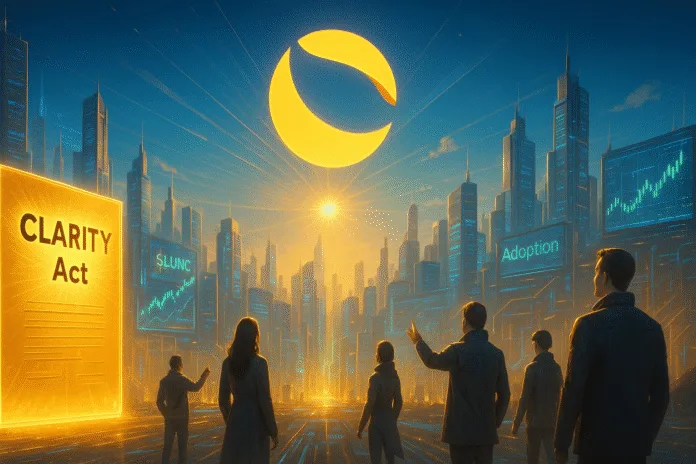
The Digital Asset Market Clarity Act of 2025 (CLARITY Act), passed by the U.S. House, is a game-changer for the cryptocurrency industry, delivering a clear and supportive regulatory framework.

At its core, the maturity clause paves the way for blockchain tokens to transition from securities to digital commodities under the Commodity Futures Trading Commission (CFTC), fostering innovation and investment.

For Lunc the native token of the vibrant Terra blockchain, this clause offers a golden opportunity to shine.

This article explores how the maturity clause positions Luna Classic for a promising future.

The Power of the Maturity Clause

The maturity clause sets clear, achievable criteria for a blockchain to be recognized as a “mature blockchain system”, allowing its tokens to be regulated as commodities with lighter oversight from the CFTC. Key requirements include:

  • Decentralization: No single entity or group can control the blockchain or hold 20% or more of the token supply, ensuring a community-driven ecosystem.
  • Functionality: The blockchain must be fully operational, publicly accessible, and capable of supporting transactions, governance, or other services.
  • Open-Source Code: Transparent, accessible code fosters trust and collaboration.
  • Certification Process: Issuers can submit a certification of maturity to the SEC, detailing governance, token utility, and decentralization. The SEC has 60 days to rebut or 120 days to request more information; otherwise, the blockchain is automatically deemed mature.
  • Time Limit: Projects have four years from their first token sale to achieve maturity, maintaining exemptions from securities laws.

Once certified as mature, tokens gain commodity status, unlocking opportunities for fundraising and market growth. Issuers can raise up to $75 million annually without SEC registration, provided they meet robust disclosure requirements (e.g., business plans, financials, and risks).

Why the Maturity Clause is a Win for Lunc ?

The maturity clause aligns perfectly with Lunc’s strengths, offering a clear path to success:

  1. Seizing Commodity Status:
    • Community-driven governance and decentralized structure make it well-suited to meet the maturity clause’s criteria. With no single entity dominating token ownership, Lunc is poised to achieve the 20% ownership threshold, securing commodity classification and reducing regulatory hurdles.
    • This status will enhance Lunc’s appeal to investors and developers, fueling growth and adoption.
  2. Regulatory Clarity Fuels Growth:
    • The CLARITY Act resolves the SEC-CFTC jurisdictional debate, providing Luna Classic with a stable, CFTC-regulated framework. This clarity is a catalyst for investor confidence, positioning LUNC as a trusted asset in the crypto market.
  3. Unlocking Fundraising Potential:
    • As a mature blockchain, Luna Classics developers could raise up to $75 million annually without SEC registration, funding cutting-edge DeFi applications and infrastructure upgrades. This influx of capital could attract institutional investors, amplifying Lunc’s market presence.
  4. Overcoming Challenges with Confidence:
    • While the 5.6 trillion token supply presents a challenge to meeting the 20% ownership criterion, Luna Classics proactive community is well-equipped to address this through strategic governance and token management.
    • The four-year maturity window provides ample time for Luna Classic to solidify its decentralized framework, ensuring compliance and avoiding stricter SEC oversight.

A Bright Future for Crypto

The CLARITY Act’s maturity clause sets a transformative precedent for the crypto industry:

  • Empowering Decentralization: It encourages projects like Luna Classic to embrace open-source, community-driven systems, driving innovation.
  • Balancing Growth and Trust: The $75 million fundraising exemption supports ambitious projects while ensuring transparency for investors.
  • Addressing Concerns: Critics note that tokens on non-mature blockchains may face regulatory uncertainty, but Lunc’s strong governance positions it to overcome such hurdles.

Luna Classics decentralized ethos and active community make it a standout candidate to thrive under the Act’s framework, setting the stage for long-term success.

Conclusion

The CLARITY Act’s maturity clause is a beacon of opportunity for Terra Luna Classic, aligning with its decentralized vision and community-driven innovation.

By achieving commodity status, LUNC can unlock lighter regulation, attract investment, and fuel ecosystem growth. With a clear regulatory path and a passionate community, LUNC is well-positioned to capitalize on the Act’s benefits.

As the SEC and CFTC finalize rulemaking within 360 days, LUNC stands ready to embrace a brighter future, solidifying its place as a leader in decentralized finance.

With new U.S. regulations now in place, TerraClassicUSD (USTC) and Terra Classic (LUNC) could be positioned for a major institutional revival.

0

A New Chapter for Crypto Regulation in the U.S.
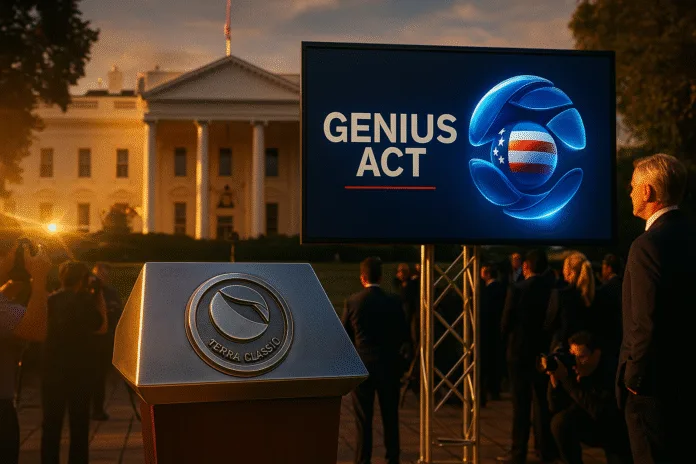
In a landmark decision, the United States has officially passed the GENIUS Act, a new law requiring all payment stablecoins to be backed by U.S. dollars or short-term government securities. This development is part of a broader crypto reform effort, which includes other bills such as the CLARITY Act and measures limiting the use of Central Bank Digital Currencies (CBDCs).

Together, these laws are designed to provide long-awaited clarity for the digital asset industry, establishing legal definitions, creating oversight structures, and improving investor protection. Analysts are calling this a “regulatory leap” that could open the door for mainstream adoption of stablecoins and other blockchain-based financial products.

What This Means for USTC and LUNC
TerraClassicUSD (USTC) is a decentralized stablecoin that originally operated through an algorithmic model tied to LUNC (Terra Classic). Unlike traditional stablecoins backed 1:1 by fiat reserves, USTC maintained its peg through a burn and mint mechanism with LUNC—creating or destroying supply to keep its price stable.

This design failed in 2022, leading to the collapse of Terra’s original ecosystem. However, the community did not abandon the project. Instead, developers and contributors have continued to rebuild Terra Classic, focusing on restoring USTC’s value and improving its underlying model.

The GENIUS Act now brings a new opportunity. Although USTC is not currently backed by fiat or Treasuries, the law may allow for decentralized stablecoins to comply, if they can prove adequate reserves or implement improved mechanisms that meet transparency and safety standards.

Why USTC Could Still Become a Leading Stablecoin
Here’s why USTC, despite its history, could become a strong contender among future stablecoins:

1. Decentralization First
USTC is one of the few stablecoins not controlled by a private company. This aligns with the growing demand for financial systems that are open, community-driven, and censorship-resistant.

2. Community Resilience
The Terra Classic community remains one of the most active and organized in the crypto space. Proposals to re-collateralize USTC, reduce supply, and improve its algorithm have gained serious traction.

3. Regulatory Repositioning
The GENIUS Act doesn’t just shut out algorithmic models, it creates a path for them to evolve. If USTC integrates a hybrid reserve model with verifiable backing and improved controls, it could fit within the law’s requirements.

4. Strategic Link to LUNC
The value of USTC is deeply connected to LUNC. As LUNC strengthens through community development, utility use cases, and smart contract upgrades, it could provide stronger support for USTC’s stabilization mechanics.

5. Institutional Curiosity
Now that the regulatory environment is clearer, institutions may revisit algorithm-based models—especially those backed by large communities and open source governance. USTC could become a pioneer in this new category of compliant decentralized stablecoins.

Market Outlook and Strategic Focus
In the short term, USTC and LUNC are likely to see increased attention, especially as the U.S. Treasury and Federal Reserve begin to release technical guidance under the GENIUS Act. If the Terra Classic community can present a credible roadmap toward regulatory compliance—such as introducing partial fiat reserves or real-time auditing tools—USTC could re-enter the U.S. market as a legal, decentralized alternative to major stablecoins like USDC or USDT.

For LUNC, this also means renewed purpose. The token may evolve into the governance and economic layer for USTC, supporting smart contracts, collateral mechanisms, and decentralized treasury management.

Final Thoughts
The GENIUS Act is more than just a policy change—it marks the beginning of a new era in crypto finance. While many stablecoins will need to adjust or exit the market, USTC has a rare opportunity: to become a fully compliant, decentralized stablecoin built on the lessons of the past and the standards of the future.

With strong community backing, technical innovation, and a clear connection to Terra Classic’s long-term vision, USTC and LUNC could be at the center of the next generation of digital currency.

How to Trade LUNC on Gate.io: A Step-by-Step Guide

0

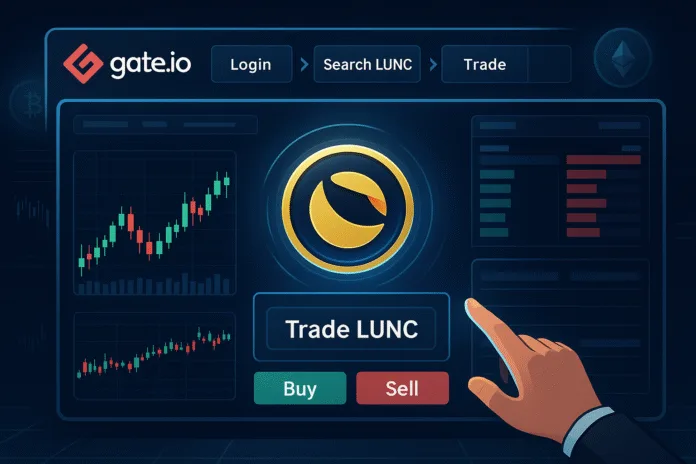
Trading Terra Classic (LUNC) on Gate.io is straightforward with the right steps. This guide outlines how to buy and sell LUNC on this leading cryptocurrency exchange.

Step 1: Create and Verify Your Account
Visit Gate.io (www.gate.io) and click “Sign Up” in the top right corner. Register using your email or phone number, set a secure password, and complete the Know Your Customer (KYC) verification by submitting valid ID documents. KYC ensures compliance and enhances account security.

Step 2: Deposit Funds
Log in to your Gate.io account. Navigate to “Wallet” and select “Deposit.” A popular method is to fund your account with Tether (USDT) via P2P trading or bank transfer. Alternatively, transfer crypto like Bitcoin or Ethereum from another wallet. Ensure funds are in your spot wallet before trading.

Step 3: Navigate to the Trading Interface
Hover over “Trade” on the top navigation bar and select “Spot.” In the market section, search for the LUNC/USDT trading pair. This opens the trading interface with price charts and the order book.

Step 4: Place a Trade
Choose between a limit order (set your desired price) or a market order (trade at the current price). Enter the amount of LUNC you want to buy or sell, then click “Buy” or “Sell” to execute the trade. Review the order details before confirming.

Step 5: Monitor and Manage Your Trades
Check your trade status in the “Order History” or “Wallet” section. For advanced options, Gate.io supports margin trading for LUNC with up to 3x leverage.

Final Note
Always conduct thorough research and practice risk management, as cryptocurrencies are volatile. For support, contact Gate.io’s Customer Support Team.