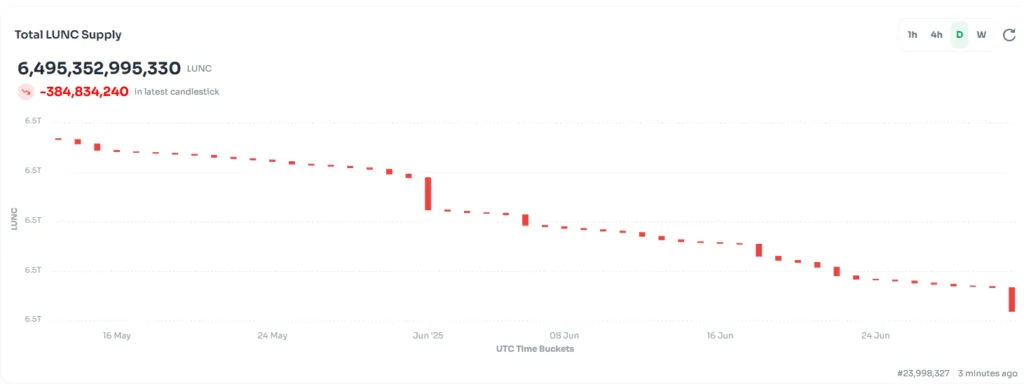
Binance has officially crossed a major milestone by reaching a total of 73 billion LUNC burned through its ongoing monthly burn program. In the most recent round, the exchange burned 300 million LUNC, continuing its long-term support for the Terra Classic ecosystem.
The LUNC burns are part of Binance’s monthly initiative, where trading fees from LUNC spot and margin pairs are sent to a burn address to permanently reduce the circulating supply. Since the program began in 2022, Binance has remained the largest single contributor to LUNC token burns.
In a separate move, Binance also burned 4 million USTC, although this burn was not part of the official LUNC burn program. The USTC burn is seen as a symbolic gesture toward broader community goals, including the long-term vision of restoring USTC stability and trust.
The Terra Classic community welcomed both actions, emphasizing the importance of continued deflationary pressure and exchange participation in token economics. As discussions continue around staking rewards, market modules, and ecosystem utility, Binance’s commitment remains a central pillar in LUNC and USTC recovery efforts.
In a show of continued support, Binance has once again proven to be a key ally of the Terra Classic (LUNC) community by carrying out its monthly LUNC burn — pushing the total amount burned to over $370 million! This initiative continues to reduce the overall supply of LUNC, helping to restore value and rebuild trust in the ecosystem following the infamous collapse.
The consistent burns by Binance send a strong message: LUNC is not forgotten. Every burn strengthens the tokenomics of Terra Classic by increasing scarcity, which, combined with growing trading activity and ecosystem development, could drive long-term value.
But it’s not just about burns. The Terra Classic community is alive and thriving, with new projects launching, innovative use cases being developed, and a steady stream of governance proposals passing. The revival of the chain is no longer a dream—it’s happening now.
There’s growing hope among the community that if trading volume on Binance continues to rise, we’ll see even larger burns, further accelerating LUNC’s recovery path. Every trade, every community vote, and every new project adds fuel to the comeback story.
We are witnessing a powerful example of what a resilient, community-led ecosystem can achieve with the right support. The crash was devastating—but the rebuild is becoming inspiring.
A huge thank you to Binance and to every supporter who’s held on and contributed. Together, we’re not just burning tokens—we’re reigniting hope.
Concept by RedlineDrifter & REDniks. Link to complete Whitepaper: www.ustprotocol.com
Overview:
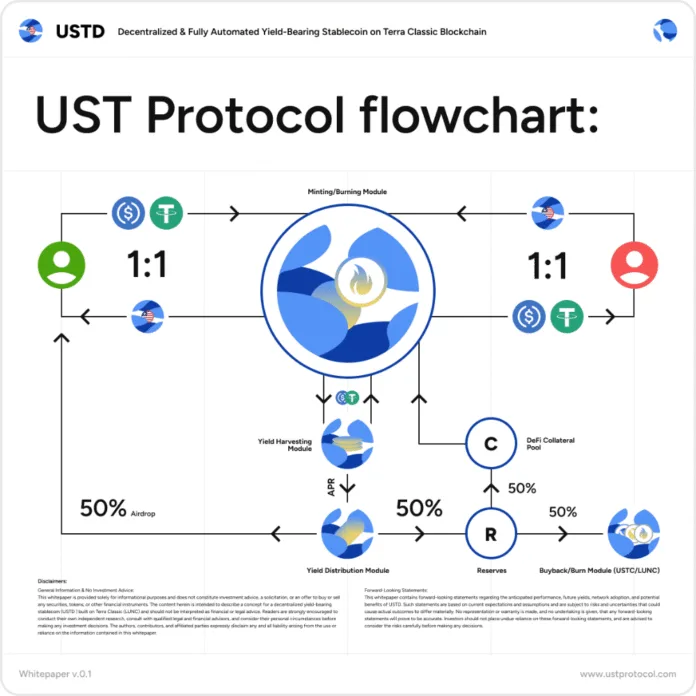
USTD is a next-generation stablecoin built directly on Terra Classic L1. Unlike previous attempts, USTD is conceived as a completely new stablecoin with additional long-term side goal of revitalizing USTC. It is designed not only to preserve a 1:1 peg with the US Dollar by being fully collateralized by fiat-backed stablecoins (USDC/USDT) but also to reward its holders with attractive yields—all delivered automatically through periodic airdrops.
USTD leverages Terra Classic’s high throughput, low fees, and robust governance framework (which governs all Terra Classic protocols) to offer a secure, transparent, and efficient solution for both retail and institutional investors.
Key Highlights:
Stable & Yield-Bearing:
• Every USTD token is minted 1:1 against USDC/USDT, and the deposited collateral is deployed into low-risk, high-liquidity decentralized pools. Approximately 20% APR (on average) is generated from these pools. Approximately 50% of the yield generated is distributed directly to USTD holders as regular on-chain airdrops.
Automatic Yield Distribution:
• Unlike many yield-bearing protocols that require additional staking, UST Protocol automatically distributes yield via regular on-chain airdrops.
Transition from USTC:
• USTD is introduced as a completely new stablecoin designed to fill the space of the currently defunct USTC. This initiative is both a fresh start with enhanced security, transparency, yield mechanics and profit generation for Terra Classic, but also in long run tool to revive USTC.
Integrated Governance:
• USTD is fully integrated into Terra Classic’s on-chain governance. All decisions, upgrades, and risk management measures affecting USTD are managed by Terra Classic Governance, ensuring alignment with the broader ecosystem.
Robust Security:
• By being fully backed with regulated assets and operating on Terra Classic L1, USTD benefits from enhanced security and transparent reserve management.
Compliance:
• USTD’s focus on yield and collateral keeps it outside the heavy “payment stablecoin” regime of the U.S. GENIUS and STABLE Acts, sparing the project costly bank‑style licensing. In Europe, MiCA applies only if USTD is publicly offered, and the protocol can tap that market by appointing a dedicated reporting entity while preserving its decentralized design. Until then, USTD remains freely usable across global DeFi, giving holders a secure, transparent, and regulator‑resilient asset.
Market Opportunity:
• Amid a rapidly evolving stablecoin and DeFi landscape, USTD addresses current shortcomings—including centralization risks and low yield—thus positioning itself as a compelling solution for a broad spectrum of users.
Vision & Mission:
Our vision is to redefine digital finance by providing a stable, yield-bearing asset that rewards holders automatically and operates in a fully decentralized, trustless environment. Our mission is to empower investors by creating an asset that offers both stability and effortless passive income—all governed under the established Terra Classic framework.
In addition, the UST Protocol, serving as the innovative engine behind USTD, is designed to complement Terra Classic’s existing Staking Protocol. By offering automated yield-bearing capabilities alongside the traditional staking mechanism, Terra Classic L1 will benefit from a dual-product ecosystem.
This synergy will provide users with both passive income through conventional staking and innovative stablecoin generating yield through automatic airdrops, enhancing overall network value and diversifying user engagement.
Further development:
Due to the complexity and scale of the project, the UST Protocol / USTD concept itself will be subject to change during the design process of the final solution, after, we hope, a positive decision from the Terra Classic community regarding implementation of the project.
Next steps:
In the next 2 weeks, a detailed proposal for the implementation of the UST Protocol / USTD will be presented and will be subject to a vote in the official Terra Classic governance
Something important is happening tomorrow. Binance, the world’s largest cryptocurrency exchange, will complete its monthly burn of LUNC (Terra Classic). This is not just another routine event. It could be a turning point for the entire LUNC community.
But what exactly is a burn?
In simple terms, burning means permanently removing coins from circulation. It is like reducing the total supply of a product so that each unit becomes more valuable over time. For LUNC, this monthly burn helps limit the number of tokens in the market, which can support price growth if demand remains strong.
Why is Binance involved?
Since 2022, Binance has been supporting the Terra Classic revival by burning a portion of the LUNC fees collected from trading on its platform. Each month, they send millions of LUNC to a burn address, making the supply smaller. This makes Binance a major player in the LUNC ecosystem.
So why are people talking about tomorrow?
Because the next burn report is due. And each time, the numbers tell a story. Will the burn be larger than last month? Will it reflect growing interest? Will it trigger a price reaction? No one knows for sure. That is why the community is watching closely.
LUNC is no longer seen as just a failed token from the past. Thanks to developers, validators, and a passionate community, it is showing signs of strength again. Real upgrades have been made. Utility is returning. And Binance’s continued support is a major vote of confidence.
Tomorrow’s burn is more than just a transaction. It is a moment of reflection. It reminds everyone that something is still happening here. Quietly. Steadily. With purpose.
The numbers will be released soon. Until then, the only question is: how big will the fire be this time?
Terra Luna Classic, known as LUNC, is one of the most talked-about cryptocurrencies in recent years. While many label Bitcoin as the king of crypto, a growing number of investors and communities are turning their attention to LUNC for its potential, strong community, and unique structure. Here’s why some believe LUNC stands out in the crowded world of digital currencies.
1. Rebuilt by the Community, Not a Corporation
LUNC was originally part of the Terra ecosystem that collapsed in 2022. Most projects would have died after such a massive failure. But what makes LUNC special is that its recovery did not come from a large company or billionaire. Instead, it was driven by everyday users and developers who believed in its future.
These supporters formed what is now one of the most active communities in crypto. They proposed improvements, restarted the network, and began long-term efforts to repair its reputation and value. This kind of bottom-up revival is rare and shows the power of a committed user base.
2. Focused on Reducing the Supply
A major issue with many cryptocurrencies is inflation. When too many coins are in circulation, the value of each one can drop. LUNC addresses this with an ongoing burn mechanism, which permanently removes coins from the system.
Exchanges like Binance have also supported this effort by burning LUNC tokens collected through trading fees. As more tokens are removed from circulation, the value of the remaining ones can rise, assuming demand stays strong or increases. This strategy is known as deflation, and it is a key part of LUNC’s long-term plan.
3. Affordable with High Growth Potential
Unlike Bitcoin or Ethereum, where buying a single coin can cost hundreds or thousands of dollars, LUNC is still priced at a fraction of a cent. This low price point allows new investors to buy large amounts with little capital.
While the low price does not guarantee profit, it gives LUNC the ability to grow by large percentages if the market turns in its favor. Many investors are drawn to this type of asymmetric opportunity, where the risk is limited but the potential upside is much larger.
4. Growing Interest from Analysts and Traders
LUNC is no longer just a recovery story. Traders and analysts are starting to pay close attention. Over the past few months, its price movements have followed recognizable patterns in technical analysis, such as support and resistance levels and triangle formations. These are signals that professional traders use when deciding whether to enter or exit a market.
Even when prices remain low, the structure of LUNC’s chart shows it is an active and liquid market with real volume. This is a positive sign for both short-term traders and long-term holders.
5. Built Around a Strong Narrative
Stories matter in crypto. The idea of a “comeback” coin that was abandoned and then rebuilt by its own users is powerful. It captures attention and builds loyalty.
LUNC has become more than just a digital asset. It represents a kind of movement. People want to be part of something that survived a crash and is now fighting to recover. This emotional connection adds value that goes beyond numbers on a chart.
A Balanced View
Calling LUNC the “king of crypto” might be an exaggeration when compared to giants like Bitcoin or Ethereum. Its market cap is still much smaller, and it has a long road ahead to become a dominant force.
However, based on its comeback story, strong community, deflation strategy, and low-cost entry point, LUNC deserves serious attention. It may not be the king, but it is a rising contender that represents something unique in the crypto world.
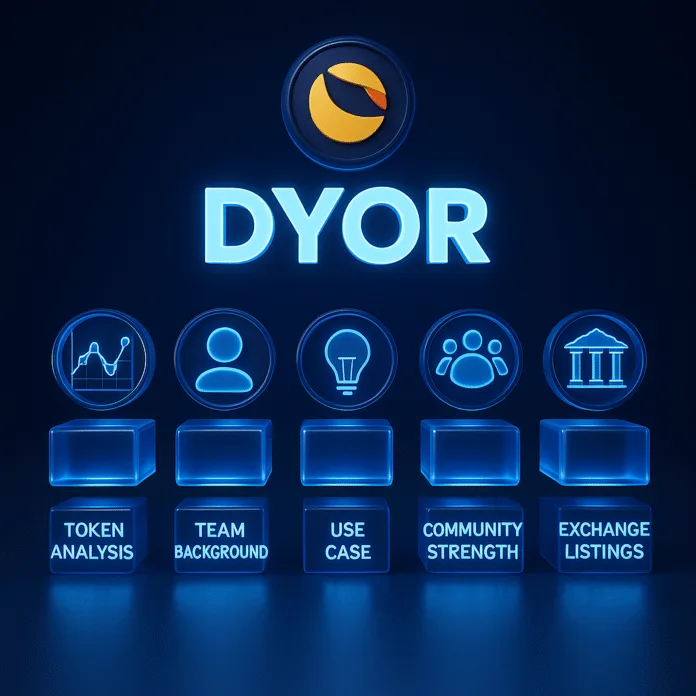
There is one phrase you will see everywhere in the crypto world: DYOR, short for Do Your Own Research. It is not just advice. It is a survival skill. In a space full of hype, influencers, fake projects, and fast-moving markets, blindly following others can lead to big losses. This article will show you how to start researching like a pro, even if you are brand new to cryptocurrency.
What Does DYOR Actually Mean?
DYOR means taking the time to understand what you are investing in before you put your money into it. Instead of relying on tweets, Telegram messages, or viral YouTube videos, you gather facts, assess risks, and make informed decisions.
In crypto, where scams and overhyped tokens are everywhere, DYOR helps you avoid being manipulated and gives you confidence in your actions.
Why Most Beginners Skip DYOR
Many beginners are excited by the idea of quick profits. They see coins going up fast and jump in without knowing the fundamentals. But this often ends in disappointment or loss.
Without research, you are guessing. And in crypto, guessing is expensive.
What You Should Research Before Buying Any Coin
Here are the essential questions every beginner should ask before investing in any cryptocurrency:
1. What Problem Does It Solve?
Real projects solve real problems. Does the token offer something useful? Is it creating a new technology, improving finance, or enabling a valuable service?
2. Who Is Behind It?
Look at the team or developers. Are they experienced? Do they have a history of successful projects? Are they public and transparent?
3. How Does the Token Work?
This includes understanding:
– The use case: What is the token actually used for?
– The tokenomics: How many coins are there? Is it inflationary or deflationary?
– The utility: Is there a reason people need this token?
4. Is There a Community?
Strong crypto projects usually have active communities on platforms like Twitter, Reddit, or Discord. An engaged, growing community is a positive sign of real interest and support.
5. Where Is It Listed?
Is the token available on major exchanges? If it is only on small or unknown platforms, there may be a reason bigger exchanges have avoided it.
6. What Do the Charts and Metrics Say?
Use tools like:
– CoinMarketCap or CoinGecko for price history and volume
– Token Sniffer or DexTools for contract and liquidity analysis
– Etherscan or Mintscan to view transactions and holders
– Do not just look at the price. Understand the volume, liquidity, and wallet distribution.
Red Flags to Watch Out For
– Anonymous team with no public info
– No working product or roadmap
– Unrealistic promises of guaranteed profits
– Fake social media hype
– Locked comments or deleted criticism
– If something feels off or too good to be true, it usually is.
Where to Start Learning and Researching
– CoinMarketCap and CoinGecko: Market data and rankings
– Messari.io: In-depth project analysis
– Crypto Twitter: Real-time insights (follow analysts, not hype accounts)
– Project Websites and Whitepapers: Go directly to the source
Final Thoughts
DYOR is not just about avoiding scams. It is about building confidence. When you understand a project, you are no longer reacting to price swings or headlines. You are investing with intention.
The crypto world rewards curiosity and punishes laziness. If you learn how to research early, you will be far ahead of most beginners. This one habit can save you from costly mistakes and prepare you to make smart moves in any market.
If you are new to cryptocurrency, one of the most important decisions you will make is how and where to store your assets. Unlike traditional bank accounts, cryptocurrencies require special tools called wallets. Choosing the right one can mean the difference between full control of your money and the risk of losing everything. This article will explain what crypto wallets are, how they work, and the critical difference between hot and cold wallets.
What Is a Crypto Wallet?
A crypto wallet is a tool that allows you to store, send, and receive cryptocurrencies. It does not actually hold the coins themselves but instead stores the private keys that give you access to your funds on the blockchain.
Whoever holds the private keys controls the crypto. That is why choosing a secure and reliable wallet is absolutely essential.
There are two main types of wallets every beginner needs to know: hot wallets and cold wallets.
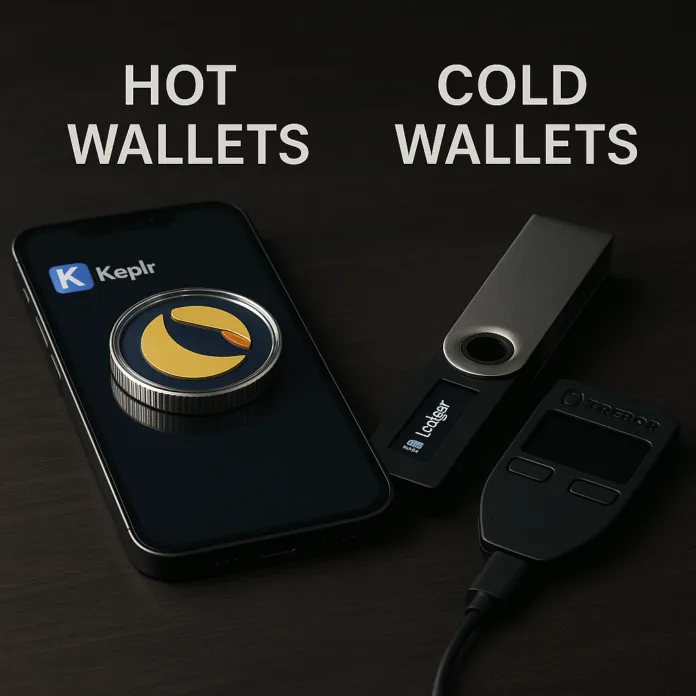
Hot Wallets: Fast and Convenient
Hot wallets are digital wallets connected to the internet. They are designed for daily use, fast transactions, and easy access. These are ideal for beginners who want to start small or interact with decentralized apps and exchanges.
Examples:
Keplr Wallet
A browser extension and mobile app commonly used with Cosmos-based chains like Terra Classic. It offers an intuitive interface for managing tokens, staking, and connecting to DeFi platforms.
Terra Station Wallet
Official wallet for the Terra blockchain, including Terra Classic. Supports token transfers, staking, governance voting, and connection with web apps.
Pros of Hot Wallets:
1. Easy to set up and use
2. Quick access to funds
3. Ideal for frequent transactions and DeFi
Cons of Hot Wallets:
1. Connected to the internet, which makes them more vulnerable to hacks
2. If your device is compromised, your funds could be at risk
Hot wallets are great for everyday users, but they require good security practices such as strong passwords and enabling two-factor authentication.
Cold Wallets: The Ultimate in Security
Cold wallets are physical devices or offline software that store your private keys completely disconnected from the internet. These are the safest option for long-term storage and are recommended for holding larger amounts of crypto.
Examples:
Ledger Nano X
A USB-like hardware wallet that stores private keys securely offline. Compatible with many cryptocurrencies and integrates with apps like Keplr and Terra Station.
Trezor Model T
Another popular hardware wallet known for its user-friendly interface and support for a wide range of coins. All signing operations happen within the device, keeping your keys secure.
Pros of Cold Wallets:
1. Extremely secure since they are offline
2. Immune to online hacking and malware
3. Best for storing large or long-term holdings
Cons of Cold Wallets:
1. More expensive than hot wallets
2. Less convenient for quick transactions
3. Requires a bit more setup and learning
Which One Should You Use?
If you are just starting out and only testing the waters, a hot wallet like Keplr or Terra Station is a great place to begin. However, once you accumulate more crypto or plan to hold for the long term, a cold wallet becomes a must.
Many experienced users use both:
Hot wallets for active trading and DeFi
Cold wallets for long-term holding and large assets
Final Thoughts
Crypto wallets are more than just apps or devices. They are the vaults to your financial future in the digital economy. Understanding how hot and cold wallets work gives you the confidence to manage your crypto securely.
Before you make your first investment or trade, make sure you choose the right wallet and secure your private keys. In the world of crypto, you are your own bank—and that means security is your responsibility.
Introduction
Everyone is talking about cryptocurrency, blockchain, and Web3, but very few truly understand the key principle that makes it all possible. That principle is decentralization. If you want to understand why crypto is more than just digital money or why companies and governments are exploring blockchain, you need to start here. This article breaks down decentralization in simple terms for anyone new to the space.
What Is Decentralization?
Decentralization means that control and decision-making do not rest in the hands of a single authority. Instead, power is distributed across a network of participants. In the context of cryptocurrency and blockchain, it means no single person, company, or government controls the system.
Traditional systems, like banks or tech companies, are centralized. They make the rules, store your data, and control your access. In a decentralized system, rules are enforced by code, data is stored across many computers, and no single party can shut the system down or change it without consensus.
A Simple Analogy
Think of the difference between a library and Wikipedia. A library has a few people who decide which books go on the shelves. It is centralized. Wikipedia is open to thousands of contributors who edit, update, and maintain content together. That is a decentralized approach. No one person controls Wikipedia, yet it continues to grow and improve because of collective input.
Why Decentralization Matters
Control and Ownership
In decentralized systems like Bitcoin or Ethereum, you own your assets directly. There is no bank or company that can freeze your account or take your funds.
Censorship Resistance
No single entity can block you from participating. In centralized platforms, your account can be banned or limited. In decentralized platforms, everyone has equal access.
Transparency
All transactions and rules are public. Anyone can audit the system at any time. This builds trust and accountability.
Security
Decentralized networks are harder to hack or shut down because they are spread across thousands of computers. There is no single point of failure.
Examples in the Real World
Bitcoin
A global, decentralized currency not controlled by any government or central bank.
Ethereum
A decentralized platform where developers build applications without relying on big tech platforms.
Decentralized Finance (DeFi)
Banking and financial services that run on smart contracts instead of traditional institutions.
File Storage
Services like IPFS or Arweave allow users to store data across a decentralized network rather than relying on one company’s server.
Is It Perfect?
Decentralization also comes with trade-offs. It can be slower, more complex, and harder to regulate. Updates and decisions take longer because they require consensus across many participants. However, these are often the necessary costs of freedom, transparency, and resilience.
Final Thoughts
Decentralization is not just a technical idea. It is a shift in how we organize trust, power, and systems in the digital world. It removes gatekeepers, empowers users, and creates networks that anyone can join and help maintain.
If you are serious about understanding crypto or blockchain, decentralization is the concept you cannot afford to ignore. It is the foundation of the entire movement and the reason why these technologies are so revolutionary.
Introduction
Cryptocurrency has rapidly become one of the most talked-about innovations in finance and technology. From Bitcoin headlines to stories of millionaires made overnight, crypto seems to be everywhere. But what exactly is cryptocurrency, and why is it generating so much attention? This guide will explain it in simple, professional language to help you understand the foundation of this digital revolution.
What Is Cryptocurrency?
Cryptocurrency is a form of digital or virtual money that exists entirely online. Unlike traditional currencies such as the US dollar or the euro, it is not issued or controlled by a central government or bank. Instead, cryptocurrencies operate on a technology called blockchain, which ensures security, transparency, and decentralization.
In essence, cryptocurrency is a digital asset designed to work as a medium of exchange, where individual coin ownership records are stored on a secure and distributed database.
How Does It Work?
At the core of every cryptocurrency is the blockchain. A blockchain is a type of digital ledger made up of blocks of information. Each block contains a list of transactions and is securely linked to the previous block, forming a chain. This system is maintained by a network of computers, often referred to as nodes, which work together to validate and record transactions.
Because of its decentralized nature, no single person or organization has full control over the blockchain. This makes it resistant to manipulation, censorship, and fraud.
Popular Cryptocurrencies
There are thousands of cryptocurrencies available today, but here are a few of the most well-known:
Bitcoin (BTC): The first and most widely recognized cryptocurrency, launched in 2009. It is often referred to as digital gold.
Ethereum (ETH): More than just a currency, Ethereum allows developers to build smart contracts and decentralized applications on its platform.
Stablecoins (such as USDT or USDC): These are cryptocurrencies tied to traditional currencies like the US dollar to reduce price volatility.
Why Are People Using It?
People are drawn to cryptocurrency for a variety of reasons:
Decentralization: No central authority controls the currency, which can provide more freedom and privacy.
Security: Transactions are encrypted and recorded on a blockchain, making them nearly impossible to alter.
Global Accessibility: Anyone with an internet connection can send and receive cryptocurrency, regardless of location or banking status.
Potential for Growth: Many investors see cryptocurrency as a new asset class with high growth potential, despite its risks.
Is It Safe?
While blockchain technology is secure, the crypto world is not without risks. Scams, phishing attacks, and poor security practices can lead to losses. It is essential to understand how wallets work, how to secure your private keys, and how to avoid fraudulent schemes. Beginners are encouraged to start slowly, do thorough research, and never invest more than they can afford to lose.
Final Thoughts
Cryptocurrency is changing how the world views money, finance, and even the internet. Whether you are curious about investing, interested in the technology, or just want to understand what everyone is talking about, learning the basics of crypto is a smart move.
The earlier you understand the fundamentals, the better prepared you will be for the future of digital finance.
This proposal explores the introduction of a staking mechanism for USTC on-chain, modeled after the existing LUNC staking system, to reduce circulating supply, stabilize the price, and support for Market Module 2 (MM2) implementation.
Utilizing USTC “Zombie” Pools
We propose leveraging abandoned USTC pools, starting with the following pool:
This pool contains 15 million USTC paired with a defunct project (C2X), which migrated to a new chain and was delisted from all centralized exchanges (CEXs). The project team provided a migration portal for holders to swap tokens, and officially terminated the C2X-USTC LP staking program on Terra Classic. Relevant details:
If this proposal advances, a window will be provided for any remaining holders to swap their CTX tokens for USTC or remove any residual liquidity from the pool.
Staking Goal and APR
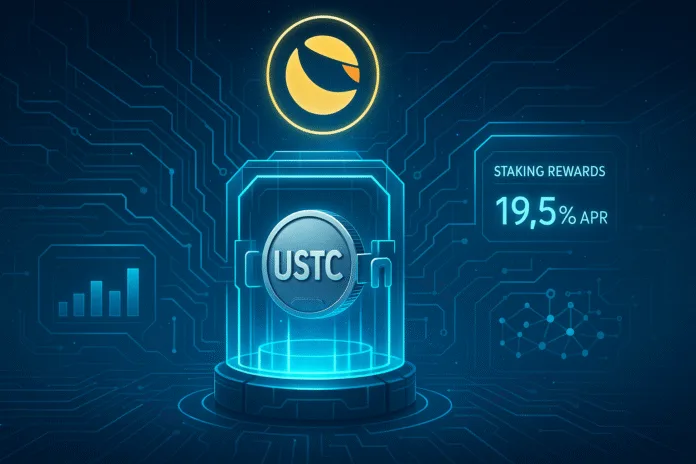
The goal is to stake at least 532 million USTC on-chain, removing it from circulation, with an estimated APR of 1.4%. This would provide sufficient rewards for approximately two years. Additional “dead” pools can be utilized in the future to sustain the system.
Proposed Solution
Governance and Rewards
The USTC staking mechanism will not grant governance voting power, only APR rewards.
To incentivize validators to run a USTC price feeder (required for Market Module 2), rewards will only be distributed to USTC stakers if their validator operates a USTC price feeder, “similar” to the LUNC staking system.
Motivation
Reducing Circulating Supply
Currently, Binance accounts for ~29% of USTC’s daily trading volume (~200 million USTC), with total daily volume across all exchanges at ~400 million USTC. Staking 532 million USTC would remove approximately 8.8% of the circulating supply, significantly reducing available tokens in the market.
Price Stabilization
Reducing the circulating supply could stabilize and potentially increase the USTC price. Additionally, as the LUNC staking system rewards both LUNC and USTC, a higher USTC price would increase the dollar value of staking rewards, encouraging more LUNC staking. This could create a snowball effect, reducing the circulating supply of both LUNC and USTC, further supporting price stability across the Terra Classic ecosystem.
Preparation for Market Module 2
The staking system would incentivize validators to run USTC price feeders, facilitating the testing and implementation of Market Module 2.
Implementation Steps
Develop test a staking mechanism for USTC on-chain.
Create a USTC price feeder (to be addressed in a separate MM2 proposal).
Audit & Implementation
Community Feedback
This is a signal proposal to gauge community sentiment regarding the USTC staking system. If the community supports this initiative, a detailed technical proposal will follow.
Please provide feedback to help shape the future of this proposal and the Terra Classic ecosystem.