
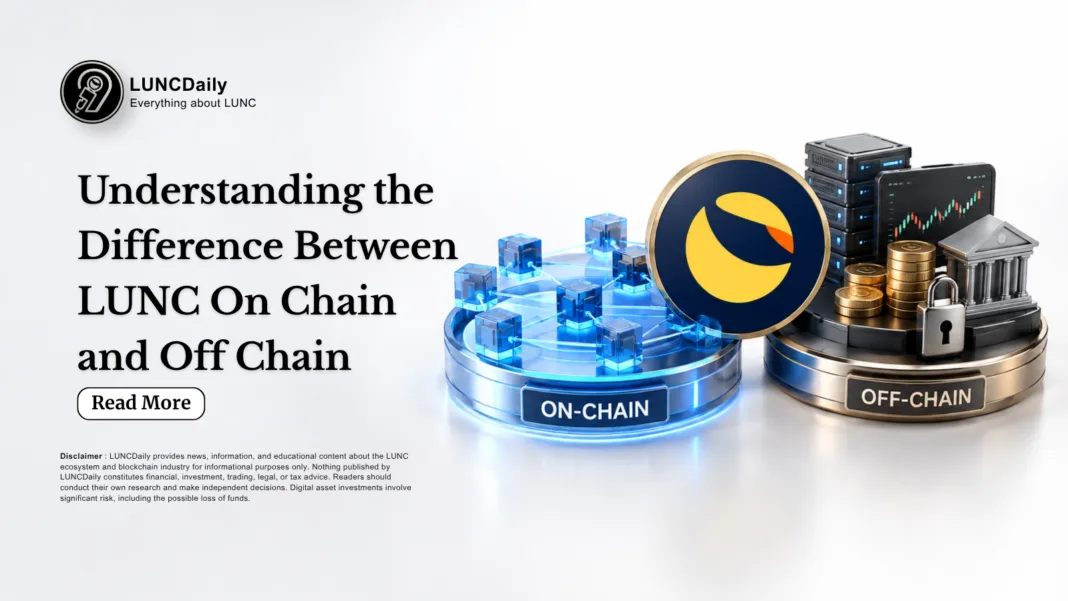


LUNC On Chain vs Off Chain: What Is the Difference and How Does the 1.5% Tax Work?
LUNC transactions can happen in two very different environments, and understanding that difference is important for anyone following the Terra Classic burn mechanism.
When LUNC moves directly through the Terra Classic blockchain, the transaction is recorded on chain and is subject to the network’s applicable rules and parameters. However, when users buy, sell, or transfer LUNC between accounts inside a centralized exchange, the activity can happen internally without creating an individual blockchain transaction for every trade.
This distinction explains why the LUNC on chain tax and off chain activity work differently.
What Is LUNC On Chain?
An on chain LUNC transaction is an activity that is processed and recorded directly on the Terra Classic blockchain.
For example, when a user sends LUNC from one personal wallet to another wallet through the Terra Classic network, the transaction is broadcast to the blockchain. Validators process the transaction, and the transaction becomes part of the public blockchain record.
On chain activity can include transactions involving personal wallets, decentralized applications and decentralized exchanges, depending on the specific transaction type.
Because the transaction interacts directly with the Terra Classic network, applicable network parameters can affect how the transaction is processed.
How Does the LUNC On Chain Tax Work?
Terra Classic currently has a 1.5% on chain burn tax for applicable taxable transactions. The current parameter was adopted through Terra Classic governance. The tax is divided into three parts:
| Allocation | Rate |
|---|---|
| LUNC burn | 1.2% |
| Community Pool | 0.15% |
| Oracle Pool | 0.15% |
| Total | 1.5% |
The 1.5% rate therefore does not mean that the entire amount is burned. 1.2% of the applicable taxable amount is allocated to the burn, while the remaining 0.3% is divided between the Community Pool and Oracle Pool.
For example, if an applicable transaction has a taxable amount of 1,000,000 LUNC, the 1.5% tax would be 15,000 LUNC.
12,000 LUNC goes toward the burn.
1,500 LUNC goes to the Community Pool.
1,500 LUNC goes to the Oracle Pool.
The actual transaction mechanics can depend on the transaction type and how the application or wallet handles the tax.
What Is LUNC Off Chain?
An off chain LUNC transaction generally refers to activity that happens outside the Terra Classic blockchain’s transaction system.
The most common example is trading inside a centralized cryptocurrency exchange.
When a user buys LUNC on an exchange, the exchange may update the user’s internal account balance rather than broadcasting a separate Terra Classic blockchain transaction for every purchase or sale.
For example, imagine a user buys 10 million LUNC on a centralized exchange.
The exchange can record that purchase internally in its own database. The blockchain does not necessarily record a separate transaction showing that specific user’s purchase from another exchange user.
This is why exchange trading activity should not automatically be treated as the same thing as on chain LUNC transfers.
The Key Difference Between On Chain and Off Chain
The easiest way to understand the difference is to look at where the transaction is processed.
| Feature | LUNC On Chain | LUNC Off Chain |
|---|---|---|
| Processing location | Terra Classic blockchain | Exchange or other internal system |
| Recorded directly on blockchain | Yes | Usually no for internal activity |
| Terra Classic network involved | Yes | Not necessarily |
| On chain tax applicable | Can apply to taxable transactions | Not automatically |
| Blockchain transaction created | Yes, when the activity is an on chain transaction | Usually not for internal exchange trades |
| Example | Wallet to wallet transfer | Buying LUNC inside a centralized exchange |
The important point is that off chain does not mean the LUNC is not real. It means the particular activity is being recorded outside the blockchain’s transaction layer.
What Happens When LUNC Moves Between an Exchange and a Wallet?
This is where the difference becomes especially important.
Suppose a user buys LUNC on a centralized exchange and later withdraws it to a Terra Classic wallet.
The purchase inside the exchange can be an off chain transaction.
The withdrawal from the exchange to the user’s wallet, however, requires the exchange to send LUNC through the Terra Classic network. That creates an on chain transaction.
The same principle applies in the opposite direction.
A user can send LUNC from a personal wallet to an exchange. That deposit requires an on chain blockchain transaction.
Once the LUNC arrives at the exchange, subsequent trading between users inside the exchange can be recorded internally rather than as separate Terra Classic transactions.
Does Every LUNC Trade Pay the 1.5% Tax?
No.
The 1.5% figure refers to the on chain tax parameter, not a universal 1.5% charge on every LUNC transaction everywhere.
The key question is whether the activity creates an applicable taxable transaction on the Terra Classic blockchain.
A trade that happens internally within a centralized exchange does not automatically trigger the Terra Classic on chain tax simply because the asset being traded is LUNC.
However, an exchange withdrawal or deposit involving the Terra Classic blockchain is an on chain transaction and can be subject to the applicable network rules.
There can also be exchange specific fees or policies that are separate from the Terra Classic network tax.
Why This Difference Matters for LUNC Burns
The distinction between on chain and off chain activity is important when discussing LUNC burns.
On chain taxable activity can contribute directly to the Terra Classic burn mechanism through the burn tax.
Off chain trading does not automatically create the same on chain tax event.
This means a large amount of LUNC trading volume on centralized exchanges should not automatically be interpreted as an equivalent amount of on chain taxable volume.
For example, if millions of LUNC are traded between users inside an exchange, those trades can represent significant market activity while still not creating individual Terra Classic blockchain transactions for each trade.
On the other hand, moving LUNC between an exchange and an external wallet requires interaction with the blockchain.
Why On Chain Volume and Exchange Volume Should Be Viewed Separately
LUNC market volume and LUNC on chain volume measure different types of activity.
Exchange volume can include buying and selling activity occurring inside centralized trading platforms.
On chain volume refers to transactions that actually interact with the Terra Classic blockchain.
These numbers therefore should not be treated as interchangeable.
A high exchange trading volume does not necessarily mean the same amount of LUNC has moved through taxable on chain transactions.
Likewise, an increase in on chain activity can have different implications depending on the types of transactions taking place.
What About Decentralized Exchanges?
Decentralized exchanges operate differently from centralized exchanges because transactions generally interact directly with blockchain smart contracts.
When a LUNC swap is processed through an on chain decentralized application, the transaction can interact with the Terra Classic network and its applicable tax rules.
However, the exact treatment depends on the transaction structure and the current Terra Classic parameters.
Terra Classic’s v3.3.0 update also changed how the burn tax is handled by moving tax handling internally on chain rather than relying on clients to calculate it in the same way as before.
This makes it important to distinguish between the type of transaction and simply calling something a “trade.”
A Simple Example
Example 1: Wallet to Wallet
Alice sends 10 million LUNC from her Terra Classic wallet to Bob’s Terra Classic wallet.
This is an on chain transaction.
If the transaction is taxable under the current network parameters, the applicable tax is processed through the Terra Classic network.
Example 2: Buying LUNC on a Centralized Exchange
Alice buys 10 million LUNC from another trader on a centralized exchange.
The exchange can record the transaction internally.
This does not automatically create a separate Terra Classic blockchain transaction for the trade itself.
Example 3: Withdrawing LUNC From the Exchange
Alice withdraws her 10 million LUNC from the exchange to her Terra Classic wallet.
The exchange must send the LUNC through the Terra Classic network.
This is an on chain transaction and can therefore be subject to the applicable Terra Classic network tax.
On Chain vs Off Chain: The Bottom Line
The difference between LUNC on chain and off chain is primarily about where the transaction is processed and recorded.
On chain activity interacts directly with the Terra Classic blockchain and can be subject to its network parameters, including the current 1.5% tax on applicable taxable transactions.
Off chain activity, such as internal trading on a centralized exchange, can be recorded within the exchange’s own system without creating an individual Terra Classic blockchain transaction for every trade.
For the LUNC community, this distinction is particularly important when discussing burns. Trading volume on an exchange should not automatically be counted as taxable on chain volume, and an on chain transfer should not be confused with an internal exchange transaction.
Understanding these two types of activity provides a clearer picture of how LUNC moves through the ecosystem and how the Terra Classic burn mechanism works.