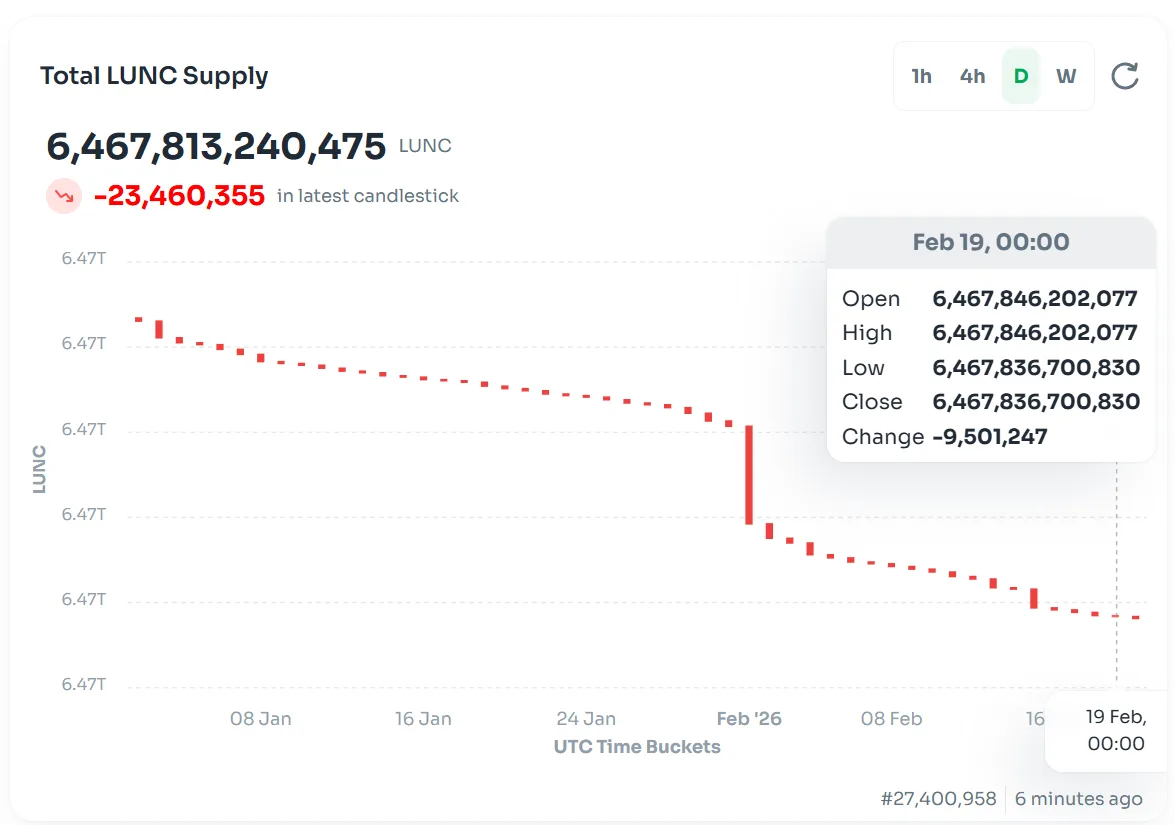
The Terra Classic network continues to reduce its circulating supply through ongoing burn activity. Over the past 25 days, a total of 6,330,076,656 LUNC has been burned, reinforcing long term supply reduction efforts across the ecosystem.
Burn activity recorded throughout January reflects consistent participation from exchanges, community driven initiatives, and on chain mechanisms. While daily burn volumes vary, the overall trend demonstrates sustained commitment to reducing LUNC supply.
The largest burn event occurred on January 1, when more than 5.29 billion LUNC was burned through Binance’s monthly LUNC burn program. This single event accounts for the majority of the total burn volume during the period and remains the most significant contributor to Terra Classic’s ongoing supply reduction strategy.
Outside of the Binance burn, daily LUNC burns ranged from several million to nearly two hundred million tokens, indicating steady on chain activity and continued engagement from the Terra Classic community.
Daily LUNC Burn Data
Month
Date
LUNC Burned
January
1
5,367,757,097
January
2
36,700,121
January
3
194,515,792
January
4
59,068,461
January
5
22,184,507
January
6
55,976,794
January
7
58,298,205
January
8
85,060,487
January
9
22,167,180
January
10
22,949,053
January
11
34,617,148
January
12
33,911,987
January
13
18,745,561
January
14
35,139,054
January
15
16,451,097
January
16
29,576,801
January
17
12,733,630
January
18
17,668,179
January
19
45,755,919
January
20
29,137,485
January
21
25,392,519
January
22
38,485,760
January
23
19,364,345
January
24
17,237,217
January
25
31,182,257
Total
6,330,076,656
What This Means for Terra Classic
Token burning remains a core component of Terra Classic’s recovery strategy. By permanently removing LUNC from circulation, burn initiatives aim to support long term supply reduction while strengthening confidence in the network’s economic model.
With Binance continuing its monthly burn commitment and the community maintaining consistent daily burn activity, Terra Classic shows ongoing momentum toward its broader supply management objectives.
As governance upgrades and ecosystem development progress alongside burn mechanisms, LUNC remains one of the most actively managed recovery focused blockchains in the market.
Terra Classic is taking a major step forward as the network considers an upgrade to Cosmos SDK v0.53.x with IBC v2 Eureka support. A new community spending proposal has officially entered the voting stage, and early results show overwhelming support from validators and delegators.
At the time of writing, the proposal has received approximately 99.9 percent votes in favor and is widely expected to pass.
If approved, this upgrade will modernize the Terra Classic blockchain and significantly improve its interoperability within the Cosmos ecosystem.
The proposal builds on earlier discussions and feedback following Proposal 12142. Based on community input, OrbitLabs has suggested skipping the previously planned Cosmos SDK v0.50 upgrade and moving directly to v0.53.x. This approach reduces complexity and avoids the need for multiple mainnet upgrade events.
Why Upgrade Directly to Cosmos SDK v0.53
Completes all required migrations in a single network upgrade, reducing coordination effort and minimizing downtime
Uses Cosmos SDK v0.53.x, the latest stable long term release, improving future compatibility and maintenance
Eliminates the need for an intermediate v0.50 mainnet deployment
Enables IBC v2 Eureka, unlocking advanced routing and hub and spoke connectivity through the Cosmos Hub
Improves cross chain flexibility and interoperability across the Cosmos ecosystem
Scope of the Upgrade
The proposed work includes upgrading core modules to ensure compatibility with Cosmos SDK v0.53.x, along with Wasmd v0.61.x. In addition, IBC Go will be upgraded directly from version 7.10.0 to version 10.x. This change activates IBC v2 routing logic and allows more advanced message flows such as multi hop token transfers.
Testing and quality assurance play a key role in this proposal. The upgrade will first be deployed on the rebel 2 testnet, where extensive testing will be conducted. This includes connection and channel handshakes, ICS 20 token transfers, and IBC v2 message routing between multiple Cosmos SDK v0.53 chains. Additional testing will ensure smart contracts and standard SDK messages continue to function normally after the upgrade.
Updated documentation will also be provided. Validator runbooks will be revised to reflect a single step upgrade process. Any breaking changes will be clearly documented, and examples of IBC v2 message formats will be shared for developers and integrators.
How This Plan Improves on the Previous Proposal
Under the original plan, Terra Classic would have upgraded to Cosmos SDK v0.50 first, followed by a later upgrade to v0.53. The updated proposal replaces this with a single upgrade directly to v0.53.x. This change reduces workload, avoids repeated network disruptions, and delivers IBC v2 support immediately instead of delaying it.
Budget Overview
The total budget requested for the combined upgrade is 56,000 US dollars. The funding is divided into two phases to ensure transparency and accountability.
Phase One: Testnet Implementation and Validation
Budget: 40,000 US dollars
This phase covers code migration to Cosmos SDK v0.53.x, rebel 2 testnet deployment, extended IBC v2 testing, and the publication of preliminary documentation for developers.
Phase Two: Mainnet Execution and Post Upgrade Support
Budget: 16,000 US dollars
This phase includes governance preparation, validator coordination, mainnet upgrade execution, and immediate post upgrade monitoring.
The additional 8,000 US dollars compared to the earlier proposal reflects the extra work required to migrate directly to SDK v0.53.x, enable IBC v2 Eureka, and extend the testing period. The exact LUNC amount for each phase will be calculated at the time of submission for each community spend proposal.
Proposed Timeline
The upgrade process is planned over approximately thirteen weeks. The first eight weeks will focus on core code migration and testnet deployment. Weeks nine and ten are reserved for extended testnet testing, particularly for IBC v2 message routing and failure scenarios. Week eleven will focus on documentation and final reviews. Weeks twelve and thirteen will cover governance submission and mainnet upgrade execution.
This timeline is slightly longer than the original plan, adding extra time to ensure IBC v2 functionality is fully tested before reaching mainnet.
Risks and Mitigation
Cosmos SDK v0.53.x introduces optional features such as protocol pools, epochs, and unordered transactions. To reduce risk, these features will remain disabled unless future governance decides otherwise.
Another potential risk is related to IBC v2 interoperability. To address this, full end to end testing will be conducted across multiple Cosmos SDK v0.53.x chains during an extended testnet phase.
Expected Outcome
Once completed, Terra Classic will operate on the latest stable Cosmos SDK release and fully support IBC v2 Eureka. The network will be better positioned for cross chain activity, while avoiding the need for a second major upgrade. Validators and developers will benefit from a well documented and tested upgrade path, strengthening the long term sustainability of the Terra Classic ecosystem.
More than 740,000 USTC tokens have been burned during the first 23 days of January, showing continued efforts to reduce the circulating supply. According to the latest data, a total of 744,394 USTC has been permanently removed from circulation through daily burn activity.
Token burns are an important mechanism for the Terra Classic ecosystem. By reducing supply, burns can help support long term stability and demonstrate ongoing community and ecosystem participation.
Daily USTC Burn Breakdown
The table below shows the daily USTC burn data recorded from January 1 to January 23.
Month
Date
USTC Burn
January
1
33,407
January
2
93,158
January
3
15,065
January
4
7,253
January
5
15,637
January
6
7,618
January
7
9,758
January
8
33,196
January
9
58,758
January
10
115,023
January
11
8,474
January
12
7,387
January
13
18,707
January
14
6,542
January
15
9,397
January
16
9,043
January
17
8,298
January
18
5,860
January
19
131,816
January
20
17,210
January
21
44,796
January
22
77,570
January
23
10,421
Total
744,394
Key Observations
The highest daily burn occurred on January 19, when more than 131,000 USTC was burned in a single day. Another notable spike was recorded on January 10, with over 115,000 USTC burned.
While daily burn amounts vary, the overall trend confirms steady burn activity throughout the month. Such fluctuations are normal and often depend on on chain usage, transactions, and ecosystem initiatives.
What This Means for Terra Classic
Consistent USTC burns reflect ongoing engagement within the Terra Classic network. Although burn volume alone does not guarantee price movement, it remains a positive signal for long term supply reduction efforts.
As January continues, the community will be watching closely to see whether burn activity maintains its current pace or increases further through higher on chain activity and ecosystem growth.
The Terra Classic network has recorded a significant milestone in its ongoing token reduction efforts. Over the past 23 days, more than 6.28 billion LUNC have been permanently removed from circulation. This steady burn activity highlights continued community participation and on chain usage across the ecosystem.
The majority of the burn volume came at the beginning of the month. On January 1 alone, over 5.36 billion LUNC were burned. This large single day burn contributed heavily to the overall total and set a strong starting point for January.
Following this event, daily burn amounts stabilized at lower but consistent levels. Throughout the rest of the month, daily burns ranged from around 12 million to over 85 million LUNC. While these figures are smaller compared to the first day, they still reflect ongoing network activity and steady contributions to supply reduction.
Burning LUNC helps reduce the total circulating supply over time. This mechanism is widely viewed by the community as a long term effort to support network value and sustainability. Continued on chain transactions, application usage, and community initiatives remain key drivers behind these burns.
Orbit Wire Launches Telegram Price Bot for the Terra Classic Ecosystem
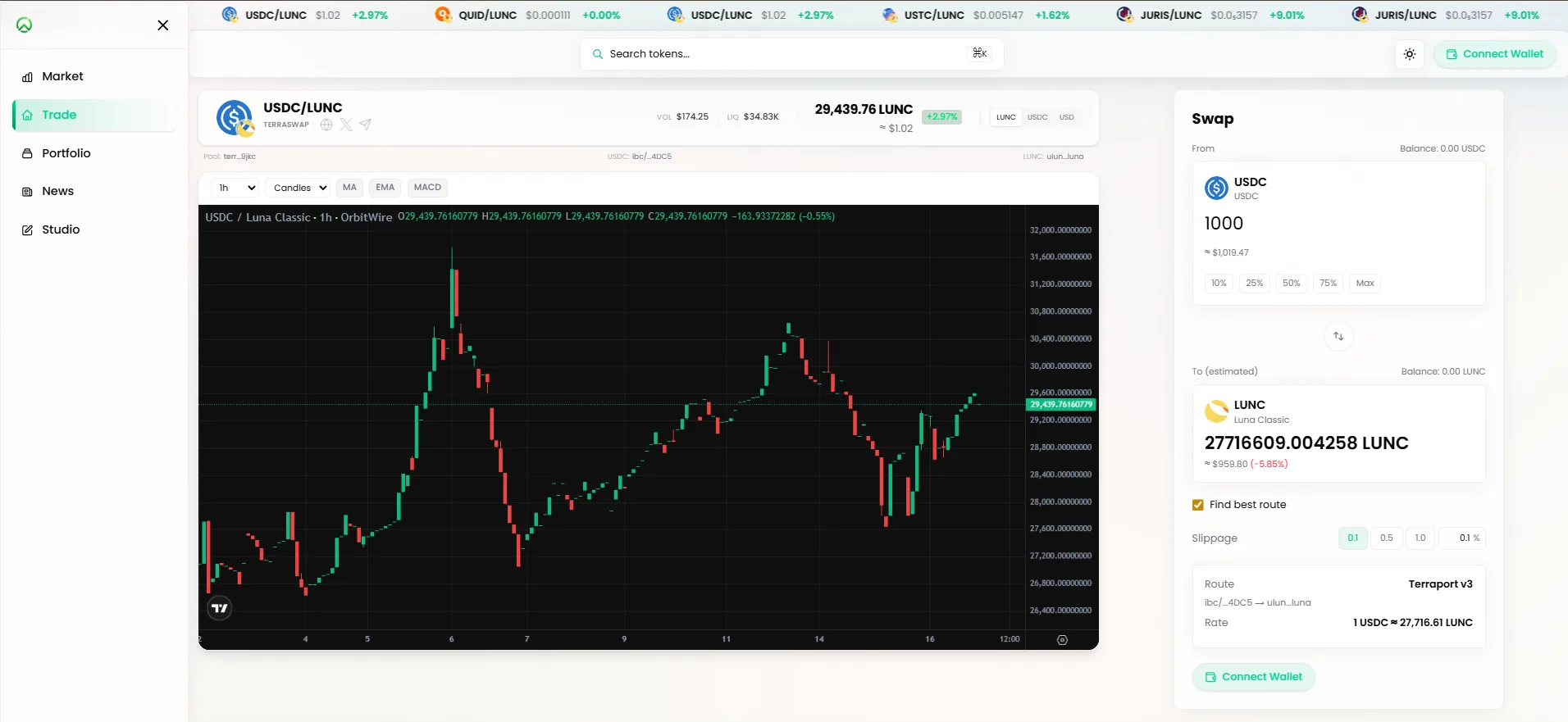
Orbit Wire has launched a new Telegram Price Bot to help the Terra Classic community access token information quickly and easily. This bot allows users to check prices and market data for LUNC, USTC, and all tokens in the Terra Classic ecosystem directly from Telegram, without opening a browser.
The bot is free to use and can be added to any Telegram group. It is designed to make price checking simple, fast, and accessible for everyone in the community.
How the Orbit Wire Telegram Price Bot Works
Using the Orbit Wire Telegram Price Bot is very simple and does not require technical knowledge. Follow these steps:
Add the Orbit Wire Price Bot to your Telegram group or open it in a private chat
In the chat, type the command: /p TOKENNAME
Send the message
The bot receives your request
The bot asks Orbit Wire for the latest token data
Orbit Wire sends real time information back to the bot
The bot displays the token data instantly in Telegram
The entire process happens in seconds.
What Information the Bot Shows
After using the command, the bot displays important token details, including:
The platform where the token is listed, such as MIOFF
The blockchain network, which is Terra Classic
The token price shown in both USD and LUNC
Available liquidity
Twenty four hour trading volume
Simple One Sentence Explanation
This Telegram bot lets users check Terra Classic token prices and market data by typing a simple command, using real time data from Orbit Wire.
Ultra Simple Explanation
Type /p (tokenname) in Telegram and the bot will show the token price, liquidity, and trading volume from USDC using Orbit Wire data.
Beginner Friendly Explanation of the Latest SDK v53 Update on Luna Classic
Terra Classic is currently testing a major software upgrade on its rebel 2 testnet. The upgrade brings the network in line with the latest Cosmos SDK v0.53 and IBC v2 standards. The testnet has been running smoothly for around three weeks, showing stable core chain services.
This article explains the update in a simple way and highlights what it means for users and developers.
What Is Being Tested on Terra Classic
The rebel 2 testnet is running Cosmos SDK v0.53.x
The upgrade has been active for approximately three weeks
Core chain services remain stable
Active testing is still ongoing
This upgrade is not yet live on mainnet
What Is a Testnet
A testnet is a practice network used before mainnet deployment.
Developers test upgrades safely
No real funds are involved
Issues can be fixed early
Mainnet users are not affected
What Was Upgraded
Two major components were updated.
Cosmos SDK v0.53.4 is the main blockchain framework
It manages transactions, modules, and core logic
It is widely used across Cosmos based networks
IBC v2 (IBC go v10.3.0) handles cross chain communication
It enables blockchain interoperability
It is the latest supported version
Is the Network Stable
Based on the developer update:
Core chain services are stable
The testnet has been running for about three weeks
No major issues have been reported
Testing is still ongoing
What Actually Changed for the Ecosystem
Only one visible change was introduced
The change mainly affects developers
Normal users are largely unaffected
The change is related to transaction outputs
Transaction Logs and Events Explained Simply
When a transaction is sent, the blockchain returns information about what happened.
Previously, this information was returned as logs
With Cosmos SDK v0.53, logs are deprecated
Events are now the official source of transaction data
Smart contracts already emit events
Events are indexed and searchable
Most explorers already rely on events
How Terra Classic Reduced Potential Issues
Terra Classic introduced a compatibility layer to reduce disruption.
When querying confirmed transactions, logs are reconstructed from events
When broadcasting transactions, logs are no longer included
This follows the new Cosmos SDK standards
What This Means for Developers
No changes are needed for most applications.
Apps that query transactions after confirmation
Indexers already using events
Smart contract event handling
Changes are required for some applications.
Apps that expect logs immediately after broadcasting a transaction
Wait for the transaction to be included in a block
Query the transaction by its hash
Read transaction data from events
New Recommended Transaction Flow
Old method:
Send transaction
Read logs immediately
New method:
Broadcast transaction
Wait for block inclusion
Query transaction by hash
Read data from events
Impact Summary
Most applications will continue to work normally
Only broadcast time log dependent apps need updates
Terra Classic now aligns with the latest Cosmos SDK behavior
Future upgrades become easier and safer
Final Recommendation
Use events as the primary source of transaction data
SDK v0.53 Update: Terra Classic Rebel 2 Testnet Runs With Stable Core Services
The Terra Classic rebel 2 testnet has been running on Cosmos SDK v0.53.x for approximately three weeks, according to the latest developer update. During this period, core chain services have remained stable, while the network continues to undergo active testing.
This testnet configuration moves Terra Classic onto Cosmos SDK version 0.53.4 and IBC go version 10.3.0, also referred to as IBC v2. These versions represent the latest upstream releases within the Cosmos ecosystem and are widely adopted across multiple networks.
Testnet Status and Stability
The update confirms that the rebel 2 testnet has been operating continuously with the new SDK for several weeks. Core blockchain services are functioning as expected, indicating a stable test environment. However, testing remains ongoing, and the network has not yet completed the full evaluation process.
This extended testnet phase is intended to validate behavior changes introduced by the newer Cosmos SDK and IBC versions before any future production level decisions are made.
Transaction Output Behavior Change
The only ecosystem visible change identified during testing relates to transaction output behavior. With the introduction of Cosmos SDK v0.53 and ABCI 2.0, the SDK no longer constructs transaction logs. Instead, events are now defined as the canonical and protocol level transaction output.
This behavior change originates from upstream Cosmos SDK development and applies across the broader Cosmos ecosystem.
Events Replace Logs as Canonical Output
Under the new SDK behavior, both logs and raw log fields are deprecated and are no longer constructed by default. Events now serve as the official source of transaction information.
Smart contracts continue to emit events as before, and these events remain indexed and fully queryable. Blockchain explorers and indexers that already rely on events are not affected by this change.
Terra Classic Compatibility Handling
To reduce ecosystem disruption while aligning with upstream SDK behavior, Terra Classic has implemented a compatibility layer for transaction query endpoints. When transactions are queried after inclusion, legacy logs are reconstructed from events to support existing applications.
Broadcast transaction responses now follow upstream behavior and do not include logs.
Developer Impact
Applications that query transaction results after block inclusion continue to function without changes. Indexers and applications that consume events are also unaffected, as are smart contract event subscriptions.
Applications that rely on transaction logs returned at broadcast time must update their workflow. These applications are required to wait for transaction inclusion, query the transaction by hash, and read data from events or reconstructed logs.
Recommended Developer Approach
Developers are encouraged to treat events as the canonical source of transaction data and to adopt query based transaction result handling. This approach aligns Terra Classic with Cosmos SDK v0.53 and IBC v2 standards and supports long term compatibility across the Cosmos ecosystem.
Conclusion
The Terra Classic rebel 2 testnet continues to run Cosmos SDK v0.53.x with stable core services while active testing remains underway. The primary visible change involves transaction output behavior, reflecting upstream Cosmos SDK updates. Ongoing testing will further validate stability and compatibility as development progresses.
The Luna Classic staking ratio has started to show a slow but positive recovery after a recent decline earlier this month.
On 19 January, the Luna Classic staking ratio dropped to around 15.05 percent. This decrease reflected a temporary reduction in staked LUNC as some holders chose to unstake or move their tokens. Such movements are common during periods of market uncertainty or short term price fluctuations.
In the days that followed, the staking ratio stabilized and has now begun to rise again. As of today, the Luna Classic staking ratio has increased to approximately 15.1 percent. This gradual improvement suggests that some LUNC holders are returning to staking, signaling renewed confidence in the network.
Staking plays an important role in the Luna Classic ecosystem. A higher staking ratio helps strengthen network security and shows long term commitment from the community. While the current increase is modest, it represents a positive shift after the recent dip.
Overall, the slow rise in the Luna Classic staking ratio indicates early signs of recovery. Continued growth in staking participation could support network stability and reflect improving sentiment among LUNC holders in the coming weeks.
The Terra Classic ecosystem continues to reduce its circulating USTC supply through ongoing burn activity. Over the last 21 days of January, a total of 656,403 USTC has been permanently removed from circulation.
This consistent burn activity reflects on the role of on chain transactions and projects in supporting long term supply reduction.
Daily USTC Burn Breakdown
Below is the detailed daily USTC burn record for the first 21 days of January.
Month
Date
USTC Burned
January
1
33,407
January
2
93,158
January
3
15,065
January
4
7,253
January
5
15,637
January
6
7,618
January
7
9,758
January
8
33,196
January
9
58,758
January
10
115,023
January
11
8,474
January
12
7,387
January
13
18,707
January
14
6,542
January
15
9,397
January
16
9,043
January
17
8,298
January
18
5,860
January
19
131,816
January
20
17,210
January
21
44,796
Total
656,403
What This Means for Terra Classic
While no single day dominates the overall burn total, the steady daily reductions show that USTC burns are being supported by regular on chain activity and projects in supporting burn.
Sustained transaction usage remains an important factor in long term supply management. As network participation continues, these incremental burns can contribute to gradual improvements in token economics over time.
Final Thoughts
The removal of more than 650,000 USTC in just 21 days highlights ongoing efforts within the Terra Classic ecosystem to manage supply responsibly. consistent on chain activity and projects in supporting burn will remain key elements in maintaining momentum for future burn progress.
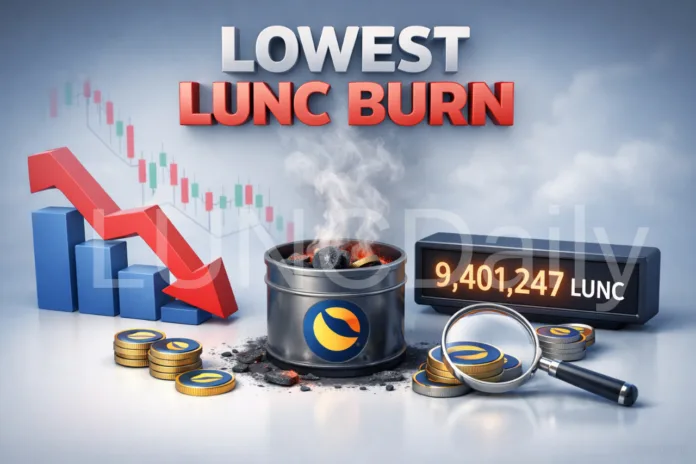
Luna Classic burn rate has become worse in January based on daily burn data.
In the last 18 days, Luna Classic burn rates cannot pass 100 million LUNC per day. To be more worse, in the last 13 days, Luna Classic burn rates cannot pass 50 million LUNC per day.
Although the total burned amount in January looks large, most of it came from January 1. On that day, more than 5.3 billion LUNC was burned, with 5.29 billion coming from Binance’s monthly LUNC burn program.
Below is the daily Luna Classic burn recap for January.