Many community members keep asking the same question: how long does it take to burn 1 trillion LUNC?
To answer this, we use simple math based on real on chain data, not assumptions or price speculation.
This analysis reflects historical burn performance only.
Before reviewing the numbers, it is important to understand that LUNC is burned through two mechanisms.
The first is on chain transaction burns, which come from real network usage such as transfers and smart contract interactions.
The second is direct wallet burns, where LUNC is manually sent to the burn wallet by individuals, exchanges, or organizations.
Both burn sources are calculated separately to keep the analysis transparent.
Time Period Covered
Description
Duration
Burn start date
May 13, 2022
End date
January 28, 2026
Total duration
1,356 days
Total LUNC Burned
Burn Source
Total Burned
On chain transactions
84.49 billion LUNC
Direct wallet burns
352.57 billion LUNC
Total burned
437.06 billion LUNC
This clearly shows that most LUNC burns so far come from direct wallet burns rather than organic network activity.
Average Daily Burn Rate
Using a total duration of 1,356 days, the average daily burn rate can be calculated.
Total burn rate including all sources:
437.06 billion LUNC divided by 1,356 days equals approximately 322.4 million LUNC burned per day.
On chain transaction burns only:
84.49 billion LUNC divided by 1,356 days equals approximately 62.3 million LUNC burned per day.
Time Required to Burn 1 Trillion LUNC
Burn Scenario
Days Required
Years Required
All burn sources
3,101 days
Approximately 8.5 years
On chain only
16,048 days
Approximately 43.9 years
Projection Breakdown
Burn Scenario
Days
Months
Years
All burn sources
3,101
About 102 months
About 8.5 years
On chain only
16,048
About 528 months
About 43.9 years
Key Observations
More than eighty percent of all LUNC burned so far comes from direct wallet burns.
On chain transaction burns alone are too slow to significantly reduce supply within a reasonable timeframe.
Without a major increase in real network usage, utility, and transaction volume, the burn rate will remain limited.
This analysis shows that sustainable supply reduction depends on stronger on chain activity rather than voluntary burns.
An altcoin season refers to a market phase where most altcoins consistently outperform Bitcoin over a sustained period. This usually happens after Bitcoin completes a strong upward move and capital begins rotating into alternative cryptocurrencies.
When the Last Altcoin Season Occurred
The last confirmed and market wide altcoin season took place in 2021. It remains the clearest example of a full altcoin cycle in recent crypto history.
Key Characteristics of the 2021 Altcoin Season
Bitcoin led the market with a major rally before slowing down
Capital rotated from Bitcoin into Ethereum and then into altcoins
Bitcoin dominance declined steadily
A broad range of altcoins outperformed Bitcoin, not just a few sectors
Timeframe of the Last Altcoin Season
Began in early 2021
Peaked between February and November 2021
Ended as market momentum weakened toward the end of the year
Market Performance During 2021
Ethereum reached new all time highs
Layer 1 and Layer 2 projects saw strong growth
Decentralized finance and non fungible token sectors expanded rapidly
Retail participation increased across the entire altcoin market
What Happened After 2021
2022 entered a prolonged bear market
Overall crypto activity declined sharply
No sustained altcoin outperformance occurred
Altcoin Activity in 2023
Selective rallies appeared in specific sectors
Artificial intelligence and scaling solutions gained temporary attention
Bitcoin dominance remained strong
These conditions did not meet altcoin season criteria
Market Conditions in 2024 and 2025
Bitcoin and Ethereum continued to lead price action
Some altcoins performed well individually
Broad market rotation into altcoins did not occur
This phase is better defined as a transition period
Key Indicators of a True Altcoin Season
Bitcoin completes a strong upward move
Bitcoin dominance peaks and begins to decline
Altcoins outperform Bitcoin across multiple sectors
Momentum lasts for several months
Conclusion
The last full and confirmed altcoin season occurred in 2021. Since then, the market has experienced recovery phases and limited altcoin rallies, but not a complete and sustained shift away from Bitcoin dominance. Understanding these cycles helps investors distinguish between short term hype and true market trends.
Did You Know Only 1 Billion LUNC Was Burned in January Through On Chain Activity
As January comes to an end, it is important for the Luna Classic community to re evaluate the current state of on chain burn activity. Many community members focus on total burn numbers, but a closer look shows that on chain activity remains relatively weak.
In January, the total amount of LUNC burned through on chain related activity reached over 6.3 billion LUNC. While this may sound significant at first glance, the daily burn rate throughout the month struggled to consistently pass 100 million LUNC per day. This highlights ongoing challenges in driving strong on chain usage and transaction volume.
A major factor that impacts monthly burn totals is Binance. During January, Binance burned approximately 5,295,992,495 LUNC as part of its monthly LUNC burn program. This burn was generated from LUNC trading fees collected on Binance during December 2025.
If the Binance burn is excluded, the remaining LUNC burned so far is just over 1 billion. Even this figure does not come entirely from pure on chain activity. Some burns are contributed by validators, projects, wallets, and exchanges. However, these contributions remain relatively small. For simplicity, the remaining amount can be viewed as largely representing on chain activity.
The data below shows the daily LUNC burn figures recorded throughout January.
Month
Date
LUNC Burn
January
1
71,764,602
January
2
36,700,121
January
3
194,515,792
January
4
59,068,461
January
5
22,184,507
January
6
55,976,794
January
7
58,298,205
January
8
85,060,487
January
9
22,167,180
January
10
22,949,053
January
11
34,617,148
January
12
33,911,987
January
13
18,745,561
January
14
35,139,054
January
15
16,451,097
January
16
29,576,801
January
17
12,733,630
January
18
17,668,179
January
19
45,755,919
January
20
29,137,485
January
21
25,392,519
January
22
38,485,760
January
23
19,364,345
January
24
17,237,217
January
25
31,182,257
January
26
37,348,523
Total
1,071,432,684
Overall, January data shows that on chain burn activity remains modest. While exchange driven burns such as Binance play a major role in reducing supply, long term sustainability depends on stronger on chain usage. Increased transactions, real applications, and broader ecosystem growth are essential to improving daily burn rates and supporting the future of the Luna Classic network.
Nearly 800,000 USTC Burned in the Last 26 Days as Community Efforts Continue
The Terra Classic community continues to show steady commitment to supply reduction as nearly 800,000 USTC tokens have been burned over the past 26 days. According to on chain data, a total of 786,277 USTC has been removed from circulation between January 1 and January 26.
Token burning remains one of the key mechanisms used by the community to reduce circulating supply and support long term recovery efforts. While daily burn amounts vary, the overall trend highlights consistent participation and ongoing activity across the Terra Classic ecosystem.
Several days recorded notable spikes in burn volume, particularly on January 2, January 10, and January 19. These higher burn days contributed significantly to the monthly total and reflect moments of increased community engagement.
Daily USTC Burn Data
Month
Date
USTC Burn
January
1
33,407
January
2
93,158
January
3
15,065
January
4
7,253
January
5
15,637
January
6
7,618
January
7
9,758
January
8
33,196
January
9
58,758
January
10
115,023
January
11
8,474
January
12
7,387
January
13
18,707
January
14
6,542
January
15
9,397
January
16
9,043
January
17
8,298
January
18
5,860
January
19
131,816
January
20
17,210
January
21
44,796
January
22
77,570
January
23
10,421
January
24
14,897
January
25
13,725
January
26
13,261
Total
786,277
What This Means for Terra Classic
Consistent USTC burning demonstrates sustained community involvement and reinforces long term supply management goals. While the burn volume alone does not determine price movement, it plays an important role in strengthening confidence and transparency within the ecosystem.
As the Terra Classic network continues to evolve, ongoing burn activity remains a positive signal of collaboration between validators, developers, and community members.
Luna Classic Burn Rate Continues to Decline as Daily Burns Stay Below 50 Million LUNC Per Day
The Luna Classic burn rate continued to decline throughout January 2026, with daily burns struggling to reach 50 Million LUNC per day over the past 18 days. This slowdown is mainly caused by reduced on chain activity across the network.
Token burning remains a key mechanism for lowering LUNC supply and supporting long term ecosystem recovery. However recent data shows that most daily burns are relatively small, reflecting weak transaction volume and limited network usage.
On chain activity plays a direct role in burn performance. When transactions decrease, fewer fees are collected and fewer tokens are removed from circulation. As a result, organic burns generated by daily network usage remain low.
Despite the decline in daily burn rates, January 2026 still recorded a large total burn figure due to external contributions.
Daily LUNC Burn Recap for January 2026
Month
Date
LUNC Burned
January
1
5,367,757,097
January
2
36,700,121
January
3
194,515,792
January
4
59,068,461
January
5
22,184,507
January
6
55,976,794
January
7
58,298,205
January
8
85,060,487
January
9
22,167,180
January
10
22,949,053
January
11
34,617,148
January
12
33,911,987
January
13
18,745,561
January
14
35,139,054
January
15
16,451,097
January
16
29,576,801
January
17
12,733,630
January
18
17,668,179
January
19
45,755,919
January
20
29,137,485
January
21
25,392,519
January
22
38,485,760
January
23
19,364,345
January
24
17,237,217
January
25
31,182,257
January
26
37,348,523
Total
6,367,425,179
Binance Contribution Dominates Monthly Burns
Although more than 6.36 billion LUNC were burned in January 2026, most of this amount did not come from daily on chain activity. Approximately 5.29 billion LUNC were burned through Binance’s monthly LUNC burn program.
This means organic burns generated by the Luna Classic network itself remain relatively low. Without stronger ecosystem usage and higher transaction volume, daily burn levels are unlikely to improve significantly.
Outlook for Luna Classic
The current data highlights the importance of real network growth. Increased application usage, higher transaction activity, and broader community participation are necessary to support sustainable and consistent LUNC burns.
While centralized burn programs continue to play an important role, long term supply reduction will depend on organic on chain demand.
Why Buy and Hold Remains the Strongest Strategy for Long Term LUNC Investors
Binance founder Changpeng Zhao, widely known as CZ, has stated that very few trading strategies consistently outperform the simple buy and hold approach. His message is clear. For most people, long term patience beats short term trading.
This perspective is especially relevant for the Terra Classic community. As LUNC prices decline to around 0.000037 dollars, many community members feel discouraged. Falling prices can affect investor confidence and create fear about the future of LUNC.
It is important to understand that not everyone in the LUNC ecosystem is a trader or a builder. The majority of community members are investors. When prices continue to decline, emotional decisions often lead to panic selling. In many cases, this results in investors locking in losses and losing the long term value of their investment.
For investors, the buy and hold strategy may be the most suitable approach. Below are the key reasons why this strategy often delivers better outcomes.
Buy and Hold Reduces Emotional Decisions
Crypto markets move quickly and emotions often drive poor decisions. Fear during price drops and greed during price spikes cause many investors to buy high and sell low.
Buy and hold removes constant decision making. Investors focus on the long term vision rather than short term price movements. This reduces stress and helps avoid costly emotional mistakes.
Time in the Market Matters More Than Timing the Market
Trying to predict the perfect time to buy or sell is extremely difficult. Even professional traders struggle to do this consistently.
Long term investors benefit from staying in the market during recovery phases and growth cycles. Missing just a few strong price recovery days can significantly reduce overall returns. Buy and hold ensures investors remain positioned when momentum returns.
Lower Fees and Fewer Losses
Frequent trading comes with transaction fees, slippage, and execution errors. Over time, these costs slowly reduce capital.
Buy and hold minimizes these expenses. Investors enter the market once and allow their investment to grow without constant deductions. This allows compounding to work more effectively over time.
LUNC Development Is a Long Term Process
The Terra Classic ecosystem continues to evolve through network upgrades, infrastructure improvements, and community driven initiatives. These developments do not reflect instantly in price.
Long term value often follows sustained development, ecosystem growth, and renewed confidence. Buy and hold investors position themselves to benefit from these long term improvements rather than reacting to short term volatility.
Buy and Hold Fits Most Investors
While active trading may work for a small number of highly skilled professionals, most retail investors struggle to outperform the market.
Buy and hold is not about doing nothing. It is about choosing a strategy that aligns with long term growth, reduces mistakes, and protects mental well being.
For the majority of LUNC investors, patience and discipline offer a stronger foundation than constant trading.
Final Thoughts
Price declines can test confidence and patience, especially during uncertain market conditions. However, history shows that long term investors who avoid panic selling often achieve better results.
As CZ has pointed out, very few strategies beat buy and hold. For LUNC investors focused on the future rather than short term price action, this approach may offer clarity, stability, and long term opportunity.
Luna Classic Price Hits January Low as Bitcoin Drops to 86000 Dollars
The cryptocurrency market experienced a sudden shock after Bitcoin dropped sharply to the 86000 dollar price level. This unexpected move caused widespread selling across the market and pushed many altcoins lower, including Luna Classic.
The drop in Bitcoin price caught many investors by surprise and quickly affected overall market sentiment. As Bitcoin leads the broader crypto market, most digital assets followed the same downward trend within hours.
Market Reaction and Possible Causes
Some members of the crypto community believe the sudden decline was linked to uncertainty around the United States government. Concerns have grown over a potential government shutdown next week, as the Clarity Act has not yet passed. This uncertainty appears to have added pressure to an already fragile market.
While no official confirmation links the price drop directly to political events, fear and speculation played a major role in accelerating sell offs across major cryptocurrencies.
Luna Classic Reaches Lowest Price in January
As Bitcoin fell, Luna Classic also moved lower and reached a price of 0.000035 dollars. This marked the lowest price level for LUNC in January 2026. The decline reflected the broader market movement rather than any specific issue within the Terra Classic ecosystem.
Despite the drop, trading activity remained active, showing that interest in Luna Classic continues even during periods of high volatility.
Early Signs of Recovery
Following the initial decline, Luna Classic has started to show early signs of recovery. At the time of writing, the LUNC price has risen to around 0.000037 dollars. This rebound suggests that some buyers are stepping back into the market as prices stabilize.
While market conditions remain uncertain, the recent price movement indicates that Luna Classic is attempting to recover alongside the broader crypto market.
Looking Ahead
The coming days may remain volatile as investors continue to react to macroeconomic and political developments. Bitcoin price movement will likely remain a key factor influencing Luna Classic and the wider crypto market.
As always, traders and investors are encouraged to stay informed and monitor market conditions closely.
The Terra Classic network continues to reduce its circulating supply through ongoing burn activity. Over the past 25 days, a total of 6,330,076,656 LUNC has been burned, reinforcing long term supply reduction efforts across the ecosystem.
Burn activity recorded throughout January reflects consistent participation from exchanges, community driven initiatives, and on chain mechanisms. While daily burn volumes vary, the overall trend demonstrates sustained commitment to reducing LUNC supply.
The largest burn event occurred on January 1, when more than 5.29 billion LUNC was burned through Binance’s monthly LUNC burn program. This single event accounts for the majority of the total burn volume during the period and remains the most significant contributor to Terra Classic’s ongoing supply reduction strategy.
Outside of the Binance burn, daily LUNC burns ranged from several million to nearly two hundred million tokens, indicating steady on chain activity and continued engagement from the Terra Classic community.
Daily LUNC Burn Data
Month
Date
LUNC Burned
January
1
5,367,757,097
January
2
36,700,121
January
3
194,515,792
January
4
59,068,461
January
5
22,184,507
January
6
55,976,794
January
7
58,298,205
January
8
85,060,487
January
9
22,167,180
January
10
22,949,053
January
11
34,617,148
January
12
33,911,987
January
13
18,745,561
January
14
35,139,054
January
15
16,451,097
January
16
29,576,801
January
17
12,733,630
January
18
17,668,179
January
19
45,755,919
January
20
29,137,485
January
21
25,392,519
January
22
38,485,760
January
23
19,364,345
January
24
17,237,217
January
25
31,182,257
Total
6,330,076,656
What This Means for Terra Classic
Token burning remains a core component of Terra Classic’s recovery strategy. By permanently removing LUNC from circulation, burn initiatives aim to support long term supply reduction while strengthening confidence in the network’s economic model.
With Binance continuing its monthly burn commitment and the community maintaining consistent daily burn activity, Terra Classic shows ongoing momentum toward its broader supply management objectives.
As governance upgrades and ecosystem development progress alongside burn mechanisms, LUNC remains one of the most actively managed recovery focused blockchains in the market.
Terra Classic is taking a major step forward as the network considers an upgrade to Cosmos SDK v0.53.x with IBC v2 Eureka support. A new community spending proposal has officially entered the voting stage, and early results show overwhelming support from validators and delegators.
At the time of writing, the proposal has received approximately 99.9 percent votes in favor and is widely expected to pass.
If approved, this upgrade will modernize the Terra Classic blockchain and significantly improve its interoperability within the Cosmos ecosystem.
The proposal builds on earlier discussions and feedback following Proposal 12142. Based on community input, OrbitLabs has suggested skipping the previously planned Cosmos SDK v0.50 upgrade and moving directly to v0.53.x. This approach reduces complexity and avoids the need for multiple mainnet upgrade events.
Why Upgrade Directly to Cosmos SDK v0.53
Completes all required migrations in a single network upgrade, reducing coordination effort and minimizing downtime
Uses Cosmos SDK v0.53.x, the latest stable long term release, improving future compatibility and maintenance
Eliminates the need for an intermediate v0.50 mainnet deployment
Enables IBC v2 Eureka, unlocking advanced routing and hub and spoke connectivity through the Cosmos Hub
Improves cross chain flexibility and interoperability across the Cosmos ecosystem
Scope of the Upgrade
The proposed work includes upgrading core modules to ensure compatibility with Cosmos SDK v0.53.x, along with Wasmd v0.61.x. In addition, IBC Go will be upgraded directly from version 7.10.0 to version 10.x. This change activates IBC v2 routing logic and allows more advanced message flows such as multi hop token transfers.
Testing and quality assurance play a key role in this proposal. The upgrade will first be deployed on the rebel 2 testnet, where extensive testing will be conducted. This includes connection and channel handshakes, ICS 20 token transfers, and IBC v2 message routing between multiple Cosmos SDK v0.53 chains. Additional testing will ensure smart contracts and standard SDK messages continue to function normally after the upgrade.
Updated documentation will also be provided. Validator runbooks will be revised to reflect a single step upgrade process. Any breaking changes will be clearly documented, and examples of IBC v2 message formats will be shared for developers and integrators.
How This Plan Improves on the Previous Proposal
Under the original plan, Terra Classic would have upgraded to Cosmos SDK v0.50 first, followed by a later upgrade to v0.53. The updated proposal replaces this with a single upgrade directly to v0.53.x. This change reduces workload, avoids repeated network disruptions, and delivers IBC v2 support immediately instead of delaying it.
Budget Overview
The total budget requested for the combined upgrade is 56,000 US dollars. The funding is divided into two phases to ensure transparency and accountability.
Phase One: Testnet Implementation and Validation
Budget: 40,000 US dollars
This phase covers code migration to Cosmos SDK v0.53.x, rebel 2 testnet deployment, extended IBC v2 testing, and the publication of preliminary documentation for developers.
Phase Two: Mainnet Execution and Post Upgrade Support
Budget: 16,000 US dollars
This phase includes governance preparation, validator coordination, mainnet upgrade execution, and immediate post upgrade monitoring.
The additional 8,000 US dollars compared to the earlier proposal reflects the extra work required to migrate directly to SDK v0.53.x, enable IBC v2 Eureka, and extend the testing period. The exact LUNC amount for each phase will be calculated at the time of submission for each community spend proposal.
Proposed Timeline
The upgrade process is planned over approximately thirteen weeks. The first eight weeks will focus on core code migration and testnet deployment. Weeks nine and ten are reserved for extended testnet testing, particularly for IBC v2 message routing and failure scenarios. Week eleven will focus on documentation and final reviews. Weeks twelve and thirteen will cover governance submission and mainnet upgrade execution.
This timeline is slightly longer than the original plan, adding extra time to ensure IBC v2 functionality is fully tested before reaching mainnet.
Risks and Mitigation
Cosmos SDK v0.53.x introduces optional features such as protocol pools, epochs, and unordered transactions. To reduce risk, these features will remain disabled unless future governance decides otherwise.
Another potential risk is related to IBC v2 interoperability. To address this, full end to end testing will be conducted across multiple Cosmos SDK v0.53.x chains during an extended testnet phase.
Expected Outcome
Once completed, Terra Classic will operate on the latest stable Cosmos SDK release and fully support IBC v2 Eureka. The network will be better positioned for cross chain activity, while avoiding the need for a second major upgrade. Validators and developers will benefit from a well documented and tested upgrade path, strengthening the long term sustainability of the Terra Classic ecosystem.
More than 740,000 USTC tokens have been burned during the first 23 days of January, showing continued efforts to reduce the circulating supply. According to the latest data, a total of 744,394 USTC has been permanently removed from circulation through daily burn activity.
Token burns are an important mechanism for the Terra Classic ecosystem. By reducing supply, burns can help support long term stability and demonstrate ongoing community and ecosystem participation.
Daily USTC Burn Breakdown
The table below shows the daily USTC burn data recorded from January 1 to January 23.
Month
Date
USTC Burn
January
1
33,407
January
2
93,158
January
3
15,065
January
4
7,253
January
5
15,637
January
6
7,618
January
7
9,758
January
8
33,196
January
9
58,758
January
10
115,023
January
11
8,474
January
12
7,387
January
13
18,707
January
14
6,542
January
15
9,397
January
16
9,043
January
17
8,298
January
18
5,860
January
19
131,816
January
20
17,210
January
21
44,796
January
22
77,570
January
23
10,421
Total
744,394
Key Observations
The highest daily burn occurred on January 19, when more than 131,000 USTC was burned in a single day. Another notable spike was recorded on January 10, with over 115,000 USTC burned.
While daily burn amounts vary, the overall trend confirms steady burn activity throughout the month. Such fluctuations are normal and often depend on on chain usage, transactions, and ecosystem initiatives.
What This Means for Terra Classic
Consistent USTC burns reflect ongoing engagement within the Terra Classic network. Although burn volume alone does not guarantee price movement, it remains a positive signal for long term supply reduction efforts.
As January continues, the community will be watching closely to see whether burn activity maintains its current pace or increases further through higher on chain activity and ecosystem growth.



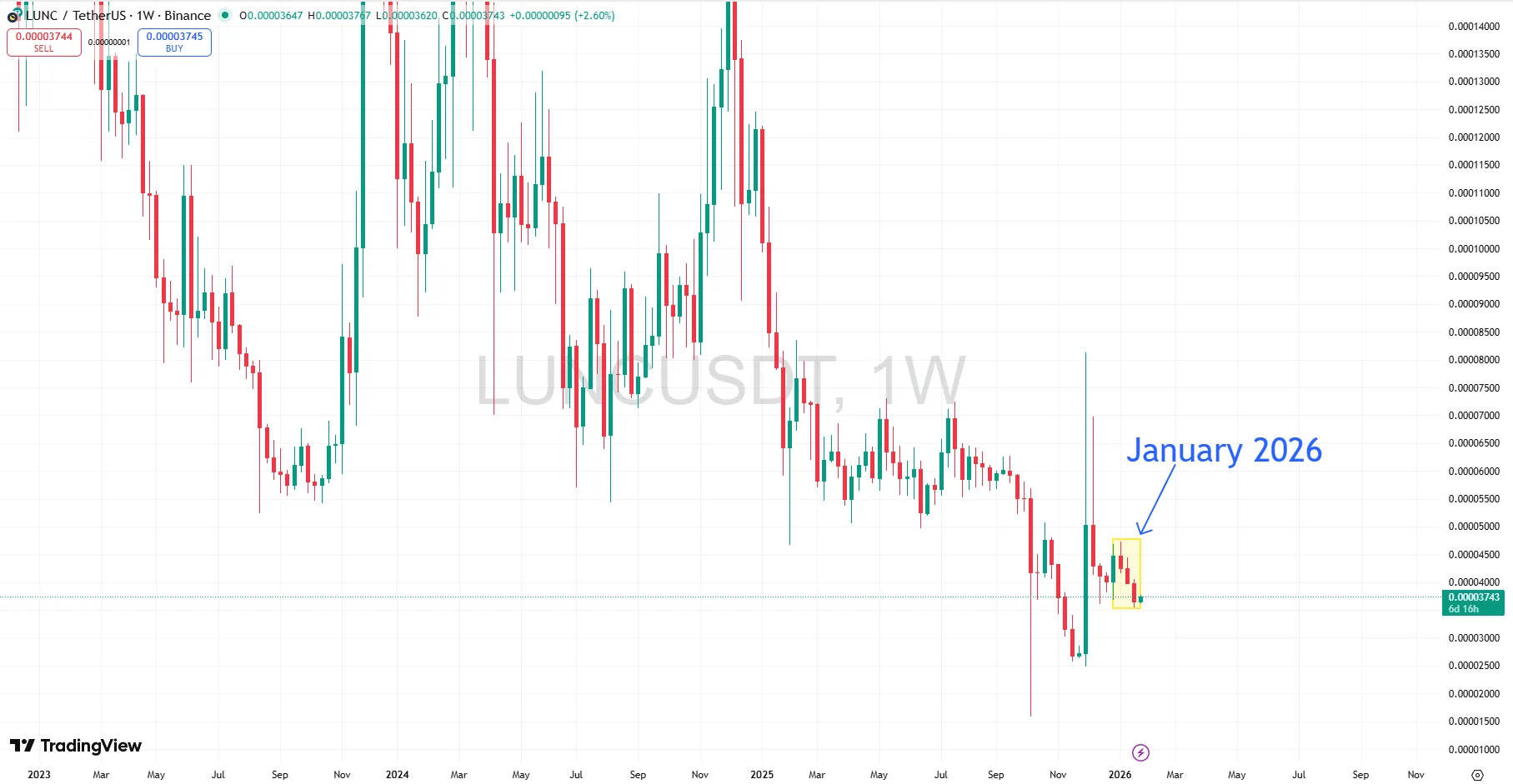 As Bitcoin fell, Luna Classic also moved lower and reached a price of 0.000035 dollars. This marked the lowest price level for LUNC in January 2026. The decline reflected the broader market movement rather than any specific issue within the Terra Classic ecosystem.