Home Blog Page 25

Over 6.28 Billion LUNC Burned in the Last 23 Days

0

Over 6.28 Billion LUNC Burned in the Last 23 Days

The Terra Classic network has recorded a significant milestone in its ongoing token reduction efforts. Over the past 23 days, more than 6.28 billion LUNC have been permanently removed from circulation. This steady burn activity highlights continued community participation and on chain usage across the ecosystem.

The majority of the burn volume came at the beginning of the month. On January 1 alone, over 5.36 billion LUNC were burned. This large single day burn contributed heavily to the overall total and set a strong starting point for January.

Following this event, daily burn amounts stabilized at lower but consistent levels. Throughout the rest of the month, daily burns ranged from around 12 million to over 85 million LUNC. While these figures are smaller compared to the first day, they still reflect ongoing network activity and steady contributions to supply reduction.

Burning LUNC helps reduce the total circulating supply over time. This mechanism is widely viewed by the community as a long term effort to support network value and sustainability. Continued on chain transactions, application usage, and community initiatives remain key drivers behind these burns.

Daily LUNC Burn Data

Month Date LUNC Burn
January 1 5,367,757,097
January 2 36,700,121
January 3 194,515,792
January 4 59,068,461
January 5 22,184,507
January 6 55,976,794
January 7 58,298,205
January 8 85,060,487
January 9 22,167,180
January 10 22,949,053
January 11 34,617,148
January 12 33,911,987
January 13 18,745,561
January 14 35,139,054
January 15 16,451,097
January 16 29,576,801
January 17 12,733,630
January 18 17,668,179
January 19 45,755,919
January 20 29,137,485
January 21 25,392,519
January 22 38,485,760
January 23 19,364,345
Total 6,281,657,182

Orbit Wire Launches Telegram Price Bot for the Terra Classic Ecosystem

0

Orbit Wire Launches Telegram Price Bot for the Terra Classic Ecosystem

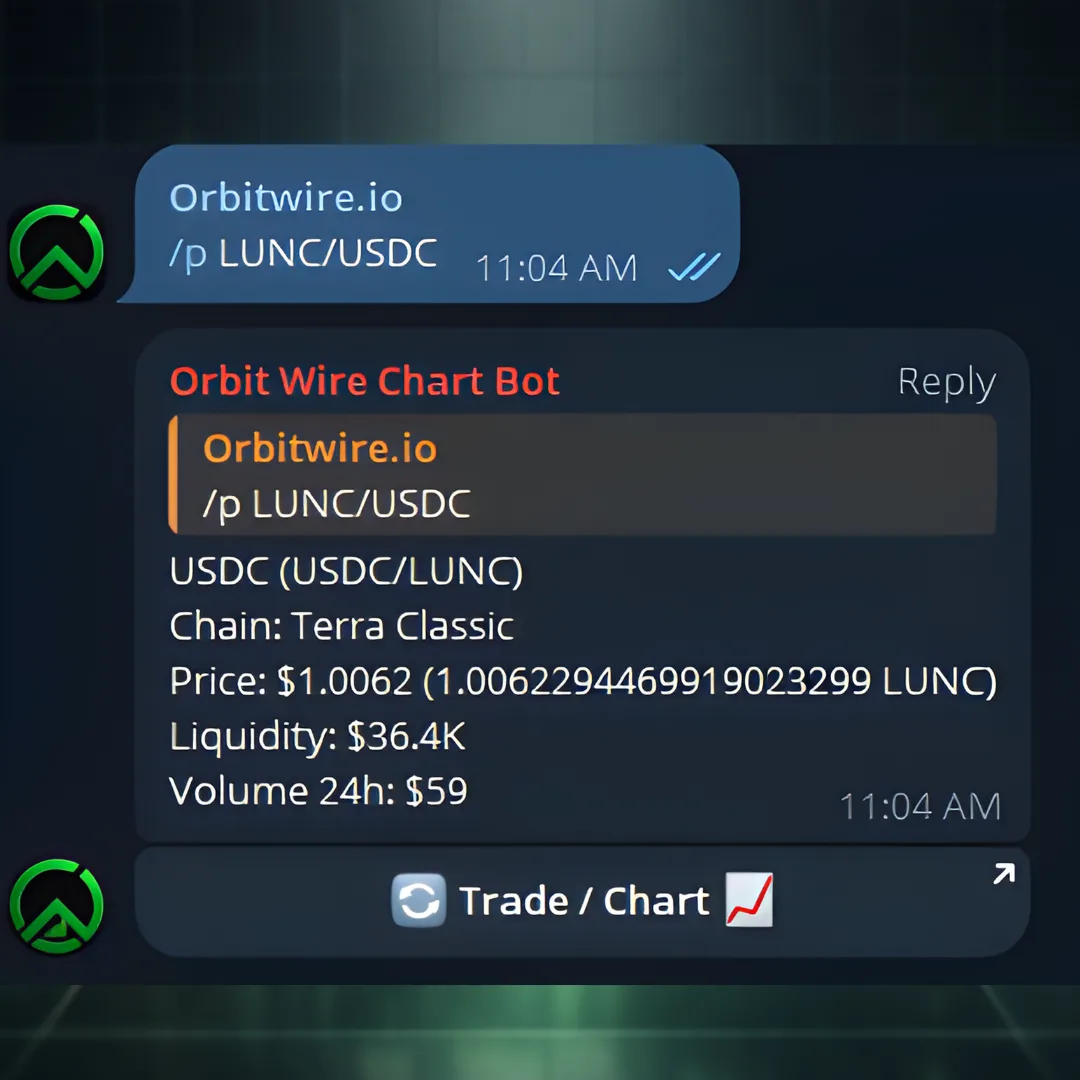
Orbit Wire has launched a new Telegram Price Bot to help the Terra Classic community access token information quickly and easily. This bot allows users to check prices and market data for LUNC, USTC, and all tokens in the Terra Classic ecosystem directly from Telegram, without opening a browser.

The bot is free to use and can be added to any Telegram group. It is designed to make price checking simple, fast, and accessible for everyone in the community.

How the Orbit Wire Telegram Price Bot Works

Using the Orbit Wire Telegram Price Bot is very simple and does not require technical knowledge. Follow these steps:

  1. Add the Orbit Wire Price Bot to your Telegram group or open it in a private chat
  2. In the chat, type the command:
    /p TOKENNAME
  3. Send the message
  4. The bot receives your request
  5. The bot asks Orbit Wire for the latest token data
  6. Orbit Wire sends real time information back to the bot
  7. The bot displays the token data instantly in Telegram

The entire process happens in seconds.

What Information the Bot Shows

After using the command, the bot displays important token details, including:

  • The platform where the token is listed, such as MIOFF
  • The blockchain network, which is Terra Classic
  • The token price shown in both USD and LUNC
  • Available liquidity
  • Twenty four hour trading volume

Simple One Sentence Explanation

This Telegram bot lets users check Terra Classic token prices and market data by typing a simple command, using real time data from Orbit Wire.

Ultra Simple Explanation

Type /p (tokenname) in Telegram and the bot will show the token price, liquidity, and trading volume from USDC using Orbit Wire data.

Beginner Friendly Explanation of the Latest SDK v53 Update on Luna Classic

0

Beginner Friendly Explanation of the Latest SDK v53 Update on Luna Classic

Terra Classic is currently testing a major software upgrade on its rebel 2 testnet. The upgrade brings the network in line with the latest Cosmos SDK v0.53 and IBC v2 standards. The testnet has been running smoothly for around three weeks, showing stable core chain services.

This article explains the update in a simple way and highlights what it means for users and developers.

What Is Being Tested on Terra Classic

  1. The rebel 2 testnet is running Cosmos SDK v0.53.x
  2. The upgrade has been active for approximately three weeks
  3. Core chain services remain stable
  4. Active testing is still ongoing
  5. This upgrade is not yet live on mainnet

What Is a Testnet

A testnet is a practice network used before mainnet deployment.

  1. Developers test upgrades safely
  2. No real funds are involved
  3. Issues can be fixed early
  4. Mainnet users are not affected

What Was Upgraded

Two major components were updated.

  1. Cosmos SDK v0.53.4 is the main blockchain framework
  2. It manages transactions, modules, and core logic
  3. It is widely used across Cosmos based networks
  4. IBC v2 (IBC go v10.3.0) handles cross chain communication
  5. It enables blockchain interoperability
  6. It is the latest supported version

Is the Network Stable

Based on the developer update:

  1. Core chain services are stable
  2. The testnet has been running for about three weeks
  3. No major issues have been reported
  4. Testing is still ongoing

What Actually Changed for the Ecosystem

  1. Only one visible change was introduced
  2. The change mainly affects developers
  3. Normal users are largely unaffected
  4. The change is related to transaction outputs

Transaction Logs and Events Explained Simply

When a transaction is sent, the blockchain returns information about what happened.

  1. Previously, this information was returned as logs
  2. With Cosmos SDK v0.53, logs are deprecated
  3. Events are now the official source of transaction data
  4. Smart contracts already emit events
  5. Events are indexed and searchable
  6. Most explorers already rely on events

How Terra Classic Reduced Potential Issues

Terra Classic introduced a compatibility layer to reduce disruption.

  1. When querying confirmed transactions, logs are reconstructed from events
  2. When broadcasting transactions, logs are no longer included
  3. This follows the new Cosmos SDK standards

What This Means for Developers

No changes are needed for most applications.

  1. Apps that query transactions after confirmation
  2. Indexers already using events
  3. Smart contract event handling

Changes are required for some applications.

  1. Apps that expect logs immediately after broadcasting a transaction
  2. Wait for the transaction to be included in a block
  3. Query the transaction by its hash
  4. Read transaction data from events

New Recommended Transaction Flow

Old method:

  1. Send transaction
  2. Read logs immediately

New method:

  1. Broadcast transaction
  2. Wait for block inclusion
  3. Query transaction by hash
  4. Read data from events

Impact Summary

  1. Most applications will continue to work normally
  2. Only broadcast time log dependent apps need updates
  3. Terra Classic now aligns with the latest Cosmos SDK behavior
  4. Future upgrades become easier and safer

Final Recommendation

  1. Use events as the primary source of transaction data
  2. Rely on query based transaction results
  3. Maintain compatibility with Cosmos SDK v0.53
  4. Prepare for future ecosystem updates

SDK v0.53 Update: Terra Classic Rebel-2 Testnet Runs With Stable Core Services

0

SDK v0.53 Update: Terra Classic Rebel 2 Testnet Runs With Stable Core Services

The Terra Classic rebel 2 testnet has been running on Cosmos SDK v0.53.x for approximately three weeks, according to the latest developer update. During this period, core chain services have remained stable, while the network continues to undergo active testing.

This testnet configuration moves Terra Classic onto Cosmos SDK version 0.53.4 and IBC go version 10.3.0, also referred to as IBC v2. These versions represent the latest upstream releases within the Cosmos ecosystem and are widely adopted across multiple networks.

Testnet Status and Stability

The update confirms that the rebel 2 testnet has been operating continuously with the new SDK for several weeks. Core blockchain services are functioning as expected, indicating a stable test environment. However, testing remains ongoing, and the network has not yet completed the full evaluation process.

This extended testnet phase is intended to validate behavior changes introduced by the newer Cosmos SDK and IBC versions before any future production level decisions are made.

Transaction Output Behavior Change

The only ecosystem visible change identified during testing relates to transaction output behavior. With the introduction of Cosmos SDK v0.53 and ABCI 2.0, the SDK no longer constructs transaction logs. Instead, events are now defined as the canonical and protocol level transaction output.

This behavior change originates from upstream Cosmos SDK development and applies across the broader Cosmos ecosystem.

Events Replace Logs as Canonical Output

Under the new SDK behavior, both logs and raw log fields are deprecated and are no longer constructed by default. Events now serve as the official source of transaction information.

Smart contracts continue to emit events as before, and these events remain indexed and fully queryable. Blockchain explorers and indexers that already rely on events are not affected by this change.

Terra Classic Compatibility Handling

To reduce ecosystem disruption while aligning with upstream SDK behavior, Terra Classic has implemented a compatibility layer for transaction query endpoints. When transactions are queried after inclusion, legacy logs are reconstructed from events to support existing applications.

Broadcast transaction responses now follow upstream behavior and do not include logs.

Developer Impact

Applications that query transaction results after block inclusion continue to function without changes. Indexers and applications that consume events are also unaffected, as are smart contract event subscriptions.

Applications that rely on transaction logs returned at broadcast time must update their workflow. These applications are required to wait for transaction inclusion, query the transaction by hash, and read data from events or reconstructed logs.

Recommended Developer Approach

Developers are encouraged to treat events as the canonical source of transaction data and to adopt query based transaction result handling. This approach aligns Terra Classic with Cosmos SDK v0.53 and IBC v2 standards and supports long term compatibility across the Cosmos ecosystem.

Conclusion

The Terra Classic rebel 2 testnet continues to run Cosmos SDK v0.53.x with stable core services while active testing remains underway. The primary visible change involves transaction output behavior, reflecting upstream Cosmos SDK updates. Ongoing testing will further validate stability and compatibility as development progresses.

Luna Classic Staking Ratio Shows Early Signs of Recovery

0

The Luna Classic staking ratio has started to show a slow but positive recovery after a recent decline earlier this month.

On 19 January, the Luna Classic staking ratio dropped to around 15.05 percent. This decrease reflected a temporary reduction in staked LUNC as some holders chose to unstake or move their tokens. Such movements are common during periods of market uncertainty or short term price fluctuations.

In the days that followed, the staking ratio stabilized and has now begun to rise again. As of today, the Luna Classic staking ratio has increased to approximately 15.1 percent. This gradual improvement suggests that some LUNC holders are returning to staking, signaling renewed confidence in the network.

Staking plays an important role in the Luna Classic ecosystem. A higher staking ratio helps strengthen network security and shows long term commitment from the community. While the current increase is modest, it represents a positive shift after the recent dip.

Overall, the slow rise in the Luna Classic staking ratio indicates early signs of recovery. Continued growth in staking participation could support network stability and reflect improving sentiment among LUNC holders in the coming weeks.

Over 650,000 USTC Burned in the Last 21 Days as Supply Reduction Continues

0

Over 650,000 USTC Burned in the Last 21 Days

The Terra Classic ecosystem continues to reduce its circulating USTC supply through ongoing burn activity. Over the last 21 days of January, a total of 656,403 USTC has been permanently removed from circulation.

This consistent burn activity reflects on the role of on chain transactions and projects in supporting long term supply reduction.

Daily USTC Burn Breakdown

Below is the detailed daily USTC burn record for the first 21 days of January.

Month Date USTC Burned
January 1 33,407
January 2 93,158
January 3 15,065
January 4 7,253
January 5 15,637
January 6 7,618
January 7 9,758
January 8 33,196
January 9 58,758
January 10 115,023
January 11 8,474
January 12 7,387
January 13 18,707
January 14 6,542
January 15 9,397
January 16 9,043
January 17 8,298
January 18 5,860
January 19 131,816
January 20 17,210
January 21 44,796
Total 656,403

What This Means for Terra Classic

While no single day dominates the overall burn total, the steady daily reductions show that USTC burns are being supported by regular on chain activity and projects in supporting burn.

Sustained transaction usage remains an important factor in long term supply management. As network participation continues, these incremental burns can contribute to gradual improvements in token economics over time.

Final Thoughts

The removal of more than 650,000 USTC in just 21 days highlights ongoing efforts within the Terra Classic ecosystem to manage supply responsibly. consistent on chain activity and projects in supporting burn will remain key elements in maintaining momentum for future burn progress.

Luna Classic Burn Rate Becomes Worse in January

0

Luna Classic Burn Rate Becomes Worse in January

Luna Classic burn rate has become worse in January based on daily burn data.

In the last 18 days, Luna Classic burn rates cannot pass 100 million LUNC per day. To be more worse, in the last 13 days, Luna Classic burn rates cannot pass 50 million LUNC per day.

Although the total burned amount in January looks large, most of it came from January 1. On that day, more than 5.3 billion LUNC was burned, with 5.29 billion coming from Binance’s monthly LUNC burn program.

Below is the daily Luna Classic burn recap for January.

Month Date LUNC Burned
January 1 5,367,757,097
January 2 36,700,121
January 3 194,515,792
January 4 59,068,461
January 5 22,184,507
January 6 55,976,794
January 7 58,298,205
January 8 85,060,487
January 9 22,167,180
January 10 22,949,053
January 11 34,617,148
January 12 33,911,987
January 13 18,745,561
January 14 35,139,054
January 15 16,451,097
January 16 29,576,801
January 17 12,733,630
January 18 17,668,179
January 19 45,755,919
January 20 29,137,485
January 21 25,392,519
Total 6,223,807,077

Luna Classic Price Falls 14% as Broader Crypto Market Faces Pressure

0

Luna Classic has experienced a noticeable price decline over the past week, reflecting broader weakness across the cryptocurrency market. In the last seven days, the price of LUNC has dropped by around 14 percent, bringing its current value to approximately 0.000038 dollars.


This price movement is not unique to Luna Classic. Most major cryptocurrencies have also recorded losses during the same period. The wider market downturn has created selling pressure across altcoins, including LUNC, as investors respond to changing market conditions.

One of the main factors behind this decline is the recent drop in Bitcoin’s price to the 88000 level. As the largest cryptocurrency, Bitcoin often sets the overall market direction. When Bitcoin weakens, confidence across the crypto market tends to decline, leading to reduced trading activity and lower prices for many digital assets.

Despite the short term price drop, Luna Classic continues to maintain active on chain activity and a committed community. Market corrections are a common part of the crypto cycle, especially during periods of uncertainty led by Bitcoin price movements.

As the market stabilizes, future price performance for LUNC will likely depend on broader market sentiment, Bitcoin recovery, and continued development within the Luna Classic ecosystem. For now, the recent decline highlights the strong connection between altcoins and overall crypto market trends.

Over 600,000 USTC Burned in 20 Days

0

USTC Burn Surpasses 600,000 Tokens in 20 Days as On Chain Activity Continues

The Terra Classic ecosystem continues to record steady progress in reducing USTC supply through ongoing burn activity. Over the last 20 days, more than 600,000 USTC tokens have been permanently removed from circulation.

Based on burn data recorded from January 1 to January 20, a total of 611,607 USTC has been burned. While daily burn amounts vary, the consistent accumulation confirms that on chain transactions and usage remain active within the network.

Several days recorded higher burn volumes, reflecting periods of increased transaction activity. This steady reduction in supply plays an important role in supporting long term ecosystem sustainability and strengthening confidence in Terra Classic’s ongoing recovery efforts.

Although the burn rate is not aggressive, continued participation from applications, users, and protocols contributes incremental progress. Over time, these consistent burns help reduce excess supply and reinforce the importance of real on chain usage rather than short term spikes.

USTC Daily Burn Summary January 1 to January 20

Date USTC Burned
January 1 33,407
January 2 93,158
January 3 15,065
January 4 7,253
January 5 15,637
January 6 7,618
January 7 9,758
January 8 33,196
January 9 58,758
January 10 115,023
January 11 8,474
January 12 7,387
January 13 18,707
January 14 6,542
January 15 9,397
January 16 9,043
January 17 8,298
January 18 5,860
January 19 131,816
January 20 17,210
Total 611,607

The latest USTC burn figures highlight steady and ongoing on chain participation across the Terra Classic network. While daily burns fluctuate, the cumulative total demonstrates that consistent activity continues to contribute toward long term supply reduction and ecosystem stability.

Over 6.2 Billion LUNC Burned in 21 Days

0

Over 6.2 Billion LUNC Burned in 21 Days as January Burn Activity Continues

The Terra Classic network has recorded a significant reduction in circulating supply during January, with more than 6.2 billion LUNC burned over the last 21 days. This data highlights ongoing deflationary efforts and continued participation from the ecosystem, even as daily burn levels fluctuate.

Based on available burn records, the total amount of LUNC removed from circulation between January 1 and January 21 has reached approximately 6.20 billion tokens. It is important to note that the data for January 21 is not yet final, meaning the total burn figure may still increase by the end of the day.

Binance Monthly Burn Dominates Early January

A large portion of the January burn total came on January 1, when over 5.36 billion LUNC was burned. This spike was mainly driven by Binance’s monthly LUNC burn mechanism, which continues to play a major role in reducing supply.

Outside of this event, daily burns have remained relatively modest, reflecting lower on chain transaction volume and network activity. Most daily burns throughout the month have remained below 100 million LUNC.

Daily LUNC Burn Breakdown

The table below provides a clear overview of the daily LUNC burn amounts recorded so far in January.

Month Date LUNC Burned
January 1 5,367,757,097
January 2 36,700,121
January 3 194,515,792
January 4 59,068,461
January 5 22,184,507
January 6 55,976,794
January 7 58,298,205
January 8 85,060,487
January 9 22,167,180
January 10 22,949,053
January 11 34,617,148
January 12 33,911,987
January 13 18,745,561
January 14 35,139,054
January 15 16,451,097
January 16 29,576,801
January 17 12,733,630
January 18 17,668,179
January 19 45,755,919
January 20 29,137,485
January 21 3,362,922
Total 6,201,777,480

Note: January 21 data is not final and may increase as the day concludes.

What This Means for Terra Classic

While the overall burn total is boosted by a single large event, the consistent daily burns demonstrate that on chain mechanisms remain active. Transaction fees, application usage, and exchange supported burns continue to contribute to gradual supply reduction.

Sustained on chain activity and expanded use cases remain critical factors for increasing future burn rates. As development and ecosystem participation grow, daily burn figures may strengthen beyond current levels.

Conclusion

The burning of over 6.2 billion LUNC in just 21 days reflects continued commitment to reducing Terra Classic’s circulating supply. Although daily burns remain relatively low outside of major exchange contributions, the long term impact depends on improving network usage and transaction volume.

As January progresses, the community will closely monitor burn trends to assess whether on chain activity can support stronger and more consistent supply reduction moving forward.