Home Blog Page 29

6.4 Trillion LUNC Burn — Was Really Burned or Just a Glitch

0

Was 6.4 Trillion LUNC Really Burned or Just a Glitch

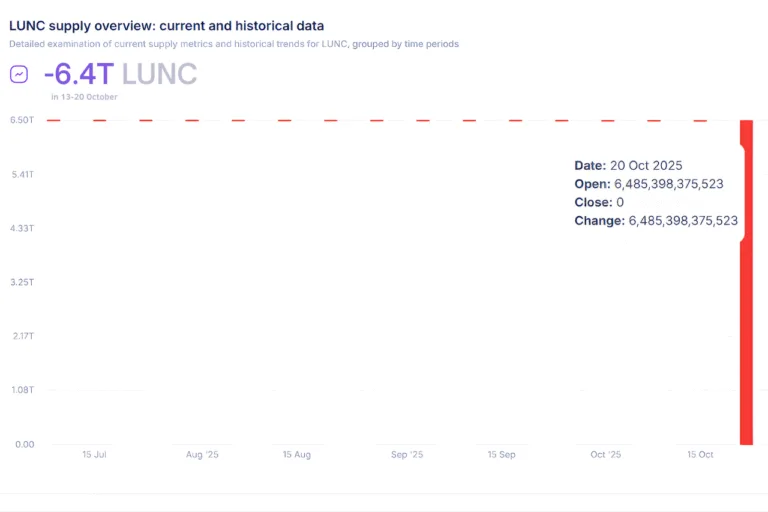
In the last two days, many people have shared posts claiming that 6.4 trillion LUNC were burned. This number came from a chart on the LUNC Tech platform, shown on their weekly burn chart dated October 20 2025.

But let us check if this is correct or not.

1. Comparing data from another tracker

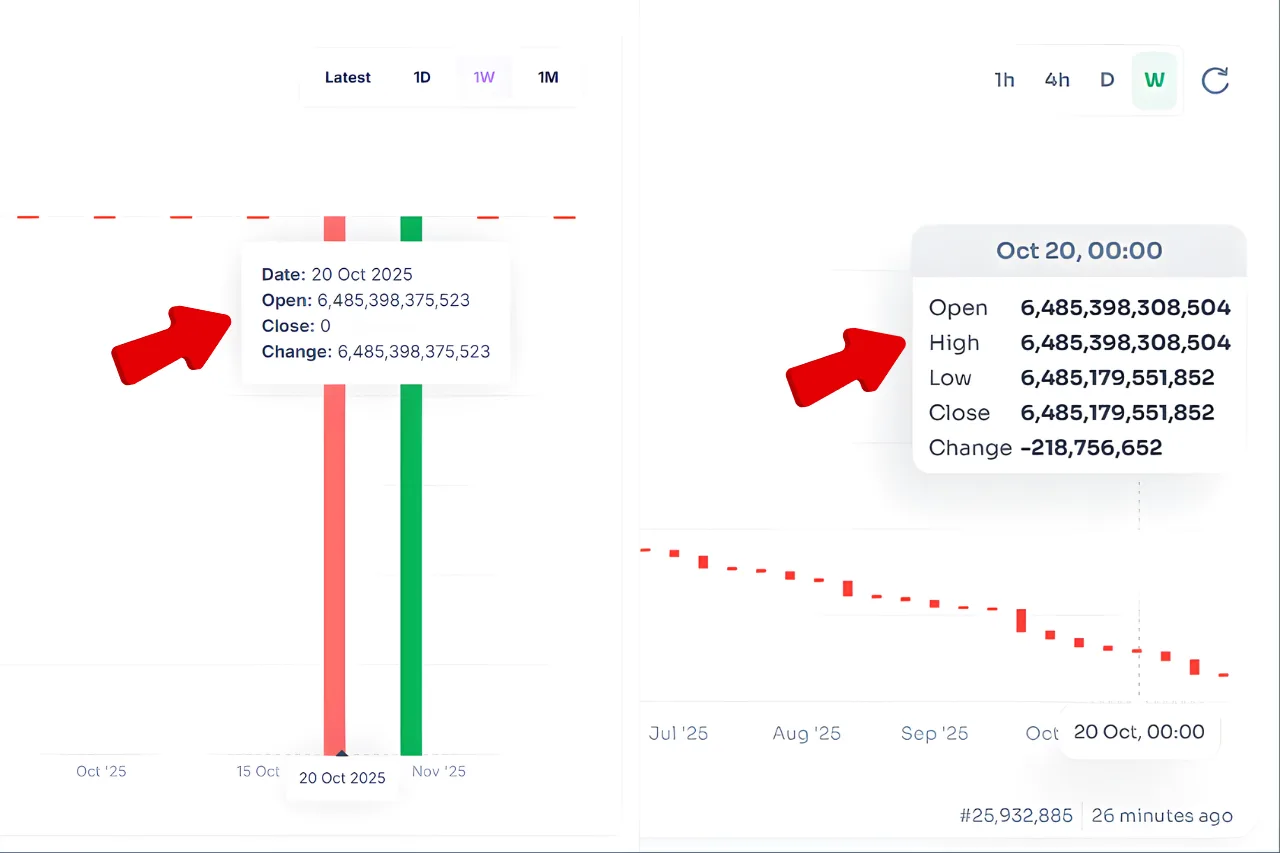
To confirm the number, we checked another website that tracks LUNC supply called StakeBin.
StakeBin data comparison image

On the same week, StakeBin shows only 218 million LUNC burned, not 6.4 trillion. That is a very big difference between the two platforms.

2. Checking LUNC Tech daily burn posts

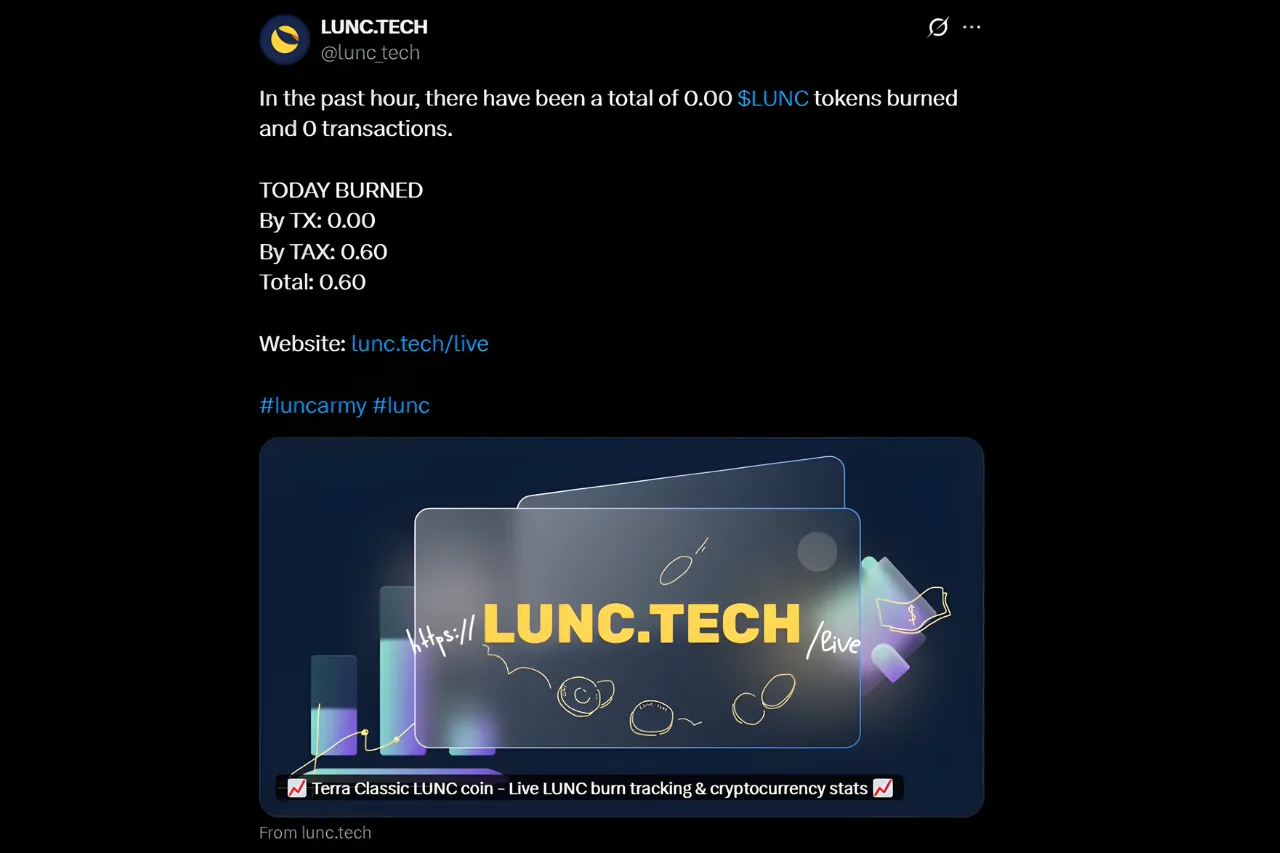
LUNC Tech usually posts a daily recap of LUNC burns on their X account.
LUNC Tech daily burn recap image

Between October 13 and 20, there were no posts or updates showing that 6.4 trillion LUNC were burned. If a huge burn like that had really happened, they would have posted it clearly.

3. Strange data on the LUNC Tech chart

The LUNC Tech chart dated October 27 shows something strange.
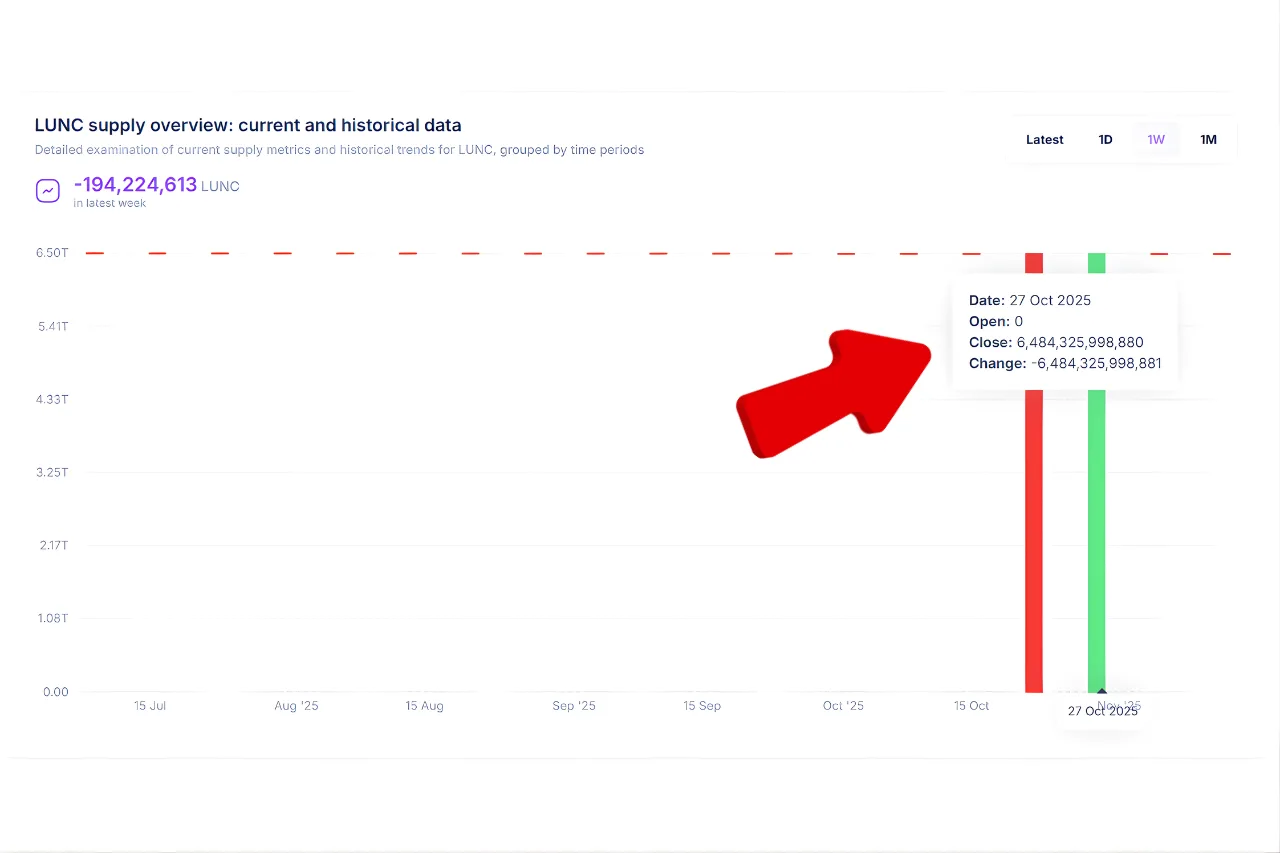
LUNC Tech chart anomaly image

The supply number starts at zero and then rises to 6.4 trillion. This is impossible because it means that between October 20 and 27, the total supply was zero. We know that exchanges like Binance hold trillions of LUNC and that almost 1 trillion LUNC is staked. If the chart were true, it would mean that all LUNC tokens were deleted from the network, which is not the case. So the most logical reason is that this was a data glitch.

No official explanation yet

Until now, LUNC Tech has not made any official statement or clarification about this issue.

Conclusion

After checking multiple sources, we can say that the claim about 6.4 trillion LUNC burned is not correct. The numbers from other platforms do not match, and the supply pattern shown is impossible in real conditions. It looks like a display or data error on the LUNC Tech platform.

If anyone has strong evidence or an official statement, we are open to reviewing it again.

Over 650,000 USTC Burned in Just 11 Days of November

0

Over 650,000 USTC Burned in Just 11 Days of November

The Terra Classic community continues to make progress in reducing the supply of USTC, with more than 650,000 USTC tokens burned in the first 11 days of November 2025. This consistent burn activity highlights the ongoing community driven effort to restore the USTC peg and strengthen the Terra Classic ecosystem.

According to community data, daily burns have steadily increased since the start of the month. The most significant burn occurred on November 11, with 167,361 USTC removed from circulation. Although the day has not yet ended, the total number of burned tokens has already reached 653,720 USTC.

Date USTC Burned
November 1 16,784
November 2 21,155
November 3 35,884
November 4 33,414
November 5 20,066
November 6 159,089
November 7 49,063
November 8 11,890
November 9 25,819
November 10 113,195
November 11 167,361 (ongoing)
Total 653,720

The burn data reflects the community’s ongoing commitment to the USTC re pegging strategy. As efforts continue across exchanges and community driven initiatives, the total burn count is expected to grow further before the end of the month.

This momentum underscores a strong belief among Terra Classic supporters that consistent token reduction can help stabilize the network and pave the way for future recovery.

Over 2.3 Billion LUNC Burned in the Last 11 Days

0

Over 2.3 Billion LUNC Burned in the Last 11 Days

The Terra Classic community is once again showing impressive momentum, with more than 2.3 billion LUNC burned in the first 11 days of November 2025. This rapid pace highlights the community’s determination to reduce the total supply and restore long term value to the network.

The burn campaign remains one of the most powerful efforts within the Terra Classic ecosystem. Supported by both independent holders and exchange initiatives, the ongoing destruction of LUNC tokens demonstrates a unified goal of rebuilding trust and utility.

LUNC Burn Recap for November

Month Date LUNC Burned
November 1 672,483,780
November 2 30,795,957
November 3 505,476,172
November 4 259,292,102
November 5 220,329,764
November 6 228,837,914
November 7 182,946,514
November 8 15,488,977
November 9 30,022,743
November 10 137,746,118
November 11 55,504,462*

*Note: November 11 data is still being updated as new burns are recorded.

So far this month a total of 2,338,924,503 LUNC has been burned. This milestone underscores the sustained commitment of the Terra Classic community to reducing supply and supporting the network’s recovery.

With growing community participation and steady burn activity, the first half of November stands out as one of the strongest periods yet for the ongoing LUNC revival.

This Proposal Will Bring Cross-Chain Connectivity Back to Terra Classic

0

This Proposal Will Bring Cross-Chain Connectivity Back to Terra Classic

The Hyperlane Integration proposal is designed to bring cross-chain connectivity back to Terra Classic, ending the network’s current isolation from other blockchains.

Currently, Terra Classic cannot interact with other chains because the Wormhole bridge, the previous system that enabled token transfers between networks, has stopped supporting the Terra Classic network.

This disconnection means:

  • LUNC, USTC, and CW20 tokens cannot move to or from other blockchains.
  • Terra Classic’s liquidity is trapped within its own ecosystem, limiting trading and growth opportunities.

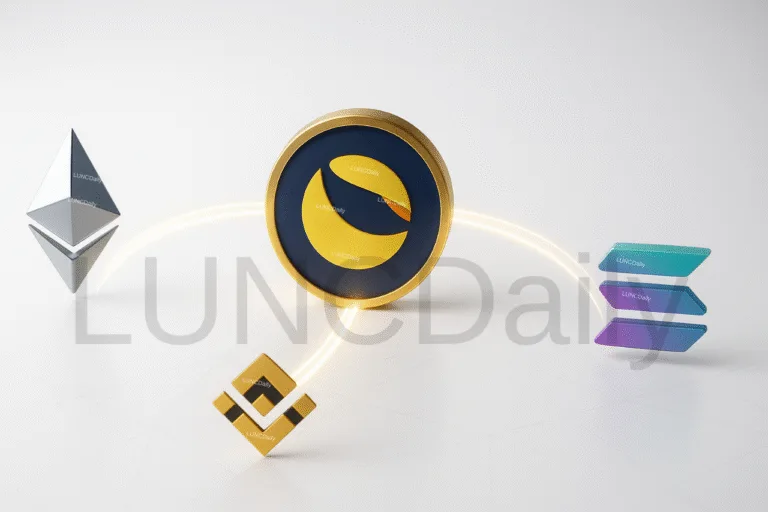
The Hyperlane integration aims to solve this by introducing a new decentralized, community-controlled bridge that will connect Terra Classic with Ethereum, Binance Smart Chain (BSC), and Solana.

In simple terms, the proposal is about reconnecting Terra Classic to the global blockchain ecosystem — securely and permanently.

Benefits of the Hyperlane Integration

1. Restores Cross-Chain Transfers

Once deployed, Hyperlane will allow LUNC, USTC, and CW20 tokens to move between Terra Classic and other major blockchains such as Ethereum, BSC, and Solana. This restores the ability to send, receive, and trade Terra Classic assets across multiple ecosystems.

2. Brings Global Liquidity

By connecting Terra Classic to decentralized exchanges like Uniswap, PancakeSwap, and Jupiter, the proposal opens access to larger markets and greater trading volume. This can help:

  • Increase demand for LUNC and USTC
  • Improve the visibility and value of CW20 tokens
  • Attract new users and investors to the ecosystem

3. Fully Decentralized and Community-Owned

Unlike Wormhole, which relied on external providers, Hyperlane is entirely community-run. Validators, relayers, and configurations will be managed by the Terra Classic community, ensuring:

  • Independence from third-party companies
  • Transparency in bridge operations
  • Security through a multi-signature system maintained by trusted members

4. Supports Existing and Future Tokens

Hyperlane will support all native and CW20 assets, enabling both existing and future community tokens to gain global exposure and access to new trading platforms.

5. Encourages Growth and Innovation

With cross-chain features restored, developers can:

  • Build new decentralized applications (DApps) that interact with multiple blockchains
  • Form strategic partnerships with other ecosystems
  • Strengthen Terra Classic’s position as an open and innovative blockchain network

6. Proven and Reliable Technology

Hyperlane is a trusted multichain protocol, already connected to over 130 blockchains. It has facilitated more than $10 billion in asset transfers and processes over 10,000 transactions daily, proving its stability and scalability.

In Summary

Purpose:
To reconnect Terra Classic with other major blockchains and restore the cross-chain functionality lost after Wormhole support ended.

Key Benefits:

  • Restores LUNC and USTC movement across chains
  • Expands liquidity and market access
  • Enhances decentralization and community control
  • Supports all CW20 tokens
  • Enables new development and innovation
  • Uses proven, industry-trusted technology

Luna Classic Community Burns Over $83,000 in LUNC and USTC This November

0

Luna Classic Community Burns Over $83,000 in LUNC and USTC This November

The Luna Classic (LUNC) community has once again shown its dedication to reducing token supply. In November, the community collectively burned $83,282 in total, combining both LUNC and USTC.

Based on current market prices, the total includes 2.1 billion LUNC, valued at $80,505, and 373,000 USTC, valued at $2,777. This ongoing initiative highlights the community’s consistent effort to support the long-term recovery and stability of the Terra Classic ecosystem.

November Burn Breakdown

Month Date LUNC Burned USTC Burned
November 1 672,483,780 16,784
November 2 30,795,957 21,155
November 3 505,476,172 35,884
November 4 259,292,102 33,414
November 5 220,329,764 20,066
November 6 228,837,914 159,089
November 7 182,946,514 49,063
November 8 15,488,977 11,890
November 9 30,022,743 25,819

The Luna Classic community continues to maintain one of the most active burn campaigns in the crypto space. Each burn contributes to reducing the overall token supply, helping strengthen community confidence and the ongoing revival of the Terra Classic network.

Luna Classic Staking Ratio Falls to 14.8 Percent as Over 964 Billion LUNC Remain Staked

0

Luna Classic Staking Ratio Falls to 14.8 Percent as Over 964 Billion LUNC Remain Staked

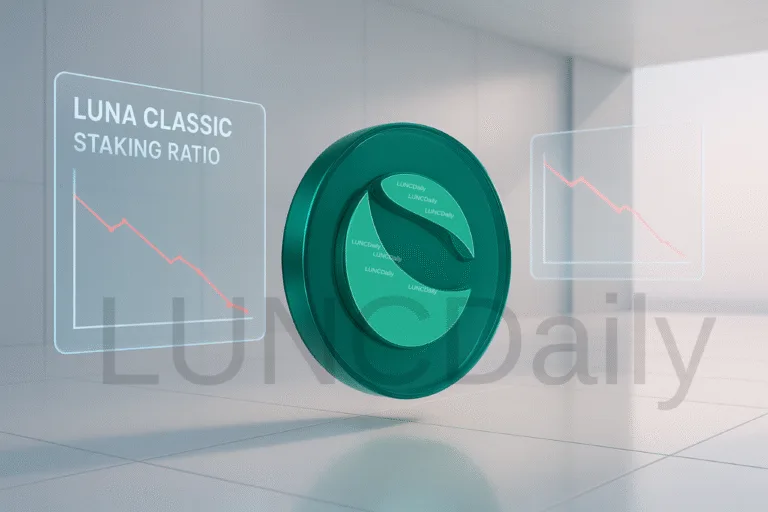
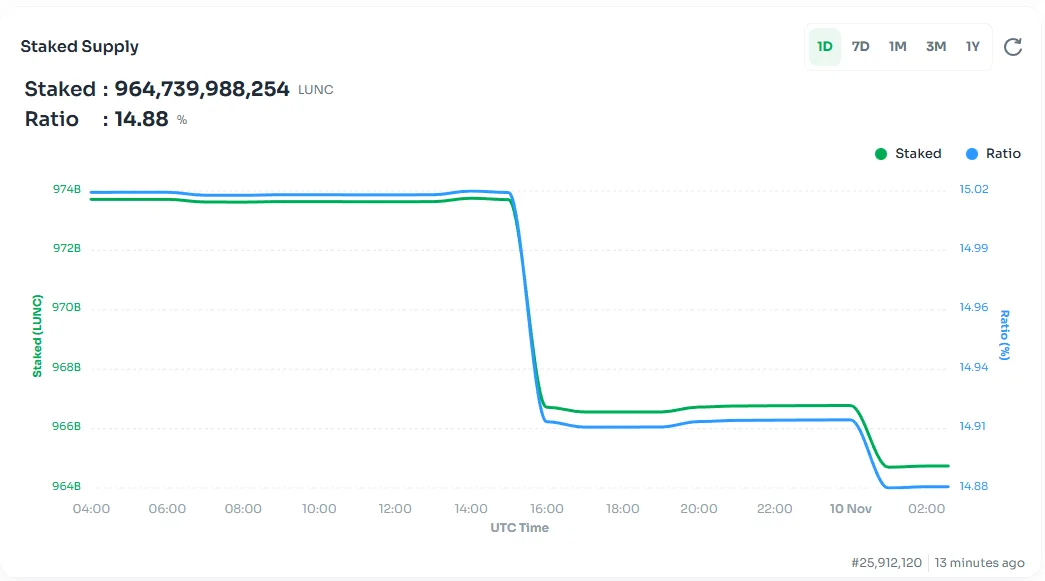
The Luna Classic (LUNC) network has seen a noticeable decline in its staking ratio, dropping from 15 percent to 14.8 percent within a short period.

On November 9 at 14:59 UTC, the staking ratio stood at 15 percent. One hour later, by 15:59 UTC, it had fallen to 14.91 percent. As of today, the ratio continues to decline and currently stands at 14.8 percent.

Luna Classic staking ratio chart
Recent Luna Classic staking ratio changes from 15% to 14.8%

Despite the drop, the total amount of LUNC staked remains significant, with more than 964 billion LUNC still locked in staking. The change in staking ratio could indicate recent validator adjustments or a shift in delegator behavior across the network.

Staking ratio is an important indicator of network participation and decentralization. A lower ratio may signal reduced community engagement or increased liquid supply in circulation.

The Luna Classic community continues to monitor these fluctuations closely, as staking plays a vital role in maintaining network security and stability.

LUNC Price Peaks Nearly 15 Percent in Just One Day

0

LUNC Price Peaks Nearly 15 Percent in Just One Day

The Luna Classic (LUNC) community saw something exciting yesterday as the token price peaked by 14.7 percent in just 24 hours.

LUNC started the day at $0.00003484 before climbing quickly to a high of $0.00003999. The move surprised many traders and brought new attention to the project.

Right now, the LUNC price is around $0.00003772, holding most of its gains after the strong rally. Many in the community are now watching closely to see if this momentum will continue and push the price even higher.

Did You Know It Only Takes 5 Big Validators Working Together to Control the Luna Classic Network

0

Did You Know It Only Takes 5 Big Validators Working Together to Control the Luna Classic Network

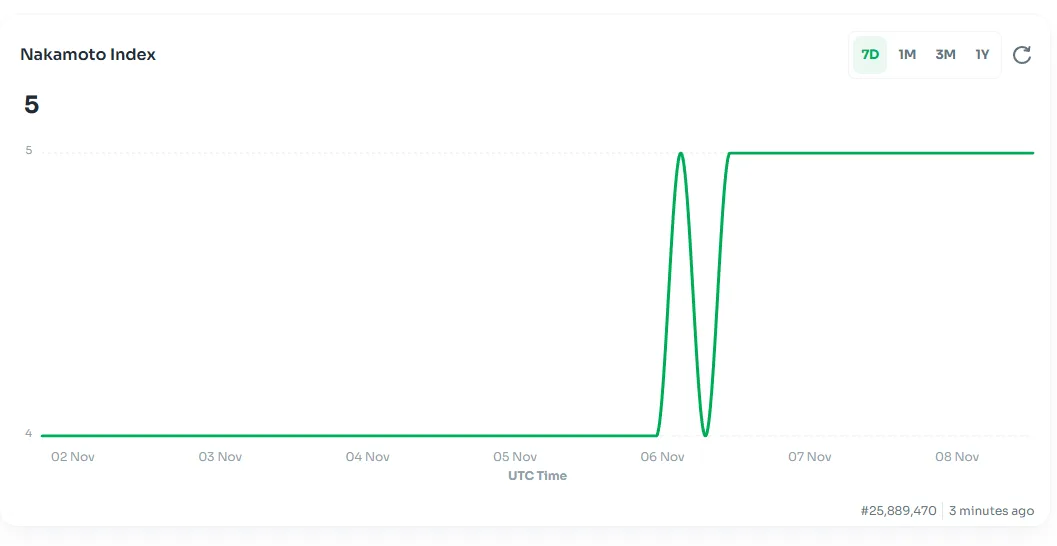
The Luna Classic network currently has a Nakamoto Index of 5, meaning it would take only five independent validators working together to control or disrupt the network. This number helps the community understand how decentralized the system really is.

Luna CLassic Nakamoto Index

What Is the Nakamoto Index

The Nakamoto Index measures how decentralized a blockchain network is. It shows the minimum number of validators or independent entities that would need to cooperate to take control of the system or stop it from working properly.

A smaller number means the network is more centralized because fewer validators have enough power to make major changes. A larger number means the network is more decentralized and secure.

Understanding the Nakamoto Index Values

  • Value 1 means one validator can control or stop the network. This shows very high centralization.
  • Values 2 to 4 mean a small group can still control the system.
  • Values 5 to 6 mean several validators would need to work together, showing better decentralization and stronger protection.

What It Means for Luna Classic

A Nakamoto Index of 5 means five large validators would need to join forces to control the Luna Classic network. This is a sign that the network is improving its decentralization but still depends on a few key players.

As Luna Classic continues to grow, increasing the Nakamoto Index will make the network more secure, fair, and resistant to control by any small group of validators.

Over 2.1 Billion LUNC Burned in Just 7 Days

Over 2.1 Billion LUNC Burned in Just 7 Days

The Terra Classic community has continued its strong momentum in November with more than 2.1 billion LUNC burned within just the first seven days of the month. This consistent burn activity highlights the community’s ongoing effort to reduce supply and strengthen the token’s long-term value.

Here is the detailed breakdown of LUNC burns recorded between November 1 and November 7:

Date LUNC Burned
November 1 672,483,780
November 2 30,795,957
November 3 505,476,172
November 4 259,292,102
November 5 220,329,764
November 6 228,837,914
November 7 182,946,514
Total 2,100,162,203

This impressive total shows that the Terra Classic ecosystem continues to push forward with strong community-driven initiatives, validator contributions, and exchange burns. The growing number of daily burns also demonstrates renewed confidence and active participation from holders and supporters who believe in the long-term recovery of LUNC.

As burn rates remain steady, many in the community see this as a key signal of progress toward a more balanced and sustainable LUNC economy.

USTC Repeg Plan Goes Live: How USTR and UST1 Will Help Restore Stability

0

USTC Repeg Plan Goes Live: How USTR and UST1 Will Help Restore Stability

The new repeg plan for USTC has officially started for the Terra Classic community. It introduces two new tokens from Ceramic called USTR and UST1. Both are created to help bring stability back to the Terra Classic ecosystem.

Currently, just under 22 million USTC have been pre registered for the CMM swap. This allows USTC holders to deposit their tokens and get USTR at a 1 to 1 rate.

How USTR and UST1 Help Repeg USTC

The new plan introduces three main tokens: USTR, DISP, and UST1. Each has a specific purpose that helps rebuild the system in a safe and sustainable way.

USTR The Transition Token

USTR is a temporary token that helps collect old USTC and turn it into reserves for a new, more stable system.

Here is how it works:

  • USTC holders can swap their tokens for USTR during a 100 day event.
  • The swap rate starts at 1 USTC = 1 USTR and slowly changes to 2 USTC to 1 USTR, meaning early users get better value.
  • A referral program gives both referrers and new users a 10 percent USTR bonus.
  • All USTC collected from the swap is stored in a collateral pool, which will later be used to back the new stablecoin UST1.

In short, USTR gathers USTC and helps build the base reserves for the new stablecoin system.

DISP The Governance Token

DISP gives the community voting power and helps fund the system.

DISP will be sold after the USTR swap through a bonding curve model where its price increases as more people buy. The money raised from selling DISP goes into the Collateral Market Mechanism (CMM), which acts as a decentralized treasury.

DISP holders can vote on key decisions such as:

  • How the collateral is used
  • Changes to system policies
  • Elections for board members who manage the CMM

This design ensures the community has control over how the system runs and prevents any single group from taking over.

UST1 The New Stablecoin

After the liquidity and governance parts are complete, the new stablecoin UST1 will launch. UST1 replaces USTC as the main stable asset in the Terra Classic network.

Key features:

  • Over collateralized and backed by real assets such as BTC, ETH, BNB, and USDT.
  • Community governed through DISP stakers and elected members.
  • Stabilized automatically by smart contracts that use price oracles to adjust collateral when markets change.

How it keeps stability:

  • The CMM only creates new UST1 when there is enough collateral in reserve.
  • If reserves are too low, no new UST1 is created until reserves recover.
  • The system rewards stakers and burns some tokens to help control inflation.
  • The system can also buy and burn LUNC to support both UST1 and the Terra Classic network.

The Final Goal A Fully Stable System

Here is the process in order:

  1. People swap USTC for USTR to build the first collateral pool.
  2. DISP is sold to fund the system and give governance power to the community.
  3. UST1 launches as a new stablecoin backed by real assets.
  4. The CMM manages reserves automatically for long term stability.
  5. UST1 reaches and maintains the 1 dollar value.

In Simple Terms

USTR collects old USTC and builds the new reserves.

DISP gives the community control and funding power.

UST1 becomes the new stablecoin backed by real assets and designed to stay at 1 dollar.

Together, USTR, DISP, and UST1 replace the old algorithm based model with a collateral backed and community controlled system. This is a major step toward bringing back stability and trust to Terra Classic and the USTC ecosystem.