Home Blog Page 32

LUNC Community Close to 2.5 Billion Burn: Can Community Do It in One Day?

0

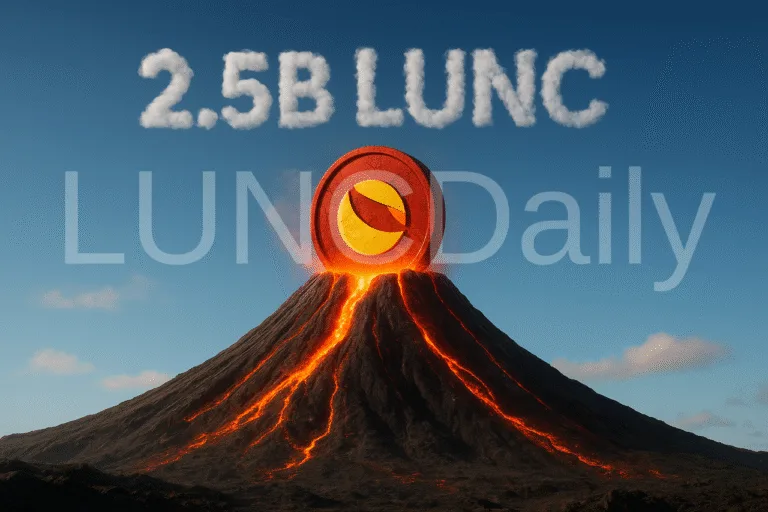
Terra Classic (LUNC) has already burned 2.14 billion tokens this October. With only one day left, the community is trying to reach 2.5 billion.

Burning tokens reduces the total supply, which can make the remaining tokens more valuable. The LUNC community has been helping by sending tokens to burn addresses and joining special burn programs.

If the community reaches 2.5 billion burns in one day, it would show how active and committed LUNC holders are. This could also make more people confident in the token and the network.

As October ends, everyone is watching to see if the LUNC community can make this last-minute push. Will they reach 2.5 billion burned tokens? The answer is just hours away.

LUNC Price Breakdown: Is This the Start of a Bigger Correction?

LUNC Price Faces Correction After Breaking Key Trendline

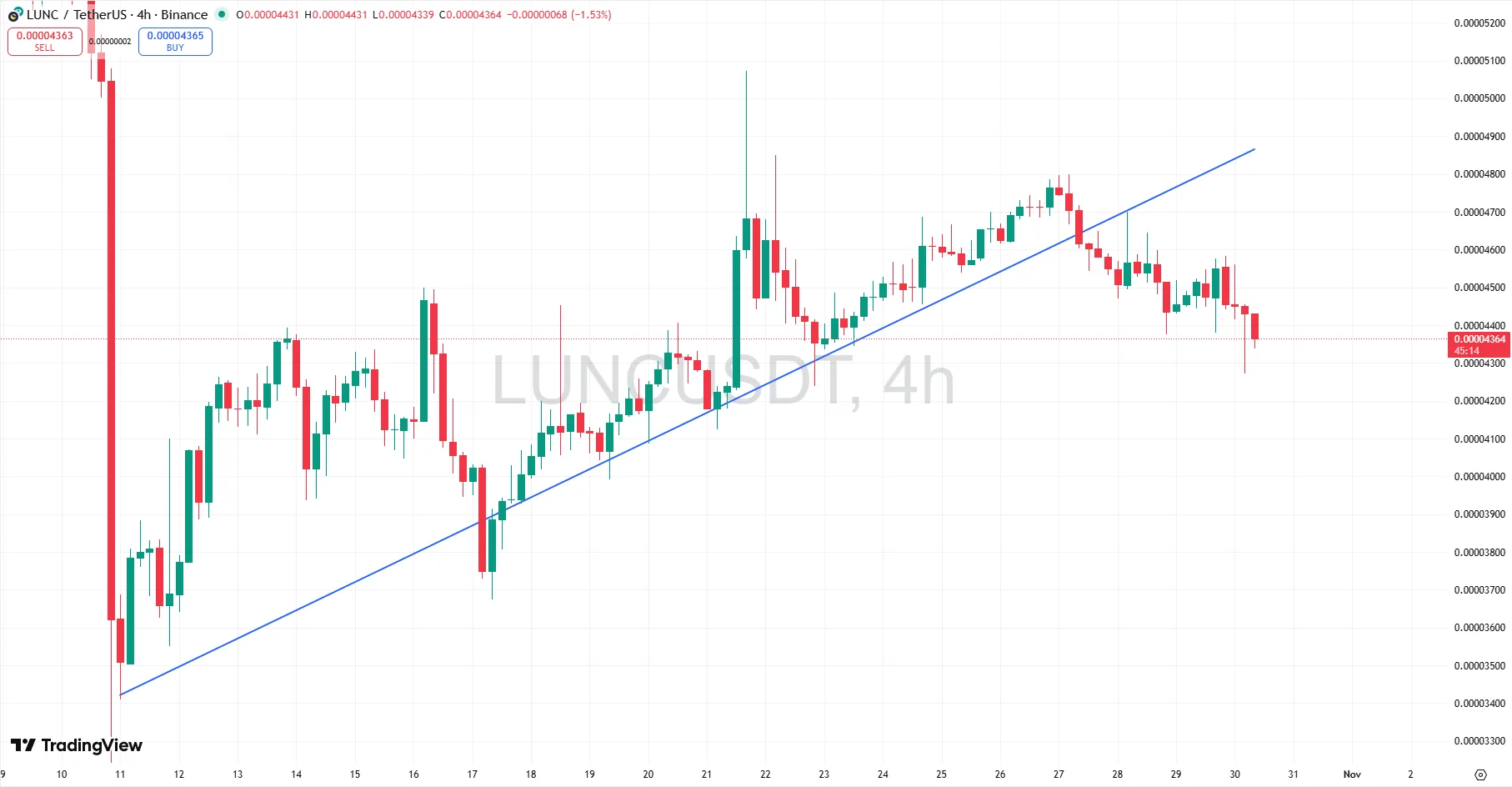
The recent price movement of Terra Classic (LUNC) indicates a weakening bullish trend as the market breaks below a key support line on the four hour chart. This technical signal suggests a short term correction phase may be underway after a steady two week rally.

LUNC Downtrend Analysis

Market Overview

LUNC had been trading in an upward pattern, forming higher highs and higher lows. The trendline break now confirms a shift in market sentiment from bullish to neutral. Traders often view this type of break as a sign that the market could consolidate or retrace before attempting another move upward.

Key Support and Resistance Levels

Support Areas

  • 0.0000430 — Current area being tested
  • 0.0000415 to 0.0000420 — Next possible support range

Resistance Areas

  • 0.0000465 to 0.0000475 — Upper boundary of the recent weekly range

Trading Volume and Market Sentiment

The 24 hour trading volume is approximately 11.68 million USD. While this shows that traders remain active, there has not been a significant increase in buying volume. The lack of a sharp volume spike during the recent decline suggests the move is more of a technical correction rather than panic selling.

Performance Summary

Period Change Market Tone
24 Hours -3.3% Short term weakness
7 Days -1.5% Mild correction
14 Days +0.6% Neutral mid term
30 Days -18.5% Extended downtrend

Analyst Insight

LUNC is currently in a correction phase after losing upward momentum. Traders should watch the 0.0000430 support level closely as it will determine whether the market stabilizes or continues to fall. A strong rebound above 0.0000465, accompanied by higher trading volume, would be the first signal of renewed bullish strength.

Five Simple Reasons Why LUNC Price Down

Five Simple Reasons Why LUNC Price Went Down

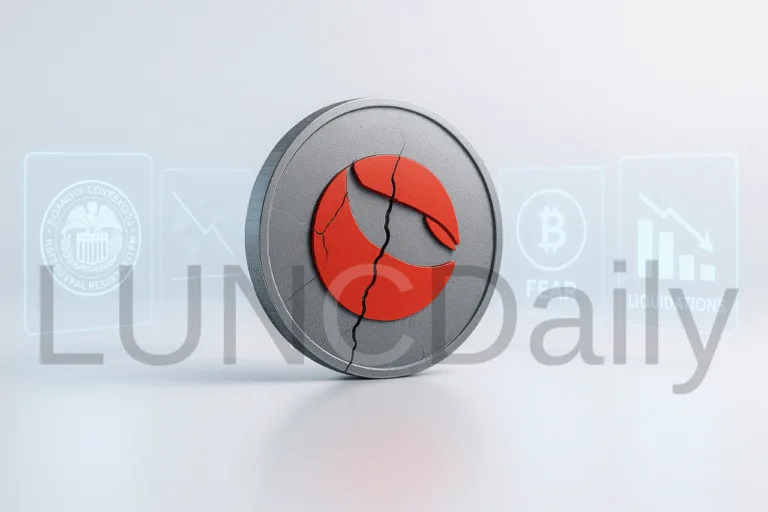
The recent drop in Terra Classic (LUNC) has raised questions among new investors. Several global and market-wide events have played a role. Below are the five main reasons behind the decline, explained in clear and simple terms.

  1. Federal Reserve Rate Cut Created Uncertainty

    The US Federal Reserve cut interest rates again, lowering them to a range of 3.75% to 4%. Normally, lower rates support risky assets like cryptocurrencies. However, Fed Chair Jerome Powell said he is not sure if another cut will come in December. That uncertainty disappointed investors who had expected a more positive outlook. As a result, many traders moved away from crypto in the short term, causing prices to fall.

  2. Global Crypto Market Decline

    The entire crypto market fell by 2.19 percent to a total market capitalization of 3.73 trillion dollars. When the overall market drops, most cryptocurrencies follow the same direction, including LUNC. This shows that LUNC’s recent decline is part of a wider trend rather than a project-specific issue.

  3. Bitcoin’s Price Pullback

    Bitcoin pulled back to around 108,000 dollars. Because Bitcoin leads the crypto market, its movements strongly affect other coins. When Bitcoin goes down, altcoins like LUNC usually follow as traders reduce their positions to limit risk.

  4. Rising Fear in the Market

    The Crypto Fear and Greed Index dropped to 34, indicating growing fear among investors. When fear dominates, people prefer to hold cash or stable assets instead of cryptocurrencies. This reduced demand puts downward pressure on prices across the market.

  5. Large-Scale Liquidations

    Over 829 million dollars worth of crypto trading positions were liquidated in a 24-hour period. Most of these were long positions totaling 662 million dollars. Forced selling from liquidations often accelerates price declines, making short-term drops sharper and more sudden.

Combined Effect on Terra Classic

All these factors have created a cautious market environment. Reduced liquidity, lower confidence, and global uncertainty have pushed LUNC prices lower. While short-term volatility may continue, lower interest rates and easing financial conditions could help crypto, including LUNC, recover once markets stabilize.

Easy Guide: Market Cap vs Fully Diluted Valuation in Terra Luna Classic

Understanding the Difference Between Market Cap and Fully Diluted Valuation in Terra Luna Classic

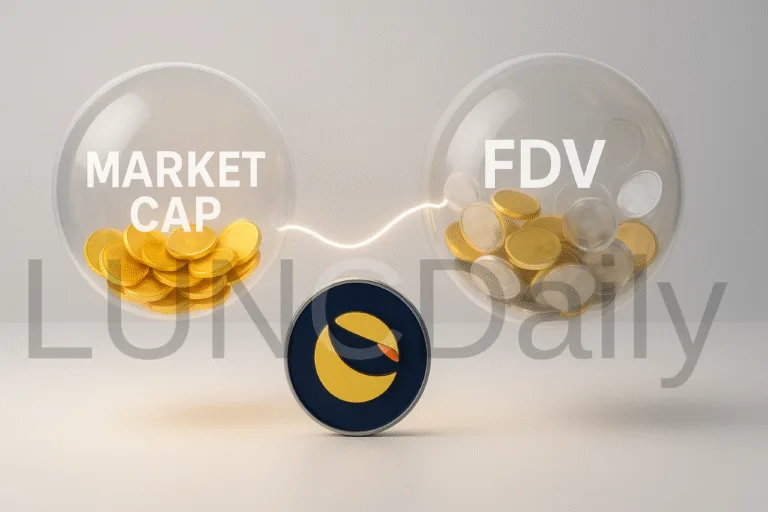
Terra Luna Classic Market Cap vs FDV illustration

If you often check Terra Luna Classic statistics, you might see two numbers that look similar: Market Cap and FDV or Fully Diluted Valuation. Many beginners get confused about what they mean. Let’s make it simple.

What is Market Cap

Formula:
Market Cap = Current Price × Circulating Supply

Market Cap shows how much all circulating LUNC coins are worth right now. It is like checking the total value of coins that are already available in the market. Locked or reserved coins are not included.

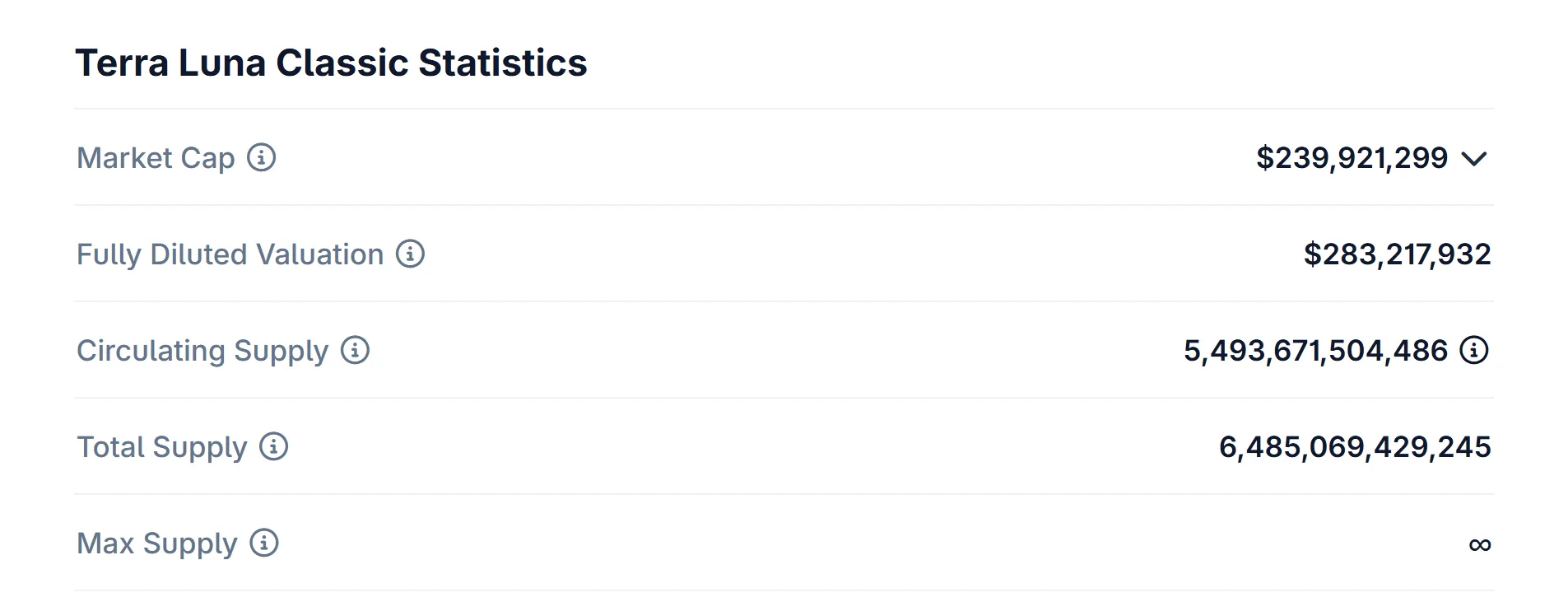
Example using Terra Luna Classic:
Current Price: $0.0000436
Circulating Supply: 5,493,671,504,486 LUNC

Calculation:
$0.0000436 × 5,493,671,504,486 = $239,921,299

So the Market Cap of Terra Luna Classic is about $239.9 million. This number tells us the total value of all LUNC coins that people can trade right now.

What is FDV or Fully Diluted Valuation

Formula:
FDV = Current Price × Total Supply

FDV shows the total value if every LUNC coin was already released and available to trade. It is a “what if” number because not all coins are in circulation yet.

Example using Terra Luna Classic:
Current Price: $0.0000436
Total Supply: 6,485,069,429,245 LUNC

Calculation:
$0.0000436 × 6,485,069,429,245 = $283,217,932

So the FDV of Terra Luna Classic is about $283.2 million. This number shows what the total value would be if every LUNC coin existed in the market at the current price.

Why These Numbers Are Different

The Market Cap is smaller because it only includes the coins already in circulation.
The FDV is bigger because it counts all coins that could be released in the future.

For investors, this difference is important. If FDV is much higher than Market Cap, it means more coins will enter the market later, which could affect the price. If the two numbers are close, it means most coins are already circulating and future dilution is smaller.

In Terra Luna Classic’s case, the FDV is only slightly higher than the Market Cap, meaning most coins are already in the market.

Key Takeaway

Market Cap shows today’s real value based on coins already in circulation.
FDV shows the possible future value if all coins are released.
The smaller the gap between Market Cap and FDV, the less new supply is waiting to enter the market.

USTC Burn Rate Reaches 2.64 Million in the Last 30 Days

0

USTC Burn Rate Reaches 2.64 Million in the Last 30 Days

In the past 30 days, the Terra Classic community has successfully burned more than 2.64 million USTC. This consistent effort reflects the community’s commitment to restoring the stablecoin’s value and maintaining long term sustainability within the Terra Classic ecosystem.

The burn process plays a key role in reducing the circulating supply of USTC. By continuously removing tokens from circulation, the community aims to bring balance between demand and supply, which can help support the stablecoin’s price recovery over time.

Since the USTC depeg event, community members and developers have been collaborating on multiple strategies, including burn mechanisms and utility based initiatives. These actions demonstrate a united effort to rebuild confidence and utility for USTC within the Terra Classic network.

As October nears its end, the steady burn rate of over 2.64 million USTC highlights growing momentum and renewed optimism across the Terra Classic community. This progress underscores the ongoing mission to strengthen the project’s foundation and revive the value of its core assets.

LUNC Burn Rate Nears 2.2 Billion in the Last 30 Days

0

LUNC Burn Rate Nears 2.2 Billion in the Last 30 Days

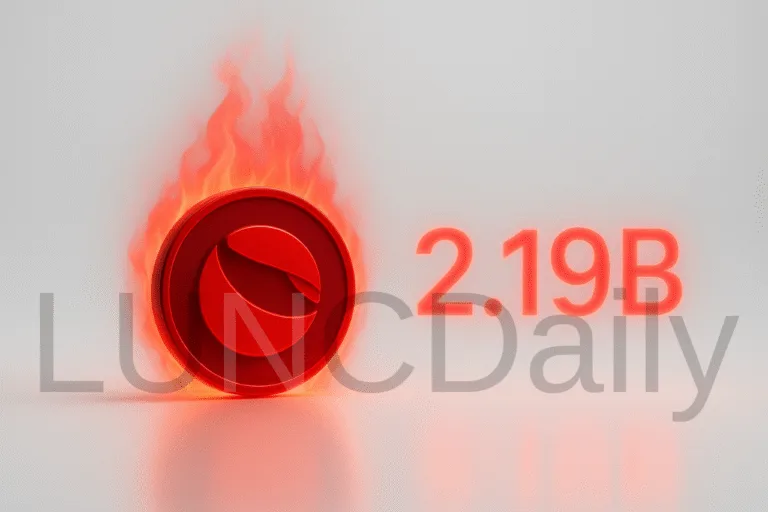
In the past 30 days, the Terra Classic community has successfully burned more than 2.19 billion LUNC. This steady progress highlights the ongoing community effort to reduce the token’s total supply and strengthen its long term value.

With only two days left before the end of October, the community is closely watching whether the burn total will continue to rise or slow down as the month concludes.

The final figures will depend on community driven initiatives during the remaining days. Regardless of the outcome, the continuous burn shows that the LUNC community remains active and committed to supporting the network’s recovery.

Do Kwon Was Right About the Future of Stablecoins

0

Do Kwon Was Right About the Future of Stablecoins

In 2022, Do Kwon joined Azeem Azhar on the Exponential View podcast. In that episode, he shared his thoughts about the future of stablecoins. What he said back then is now becoming reality.

What Do Kwon Said About Stablecoins

DO KWON: ” When I first started looking into crypto in late 2016, early 2017 timeline, one of the most fascinating things to me is that for an industry that brands itself the cryptocurrency industry, there were very few people that was actually working on the problem of making better currency. Most entrepreneurs were focused on either building better apps or creating better blockchains.
I think, though, that if we are to fulfill sort of the holy grail mission of Bitcoin, which is to become peer-to-peer electronic cash, and then to realize a lot of the innovation that we created in 2020, 2021 of DeFi, it’s really important to have a decentralized dollar. And what that means is a cryptocurrency that retains all the price stability profile of Fiat currencies, like the dollar, the Korean won, the Japanese yen, while at the same time, it also maintains a lot of the programmable and censorship-resistant properties of Ethereum and Bitcoin.
So that’s essentially why I think a stablecoin is the most interesting project. And the numbers back this up. So stablecoins make up about 80% of all spot volume across all crypto trading. It makes up the greatest amount of volume in both TVL and quote currency volumes across DeFi and on-chain metrics. So I would say that both from sort of a future-proof perspective and how the numbers speak today, the stablecoin is far the most important product in crypto. “

Do Kwon explained that when he first entered the crypto world in 2016 and 2017, most people were not focused on improving money itself. Many were building new apps and blockchains, but very few were trying to make better digital money.

He said that if cryptocurrency wants to achieve Bitcoin’s original goal of being used as real electronic cash, it must have a stable and decentralized currency.

He described the ideal stablecoin as a digital version of the dollar or other fiat currencies that keeps its price stable but also has the benefits of crypto, such as transparency, freedom, and decentralization.

He also mentioned that stablecoins already made up most of the crypto trading volume and were the most used product in decentralized finance. For him, that was proof that stablecoins were the most important part of the crypto economy.

What the Statement Means in Context

Do Kwon was making one clear point. Crypto was meant to create a new kind of money, but most of the industry was not focused on that. Stablecoins became the first real answer to that goal.

Stablecoins connect two things:

  • The price stability of regular currencies like the dollar
  • The openness and freedom of blockchain technology

He believed that if cryptocurrency is ever going to be used for daily payments and not just for trading, stablecoins are the key.

The Global Trend Today

Now, a few years later, his prediction is coming true.

The Growth of Stablecoins

Stablecoins are now used more than Bitcoin or Ethereum for daily transactions. They are the main tools for:

  • Trading
  • Payments
  • DeFi projects
  • Sending money across borders

They have become the digital version of the dollar inside the blockchain world.

Governments Are Creating Their Own Versions

Many countries have noticed this and are now building their own digital currencies, often called Central Bank Digital Currencies or CBDCs. These projects aim to make payments faster, reduce cash use, and keep control of money in a digital world.

The United States has also started to create friendlier crypto policies, showing that governments are beginning to accept digital currencies as part of the global financial system.

The Connection to Terra Classic (LUNC)

Do Kwon’s idea about stable, programmable digital money matches what is happening now. The Terra Classic blockchain already has a big advantage because it supports more than 20 different stablecoins.

This means the Luna Classic community is already moving in the right direction. To truly bring LUNC back to life, focusing on rebuilding and repegging its own stablecoin like USTC is one of the best steps forward.

Conclusion

Do Kwon’s prediction from 2022 is becoming true. Stablecoins are no longer just an experiment. They are now at the center of the crypto world. And Terra Classic, with its experience in stablecoins, is in a strong position to grow again as the world moves toward digital money.

Terra Classic Revival 2025: LUNC Blockchain Adoption, Community Strength & Holder Unity

In the ever-evolving world of cryptocurrency, Terra Classic (LUNC) stands as a testament to resilience. Once shattered by the 2022 collapse, the LUNC blockchain is experiencing a remarkable revival in 2025. With major upgrades like the v3.5.0 mainnet rollout in August and a hard fork on October 20, developers are injecting new life into this Cosmos-based chain. But the burning question remains: Are businesses and projects embracing the LUNC blockchain again? And does Terra Classic still boast a strong, united community?

The answer is a resounding yes on both fronts. Ecosystem growth is accelerating, with innovative projects like Terraport DEX, Garuda DEX, and TerraCasino leading the charge. These DeFi platforms, powered by LUNC, are fostering liquidity and utility. Partnerships with Orbit Labs have launched $TERRA, a yield-bearing stablecoin, while the Sub-DAO Initiative empowers community-driven governance. Over 3.2 billion LUNC tokens were burned in September alone, reducing supply and signaling deflationary momentum. Binance’s ongoing burns—1.72 billion LUNC in January—further bolster confidence, with analysts forecasting a 180% surge if upgrades succeed.

Terra Classic’s community remains its greatest asset. Dubbed the “LUNC Army,” holders and supporters are more active than ever. Social media buzz on X (formerly Twitter) reveals daily discussions on staking rewards, NFT integrations like LUNCHeroes, and repeg strategies for USTC. Governance proposals, such as injecting 25,000 USDC into Terraswap DEX, pass with 99% approval rates, showcasing unity. In 2025, over 3.2 billion LUNC from the community pool funded technical upgrades, liquidity boosts, and marketing—proof of collective commitment. Investors are diversifying into Layer-2 solutions like JURIS lending protocols, driving on-chain activity and TVL growth.

Are holders as united as before? Absolutely. Post-crash divisions have healed, with global validators from every continent collaborating on SDK 0.50 updates and bug fixes. The community’s focus on long-term sustainability—rejecting short-term speculation—has attracted institutional eyes, despite delistings like OKX’s. Trading volume hit $25 million in July, underscoring renewed adoption.

As 2025 unfolds, LUNC blockchain adoption signals a broader crypto comeback. With burns exceeding 415 billion tokens cumulatively and DeFi TVL rising, Terra Classic isn’t just surviving—it’s thriving. For holders, this unity translates to potential gains: price predictions eye $0.00019 by year-end. The LUNC revival proves that passion and innovation can rebuild from ashes. Join the army; the future is classic.

LUNC Adoption 2025: DeFi, NFTs & Gaming Rebound?

In 2025, LUNC adoption is showing early signs of recovery after the 2022 Terra collapse. The Terra Luna Classic blockchain, once written off, now sees renewed interest in DeFi, NFTs, and gaming. With over 395 billion tokens burned and key upgrades deployed, is the ecosystem finally rebounding?

LUNC Token Burns Fuel 2025 Momentum

Binance burned 1.7 billion LUNC in January 2025, while community efforts removed 3.2 billion more by September. These LUNC burns reduce supply by ~5% quarterly, boosting scarcity and investor confidence. Analysts now forecast a potential 555% price surge by year-end, driven by LUNC adoption 2025 trends.

DeFi Revival on Terra Luna Classic

DeFi on LUNC leads the comeback. Garuda DEX enables permissionless trading, while Terraport and Juris Protocol launch lending and yield farming. The new $TERRA stablecoin, backed by TerraCasino, adds real utility. TVL has stabilized near $115 million, with LUNC DeFi protocols gaining traction post-v3.5.0 upgrade.

NFTs & Gaming: The Next Frontier

LUNC NFTs gain momentum with MIATA Marketplace, launching November 2025. Featuring 3,000+ collections from MetaGloria, it rivals Polygon and burns LUNC per trade. Ukrainian devs target crypto gaming, using IBC relayers to connect Cosmos ecosystems. Though early, LUNC gaming dApps spark “100x potential” buzz on X.

Challenges Remain, But Hope Rises

Despite OKX and eToro delistings, LUNC adoption 2025 grows through community governance, Tax2Gas funding, and whale accumulation. Upgrades like Orbit Labs v3.4.0 improve dApp compatibility, laying groundwork for mass adoption.

LUNC adoption 2025 is no longer a dream—it’s a data-backed reality. From DeFi liquidity to NFT marketplaces and gaming integrations, Terra Luna Classic is rising. Will 2025 be the year LUNC reclaims relevance?

Recovery of Misappropriated Funds from Converter Contract Exploit and Allocation to Terra Classic Community Pool with 15% Finder’s Fee

0

Summary

This text proposal signals community support for the recovery of approximately 1,785.93 webETH
(equivalent to ETH on the Ethereum mainnet, valued at roughly $6.68 million at the time of transfer) that were
illegitimately extracted from the Terra Classic converter contract
(terra1emvfel8x7wmvkwjfq3jpa6sq4nsfjjqjm7ucnl) through an unauthorized migration and subsequent Wormhole bridge transfer.

Upon successful recovery, 15% of the funds will be allocated as a finder’s fee to the discoverers,
“$KNEEL Team 6,” who identified the exploit and will lead the decentralized recovery efforts. The remaining 85%
will be returned to the Terra Classic community pool to benefit the ecosystem.

The proposer, who assisted in drafting this proposal, will provide oversight to ensure transparency throughout the process.

Motivation

The Terra Classic converter contract facilitates the conversion and burning of bETH in exchange for releasing locked webETH, supporting the network’s bridging functionality.
However, a series of transactions exploited a vulnerability in the contract’s migration process, resulting in the unauthorized transfer
of significant assets out of the network.

This incident represents both a financial loss to the Terra Classic community and a breach of trust in the protocol’s security.
Recovering these funds would restore substantial value to the community pool and enable continued investment in the network’s growth.

Recovered assets can support essential activities such as:

  • Core protocol development
  • Node infrastructure maintenance
  • Validator incentives
  • Security audits
  • Cross-chain interoperability enhancements
  • Community-driven initiatives approved through governance

The 15% finder’s fee incentivizes decentralized discovery and resolution of such issues, aligning with blockchain principles of transparency and accountability.
The discoverer will conduct recovery operations without requesting any upfront funding, while the proposer ensures full community oversight
and reporting transparency.

Proposal Details

Background on the Exploit

The exploit occurred through the following sequence of transactions on Terra Classic:

  • Store Code
    Transaction: 884DD10DF19B4D0A3B7F02A03644C88DFF9A86B0623D2A1EF60633ADEBD2DFDA
    Date: June 18, 2025 — Uploaded new contract code (ID 10150) containing a malicious migration handler
    capable of arbitrary state changes, including balance extraction.
  • Authorization
    Transaction: 341A8FFEF05832CF9F03688F25254B56108915412D8339175F2AABC6ED2EBAAF
    Date: July 1, 2025 — Granted indefinite migration execution rights to the grantee address
    terra12jpf48ctwyfv05qr5q4knvvcua38vqq64ql4m8 on behalf of the converter contract owner.
  • Migration
    Transaction: 6F32E7899E9F44AED86F3CD7D98FF5909F260FDCF9304E45F30968FF1A868AB9
    Date: July 2, 2025 — The grantee executed the migration to code ID 10150, triggering unauthorized transfer of
    1,786.02980355 webETH from the converter contract to the granter.
  • Wormhole Transfer
    Transaction: 1A329188F31068BCEABA350D671823F5FBDEAF0C9BB900EAAEA2BCEEFC735EFC
    Date: July 2, 2025 — Initiated a Wormhole bridge transfer of 1,785.92980355 webETH to the Ethereum mainnet.
    The encoded recipient address decodes to 0x6b671b51258db0316dd89bc0075d6113488be5e8.
  • Arrival on Ethereum Mainnet
    Transaction: 0x949600fc8bf2cbb6fae555f3e9cf1f9187d2e57eac12dcd302059f78727f3a25
    Date: July 2, 2025 — The bridged funds (1,785.615 ETH) were released to the same address, where they currently remain.

These transactions confirm an unauthorized extraction, inconsistent with the converter contract’s intended behavior.
Recovery will require blockchain forensic experts to decompile code, trace cross-chain flows, identify related addresses, and coordinate with exchanges and legal authorities
to locate, freeze, and reclaim the assets.

Proposed Action

  • Recovery Process: The discoverer will lead decentralized recovery efforts in coordination with legal experts, blockchain forensics teams,
    and relevant authorities. No community pool funds will be used; all costs will be covered by the discoverer and deducted from the finder’s fee if recovery succeeds.
  • Finder’s Fee: Upon successful recovery and return of funds to the community pool, the discoverer will receive 15% of the recovered amount
    as compensation.
  • Return to Community Pool: The remaining 85% will be deposited into the community pool for governance-approved initiatives.
  • Transparency: The discoverer will post regular updates on Terra Classic’s Discourse, Commonwealth, or X. If recovery is unsuccessful after reasonable effort
    (e.g., 12 months), no fee will be claimed.

This proposal is a text/signaling proposal since recovery involves off-chain actions on Ethereum; passage demonstrates community consensus and may strengthen legal or collaborative efforts.

Oversight

To ensure transparency and accountability, the proposer—who assisted in drafting this proposal—will serve as an oversight coordinator.

Responsibilities include:

  • Monitoring the recovery process led by the discoverer
  • Verifying regular public updates (monthly) on Terra Classic forums or X
  • Reviewing reports and documentation
  • Ensuring adherence to ethical and legal standards

The proposer will not handle funds or legal processes, serving solely as a community liaison to maintain transparency and trust.

Payment

Payment will occur only after successful recovery and verification that the recovered funds have been deposited into the Terra Classic community pool.

Upon completion:

  • The discoverers (“$KNEEL Team 6”, wallet: terra1fnyfl8dmyudmn8qlcwmfwj3dfw9akh9gye287z) will receive 15% of the recovered amount as the finder’s fee.
  • The remaining 85% will remain in the community pool.

All recovery-related costs are the responsibility of the discoverer. No upfront payments or community pool withdrawals will occur. All processes will be fully disclosed and documented.

Risks

  • Recovery Uncertainty: Funds reside on a separate blockchain and may be inaccessible or controlled by unknown parties.
  • Time and Costs: Recovery may take months and incur expenses, though these are borne by the discoverer.
  • Market Volatility: ETH value may fluctuate before recovery is completed.
  • No Precedent Guarantee: While similar recovery efforts have occurred within Terra Classic governance, outcomes are variable.

Timeline

  • Proposal Passage: Immediate signaling upon approval.
  • Recovery Initiation: Within 30 days of passage.
  • Progress Updates: Monthly reports until resolution.
  • Completion Target: Within 6–12 months, depending on complexity.

Conclusion

This proposal is a draft and open for community feedback to refine it into a final, actionable plan.

It addresses a critical exploit by enabling the recovery of lost community assets through a fair, incentivized, and transparent process.
Voting YES supports restoring value to the Terra Classic ecosystem, rewarding proactive security efforts, and upholding transparency and accountability.
Both the discoverer and proposer commit to maintaining ethical and legal compliance throughout the recovery process.

Join the Discussion


Join discussion on Discourse