
Home Blog Page 33

LUNC Burn Rate Declines as On Chain Trading Volume Drops

0

LUNC Burn Rate Declines as On Chain Trading Volume Drops

Over the last four days, the Terra Classic LUNC burn rate has shown a clear slowdown. Daily burn figures have fallen to less than 100 million LUNC per day, marking a noticeable change compared to previous periods.

During this four day period, the average daily burn stands at approximately 50,582,521 LUNC. This decline has raised questions within the Terra Classic community about what is causing the reduced burn activity.

The main reason behind the slowdown is lower on chain trading volume. LUNC burns are directly connected to on chain activity, especially transactions and trades that generate fees. When trading volume decreases, fewer fees are collected, and as a result, fewer tokens are burned.

To increase the LUNC burn rate, the community needs to focus on increasing on chain volume. More activity on the Terra Classic blockchain leads to higher transaction fees, which directly contributes to higher burn numbers.

One of the most effective ways to increase on chain volume is by trading directly on chain. The Terra Classic ecosystem supports trading for assets such as LUNC, USTC, USDC, and other layer two tokens.


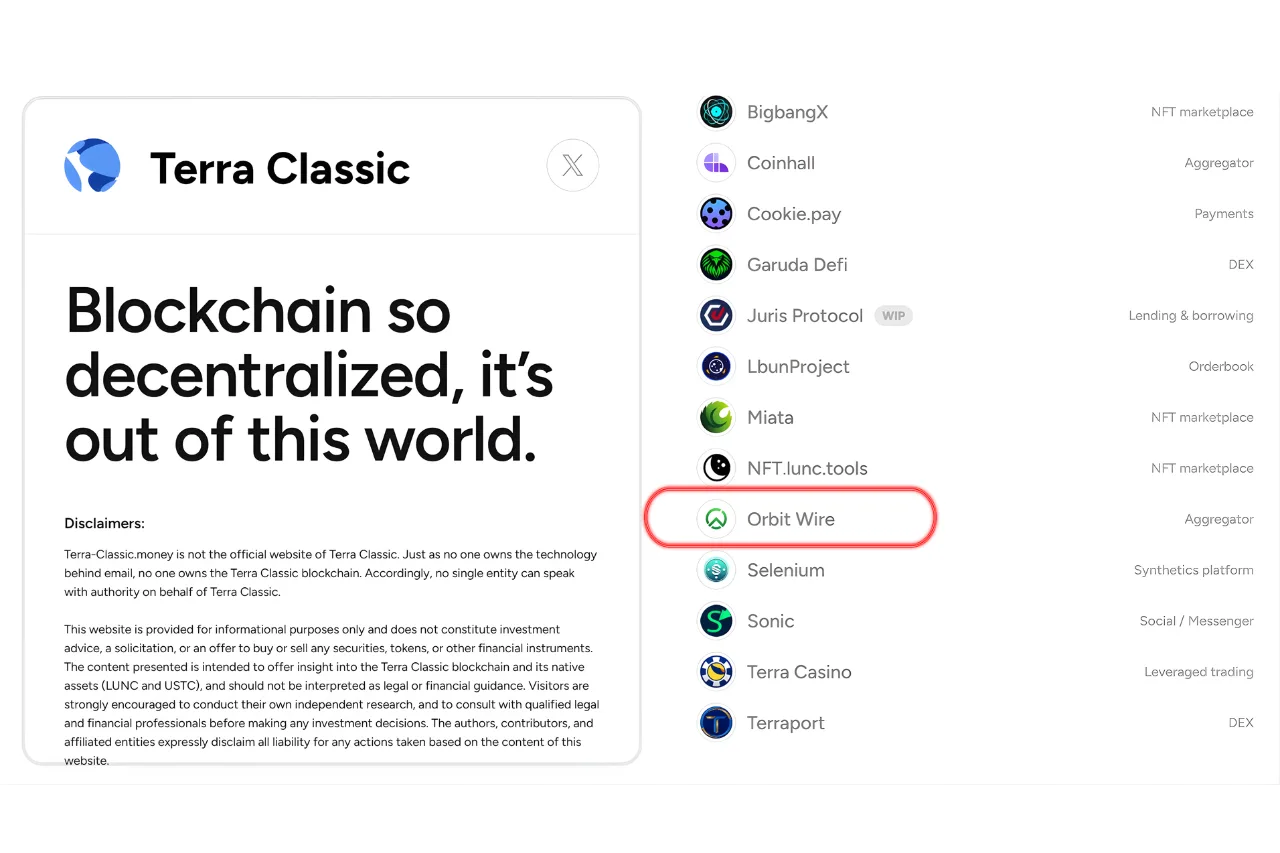
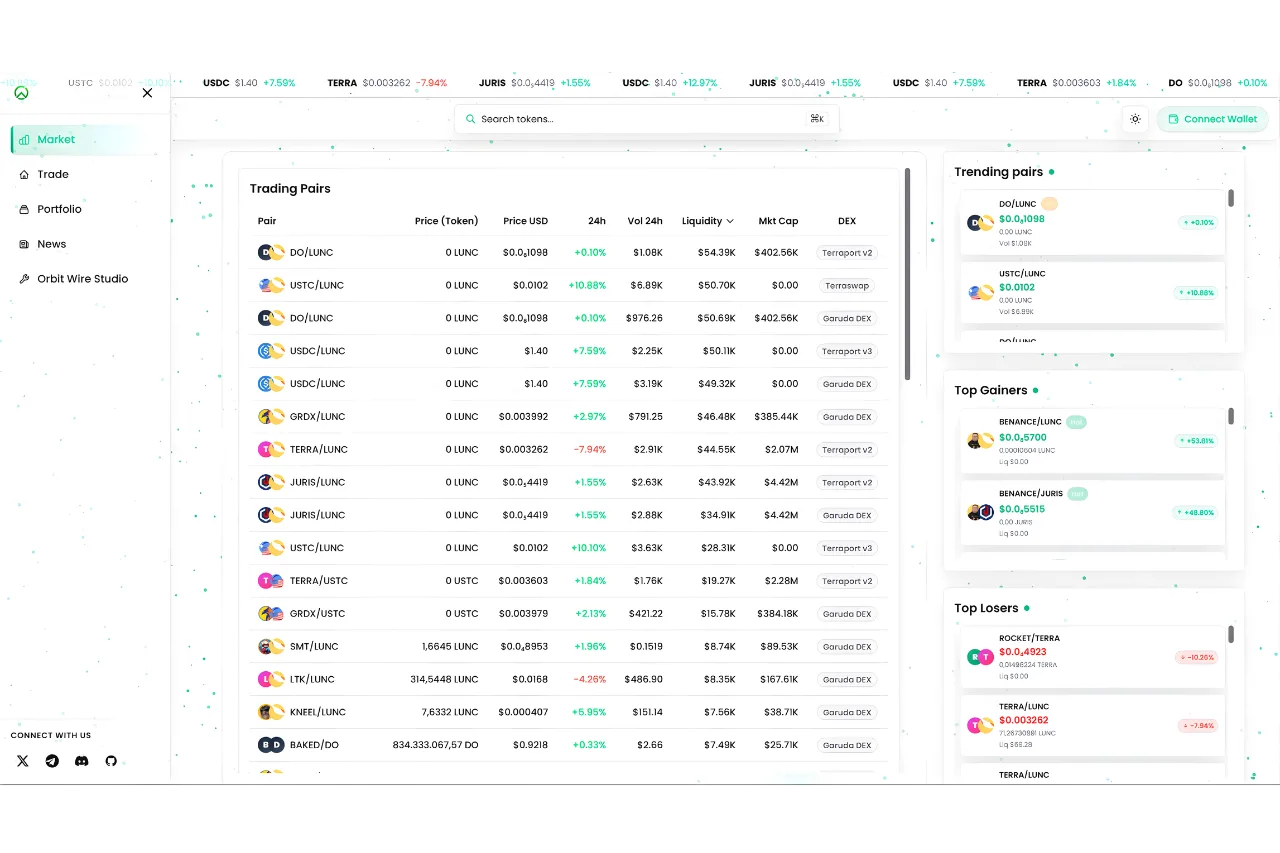
Orbit Wire provides an on chain trading platform designed specifically for the Terra Classic network. By trading on chain through Orbit Wire, community members can support network activity while contributing to the overall burn mechanism.

Increasing on chain participation remains a key factor in strengthening the Terra Classic ecosystem and supporting long term supply reduction through consistent burns.

Nearly 2 Million USTC Burned in 21 Days as Community Efforts Continue

0

Nearly 2 Million USTC Burned in 21 Days as Community Efforts Continue

The Terra Classic ecosystem continues to show steady progress in its supply reduction efforts, with nearly 2 million USTC burned over the last 21 days. This consistent burn activity reflects ongoing participation from the community and supporting platforms, reinforcing long term goals to improve token economics.

Between December 1 and December 21, a total of 1,951,595 USTC was permanently removed from circulation. Daily burn figures varied throughout the period, with several notable spikes indicating increased transaction activity and coordinated burn initiatives.

One of the most significant single day burns occurred on December 6, when over 600,000 USTC was burned in one day. Other strong burn days followed on December 4, December 5, December 10, December 15, and December 17, showing that burn momentum has been sustained rather than driven by a single event.

Regular USTC burns play an important role in the Terra Classic recovery roadmap. By gradually reducing circulating supply, the ecosystem aims to support long term stability while maintaining transparency through publicly tracked burn data.

As the Terra Classic community continues to focus on real utility, on chain activity, and responsible token management, consistent burn performance like this highlights growing commitment to the network’s future.

USTC Daily Burn Data

Month Date USTC Burn
December 1 15,068
December 2 14,622
December 3 44,933
December 4 189,151
December 5 157,437
December 6 603,331
December 7 135,725
December 8 51,193
December 9 18,630
December 10 162,388
December 11 24,001
December 12 112,496
December 13 27,710
December 14 37,447
December 15 109,253
December 16 16,841
December 17 122,039
December 18 60,992
December 19 15,841
December 20 19,067
December 21 13,430
Total 1,951,595

Over 4 Billion LUNC Burned in 21 Days Signals Strong Network Commitment

0

Over 4 Billion LUNC Burned in 21 Days Signals Strong Network Commitment

The Luna Classic network has reached an important milestone, with more than 4 billion LUNC burned in just 21 days. This achievement reflects the continued commitment of the community, validators, and ecosystem participants to reducing the circulating supply and strengthening the long term outlook of the network.

Token burning remains a core component of Luna Classic’s recovery strategy. By permanently removing tokens from circulation, the network aims to support a more sustainable economic model while reinforcing confidence among holders and builders.

During the first three weeks of December, daily burn activity remained consistent, with several days recording notably high volumes. December 1 and December 5 were standout dates, each contributing hundreds of millions of LUNC to the total burn figure.

Below is a detailed breakdown of the daily LUNC burn activity over the 21 day period.

Daily LUNC Burn Breakdown

Month Date LUNC Burned
December 1 602,506,463
December 2 40,982,656
December 3 76,774,565
December 4 57,034,202
December 5 691,616,593
December 6 308,917,077
December 7 275,683,055
December 8 125,661,572
December 9 226,866,684
December 10 234,059,483
December 11 168,749,439
December 12 335,397,628
December 13 233,673,361
December 14 108,355,346
December 15 128,830,335
December 16 62,266,063
December 17 162,927,071
December 18 85,584,019
December 19 37,754,603
December 20 40,899,393
December 21 38,092,070
Total 4,042,631,678

What This Means for Luna Classic

Burning over 4 billion LUNC in less than a month demonstrates strong on chain participation and collective responsibility across the ecosystem. While token burns alone do not guarantee price movement, they play an important role in supply reduction and long term network sustainability.

As development continues and new use cases emerge within the Luna Classic ecosystem, consistent burn activity strengthens the narrative of a community driven blockchain focused on transparency, recovery, and long term growth.

Terraform Labs Plan Administrator Plans $4 Billion Lawsuit Against Jump Trading Over Alleged Role in Collapse

0

Terraform Labs Plan Administrator Plans $4 Billion Lawsuit Against Jump Trading Over Alleged Role in Collapse

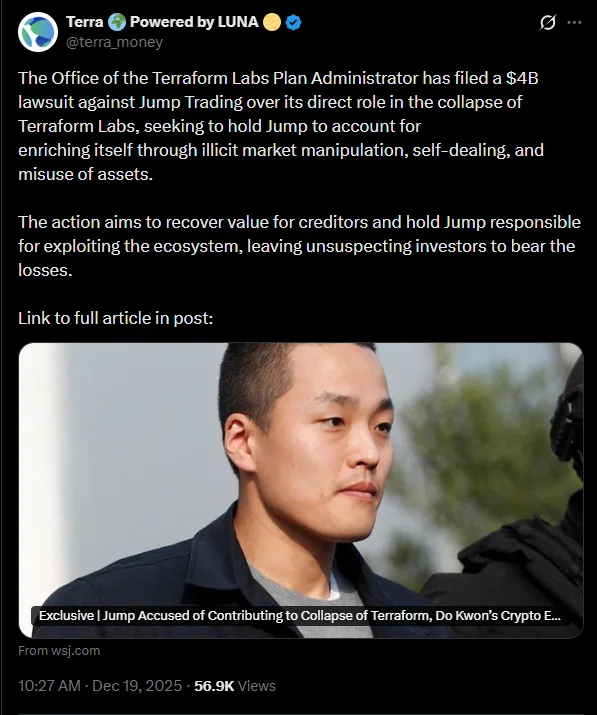
The Office of the Terraform Labs Plan Administrator has announced plans to pursue a $4 billion lawsuit against Jump Trading, a major crypto trading firm, over its alleged involvement in the collapse of Terraform Labs.

The announcement quickly drew attention after the official Terraform Labs X account became active again. The account had been inactive for around eight months before posting about the planned legal action, triggering renewed discussion across the crypto community.

Who Is Taking Legal Action

The planned lawsuit is being prepared by the court appointed Plan Administrator overseeing the bankruptcy and restructuring of Terraform Labs.

The administrator’s role is to protect creditors, review what led to the collapse, and attempt to recover lost funds. This includes examining the actions of major firms that interacted with the Terraform ecosystem during its final stages.

What Jump Trading Is Accused Of

According to the plan outlined by the administrator, Jump Trading is accused of actions that may have contributed to or worsened Terraform’s collapse.

These allegations include influencing market prices in an unfair or improper way during critical moments, prioritizing its own profits over the health of the ecosystem, and improperly using Terraform related assets or tokens.

The administrator claims these actions allowed Jump to benefit financially while the ecosystem was already under extreme stress.

Profits During the Collapse

One of the central arguments behind the planned lawsuit is that Jump Trading allegedly made substantial profits while Terraform Labs was collapsing.

During the same period, regular investors, developers, and ecosystem participants suffered heavy losses. The administrator argues that this imbalance is unacceptable and should be addressed through legal action.

Why the Lawsuit Is Being Planned

The main objective of the planned lawsuit is to recover funds and assets that Jump Trading is alleged to have gained improperly.

If successful, any recovered value would be used to compensate creditors, meaning individuals and entities that lost money because of Terraform Labs’ failure.

Another goal is accountability. The administrator aims to establish legal responsibility for actions that may have deepened the collapse and harmed trust in the ecosystem.

What This Means in Simple Terms

In simple terms, the Plan Administrator believes Jump Trading may have helped worsen Terraform’s collapse, benefited from it financially, and should potentially return billions of dollars to those who were harmed.

If the lawsuit moves forward, it could significantly impact creditor recoveries and may set an important precedent for how large trading firms are held accountable in major crypto market failures.

Luna Classic v3.6.1 Upgrade Finished: Why It Matters, Explained for Beginners

0

Luna Classic v3.6.1 Upgrade Finished: Why It Matters, Explained for Beginners

The Luna Classic network has successfully completed the v3.6.1 upgrade under the chain upgrade name v13_1. This release focuses on resolving critical security vulnerabilities and improving network stability rather than introducing new features.

The sections below explain the most important issues fixed in this upgrade and why they matter for the Luna Classic ecosystem.

1. Critical CometBFT Network Halt Vulnerability

Aspect Explanation
Issue Identified A serious security issue was found in CometBFT related to incorrect handling of BitArray data used in node to node communication
Root Cause Nodes could receive malformed BitArray messages with inconsistent internal values
Validation Problem Invalid messages were shared with other nodes before being fully validated
Node Impact When nodes attempted to process the malformed data, they could crash or enter an invalid state
Network Risk A single malicious actor could potentially trigger a cascading failure across the entire network
Worst Case Outcome The network could experience a complete halt
Fix Applied CometBFT was upgraded from version 0.37.15 to 0.37.16
Result Strict validation ensures invalid BitArray messages are rejected before propagation

This fix removes a high risk denial of service vulnerability at the consensus level and protects the network from chain wide instability.

2. Oracle Transaction Gas Limit Denial of Service Risk

Aspect Explanation
Oracle Transaction Rules Oracle transactions are free and prioritized ahead of user transactions
Access Control Only bonded validators can submit oracle transactions
Validator Set Status The validator set is currently not full
Attack Cost It was cheap for an attacker to become a validator
Attack Method A malicious validator could submit an oracle transaction with a gas limit equal to the block gas limit
Block Impact A single transaction could consume all block capacity
Transaction Exclusion User transactions and legitimate oracle votes could be blocked
Coordinated Risk Multiple attackers could manipulate oracle prices by excluding honest validator votes
Chain Condition The chain would continue producing blocks while becoming effectively unusable
Fix Applied Oracle transactions are prevented from monopolizing block gas
Result Fair block space usage and oracle price integrity are protected

These protections ensure that oracle pricing remains reliable and that normal user transactions can continue without disruption.

3. Legacy Smart Contract Query Protection

Aspect Explanation
Contract Type Some older Terra smart contracts rely on legacy query formats
Previous Risk Oversized query requests could degrade node performance
Protection Added A size limit of sixty four kilobytes is enforced for WASM queries
DoS Prevention Oversized queries are rejected early
Compatibility Handling Legacy queries are translated into the modern TerraQuery format
Result Backward compatibility is preserved without compromising network security

This change allows older contracts to remain functional while preventing query based denial of service attacks.

4. Overall Impact of the v3.6.1 Upgrade

Area Outcome
Consensus Security Fixes a critical vulnerability that could halt the network
Oracle System Removes a near zero cost oracle based denial of service attack vector
Smart Contracts Strengthens protection against query based abuse
Ecosystem Benefits Validators, users, and applications gain improved stability and security
Long Term Effect The network is better prepared for long term operation and ecosystem growth

Why This Upgrade Is Important

The Luna Classic v3.6.1 upgrade addresses multiple high impact risks that could have disrupted the network without warning. By resolving consensus level vulnerabilities, securing oracle transaction processing, and protecting smart contract queries, the network is now more stable and resilient.

This upgrade strengthens trust in the Luna Classic infrastructure and provides a safer foundation for validators, developers, and users as the ecosystem continues to grow.

Over 3.9 Billion LUNC Burned in Just 18 Days as On Chain Activity Remains Strong

0

Over 3.9 Billion LUNC Burned in Just 18 Days as On Chain Activity Remains Strong

The Terra Classic network has recorded a significant milestone, with more than 3.9 billion LUNC burned over the last 18 days. This steady reduction in supply reflects continued on chain activity and the ongoing commitment of the community and ecosystem participants to support long term sustainability.

LUNC burns are a key mechanism designed to gradually reduce the circulating supply. Each transaction burn contributes directly to this goal, making trading volume and on chain usage important factors in accelerating supply reduction.

During the first 18 days of December, daily burn figures showed consistent participation, with several high volume days pushing the total burn amount higher. The data highlights how active trading periods and increased network usage can have a direct impact on the overall burn rate.

Below is a detailed recap of LUNC burns recorded during this period.

Month Date LUNC Burn
December 1 602,506,463
December 2 40,982,656
December 3 76,774,565
December 4 57,034,202
December 5 691,616,593
December 6 308,917,077
December 7 275,683,055
December 8 125,661,572
December 9 226,866,684
December 10 234,059,483
December 11 168,749,439
December 12 335,397,628
December 13 233,673,361
December 14 108,355,346
December 15 128,830,335
December 16 62,266,063
December 17 162,927,071
December 18 85,584,019
Total 3,925,885,612

The data shows that burn activity is not driven by a single event, but rather by consistent daily participation. This trend reinforces the importance of platforms, applications, and services that increase on chain volume, as higher activity directly translates into higher burn amounts.

As the Terra Classic ecosystem continues to evolve, sustained on chain usage remains one of the most effective ways to support LUNC supply reduction. If current activity levels continue, the network could see even stronger burn figures in the coming months.

The New User and Builder Friendly Trading Platform Has Launched on Luna Classic

0

Orbit Wire Launches as a New Trading Aggregator on Luna Classic

A new trading platform has officially launched within the Luna Classic ecosystem. Orbit Wire [https://orbitwire.io/] is a trading aggregator built specifically for the LUNC blockchain, with a strong focus on usability, builder support, and increasing on chain activity.


Orbit Wire is designed to be both user friendly and builder friendly. For users, the platform offers a clear and accessible way to follow trading activity and ecosystem updates related to Luna Classic. Its simple structure helps users stay informed without unnecessary complexity.


For builders, Orbit Wire provides tools that support project growth and visibility. The platform is built to help projects contribute to higher on chain volume, which plays an important role in strengthening the long term sustainability of the Luna Classic network.

One of the key features of Orbit Wire is its dedicated news section focused entirely on the Luna Classic blockchain. This allows users to access important updates, ecosystem developments, and community news in one centralized location, reducing reliance on multiple external sources.

Orbit Wire also enables builders to create and publish their own content (image or video) using custom logos. This feature is designed to help projects market themselves more effectively, improve brand recognition, and connect directly with the Luna Classic community.


By combining trading aggregation, ecosystem focused news, and builder driven marketing tools, Orbit Wire positions itself as a valuable new platform for users and developers looking to actively participate in the Luna Classic ecosystem.

Luna Classic Oracle Pool Continues to Decline Over the Last Three Months

0

Luna Classic Oracle Pool Continues to Decline Over the Last Three Months

Over the past three months, the Luna Classic oracle pool has shown a steady and consistent decrease in balance.
This trend is clearly visible in recent on chain data, where both LUNC and USTC holdings within the oracle pool
continue to move lower over time.


The oracle pool plays an important role in the Terra Classic network. In simple terms, it is a reserve of tokens
used to reward validators and oracle operators for providing accurate price data to the blockchain. This data is
essential for maintaining network functionality, supporting smart contracts, and ensuring correct economic
calculations across the ecosystem.

As the oracle pool balance decreases, it usually indicates that rewards are being distributed faster than they
are being replenished. This can happen when network activity remains steady while inflows to the pool are limited.
While a declining oracle pool does not immediately signal a problem, it is an important metric that reflects
ongoing network usage and reward dynamics.

At the time of the latest snapshot, the oracle pool holds the following balances:

  • LUNC balance: 53,969,015,879
  • USTC balance: 176,480,239

These figures confirm a continued reduction compared to previous months. For the Luna Classic community,
monitoring the oracle pool remains important, as it directly relates to validator incentives and the long term
sustainability of network operations.

Over 3.84 Billion LUNC Burned in 17 Days Shows Strong On Chain Activity

0

Over 3.84 Billion LUNC Burned in 17 Days Shows Strong On Chain Activity

The Terra Classic network has recorded a significant milestone in token reduction, with more than 3.84 billion LUNC permanently burned over the last 17 days. This consistent burn activity reflects sustained on chain volume and growing participation across the ecosystem.

Token burning plays a critical role in Terra Classic’s long term strategy by reducing circulating supply. As more transactions occur on chain, the burn mechanism removes LUNC from circulation, supporting a healthier token economy over time.

During this 17 day period, daily burn figures remained active, with several days recording exceptionally high totals. The strongest single day burn exceeded 690 million LUNC, while multiple other days surpassed the 300 million mark. These figures highlight the impact of increased network usage and ongoing community driven activity.

Below is a detailed breakdown of the daily LUNC burn data for the period.

LUNC Daily Burn Recap

Day LUNC Burned
Day 1 602,506,463
Day 2 40,982,656
Day 3 76,774,565
Day 4 57,034,202
Day 5 691,616,593
Day 6 308,917,077
Day 7 275,683,055
Day 8 125,661,572
Day 9 226,866,684
Day 10 234,059,483
Day 11 168,749,439
Day 12 335,397,628
Day 13 233,673,361
Day 14 108,355,346
Day 15 128,830,335
Day 16 62,266,063
Day 17 162,927,071
Total 3,840,301,593

This level of sustained burning demonstrates that Terra Classic’s deflationary mechanics are actively working alongside ecosystem growth. Continued focus on building applications and increasing transaction volume remains one of the most effective ways to maintain and accelerate the LUNC burn rate.

If current activity levels continue, Terra Classic could see even stronger supply reduction trends in the coming months.

Did You Know Binance Has Already Burned Over 7.4 Billion LUNC This Year

0

Did You Know Binance Has Already Burned Over 7.4 Billion LUNC This Year

Binance continues to demonstrate strong long term support for the Luna Classic ecosystem through its ongoing LUNC burn initiative. According to the latest yearly data, the exchange has already burned more than 7.49 billion LUNC this year, making it one of the most significant contributors to LUNC supply reduction.

The Binance burn mechanism works by allocating a portion of trading fees generated from LUNC spot and margin pairs. These tokens are then sent to a designated burn address, permanently removing them from circulation. This process directly reduces the circulating supply and helps counter inflationary pressure within the Luna Classic network.

Below is the complete monthly breakdown of LUNC burned by Binance throughout this year.

Binance LUNC Burn Recap

Month LUNC Burned
January 1,721,471,820
February 736,146,374
March 760,073,176
April 521,961,991
May 413,653,487
June 498,530,317
July 375,565,485
August 441,100,594
September 455,227,785
October 356,538,666
November 652,627,275
December 562,133,714
Total 7,495,030,684

The data highlights Binance’s consistent burn activity across the entire year. January recorded the highest burn volume, while several other months exceeded 400 million LUNC. This steady pace reflects a sustained commitment rather than a short term initiative.

While token burns alone do not guarantee price increases, they remain a critical part of Luna Classic’s broader recovery strategy. When combined with community governance, protocol upgrades, and real network utility, continued burns help support healthier tokenomics over time.

As Luna Classic continues to evolve, Binance’s contribution remains a key pillar in reducing excess supply and reinforcing long term sustainability for the ecosystem.