Home Blog Page 31

Orbit Wire Trading Platform Introduces Advanced Charting and Technical Indicators for Luna Classic Traders

0

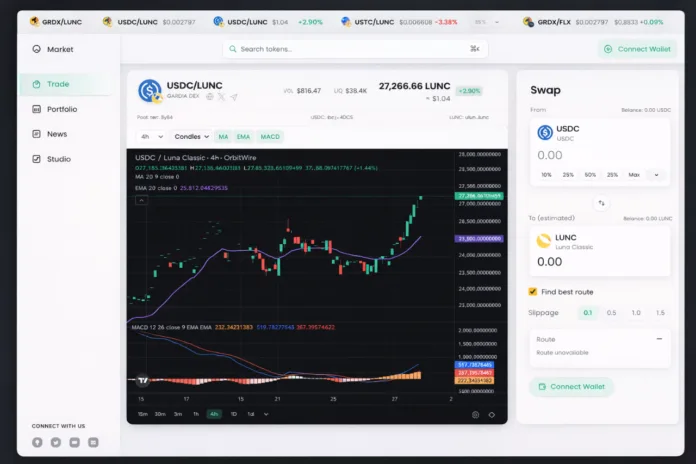
Orbit Wire has introduced new features to its trading platform, bringing a more professional and user friendly trading experience to the Luna Classic ecosystem. These updates focus on improving chart readability, technical analysis, and overall usability for both new and experienced traders.

The platform now includes three widely used technical indicators that help users better understand market trends and price movements. These indicators are Moving Average, Exponential Moving Average, and MACD. With these tools, traders can analyze momentum, identify potential trend changes, and make more informed trading decisions directly from the chart interface.
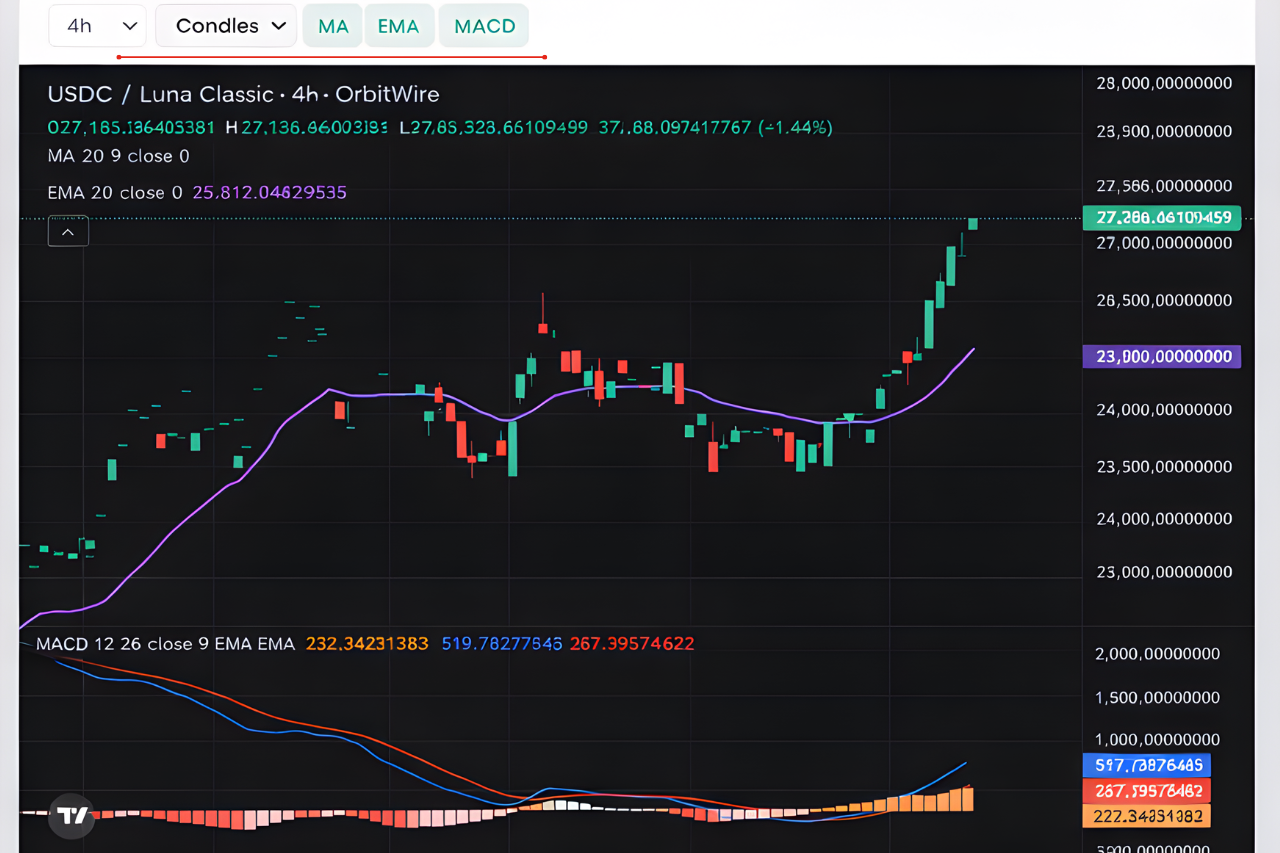


Moving Average helps smooth price data to identify overall trend direction. Exponential Moving Average places greater weight on recent prices, allowing traders to respond more quickly to market changes. MACD combines trend and momentum analysis, making it easier to identify potential buy and sell signals.

In addition to technical indicators, Orbit Wire has expanded its chart style options. Users can now choose between three chart types: candle, hollow, and area charts. This flexibility allows traders to customize their chart view based on personal preference and trading strategy, improving clarity and comfort during analysis.
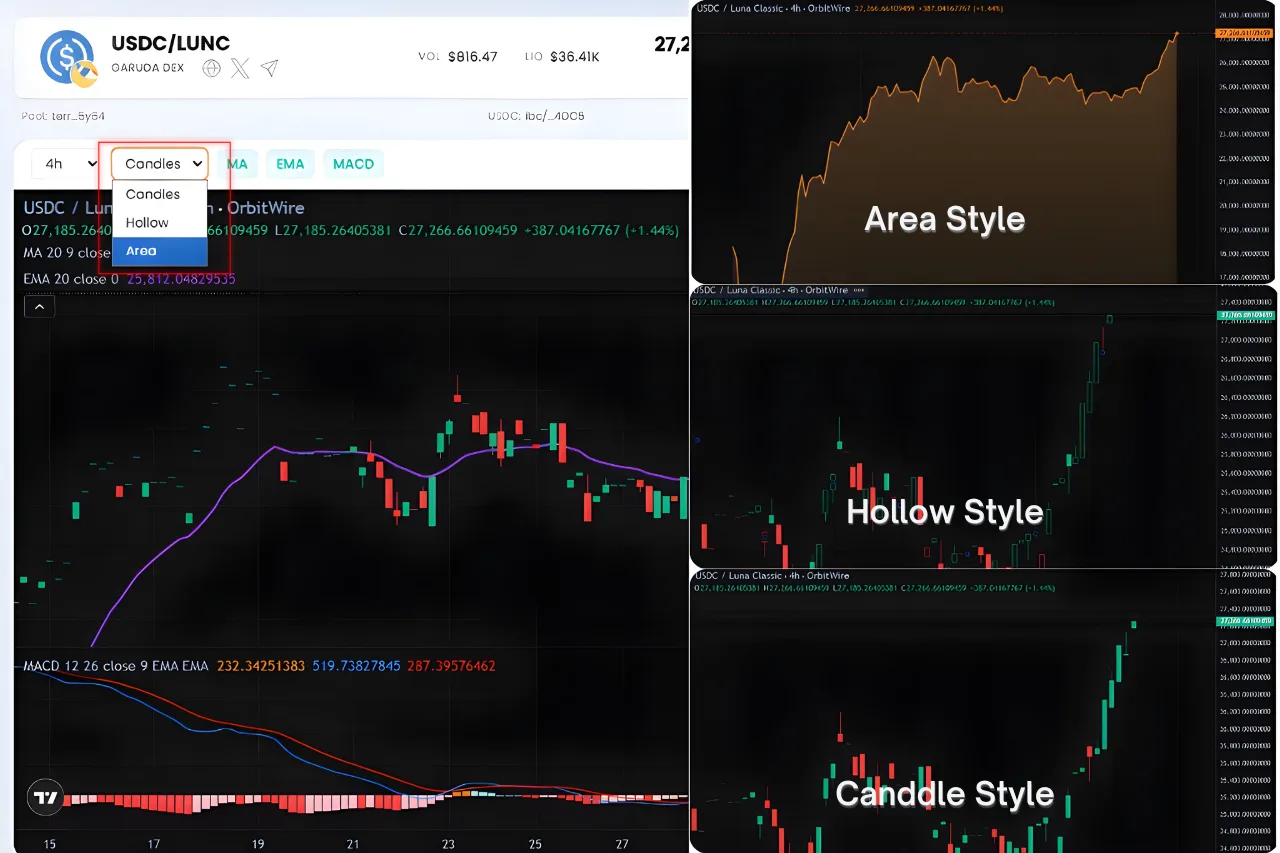


All these features are integrated into a clean and simple user interface. The updated design ensures that charts remain easy to read while still offering professional grade tools. By combining simplicity with powerful functionality, Orbit Wire aims to make trading within the Luna Classic ecosystem more accessible and efficient.

With these enhancements, Orbit Wire continues to position itself as a reliable trading platform, helping users trade their favorite Luna Classic ecosystem tokens with greater confidence and precision.
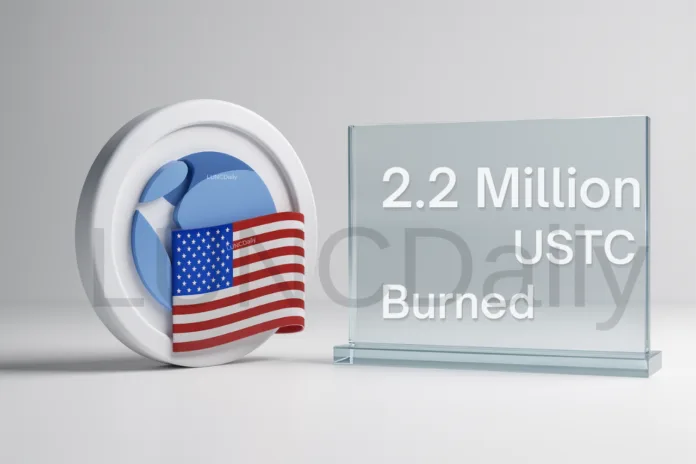

USTC Burn Update December 2025 : Over 2.2 Million Tokens Burned in 30 Days

0

USTC Burn Update December 2025 Over 2.2 Million Tokens Burned in 30 Days

USTC has recorded steady supply reduction activity throughout December 2025, with more than 2.2 million tokens burned over the last 30 days. This consistent burn performance reflects ongoing efforts by the Terra Classic ecosystem to reduce circulating supply and strengthen long term fundamentals.

Burn activity remained active almost every day in December, showing a combination of small routine burns and several higher volume days that significantly boosted the monthly total. As the year approaches its final day, the community is now watching closely to see whether total burns can reach the 2.5 million USTC milestone before 2026 begins.

USTC Burn Recap December 2025

Month Date USTC Burn
December 1 15,068
December 2 14,622
December 3 44,933
December 4 189,151
December 5 157,437
December 6 603,331
December 7 135,725
December 8 51,193
December 9 18,630
December 10 162,388
December 11 24,001
December 12 112,496
December 13 27,710
December 14 37,447
December 15 109,253
December 16 16,841
December 17 122,039
December 18 60,992
December 19 15,841
December 20 19,067
December 21 13,430
December 22 16,322
December 23 11,530
December 24 5,892
December 25 11,038
December 26 26,368
December 27 13,383
December 28 25,301
December 29 18,598
December 30 131,522
Total 2,211,549

Can USTC Reach 2.5 Million Burns Before 2026

With one day left before the end of 2025, USTC would need roughly 288,451 additional tokens burned to reach the 2.5 million mark. While this would require a higher than average daily burn, previous spikes during December show that large single day burns are possible under the right conditions.

Whether or not the target is reached, December 2025 already stands as a strong month for USTC burn activity. The continued reduction in supply highlights sustained community participation and reinforces the importance of on chain activity as the ecosystem moves into 2026.

Luna Classic Burn Report: Over 4.6 Billion LUNC Burned in the Last 30 Days

0

Luna Classic Burn Activity Overview

The Luna Classic network has recorded strong burn activity over the last 30 days, with more than 4.6 billion LUNC permanently removed from circulation. This milestone reflects consistent on chain transactions, exchange participation, and community driven efforts aimed at long term supply reduction.

Burn activity remains one of the most closely watched metrics in the Terra Classic ecosystem, as it directly impacts circulating supply and reinforces the community’s commitment to rebuilding trust and value.

Daily LUNC Burn Breakdown for December

Below is the complete daily burn recap for the last 30 days, showing how burn volume accumulated throughout the month.

Month Date LUNC Burned
December 1 602,506,463
December 2 40,982,656
December 3 76,774,565
December 4 57,034,202
December 5 691,616,593
December 6 308,917,077
December 7 275,683,055
December 8 125,661,572
December 9 226,866,684
December 10 234,059,483
December 11 168,749,439
December 12 335,397,628
December 13 233,673,361
December 14 108,355,346
December 15 128,830,335
December 16 62,266,063
December 17 162,927,071
December 18 85,584,019
December 19 37,754,603
December 20 40,899,393
December 21 38,092,070
December 22 83,014,850
December 23 43,898,770
December 24 90,472,510
December 25 80,129,950
December 26 46,332,749
December 27 40,906,672
December 28 49,217,138
December 29 67,105,240
December 30 57,989,347
Total 4,601,698,904

Can LUNC Reach 5 Billion Burned Before Year End

With one day left in 2025, the Luna Classic network would need to burn roughly 398 million additional LUNC to reach the 5 billion mark. While daily burn volumes vary, historical data shows that spikes are possible during periods of high on chain volume or large exchange burns.

Reaching 5 billion within the final day would require above average activity, but even if the target is not met, the current 4.6 billion burn already represents a strong finish to the year.

Why This Burn Milestone Matters

Sustained burn activity signals ongoing network usage and reinforces the long term deflationary vision of Luna Classic. Each burn contributes to gradual supply reduction, which many community members view as a key pillar in the ecosystem’s recovery strategy.

As 2026 approaches, consistent on chain volume and continued community participation will remain essential for maintaining and accelerating burn momentum.

USTC Price Performance Report 2025 Year End Review

0

USTC Price Performance Report 2025 Year End Review

Today marks the final day of 2025, and this report provides a clear overview of USTC price performance throughout the year.

USTC began 2025 with a price of 0.019 USD on January 1. This level reflected cautious optimism as market participants continued to monitor developments around the Terra Classic ecosystem and broader crypto market conditions.


By the end of 2025, USTC is trading at approximately 0.006 USD. Based on the yearly opening price, this represents a price decline of around 68 percent over the course of the year. The performance highlights sustained selling pressure and limited recovery momentum during 2025.

During the year, USTC reached a yearly high of 0.029 USD. This peak occurred during periods of short term speculative interest but was not sustained over the long term.

On the downside, the yearly low was recorded at approximately 0.003 USD, marking the weakest point for USTC in 2025.

Overall, USTC price action in 2025 was characterized by high volatility and a clear downward trend. The gap between the yearly high and low reflects ongoing uncertainty surrounding USTC utility, recovery mechanisms, and market confidence. As the market moves into 2026, price performance will likely continue to depend on ecosystem developments, governance decisions, and broader crypto market sentiment.

Luna Classic Price Performance Report 2025 Year End Overview

0

As 2025 comes to a close, this report provides a clear and straightforward overview of Luna Classic price performance throughout the year. The focus is on key price levels, overall market direction, and how LUNC performed from the first day to the final day of 2025.

On January 1 2025, Luna Classic began the year trading at a price of 0.0001 USD. This level reflected early year optimism as the community continued to focus on ecosystem rebuilding, on chain activity, and long term supply reduction efforts.

By the final day of 2025, the price of LUNC stands at 0.00003 USD. This represents a significant decline over the course of the year. Based on these values, Luna Classic recorded a price decrease of approximately 65.1 percent for 2025.

During the year, LUNC experienced notable price fluctuations. The highest price reached in 2025 was 0.00017 USD, marking the annual all time high. This peak reflected periods of increased trading interest and short term momentum within the market.

On the downside, the lowest price recorded in 2025 was 0.000017 USD. This annual all time low highlighted ongoing market pressure, broader crypto market uncertainty, and cautious investor sentiment.

Overall, Luna Classic 2025 price performance shows a challenging year marked by volatility and a clear downward trend from its opening price. While temporary rallies occurred, the year ended with LUNC trading well below its starting level. These figures provide important context for investors and community members as they evaluate expectations, strategies, and developments heading into 2026.

Luna Classic Oracle Pool Balance Report 2025 Year End Summary

0

Luna Classic Oracle Pool Balance Report for 2025 Year End Summary

Today marks the final day of 2025 and this report provides a clear overview of the Luna Classic Oracle Pool balance at year end. The Oracle Pool plays an important role in the Terra Classic network and monitoring its balance helps the community understand long term network sustainability.

What Is the Oracle Pool

The Oracle Pool is a reserve within the Terra Classic ecosystem used to support oracle rewards. To keep the network secure and reliable these validators are compensated from the Oracle Pool.

In simple terms the Oracle Pool ensures that essential data services on Terra Classic continue to function smoothly.

Oracle Pool Balance at the Start of 2025

At the beginning of 2025 the Oracle Pool held the following balances:

  • 86.8 billion LUNC
  • 294.1 million USTC

These funds were allocated to support oracle operations throughout the year.

Oracle Pool Balance at the End of 2025

As of today the final day of 2025 the Oracle Pool balance stands at:

  • 53 billion LUNC
  • 173.1 million USTC

This represents an approximate 40 percent decrease compared to the start of the year.

What This Change Means

The reduction in the Oracle Pool balance reflects ongoing network operations and oracle reward distributions during 2025. This usage is expected as long as Terra Classic continues to rely on decentralized price feeds and on chain data.

Tracking these changes helps the community evaluate future funding needs and assess how efficiently on chain resources are being utilized.

Closing Note

The Oracle Pool remains a core component of the Terra Classic infrastructure. Transparent reporting like this allows the community to better understand network economics and supports informed discussions as Terra Classic moves into 2026.

Will Luna CLassic Improve or Be Abandoned in 2026

0

Will LUNC Improve or Be Abandoned in 2026

With only days left before 2026, a critical question must be asked by the Terra Classic community. Will LUNC continue to improve, or will it slowly lose relevance due to the lack of a clear long term direction.

This question is not about price speculation. It is about structure, planning, and vision. As a community driven blockchain, Terra Classic depends heavily on coordination, transparency, and shared goals. Without these, even strong technical work can fail to deliver real progress.

The Missing Long Term Plan for LUNC

Throughout the past year, the Terra Classic ecosystem has seen many proposals, upgrades, and discussions. While these efforts are important and often necessary, they have largely appeared without a clearly defined long term framework.

The community has not seen a formal roadmap that explains what LUNC aims to achieve by the end of 2025, nor what the broader objectives are for 2026. There has been no widely accepted whitepaper outlining targets, priorities, or measurable milestones.

As a result, many community members feel that development is reactive rather than strategic. Proposals emerge suddenly, debates follow, and upgrades are implemented, but without a shared understanding of how these actions fit into a larger vision.

Why a 2026 Whitepaper Matters

For a community blockchain, a whitepaper is more than a technical document. It is a statement of intent. It defines where the project is going, why certain decisions are made, and how success is measured.

A 2026 whitepaper for Terra Classic should clearly explain the purpose of the network, the role of governance, the priorities for development, and the economic direction of LUNC. It should also set realistic targets that the community can track and evaluate over time.

Without this clarity, contributors may work hard but in different directions. Builders may deliver upgrades that are technically sound, yet fail to move the ecosystem toward a shared goal.

The Risk of Moving Without Direction

It is important to acknowledge and respect the builders, validators, and contributors who continue to support Terra Classic. Their efforts keep the network operational and evolving.

However, when a blockchain continues to operate without defined achievement targets, it creates the feeling of constant motion without real progress. The community appears busy, but the destination remains unclear.

Over time, this can lead to fatigue, reduced participation, and loss of confidence. A lack of direction does not only affect developers. It impacts users, investors, and partners who want to understand what Terra Classic stands for in the future.

A Call for Clear Vision and Alignment

As Terra Classic enters 2026, the focus should shift toward alignment and long term planning. The community needs a clear path, defined targets, and a shared understanding of what success looks like.

Open discussion around a 2026 roadmap and whitepaper would be a strong first step. It would help unify proposals, guide development priorities, and give the community a reason to believe in sustainable progress.

The future of LUNC does not depend on activity alone. It depends on direction, clarity, and collective purpose.

Terra Classic Yearly Community Pool Spending Report and On Chain Allocation Overview

0

Terra Classic Yearly Community Pool Spending Report and On Chain Allocation Overview

Introduction

Transparency is a core principle of on chain governance. Over the past year, the Terra Classic community has approved multiple community pool spending proposals to support development, infrastructure, liquidity, and ecosystem maintenance.

This yearly community pool spending report provides a clear overview of how LUNC funds have been allocated through approved governance proposals. The goal is to help the community better understand where resources are being deployed and why these investments matter for the long term sustainability of the Terra Classic network.

Overview of Community Pool Spending

Community pool spends are approved through governance proposals and funded directly from the Terra Classic community pool. Each proposal specifies its purpose, scope, and funding amount in LUNC.

The table below summarizes the most recent yearly community spends based on approved proposals recorded on chain.

Terra Classic Community Pool Spending

Proposal ID Proposal Title Purpose Summary Approved LUNC Amount Time Approved
12198 Fund IBC Relaying Activity Support inter blockchain communication relaying and network connectivity 254.582 million LUNC About 2 months ago
12197 Phase 2 Removal of Forked Modules Wasmd Unforking Continue OrbitLabs work to clean up forked modules 500 million LUNC 2 months ago
12183 BLV Labs Spending Proposal Wallet Whitelisting Enable wallet whitelisting functionality 133 million LUNC 6 months ago
12182 Inject Liquidity for Garuda DeFi Provide liquidity support for Garuda DeFi as outlined in proposal 12171 792.267 million LUNC 7 months ago
12180 Inject Liquidity for Terraport LUNC USDC Revisit and execute liquidity injection for Terraport trading pair 711.136 million LUNC 7 months ago
12179 Inject Liquidity for Terraswap DEX Fixed liquidity injection request linked to proposal 12171 756.43 million LUNC 7 months ago
12169 Compensation for Development and Audit Work Cover development and audit costs related to proposal 12166 24.298 million LUNC 9 months ago
12164 Additional Development Work v3.4.0 Upgrade Compensate extra development work for network upgrade 32.669 million LUNC 10 months ago
12158 Phase 1 Removal of Forked Modules Initial phase of OrbitLabs forked module cleanup 204.604 million LUNC 10 months ago
12155 BLV Labs GOV Module Improvement Improve governance module functionality 48.356 million LUNC 11 months ago
Total Total Community Pool Spend Combined approved spending across all listed proposals 3.457 billion LUNC Yearly total

Key Observations

A significant portion of community funds was allocated toward liquidity injection proposals aimed at strengthening decentralized exchanges and improving trading conditions on Terra Classic.

Development and infrastructure spending focused on removing forked modules, improving governance systems, enabling wallet functionality, and supporting network upgrades. Funding for IBC relaying also highlights continued investment in cross chain connectivity within the Cosmos ecosystem.

Conclusion

Based on the approved governance proposals listed above, the Terra Classic community allocated approximately 3.46 billion LUNC from the community pool over the reported period. Transparent reporting of these spends helps maintain trust, improves accountability, and allows LUNC holders to make informed governance decisions as the network continues to evolve.

Over 4.4 Billion LUNC Burned in the Last 28 Days Signals Strong On Chain Momentum

0

The Terra Classic network has recorded a significant increase in token burns, with more than 4.4 billion LUNC removed from circulation over the last 28 days. This steady reduction in supply reflects growing on chain activity and continued community participation across the ecosystem.

Token burning plays a crucial role in Terra Classic’s long term recovery strategy. By permanently removing LUNC from circulation, the network aims to gradually reduce total supply while encouraging sustainable on chain usage through trading, applications, and validator participation.

Daily LUNC Burn Breakdown

The following table shows the daily LUNC burn data recorded throughout December, highlighting consistent burn activity across the 28 day period.

Month Date LUNC Burned
December 1 602,506,463
December 2 40,982,656
December 3 76,774,565
December 4 57,034,202
December 5 691,616,593
December 6 308,917,077
December 7 275,683,055
December 8 125,661,572
December 9 226,866,684
December 10 234,059,483
December 11 168,749,439
December 12 335,397,628
December 13 233,673,361
December 14 108,355,346
December 15 128,830,335
December 16 62,266,063
December 17 162,927,071
December 18 85,584,019
December 19 37,754,603
December 20 40,899,393
December 21 38,092,070
December 22 83,014,850
December 23 43,898,770
December 24 90,472,510
December 25 80,129,950
December 26 46,332,749
December 27 40,906,672
December 28 49,217,138
Total LUNC Burned 4,476,604,317

What This Means for Terra Classic

The consistent daily burn trend demonstrates ongoing network usage driven by decentralized exchanges, on chain transactions, and community supported initiatives. Higher on chain volume directly contributes to increased burns, reinforcing the importance of real usage rather than speculation alone.

While token burning does not guarantee price movement, it remains a fundamental part of Terra Classic’s broader recovery efforts. Sustained burn activity combined with development, governance upgrades, and ecosystem growth continues to strengthen confidence in the network’s long term direction.

Looking Ahead

If current burn levels remain stable or continue to grow, Terra Classic could see a meaningful reduction in circulating supply over time. The focus now remains on expanding real on chain activity, supporting builders, and maintaining transparency through clear and consistent reporting.

The latest 28 day burn data confirms that Terra Classic’s on chain engine remains active, with the community continuing to contribute to the network’s long term sustainability.

How the Lunc Tools World Bot Builder Works

0

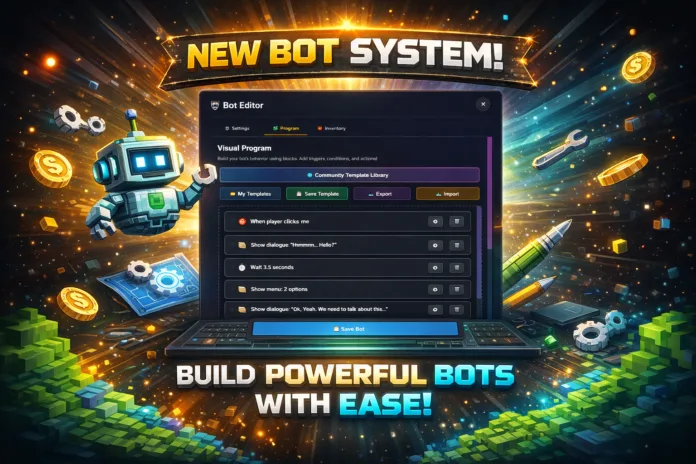
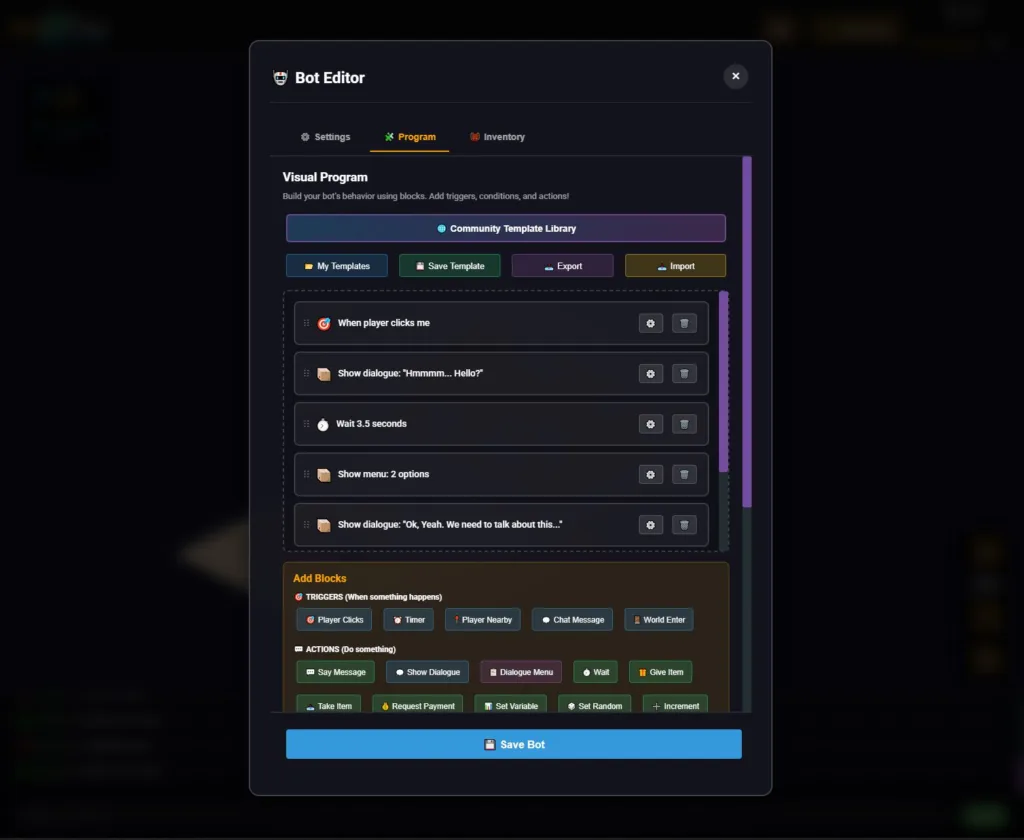
Lunc Tools World introduces a powerful and intuitive Bot Builder designed to empower creators with no coding experience to build interactive bots for virtual environments. This visual programming system enables users to define bot behavior using drag-and-drop logic blocks, making it ideal for games, social hubs, and educational experiences.

Core Features

Visual Programming Interface

The Bot Builder is divided into three main tabs: Settings, Program, and Inventory. The Program tab is where users define bot behavior using a sequence of logic blocks. These blocks are categorized into:

  • Triggers: Events that initiate bot actions (e.g., “Player Clicks”, “Player Nearby”, “World Enter”).
  • Actions: Responses the bot performs (e.g., “Show Dialogue”, “Give Item”, “Teleport Player”).
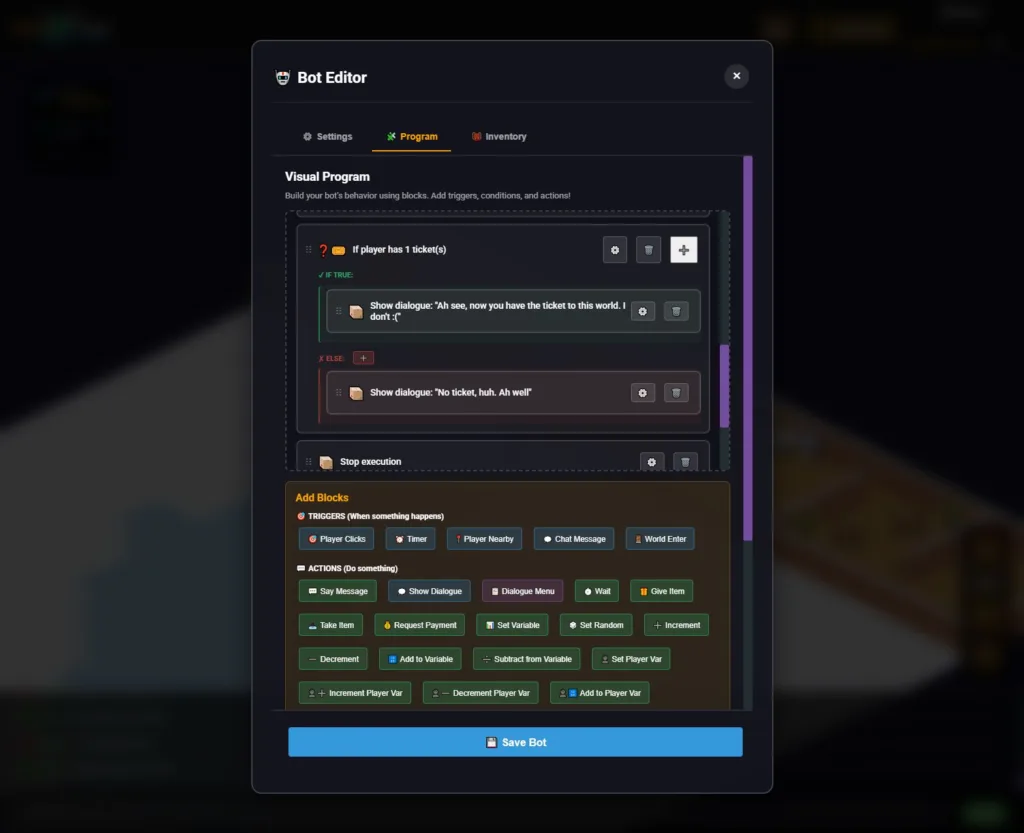
  • Conditions: Logic checks that guide branching behavior (e.g., “If player has ticket”, “Variable > 5”).

Dialogue and Interaction Blocks

Users can create immersive conversations using:

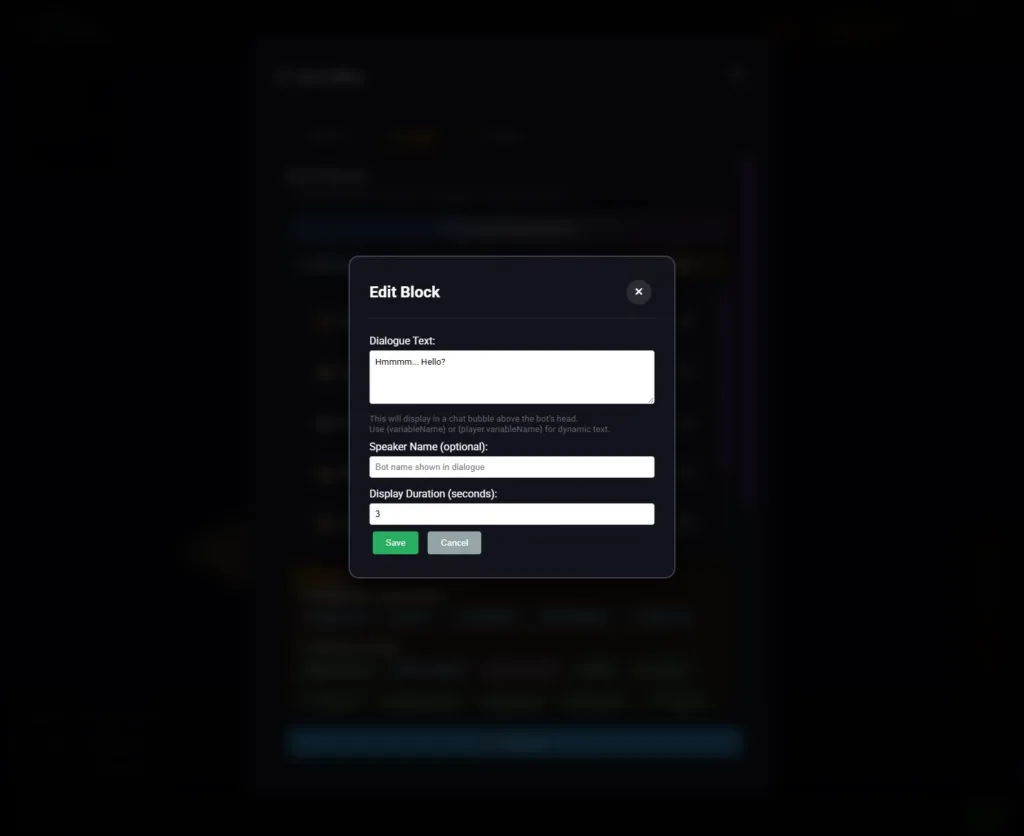
  • Show Dialogue: Displays text in a chat bubble above the bot.
  • Dialogue Menu: Presents multiple options for player choice.
  • Wait: Adds timed pauses between actions for pacing.

Dynamic text can be inserted using variables like {player.name} or {variableName} to personalize interactions.

Inventory and Variables

Bots can manage items and track player progress using:

  • Give/Take Item: Controls inventory exchanges.
  • Set/Increment Variables: Tracks state and progress.
  • Player Variables: Stores data specific to each user.

Template Library and Global Sharing

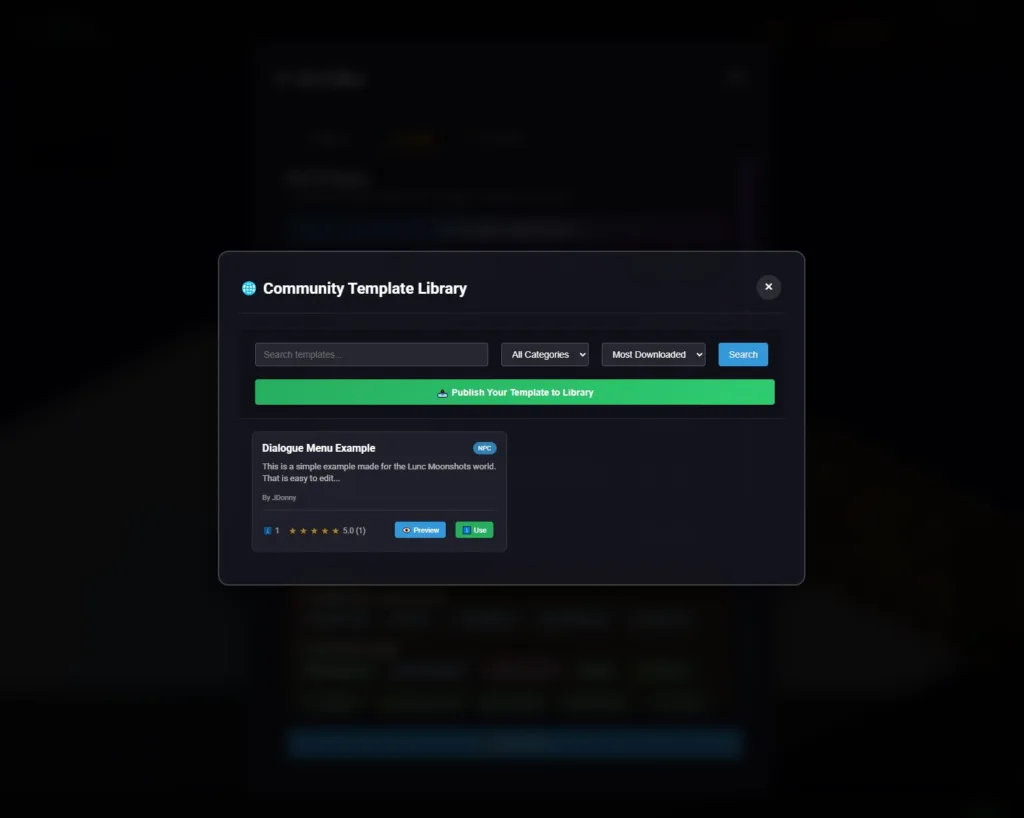
Lunc Tools World now includes a Community Template Library, allowing users to:

  • Browse Templates: Filter by category and popularity.
  • Preview and Use: Instantly load templates into the Bot Editor.
  • Publish Templates: Share custom bot logic with the community.

Templates like “Dialogue Menu Example” showcase reusable interaction systems that can be adapted for different bots.

Example Use Case

A bot might greet players when they approach, offer dialogue options, check if they hold a ticket, and respond accordingly:

Trigger: When player within 2 tiles
  → Show dialogue: "Hi! Hello there traveler."
Trigger: When player clicks me
  → Show dialogue: "Welcome to Lune Moonshots World! Would you like to know more?"
  → Wait 6.3 seconds
  → If player has 1 ticket(s)
      → Show dialogue: "Ah see, now you have the ticket to this world."
      → Stop execution
  → Else
      → Show dialogue: "No ticket, huh. Ah well"
      → Stop execution

Conclusion

The Lunc Tools World Bot Builder is a modular, scalable system for crafting interactive experiences. With its visual logic editor, dynamic dialogue tools, and community-driven template sharing, it transforms bot creation into an accessible and creative process for all users.

Create your bot now!

Create your own bot now at Lunc Tools World