Home Blog Page 5

Comparing Terra Classic’s 1.5% On Chain Tax With Other Major Blockchains

0

Is Terra Classic’s 1.5% On Chain Tax Too High?

Terra Classic has introduced a 1.5% on chain tax on eligible transactions, making it one of the few major blockchain networks that applies a percentage based transaction tax.

The change has sparked discussion across the community. Supporters believe it can accelerate $LUNC burns, while others question whether higher transaction costs could reduce on chain activity over time.

The long term impact will depend on whether increased burns can offset any decline in network usage.

Understanding the 1.5% On Chain Tax

Unlike a standard blockchain network fee, which is usually a fixed amount regardless of the value transferred, Terra Classic’s on chain tax is calculated as a percentage of every eligible transaction.

This means the amount paid increases as the size of the transaction grows.

For example:

  • Sending 100,000 $LUNC results in a tax of 1,500 $LUNC.
  • Sending 1 million $LUNC results in a tax of 15,000 $LUNC.
  • Sending 100 million $LUNC results in a tax of 1.5 million $LUNC.

For users who regularly move large amounts of capital, the cost can become significant.

How Does It Compare With Other Blockchain Networks?

A 1.5% transaction tax is generally considered high compared with most modern cryptocurrency networks.

Most Layer 1 blockchains such as Ethereum, Solana, Cosmos, Avalanche, and Sui charge only a network fee instead of a percentage of the transaction value.

Likewise, decentralized exchanges commonly charge trading fees between 0.05% and 1.0%, with around 0.3% being the industry standard.

While some tokens have introduced buy and sell taxes, many newer projects have reduced these taxes to zero in an effort to improve trading efficiency and user adoption.

Against this backdrop, a 1.5% on chain tax is considerably higher than the costs users typically experience across the broader blockchain industry.

Why Some Users Consider 1.5% High

Higher transaction costs can influence how people use a blockchain.

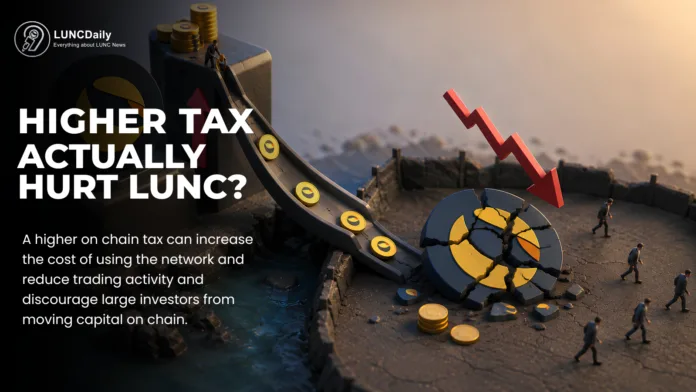
A 1.5% tax increases the cost of every eligible transfer, making large transactions more expensive than before.

This may lead to several outcomes:

  • Higher costs for users transferring funds on chain.
  • Reduced activity from traders and large holders because moving capital becomes more expensive.
  • Lower transaction volume if users choose to limit on chain transfers.
  • Reduced competitiveness compared with blockchain networks that maintain lower transaction costs.

As transaction sizes increase, the financial impact of the tax becomes more noticeable.

The Relationship Between Taxes and Token Burns

One of the primary objectives of the on chain tax is to increase the amount of $LUNC removed from circulation through token burns.

A higher tax naturally burns more tokens from each eligible transaction.

However, there is also an important economic tradeoff.

If higher transaction costs discourage users from interacting with the network, the total number of transactions could decline. If network activity falls significantly, the total amount of $LUNC burned over time may also decrease despite the higher tax rate.

In other words, a higher tax generates more burns per transaction, but fewer transactions could reduce the overall burn rate.

Balancing Burns With Network Growth

Every blockchain must balance revenue generation with user experience.

Some communities accept higher transaction taxes when they help fund ecosystem development, validator incentives, community initiatives, or token burns.

At the same time, many leading blockchain networks focus on keeping transaction costs as low as possible to encourage trading, payments, decentralized applications, and long term ecosystem growth.

For Terra Classic, the success of the 1.5% on chain tax will ultimately depend on whether it can increase token burns while maintaining healthy levels of network activity.

The coming months will provide a clearer picture of how users, developers, and market participants respond to the higher transaction costs and what impact the policy has on the long term growth of the Terra Classic ecosystem.
New Terra Classic Proposal Seeks Community Funding to Maintain IBC Relayer Infrastructure Through December 2026

0

New Terra Classic Proposal Seeks Community Funding to Maintain IBC Relayer Infrastructure Through December 2026

A new governance proposal has entered the discussion stage, requesting Community Pool funding to continue operating Terra Classic’s Inter Blockchain Communication (IBC) relayer infrastructure through December 31, 2026.

The proposal is a continuation of Proposal #12198 and aims to ensure reliable cross chain connectivity between Terra Classic and three major Cosmos ecosystem networks: Osmosis, Noble, and Axelar.

Why IBC Relayers Matter

IBC relayers are essential infrastructure that enables communication between independent Cosmos based blockchains.

They are responsible for monitoring connected networks, transmitting data, and ensuring that cross chain transactions are successfully delivered. Without active relayers, token transfers can be delayed, packets may fail to reach their destination, and decentralized applications that rely on bridged assets can experience service disruptions.

Reliable relayers also help maintain access to cross chain liquidity, stablecoin transfers through Noble, and decentralized finance activity across the Cosmos ecosystem.

Funding Request

The proposal requests a total budget of €12,100, including a precautionary 21 percent Dutch VAT.

The operational budget consists of:

  • €4,800 for server infrastructure
  • €3,200 for feed services
  • €2,000 reserved for relaying transaction fees
  • €2,100 for precautionary Dutch VAT

The final amount requested from the Community Pool will be converted into LUNC based on the LUNC to EUR exchange rate at the time the on chain spending proposal is submitted.

No Labor Costs Included

Unlike the previous funding proposal, this request does not include compensation for working hours, salaries, or management fees.

The funding is limited to infrastructure expenses, feed services, relaying transaction costs, and applicable VAT.

According to the proposal, both organizations will continue providing technical and administrative work without requesting labor compensation from the Community Pool.

Responsibilities

The proposal divides responsibilities between two organizations.

Bumeo Capital B.V. will oversee:

  • Server infrastructure
  • Financial administration
  • Community Pool fund management
  • Business coordination
  • Community communications

LuncGoblins, operated by Till Ziegler, will remain responsible for all technical operations, including relayer configuration, software updates, monitoring, incident response, and maintaining reliable packet delivery across supported networks.

Retrospective Reimbursement

The proposal also includes reimbursement for infrastructure costs incurred between May 1, 2026, and the approval of the new funding request.

Although the previous mandate had expired, the relayer infrastructure continued operating during this period, with all server, feed service, and transaction costs covered privately.

The proposal argues that reimbursing these expenses helps prevent essential public infrastructure from relying indefinitely on private funding.

Conservative VAT Approach

The proposal includes a precautionary allocation for Dutch VAT because the final tax treatment has not yet been determined.

If tax advisers or Dutch authorities later determine that VAT is not applicable, Bumeo Capital commits to returning the corresponding LUNC amount to the Terra Classic Community Pool and publicly documenting the adjustment.

Key Changes From Proposal #12198

Compared with the previous funding mandate, the proposal introduces several changes:

  • Extends funding through December 31, 2026
  • Includes reimbursement for the funding gap beginning May 2026
  • Increases monthly server costs from €130 to €150 per server
  • Removes all labor compensation
  • Introduces a dedicated monthly budget for relaying transaction fees
  • Separates technical operations from financial administration
  • Adds precautionary VAT with a commitment to return unused funds if not required

The technical scope remains unchanged, with continued support for the existing IBC connections between Terra Classic, Osmosis, Noble, and Axelar.

Requested Governance Action

The proposal asks the Terra Classic community to approve continued funding for the IBC relayer infrastructure through December 31, 2026.

If approved, the Community Pool will fund the LUNC equivalent of €12,100, allowing Bumeo Capital to manage infrastructure, finances, and communications while LuncGoblins continues overseeing the technical operation of the relayer network.

Supporters argue that maintaining reliable IBC infrastructure is essential for Terra Classic’s connectivity with the wider Cosmos ecosystem, ensuring uninterrupted access to cross chain liquidity, decentralized applications, and interoperability across supported networks.

Orbit Wire Expands to Osmosis Blockchain With Smarter Cross Chain Trading

0

Orbit Wire, the trading aggregator built on the Luna Classic blockchain, has officially added support for the Osmosis blockchain. The integration gives users access to one of the largest decentralized exchanges in the Cosmos ecosystem while delivering faster and more efficient trade execution.

With Osmosis now available on Orbit Wire, traders can access deeper liquidity through intelligent route optimization and liquidity aggregation. Instead of relying on a single decentralized exchange, Orbit Wire automatically searches multiple liquidity sources to find the most efficient trading path for every swap.

This helps users receive better execution while reducing unnecessary trading costs and slippage.

The addition of Osmosis also expands the range of assets available on Orbit Wire, allowing users to explore more trading opportunities across the growing Cosmos ecosystem without sacrificing a seamless trading experience.

As Orbit Wire continues to integrate new blockchains, the platform is focused on making decentralized trading simpler, faster, and more efficient for both new and experienced users.

The Osmosis integration marks another step in Orbit Wire’s mission to provide the best trading experience through smart routing, aggregated liquidity, and cross chain accessibility.

The Real Cost of a LUNC Transaction After the 1.5 Percent On Chain Tax Increase

0

The Real Cost of Using the Luna Classic Network

The Luna Classic community has officially increased the on chain tax from 0.5 percent to 1.5 percent. The change was designed to increase the amount of LUNC burned through network activity, but it also significantly raises the cost of using the blockchain.

For many users, a 1.5 percent tax may not sound expensive at first. However, when larger amounts are involved, the cost becomes much more noticeable and could influence how investors interact with the network.

What Does the 1.5 Percent Tax Mean?

Every taxable on chain transaction now requires users to pay a 1.5 percent tax. This can include actions such as transferring LUNC between wallets or staking tokens.

In simple terms, each time a user confirms a transaction that is subject to the tax, a percentage of the transaction amount is deducted.

Example:

  • Sending 1,000,000 LUNC requires a tax of 15,000 LUNC.
  • The recipient receives 985,000 LUNC after the tax is applied.

While 15,000 LUNC may appear relatively small, the cost becomes much higher for larger holders.

The Cost for Large Transactions

Now consider sending 100,000,000 LUNC.

  • Tax paid: 1,500,000 LUNC
  • Approximate value: $74 at the current LUNC market price

For large investors and whales, paying tens or even hundreds of dollars for a single transaction can become a major consideration. Higher transaction costs may discourage capital from moving on chain, especially when users can simply keep their assets on centralized exchanges without paying the additional tax.

Why High Transaction Costs Could Reduce On Chain Activity

Blockchain networks benefit from strong on chain activity. More transfers, staking, swaps, and decentralized finance activity generally lead to higher transaction volume and a healthier ecosystem.

However, when transaction costs become too expensive, users may reduce their activity. Large investors may avoid moving funds on chain, and some users may decide not to trade or interact with decentralized applications at all.

This could lead to:

  • Lower transaction volume
  • Reduced liquidity
  • Less decentralized finance activity
  • Fewer taxable transactions

Could Higher Taxes Result in Lower Burns?

One of the main reasons for increasing the tax was to burn more LUNC. However, a higher tax rate does not automatically guarantee higher burn numbers.

The total amount of LUNC burned depends on transaction volume. If fewer users transact because the network becomes more expensive to use, overall burn volume could eventually decline despite the higher tax percentage.

In other words, a higher tax applied to fewer transactions may generate fewer burns than a lower tax applied to a much larger number of transactions.

Trading and Swapping Can Cost Even More

Simple wallet transfers are only part of the picture.

Users who trade, swap, or buy other assets such as USTC may face additional costs beyond the 1.5 percent on chain tax. Decentralized exchanges also involve trading fees, price impact, and slippage, increasing the total cost of each transaction.

For active traders, the combined cost can become significantly higher than a simple transfer.

Final Thoughts

The increase to a 1.5 percent on chain tax has made every taxable transaction on Luna Classic more expensive. While the higher tax could increase burns in the short term, its long term success depends on whether users continue to transact on chain.

If transaction costs become too expensive, lower network activity could offset the intended benefits and reduce overall burn volume. Finding the right balance between encouraging burns and maintaining affordable transaction costs will be essential for the long term growth of the Luna Classic ecosystem.

Could a 1.5% On Chain Tax Actually Hurt Terra Classic?

0

Is a Higher On Chain Tax on Terra Classic Really a Good Thing?

The recent decision to increase the Terra Classic on chain tax to 1.5 percent has sparked debate across the LUNC community. Supporters believe that a higher tax will burn more LUNC and accelerate the reduction of the circulating supply.

At first glance, this idea sounds reasonable. If every transaction pays a larger tax, more LUNC should be burned.

However, blockchain economics are not that simple.

The real question is not how much is burned per transaction. The real question is whether people are still willing to make those transactions in the first place.

Higher Costs Reduce On Chain Activity

Every blockchain competes for users, developers, liquidity providers, and investors. One of the biggest factors they consider is transaction cost.

When on chain taxes become expensive, users naturally look for cheaper alternatives. Traders may reduce the number of swaps they perform, while projects may avoid building products that require frequent transactions.

The result is simple.

Higher transaction costs usually lead to lower transaction volume.

A blockchain with fewer transactions becomes less attractive to both users and businesses.

Whales Want Efficient Markets

Large investors, often called whales, move significant amounts of capital.

While a 1.5 percent tax may not seem large for a small transaction, it becomes extremely expensive when moving hundreds of thousands or even millions of dollars.

For example:

  • A transaction worth $1,000,000 would incur a tax of $15,000.
  • Multiple transactions could quickly add tens or even hundreds of thousands of dollars in additional costs.

Professional investors compare costs across many blockchains. If they can execute the same strategy elsewhere with significantly lower fees, there is little incentive to choose Terra Classic.

This reduces the likelihood of large capital flowing into the ecosystem.

Less Volume Can Mean Less Burn

One of the biggest misconceptions is that increasing the tax automatically increases LUNC burn.

The current model directs 1.2 percent of the 1.5 percent tax toward burning LUNC.

However, the total amount burned depends on two factors:

  • The tax rate.
  • The total transaction volume.

If transaction volume falls significantly because users avoid the network, the total amount burned can actually decrease despite the higher tax rate.

For example:

Scenario A

  • Tax: 0.5 percent
  • Daily transaction volume: 100 billion LUNC
  • Burn: 500 million LUNC

Scenario B

  • Tax: 1.5 percent
  • Daily transaction volume falls to 20 billion LUNC
  • Burn: 360 million LUNC

Although the tax rate is three times higher, the total burn becomes lower because far fewer transactions occur.

This demonstrates why transaction volume is just as important as the tax percentage itself.

Liquidity Is Essential for Growth

Healthy blockchain ecosystems depend on active liquidity.

More liquidity leads to:

  • Better trading conditions.
  • Smaller price spreads.
  • Faster trade execution.
  • Greater confidence from investors.

If high taxes discourage liquidity providers and traders, the network becomes less efficient.

Lower liquidity often leads to reduced trading activity, making the ecosystem less competitive.

Developers Also Consider Transaction Costs

Developers building decentralized applications want users to interact with their products frequently.

If every interaction carries a high tax, users may avoid using the application altogether.

This makes Terra Classic a less attractive destination for new projects compared to blockchains with lower operating costs.

In the long term, fewer applications mean fewer users and fewer transactions.

Sustainable Growth Requires Balance

Burning LUNC is important because reducing supply can strengthen the ecosystem over time.

However, burning should come from increasing economic activity rather than making each transaction more expensive.

A healthy blockchain encourages:

  • More users.
  • More applications.
  • More liquidity.
  • More transactions.

When transaction volume grows, burn naturally increases without discouraging participation.

This creates a stronger and more sustainable economic model.

Conclusion

Increasing the Terra Classic on chain tax to 1.5 percent may increase the amount burned from each individual transaction, but it also raises the cost of using the network.

Higher costs can discourage whales, reduce liquidity, lower trading activity, and make Terra Classic less attractive for developers and investors. Since only 1.2 percent of the 1.5 percent tax is allocated to burning LUNC, a significant decline in transaction volume could result in fewer total tokens being burned over time.

For Terra Classic to achieve sustainable growth, the ecosystem needs to attract more capital, more users, and more on chain activity. A lower transaction cost that encourages greater network usage may ultimately produce higher daily burn than a high tax that discourages participation.

The long term success of Terra Classic depends not only on the tax rate, but on creating an environment where people actively choose to build, trade, and invest on the network every day.

Orbit Wire Expands Multi Chain Trading With New LUNA 2.0 Blockchain Integration

0

Orbit Wire Expands Multi Chain Trading With New LUNA 2.0 Blockchain Integration

Orbit Wire has officially expanded its supported blockchain ecosystem by adding LUNA 2.0. The latest integration allows users to access LUNA 2.0 markets through Orbit Wire’s trading aggregator, providing a more efficient and seamless trading experience.

With this update, traders can execute transactions on the LUNA 2.0 network while benefiting from Orbit Wire’s intelligent routing system and aggregated liquidity. The platform is designed to search across available liquidity sources to help users achieve better execution and competitive pricing.

The addition of LUNA 2.0 marks another step in Orbit Wire’s mission to simplify decentralized trading by connecting multiple blockchain ecosystems through a single platform.

Optimized Trading Experience

Orbit Wire is built to make decentralized trading more efficient. By combining liquidity from multiple sources, the platform helps reduce trading friction and improves order execution.

Key benefits of the new LUNA 2.0 integration include:

  • Access to LUNA 2.0 markets through Orbit Wire
  • Optimized routing for more efficient trade execution
  • Aggregated liquidity across supported sources
  • A seamless trading experience through a unified interface

Expanding the Orbit Wire Ecosystem

As Orbit Wire continues to add support for more blockchain networks, users gain access to a wider range of digital assets and trading opportunities without switching between multiple platforms.

The integration of LUNA 2.0 strengthens Orbit Wire’s growing multi chain ecosystem and demonstrates its commitment to providing a more connected and efficient decentralized trading experience.

More blockchain integrations are expected as Orbit Wire continues expanding its ecosystem and bringing additional opportunities to traders across the crypto market.

Luna Classic Officially Raises On Chain Tax to 1.5%

0

Luna Classic Increases On Chain Tax to 1.5% Following Community Proposal

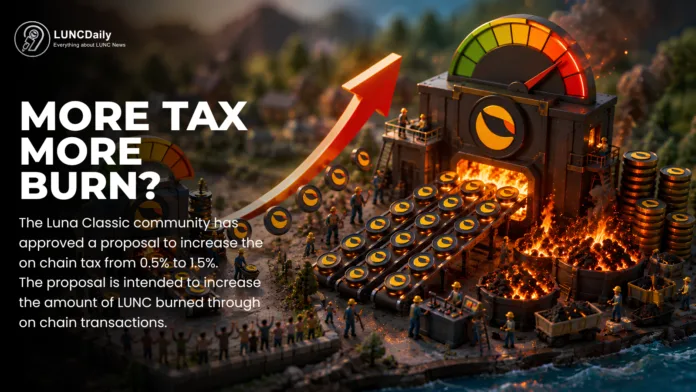
The Luna Classic community has officially approved a governance proposal to increase the network’s on chain tax from 0.5% to 1.5%.

The proposal aims to accelerate the amount of LUNC removed from circulation by directing a larger portion of transaction fees toward token burns while continuing to support the ecosystem.

How the New 1.5% On Chain Tax Is Distributed

Under the new tax structure, the 1.5% on chain tax is allocated as follows:

  • 1.2% is permanently burned, reducing the circulating supply of LUNC.
  • 0.15% is allocated to the Community Pool to support ecosystem development and community initiatives.
  • 0.15% is allocated to the Oracle Pool to help maintain essential network operations.

This allocation is designed to increase the number of LUNC tokens burned while maintaining funding for community driven development and the blockchain’s infrastructure.

A Greater Focus on LUNC Burns

The primary objective of this proposal is to strengthen Luna Classic’s deflationary model by increasing the amount of LUNC burned through eligible on chain transactions.

With the tax rate rising from 0.5% to 1.5%, a significantly larger share of transaction fees will now be directed toward token burns. Meanwhile, dedicated allocations to the Community Pool and Oracle Pool will continue to support the long term growth and stability of the Luna Classic ecosystem.

As the updated tax structure takes effect, the community will be watching its impact on LUNC burn rates, network activity, and the overall health of the ecosystem.

Over 360 Million LUNC Burned in Just Two Days as Binance Leads the Latest Burn Event

0

The Luna Classic community recorded another major milestone after more than 360 million LUNC were permanently removed from circulation in just two days.

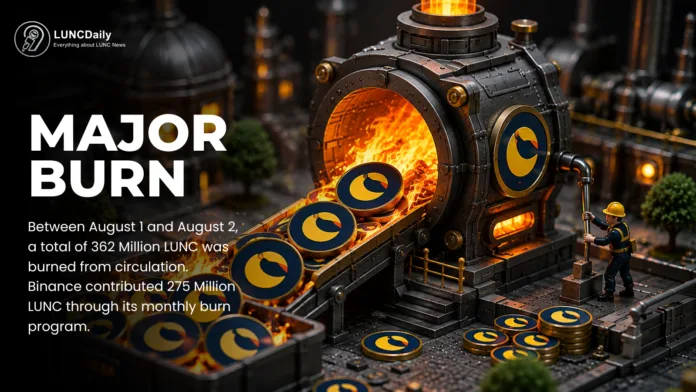
Between August 1 and August 2, 2026, a total of 362,115,370 LUNC was burned, continuing the community’s long term effort to reduce the circulating supply of Luna Classic.

The largest contribution came from Binance, which burned 275,649,084 LUNC on August 1 as part of its ongoing monthly LUNC burn program. Binance continues to be one of the biggest contributors to the Luna Classic burn initiative, regularly removing millions of LUNC from circulation through its trading fee burn mechanism.

The remaining burns came from transactions across the Luna Classic ecosystem, reflecting continued participation from users, validators, projects, and other community driven initiatives.

Token burns permanently remove coins from circulation, reducing the overall supply. While burns alone do not determine market price, they remain an important part of the Luna Classic ecosystem’s long term strategy to support a healthier token economy alongside network development and increased on chain activity.

With more than 362 million LUNC burned in only two days, the Luna Classic community continues to demonstrate its commitment to building a stronger and more sustainable ecosystem.

Terra Classic Records Over 311K Transactions as LUNC Supply Continues to Decline

0
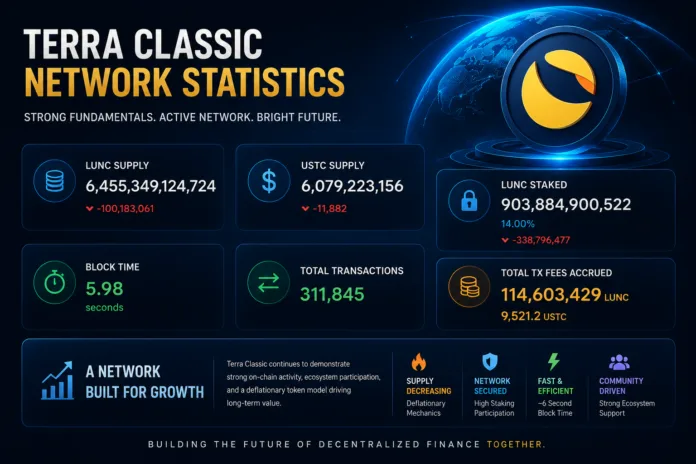
Terra Classic blockchain dashboard displaying LUNC supply, USTC supply, 903 billion LUNC staked, 311,845 transactions, 5.98-second block time, and accrued transaction fees.
Terra Classic network statistics reveal continued token supply reduction, nearly 904 billion LUNC staked, over 311,000 transactions processed, and strong on-chain ecosystem activity.

Terra Classic Network Shows Healthy On-Chain Activity Despite Market Volatility

The latest Terra Classic (LUNC) network statistics highlight the blockchain’s continued resilience as on-chain activity remains steady despite broader cryptocurrency market fluctuations. Fresh data shows that the ecosystem continues reducing token supply while maintaining strong validator participation and consistent transaction growth.

According to the latest network dashboard, the total LUNC supply has fallen to approximately 6.455 trillion tokens, with more than 100 million LUNC removed during the latest reporting period. This ongoing reduction reflects the community’s long-term commitment to lowering the circulating supply through burn mechanisms supported by exchanges, decentralized applications, and community initiatives.

One of the most encouraging metrics is the amount of LUNC currently staked, which now exceeds 903.8 billion tokens, representing roughly 14% of the total supply. High staking participation demonstrates continued confidence from long-term holders while contributing to improved network security and decentralization.

Network activity also remains healthy, with 311,845 total transactions processed during the reporting period. Consistent transaction growth indicates active usage across the Terra Classic ecosystem, including decentralized finance (DeFi), token transfers, governance participation, and other blockchain applications.

Meanwhile, the blockchain continues to operate efficiently with an average block time of just 5.98 seconds, providing users with fast transaction confirmations. The network has also generated more than 114.6 million LUNC and over 9,500 USTC in accumulated transaction fees, showcasing sustained economic activity across the ecosystem.

Although LUNC’s market price continues to experience short-term volatility, these network fundamentals paint a more optimistic long-term picture. Declining supply, strong staking participation, consistent transaction volume, and reliable network performance remain important indicators of Terra Classic’s ongoing development.

As developers continue expanding the ecosystem and the community advances governance initiatives, investors will closely monitor these on-chain metrics alongside market performance to evaluate Terra Classic’s long-term growth potential.

Terra Classic (LUNC) Price Drops Below $0.00006 – Market Analysis and Outlook

0
Terra Classic (LUNC) price chart showing a decline below $0.00006 with increased trading volume and bearish short-term market sentiment.
Terra Classic (LUNC) trades below the $0.00006 level as increased trading volume accompanies ongoing short-term selling pressure.

Terra Classic (LUNC) Faces Short-Term Selling Pressure

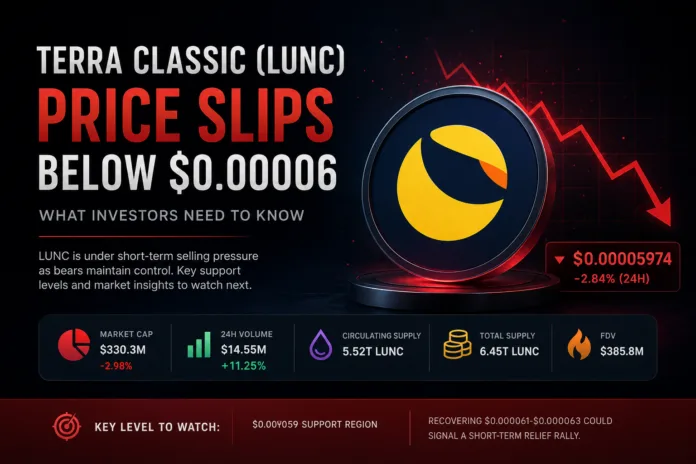
Terra Classic (LUNC) continues to experience bearish momentum after slipping below the important psychological support level of $0.00006. According to the latest market snapshot, LUNC is trading around $0.00005974, representing a 2.84% decline over the past 24 hours. Despite the price weakness, trading activity remains healthy, suggesting that investors are actively monitoring the market for the next major move.

The cryptocurrency currently holds a market capitalization of approximately $330 million, while 24-hour trading volume has climbed above $14.5 million, reflecting an increase in market participation even as prices trend lower. This combination often signals heightened volatility as traders position themselves ahead of potential breakout or breakdown scenarios.

The 24-hour chart illustrates a gradual downward trend with several failed recovery attempts throughout the trading session. Each rally has been met with renewed selling pressure, indicating that bears remain in control of short-term price action. However, the increased trading volume may also suggest that accumulation is beginning near current levels as long-term supporters of the Terra Classic ecosystem continue to monitor attractive entry points.

From a technical perspective, maintaining support around the $0.000059 region will be crucial. A successful defense could open the door for a recovery toward the $0.000061–$0.000063 range. Conversely, continued weakness may expose lower support zones before buyers regain momentum.

While short-term volatility remains elevated, Terra Classic continues to benefit from an active community, ongoing ecosystem development, validator participation, and consistent token burn initiatives that aim to reduce circulating supply over time. These long-term fundamentals remain key factors for investors evaluating the project’s future potential.

As the market enters a new trading session, participants will closely watch whether buyers can reclaim momentum or if sellers extend the current downtrend.