
Home Blog Page 92

Geopolitical Tensions Between Iran and Israel Shake Crypto Markets; Luna Classic and USTC Show Unexpected Strength

0

The intensifying conflict between Iran and Israel has sent shockwaves across global financial markets, prompting risk-off sentiment and renewed focus on macroeconomic stability. While traditional assets like oil and gold responded predictably, the cryptocurrency sector also experienced sharp volatility. Bitcoin and Ethereum faced significant intraday losses, while Luna Classic (LUNC) and TerraClassicUSD (USTC) stood out with surprising bullish momentum.

1. Rising Tensions in the Middle East
On June 13, Israel launched a series of airstrikes targeting Iranian military and nuclear infrastructure, following Tehran’s deployment of hundreds of UAVs into Israeli airspace. In retaliation, Iran conducted ballistic missile strikes, hitting civilian and military areas. Over the weekend, Israeli air campaigns expanded to Iranian oil facilities, prompting further fears of prolonged conflict and disruptions in energy supply chains, particularly through the Strait of Hormuz.

Major financial markets responded quickly. Global equity indices declined by over 1 percent, oil surged by more than 7 percent, and safe-haven assets like gold and the US dollar rallied. Analysts fear that a prolonged confrontation could impact energy inflation globally, possibly influencing future decisions by central banks such as the US Federal Reserve.

2. Bitcoin, Ethereum Decline Amid Risk Aversion
As the situation escalated, major cryptocurrencies exhibited short-term vulnerability. Bitcoin fell below $103,000 at its lowest point, down nearly 5 percent from prior highs. Ethereum also declined more than 8 percent, trading briefly under the $2,500 level. These moves reflected a broader shift away from risk assets as traders sought the relative safety of traditional instruments.

Total cryptocurrency market capitalization shrank by over $140 billion in less than 24 hours, reflecting increased uncertainty and investor caution.

3. Luna Classic and USTC Defy Market Trends
In contrast to the broader market downturn, Luna Classic (LUNC) and USTC both experienced sharp price spikes in recent days. On June 14 and 15, LUNC rallied more than 28 percent while USTC surged approximately 19 percent, defying the general downward trajectory of the crypto market.

This rally was initially driven by renewed speculation surrounding the launch of Market Module 2.0, a proposed update aimed at restoring USTC’s algorithmic utility. Although the module is still under development and has not yet been launched, positive sentiment surged following increased validator activity and community engagement. Notably, social media platforms and forums saw a marked increase in discussions about potential future burns and smart contract integrations that could drive demand.

Technical indicators also supported the move. Luna Classic broke above key resistance levels near $0.000105, triggering short-covering and momentum-based buying. USTC similarly breached the $0.025 threshold, setting off a flurry of interest among retail traders.

Institutional Signals and Macro Influences
Despite the geopolitical risks, some institutional investors appear to be holding their positions or even adding exposure. MicroStrategy confirmed an additional Bitcoin purchase last week, and ETF inflows remained steady. On-chain analysis shows that while whale wallets reduced leverage exposure, they did not exit positions entirely.

That said, further escalation in the Middle East could delay anticipated interest rate cuts by the US Federal Reserve. Rising oil prices could push inflation higher, increasing pressure on monetary policy makers and indirectly affecting crypto valuations through tighter liquidity conditions.

4. Outlook: Volatility Expected, But LUNC and USTC Remain in Focus
While broader crypto markets may continue to face turbulence due to geopolitical uncertainty, LUNC and USTC have re-entered the spotlight. Their recent price action underscores the unique nature of microcap tokens in volatile environments—capable of significant independent moves when backed by community momentum and speculative narratives.

For investors, the coming weeks will require careful monitoring of both macroeconomic headlines and developments within the Terra Classic ecosystem. Should the conflict de-escalate and crypto sentiment normalize, LUNC and USTC could maintain upward pressure, particularly if Market Module 2.0 progresses toward implementation.
Why Binance.US Should List LUNC: A Golden Opportunity

0

Binance.US has a unique chance to elevate its platform by listing Terra Classic (LUNC), a cryptocurrency with a vibrant community and promising potential. LUNC, the native token of the Terra Classic blockchain, has undergone a remarkable transformation, making it an attractive addition to Binance.US’s portfolio.

Firstly, LUNC boasts a passionate and growing community. After the Terra ecosystem’s challenges in 2022, the community rallied to rebuild trust and value. Through dedicated governance and development, LUNC has regained momentum, with active proposals and upgrades enhancing its utility. Listing LUNC would tap into this enthusiastic user base, driving trading volume and engagement on Binance.US.

Secondly, LUNC’s deflationary mechanism is a game-changer. The implementation of a burn tax on transactions reduces the token’s supply over time, potentially increasing its value. This innovative approach appeals to investors seeking assets with long-term growth potential. By listing LUNC, Binance.US can offer its users access to a token designed for scarcity-driven value appreciation.

Additionally, LUNC’s ecosystem is expanding. Developers are building decentralized applications (dApps) and exploring interoperability, positioning Terra Classic as a hub for innovation. Binance.US can attract forward-thinking traders by providing exposure to a blockchain with real-world use cases.

Finally, listing LUNC aligns with Binance.US’s mission to offer diverse, high-quality assets. It would signal confidence in LUNC’s revival, attracting new users and reinforcing Binance.US’s reputation as a forward-looking exchange. With LUNC’s strong fundamentals and community support, this listing could be a win-win, boosting platform growth while empowering investors to participate in Terra Classic’s exciting journey.

Don’t miss out—LUNC is ready to shine on Binance.US!

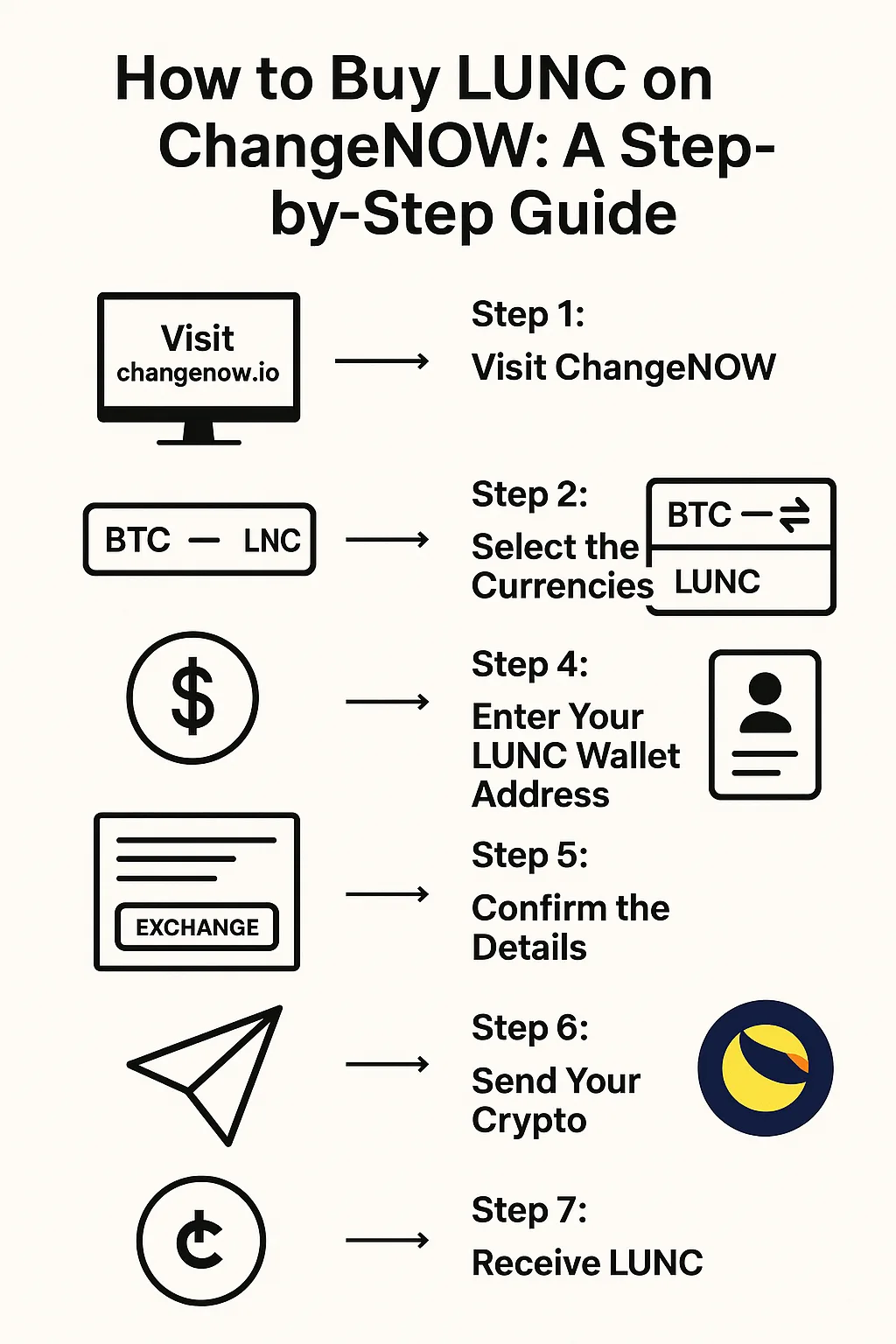
How to Buy LUNC on ChangeNOW: A Step-by-Step Guide

0

Terra Classic (LUNC) has attracted renewed attention as the community continues to push for ecosystem revival and development. If you’re looking to buy LUNC quickly and easily, ChangeNOW is a great non-custodial exchange platform that doesn’t require sign-up and supports over 900 cryptocurrencies. Here’s a simple step-by-step guide to buying LUNC on ChangeNOW.

Step 1: Visit ChangeNOW

Go to the official ChangeNOW website at https://changenow.io. Make sure you’re on the correct site to avoid phishing scams.

Step 2: Select the Currencies

On the home page, choose the cryptocurrency you want to exchange in the “You Send” field (e.g., BTC, ETH, USDT). In the “You Get” field, select LUNC as the token you wish to receive.

Step 3: Enter the Amount

Type the amount of the crypto you want to swap. ChangeNOW will automatically calculate how much LUNC you will receive based on the current market rate.

Step 4: Enter Your LUNC Wallet Address

Provide your LUNC wallet address in the designated field. This is where your purchased LUNC will be sent. Double-check the address to ensure it’s accurate and supports Terra Classic.

Step 5: Confirm the Details

Review the transaction summary, including the amount, rates, and wallet address. Once you’re ready, click “Exchange”.

Step 6: Send Your Crypto

You’ll be shown a deposit address. Send your selected crypto (e.g., ETH or BTC) to that address. Once the payment is confirmed on the blockchain, ChangeNOW will process the swap.

Step 7: Receive LUNC

After a few minutes, your LUNC will be delivered to your wallet. No registration, no delays—just fast and simple crypto swapping.

Disclaimer: Always double-check all details and use a secure network when transacting.

Terra Classic: A Blockchain Rebuilding with Promise

0

Investors in Terra Classic (LUNC) should understand that burning LUNC tokens alone won’t immediately impact the price. While token burns aim to reduce supply over time, the real catalyst for growth lies in revitalizing the ecosystem through strategic efforts. Terra Classic’s community is focused on rebuilding, and the path forward is filled with potential.

The Terra Classic blockchain is far from dead. Dedicated developers and supporters are working tirelessly to restore its reputation and functionality. Recent efforts include upgrading the network’s infrastructure, enhancing security, and fostering new use cases. These steps lay a strong foundation for long-term success, but they need amplification to regain global attention.

Marketing is critical to this revival. By showcasing Terra Classic’s unique strengths—fast transactions, low fees, and a resilient community—the project can attract developers, businesses, and users. Promoting partnerships, decentralized applications, and real-world utility will demonstrate that Terra Classic is a living, evolving blockchain with practical value.

Community-driven campaigns can also elevate visibility. Social media, AMAs, and collaborations with influencers can spread the word, while hackathons and developer grants can spark innovation. Highlighting milestones, like successful upgrades or new dApps, will rebuild trust and draw in new investors.

Price movements may not reflect these efforts immediately, but that’s no reason to lose faith. Terra Classic’s revival is a marathon, not a sprint. By focusing on development, marketing, and promotion, the community is proving its commitment to a brighter future. Investors who believe in this vision and stay patient will be part of a remarkable comeback story for Terra Classic.

Why It’s a Great Time to Invest in Terra Classic (LUNC) in H2 2025

0

Terra Classic (LUNC) is poised for a potential breakout in the second half of 2025, driven by innovative upgrades and a revitalized community. With its low entry price of approximately $0.00006 and ongoing deflationary measures, LUNC presents a compelling investment opportunity for those seeking high-growth crypto assets.

The cornerstone of LUNC’s optimism lies in the Market Module 2.0, set to reactivate the $USTC and $LUNC swap mechanism in a controlled manner. Unlike the 2022 death spiral, this upgrade includes algorithmic safeguards to prevent excessive LUNC issuance, enhancing stability and supporting USTC’s repeg efforts. This fosters confidence in the ecosystem, encouraging developers to build DeFi applications, NFTs, and other projects on Terra Classic, boosting LUNC’s utility and demand.

LUNC’s token burn program continues to reduce its 5.46 trillion circulating supply, with over 123 billion tokens burned to date. Recent burns, including 3.1 billion tokens sparking a 30% price surge, demonstrate the community’s commitment to scarcity-driven value growth. Analysts predict LUNC could reach $0.0004–$0.0012 by year-end, fueled by post-Bitcoin halving market optimism.

Community governance and partnerships, notably with Binance, further amplify LUNC’s momentum. Proposals like the 1.5% burn tax and network upgrades (e.g., v3.4.0) enhance security and scalability, attracting new investors. Technical indicators, including bullish MACD divergences, suggest a potential 168% rally to $0.000162.

In H2 2025, LUNC’s combination of technological advancements, deflationary economics, and community-driven initiatives positions it for significant growth. As the crypto market recovers, Terra Classic’s low market cap of $322 million offers substantial upside potential, making it an exciting prospect for optimistic investors.

Do We Need Binance to Enable the Market Module on Terra Classic?

0

As Terra Classic moves toward reactivating the Market Module, many in the community are asking: “Do we need Binance’s approval first?” The short and clear answer is no—Binance is not a gatekeeper to our on-chain development.

The Market Module is a native feature of the Terra blockchain, designed to enable decentralized swaps between assets like LUNC and USTC. It was once a core part of Terra’s economic engine. Reactivating it is fully within the community’s control, and it can be achieved through governance proposals and validator consensus—no centralized exchange approval required.

What would require Binance’s involvement is if we expect them to directly integrate or mirror the Market Module’s pricing, or to enable features such as auto-swaps on their exchange platform. But that’s a separate process entirely, and it doesn’t stop us from moving forward independently.

In fact, taking initiative and restoring the Market Module can show centralized exchanges that the Terra Classic ecosystem is rebuilding responsibly—with utility, governance, and functionality all coming back online. That kind of progress often attracts exchange support, not the other way around.

So let’s be clear: the community has the power to act. We can and should re-enable the Market Module, configure its parameters, and re-establish a foundation for a healthier on-chain economy—with or without Binance’s direct involvement.

This is about reclaiming our sovereignty as a decentralized network. If we lead with smart governance and measured execution, the rest—including exchange interest—will follow.

Kickstart the Second Half of 2025 with $1,000 in #LUNC & #USTC!

0

A new chapter is here — the second half of the year is your chance to reposition, reinvest, and reignite your goals. 🔥

Why not make a bold move?

💰 Invest $1,000 in #LUNC and #USTC — two of the most talked-about assets in the crypto space right now.

🔹 #LUNC (Luna Classic): A project with a dedicated community and ongoing burns driving supply down.

🔹 #USTC: The comeback story in progress — with every move, eyes are back on this once-stablecoin giant.

📈 It’s not just about money. It’s about timing.

📆 The second half of the year is when momentum builds — don’t watch it happen, be part of it.

✅ Diversify. ✅ Anticipate growth. ✅ Ride the trend.

This is your $1,000 moment.

Ready to position yourself for what could be the comeback of the year?

Terra Classic at a Crossroads: Why Activating the Market Module at Layer 1 Is Critical Now

0

Terra Classic is facing a pivotal moment—one that threatens the very foundation of our Proof-of-Stake (PoS) ecosystem. At the center of this growing crisis is the oracle pool, which has been steadily depleting over time. This pool is responsible for funding staking rewards across the network. As it continues to dry up, the economic incentives for validators and delegators diminish. Without immediate intervention, we face a downward spiral of reduced network security, weakening participation, and an overall loss of competitiveness in the broader crypto ecosystem.

Currently, staking rewards on Terra Classic are becoming less attractive—so much so that we are approaching, or even falling below, the returns offered by low-risk capital staking alternatives. This is dangerous territory. If users can achieve better yields elsewhere with less volatility and risk, we can expect an exodus of capital and validator support. In PoS chains, that’s a fatal flaw.

This is precisely why now is the time to activate the Market Module at Layer 1.

Why the Market Module Matters

The Market Module was once a core component of the Terra ecosystem, enabling users to swap between $LUNC and $USTC, while also supporting deflationary mechanisms through arbitrage and supply-demand dynamics. Since the depeg, the module has been disabled or non-operational. But today, reactivating it at Layer 1 is not just a restoration—it’s a necessity for long-term sustainability.

At Layer 1, the Market Module can:

  • Enable on-chain minting and burning of $USTC via $LUNC, and vice versa, based on market dynamics.
  • Reintroduce arbitrage opportunities that help stabilize the ecosystem and reward users.
  • Create organic deflationary pressure on both $LUNC and $USTC, reducing supply while restoring utility.
  • Support the oracle pool via transaction fees and usage incentives, helping replenish the pool and sustain staking rewards.

The Deflationary Path Forward

One of the main criticisms of the current Terra Classic economic model is the lack of consistent deflationary pressure. While burns are occurring, they are sporadic and reliant on manual governance or centralized initiatives. A functioning Market Module at Layer 1 changes that by building deflation directly into the chain’s core logic.

Every swap and arbitrage operation can help reduce total supply, reward participants, and restore a functional economic cycle. Instead of hoping for external catalysts, we empower the chain itself to become a dynamic, self-sustaining system.

Time Is Running Out

The situation is urgent. If the oracle pool continues to deplete at its current rate, we could soon face a situation where staking rewards are nearly nonexistent. This would drive away validators, reduce network decentralization, and further erode trust in the ecosystem. Once that happens, the cost of recovery will be far higher—if it’s even possible at all.

We must act before the damage becomes irreversible.

Activating the Market Module at Layer 1 is a concrete, actionable proposal. It’s not theoretical. The code can be restored. The economics are sound. And the community support is growing. This is not about going back to the past—it’s about reclaiming control over our future.

A Call to Action

The Terra Classic community has shown resilience time and time again. We’ve weathered storms, rebuilt infrastructure, and reestablished governance. But this time, our challenge is technical and economic. We must take decisive, forward-looking steps to protect what we’ve built.

Let’s not wait until our chain becomes irrelevant in a competitive staking environment. Let’s implement smart, efficient mechanisms now—before it’s too late.

Activate the Market Module at Layer 1. Restore staking viability. Reignite deflation. Revive Terra Classic.

Terra Classic Market-Module 2.0

0

A net-deflation engine that can reopen now, throttles itself as supply shrinks, and cannot be trick-printed through stale prices.


Context & Goals

2022 taught two hard lessons:

  • Unlimited capacity kills – raising base_pool and shortening pool_recovery_period (PRP) let traders mint faster than the market absorbed, destroying LUNC.
  • Hard $1 peg is lethal – valuing UST at $1 while it traded at pennies forced hyper-inflation.

Today (28 May 2025) we sit on:

  • 6.50T LUNC
  • 6B USTC
  • Burns are ≈ 1.3B LUNC/month (0.02%)

The community wants the Market Module (MM) back as soon as possible to restore utility and fee flow — but will only accept continuous net supply decline.


How the Market Module Actually Mints

2.1 base_pool — the “virtual SDR reserve”

When you swap USTC → LUNC (or vice versa), the module simulates a virtual SDR pool. It does:

  • Converts USTC to SDR using oracle price
  • Balances the virtual constant-product AMM
  • Updates SDR “debt” from the swap

Formula (simplified):

ΔLUNC_out ≈ ( SDR_spent / SDR_pool_after ) × LUNC_pool_before

larger base_pool lets a single swap mint more LUNC before the price shifts.


2.2 PRP — the Refill Timer

After a swap, a deficit d is remembered.

Each block: d_next = d_current × (1 − 1 / PRP)

  • Short PRP → fast refill → can mint again soon
  • Long PRP → slow refill → minting delayed

Daily Mint Capacity:

mint_cap_day ≈ 2 × base_pool / (PRP / 14,400)

(14,400 ≈ blocks per day on Terra Classic)


Net-Deflation Rule (Hard, Epoch-Based)

At the first block H₀ of every 30-day epoch:

taxburn_30d_token = Σ burns of token [H₀−30d , H₀−1] allowance_token = min(taxburn_30d_token × 0.80 , 100,000 SDR)

Each token (USTC and LUNC) has:

  • Independent mint limit
  • 80% of tax burns re-mintable
  • 100k SDR max cap per token

Once allowance_remaining_token hits 0, minting stops until the next epoch.


Adaptive base_pool & PRP for the Epoch

4.1 Pick a Burst Factor

Default F = 0.07 → Max 7% of allowance printed per day

desired_daily_cap = allowance × F


4.2 Solve for base_pool

base_pool_raw = desired_daily_cap × PRP / (2 × 14,400)


4.3 Supply-Scaled PRP

PRP = max(14,400, 14,400 × (S / 1T))

Example:
6.5T supply → PRP ≈ 93,600 blocks (6.5 days)


4.4 Final Clamps

base_pool = min(base_pool_raw, 0.00010 × mcap_in_SDR, 5,000,000 SDR)


Example for the First Epoch (Today)

ItemValue
burns_30d (B₀)1.3B LUNC
allowance = 0.8 × B₀1.04B LUNC ≈ 81k SDR
PRP (6.5T supply)93,600 blocks
desired_daily_cap (F=0.1)0.104B LUNC
base_pool_raw≈ 8.3k SDR
base_pool after clamps8.3k SDR
theoretical mint/day≈ 32M LUNC (2.6k SDR)

Since 32M < 104M, the PRP clamp is the active brake, not the burst factor F.


Live Price Input & Anti-Manipulation Guards

ComponentRule
Price vote period5 blocks ≈ 30s
USTC priceprice_uusd(USTC) = voting-power-weighted median this period
Quorum auto-killIf <50% VP for 25 blocks → MM.enabled = false until 5 periods OK
TWAP sanity clampSwap fails if peg price differs >10% from 45-block CEX TWAP
Stable→stable routeHard-disabled in code (ErrStableSwapDisabled)

Absolute Brakes & Governance

  • ⅔ super-majority can close the Market Module (MM) at any time.
  • Caps cannot be raised via governance.
  • MM is inherently capped by:  – 30-day burn stats  – Base pool clamps  – Oracle enforcement

Scenarios

7.1 Bull-but-Boring (Utility Returns)

LUNC in Normal Growth Scenario

LUNC burns double to 2B/month by epoch 3.   PRP still >3 days, base_pool limited by allowance.

EpochBurnsAllowanceMint (≤)Net ΔSupply
11.3B1.04B0.78B–0.52B6.4995T
21.6B1.28B1.02B–0.58B6.4989T
32.0B1.60B1.24B–0.76B6.4981T

Total LUNC deflation after 3 epochs: 1.9B (0.03%)

USTC in Normal Growth Scenario

EpochBurnsAllowanceMint (≤)Net ΔSupply
150M40M30M–20M5.98B
275M60M48M–27M5.95B
3100M80M64M–36M5.91B

Total USTC deflation after 3 epochs: 83M (1.38%)


7.2 Flash-Crash & Oracle Outage

Event:

USTC dumps to $0.004; two top validators go offline.   Quorum falls below 50% for 30s → MM shuts automatically.

Burns collapse during the next epochs.

LUNC in Crisis

EpochBurnsAllowanceMintNet Δ
crash0.2B0.16B0–0.20B
+30d0.2B0.16B≤0.16B–0.04B
+60d0.2B0.16B≤0.16B–0.04B

USTC in Crisis

EpochBurnsAllowanceMintNet Δ
crash10M8M0–10M
+30d10M8M≤8M–2M
+60d10M8M≤8M–2M

(*) Oracle kill-switch triggered → inflation = 0

Even in a disaster, deflation continues for both tokens.


Spread-Fee Policy for MM Swaps

ConditionFeeNotes
MM disabledNo swap, no fee, no burn
MM enabled & allowance > 00.35% of notionalCollected in output asset (LUNC or USTC)
Allowance exhaustedSwap refused
  • 0.35% keeps arbitrage profitable  
  • No double tax – replaces the 0.5% chain burn tax  
  • Fee split: 50% burn, 50% Oracle Pool

Oracle Module Compatibility

To reactivate MM with live pricing:

  • ✅ Add USTC to the oracle vote set  
  • ✅ Remove $1 peg assumption  
  • ✅ Add more CEX/aggregator price feeds  
  • ✅ Validators must update feeders  
  • ⚠️ Feeder binary rewrite is recommended    – Support modern APIs    – Add fallback logic    – Improve error handling

These changes must be deployed before reopening MM. Otherwise, price input will be invalid → MM disabled.


Roadmap

  • 🔧 Code merge & audit (~500–1,000 LOC)
  • 🧪 Public testnet with simulated price spikes, quorum drops, burn bursts
  • 🚀 Mainnet upgrade (two-step):  – Deploy MM in inactive mode  – Activate at next epoch boundary post-burn stats verification
  • 📊 Dashboards/API:  – Show taxburn_30d  – Show allowance_remaining
  • 📅 90-day post-mortem:  – Adjust 80% coefficient or Fonly via hard fork

What We Gain

  • ✅ Immediate reopening — utility & arbitrage from day 1  
  • 📉 Guaranteed deflation — must shrink supply every epoch  
  • 🧠 Oracle-safe — 30s lag = okay, 75s lag = MM shutdown  
  • 🔁 Elastic throttle — refill slows as supply shrinks  
  • 🔥 Spread fees:  – 50% burn  – 50% to Oracle Pool

The printer is leashed to yesterday’s bonfire — and the leash gets shorter as the fire dies out.


Voluntary Burns

At present, voluntary burns (e.g., Binance, user burns to burn module terra1...anxu) are a large portion of total burns.

Proposal:   Exclude voluntary burns from taxburn_30dcalculation to:

  • Keep voluntary burners engaged  
  • Avoid reducing minting capacity unnecessarily

Any allowance increase should be discussed after testing and deployment.


Important Notes

  • Burn data cannot be predicted
  • MM behavior depends on assumptions and must be tested
  • Adjustments to parameters like F and the 80% ratio should be done on testnet first

StrahCole ✰

Vegas

LEARN MORE

MIOFF Festival Bringing Luna Classic to a Real-World Audience, The Tour Begin on June 19

0

The MIOFF Festival Tour officially begins on June 19, and this year, it is putting Luna Classic front and center. This is not just a festival. It is a live event where music, culture, and MIOFF bring blockchain come together to create real impact.

MIOFF is using its festival power to push Luna Classic into the real world. With hundreds of people expected at each event, this is a golden chance to show what Luna Classic is all about. While most crypto stays online, MIOFF is taking LUNC directly to the crowd.

This move is not just for the crypto fans. MIOFF wants to reach people who have never touched digital assets before. By bringing Luna Classic into a fun and exciting environment, the festival makes it easy for new users to learn, explore, and get involved.

New people mean new money, new ideas, and stronger community growth. That is what MIOFF is aiming for. This tour is more than just promotion. It is a real step toward adoption and awareness.

If you are looking for a project that is taking bold steps, Luna Classic at the MIOFF Festival is one to watch. The stage is set, the crowd is ready, and LUNC is about to shine like never before.