Home Blog Page 94

Why Tariffs Make Now a Strategic Time to Buy LUNC

As the United States enacts a new wave of tariffs aimed at protecting domestic industries, markets are responding with characteristic uncertainty. Historically, such periods of economic disruption have prompted investors to re-evaluate asset allocations, with many turning to alternatives that offer resilience against inflation, currency devaluation, and geopolitical tension. While Bitcoin often captures headlines during such shifts, there is a growing case for considering Terra Classic (LUNC) as a strategic asset in this new landscape.


The Impact of Tariffs on Global Markets

Tariffs, by design, increase the cost of imported goods. While they can offer short-term relief to domestic producers, they also tend to raise prices for consumers and create frictions in global supply chains. These effects, in turn, can stoke inflation and dampen consumer confidence with two key variables that influence market behavior.

In response, investors typically seek out stores of value or assets not directly exposed to centralized monetary policy. Cryptocurrencies have increasingly filled that role.


Why Terra Classic (LUNC) Deserves Attention

Terra Classic may not be the largest player in the digital asset space, but it remains one of the most active and resilient blockchain ecosystems, supported by a decentralized governance model and a vibrant global community. As traditional markets react to policy induced volatility, LUNC offers a unique value proposition:

1. Decentralization as a Hedge Against Policy Risk
LUNC operates outside the jurisdiction of any single government or central bank. This independence makes it attractive in times of economic nationalism, when capital controls, monetary expansion, or tariffs disrupt conventional investment channels.

2. A Deflationary Supply Mechanism
One of Terra Classic’s most notable features is its ongoing token burn strategy, which gradually reduces the total supply of LUNC. In an inflationary environment, assets with deflationary mechanics often gain attention as potential stores of value.

3. Broad Accessibility and Liquidity
Unlike traditional assets, LUNC can be accessed and traded 24/7 across global exchanges. This level of liquidity is particularly useful during market disruptions, when timing and accessibility can be critical.

4. Ecosystem Rebuilding and Community Engagement
Despite its past challenges, Terra Classic has demonstrated strong grassroots support and a renewed focus on building practical use cases. From decentralized finance applications to governance upgrades, the ecosystem continues to evolve in response to both community needs and market trends.


Strategic Timing

In periods of macroeconomic transition, first-movers tend to outperform. The imposition of tariffs represents not only a shift in trade policy but a broader indication of uncertainty ahead. As institutional and retail investors look to diversify beyond traditional assets, early positioning in high-potential blockchain networks like Terra Classic could yield significant upside.


Conclusion

Tariffs rarely operate in isolation; their economic consequences ripple through markets, influencing everything from interest rates to global capital flows. In this climate, Terra Classic (LUNC) emerges as a viable alternative which offering decentralization, deflationary potential, and strong community-driven momentum. For those seeking a hedge against policy-driven volatility, now may be a particularly strategic time to explore LUNC as part of a broader, future-oriented investment strategy.


Bit Bonds: A $2 Trillion Proposal and What It Signals for Terra Classic

In a bold new vision to combat rising national debt, the U.S. government is exploring the issuance of “Bit Bonds” a $2 trillion initiative that would tie sovereign debt instruments to Bitcoin. As reported by Forbes, this proposal could represent one of the most significant intersections between traditional finance and decentralized digital assets to date. While its immediate implications center on fiscal policy and macroeconomics, the ripple effects across the blockchain industry are far-reaching.

Among the projects poised to benefit from such a shift is Terra Classic (LUNC), a decentralized blockchain ecosystem with an active community and a growing suite of use cases.


A Paradigm Shift in Government Finance

The concept behind Bit Bonds is simple but revolutionary: rather than issuing traditional Treasury bonds denominated solely in U.S. dollars, the government would incorporate Bitcoin exposure into the instruments. Proponents argue that doing so could attract a broader range of investors, reduce long-term borrowing costs, and hedge against inflation while demonstrating a willingness to engage with the future of money.

This represents not just an evolution in government financing, but a powerful validation of the broader digital asset market.


Implications for Terra Classic (LUNC)

While Bitcoin may be the anchor asset in the Bit Bond discussion, its formal integration into government finance serves as a bellwether for the entire blockchain sector. Terra Classic, though not directly involved, stands to gain in several key areas:

1. Market Legitimacy
Government led adoption of blockchain-based instruments sends a strong signal to investors and institutions that digital assets are here to stay. This could lead to increased scrutiny but also increased legitimacy for projects like Terra Classic that have weathered volatility and evolved through community governance.

2. Regulatory Maturity
A move as significant as Bit Bonds would likely necessitate clearer policy and compliance frameworks around digital assets. For Terra Classic, a more stable and transparent regulatory environment would lower entry barriers for developers, investors, and ecosystem partners.

3. Investor Diversification
As capital begins to flow into government-linked crypto products, attention will naturally turn to high-potential altcoin ecosystems. LUNC, with its vibrant community and ongoing development roadmap, may become an attractive diversification option for those seeking exposure beyond Bitcoin and Ethereum.

4. Infrastructure Expansion
Bit Bonds could accelerate public-private partnerships and the integration of blockchain technologies into legacy systems. This could pave the way for platforms like Terra Classic to participate in future initiatives, including stablecoin frameworks, decentralized finance applications, and cross-chain solutions.


Looking Ahead

The U.S. government’s consideration of Bit Bonds is more than a fiscal innovation, it is a statement about the role of digital assets in the global financial future. For Terra Classic and other decentralized networks, it is both a challenge and an opportunity: to rise to the level of trust and utility required to play a meaningful role in a changing financial order.

If Bit Bonds become a reality, they could represent the beginning of a new era, one where traditional finance and decentralized technologies not only coexist but collaborate.

Over 2B LUNC, USTC Burned As Terra Gets Rid Of Luna Classic

On-chain records showcase a massive burn of Terra system’s native tokens, sparking rebound hopes for LUNC holders.

Better days are coming soon for the game-tested Terra Luna Classic (LUNC) community, as the altcoin’s parent company TerraForm Labs is forced by the U.S. Securities and Exchange Commission (SEC) to wind down operations.

Terra Burns Big Pile Of LUNC & USTC

For the LUNC community, there’s a bi-folded benefit in these circumstances, as the $4.47B settlement with the SEC obliges TerraForm Labs to get rid of all their Terra Luna token reserves. Not only that solidifies independence from the embattled fintech company, but also eliminates a big portion of Terra Luna Classic (LUNC) and Terra Classic USD (USTC) coins from circulation.

The latest on-chain records show that the wait is over – Luna Foundation Guard (LFG) processed two crucial burning transactions today, eradicating 211,577,500 LUNC and 1,754,725,793 USTC tokens and restoring some optimism among community members.

After this LUNC & USTC burning deed, the malfunctioning USTC stablecoin’s supply has been cut down to 5,596,629,711, while Terra Luna Classic’s (LUNC) highly overminted supply plunged to 5,443,544,767,812 tokens. These deflationary tactics aim at long-term sustainability, while neither Terra Classic, nor the USTC coin had seen immediate price appreciation.

Why Terra Luna Classic’s Price Lags

With over $19 million down the drain, this supply cut for USTC & LUNC could only bear fruit in bullish price momentum if Terra Luna Classic’s chain picks up a significant trading volume. Currently, Terra Classic is on the verge of exiting the TOP 200 by global market cap, nabbing just $12.9 million in trades in the latest 24-hour frame.

And so, short-sellers, known as bears in crypto slang, have annihilated a major LUNC support level at $0.00006, Terra Luna Classic’s price could face a further freefall. Meanwhile, things are not looking better for USTC, as the de-pegged stablecoin is trading at a 1.1% fraction of its original price. Grasping twice as less in trading volume as LUNC, the $1 re-peg dream for USTC is still far away.

$LUNC $USDC

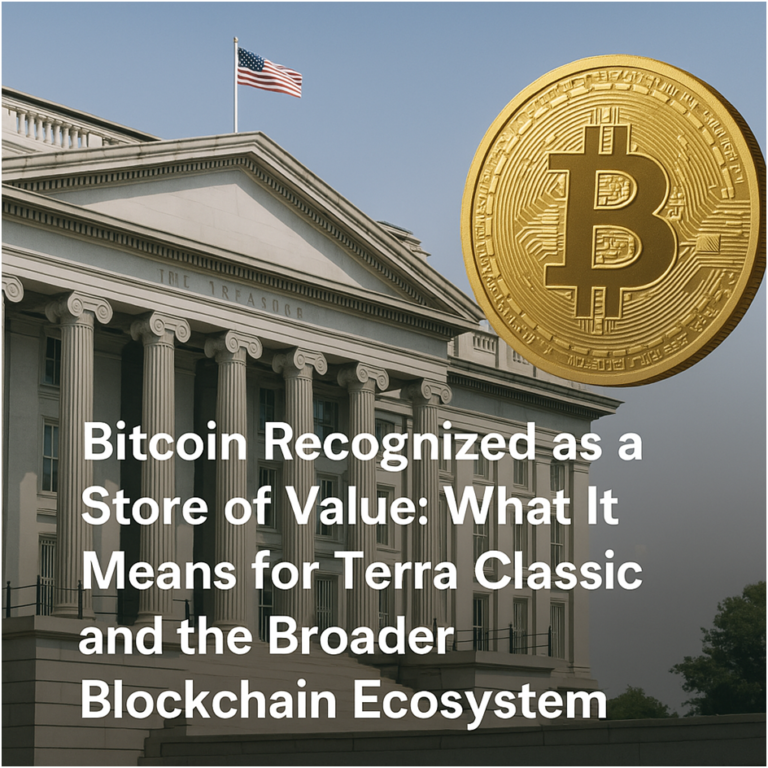
Bitcoin Recognized as a Store of Value: What It Means for Terra Classic and the Broader Blockchain Ecosystem

In a landmark statement that may reshape the global financial landscape, the U.S. Treasury Secretary has publicly recognized Bitcoin as a “store of value to rival gold,” according to a report published by Forbes. This declaration follows a period of heightened market volatility, with Bitcoin’s price outperforming traditional equities amid a sharp downturn in U.S. stock markets under the current administration.

The announcement is being hailed as a turning point for digital assets, marking the first time a sitting Treasury Secretary has placed Bitcoin on par with one of the world’s oldest and most recognized stores of value. But beyond Bitcoin, the implications for the broader crypto ecosystem, including emerging and legacy blockchains such as Terra Classic (LUNC)—are substantial.

A Shift in Market Perception

Bitcoin’s recognition by a top U.S. official signals growing institutional and governmental acknowledgment of digital assets as viable components of the financial system. For projects like Terra Classic, this shift brings new legitimacy. Once associated primarily with retail driven speculation, LUNC now has an opportunity to be reevaluated in the context of a maturing crypto landscape.

Renewed Institutional Interest

While Terra Classic has had a complex history, it remains supported by a committed community and continues to evolve through decentralized governance. The Treasury Secretary’s statement could indirectly stimulate renewed institutional interest in alternative blockchain ecosystems, as investors diversify beyond Bitcoin in search of undervalued or high-utility digital assets. For Terra Classic, this could mean increased liquidity, market engagement, and technical contributions.

Policy and Regulatory Tailwinds

With the U.S. Treasury now openly discussing the role of cryptocurrencies in wealth preservation, the regulatory narrative may begin to shift. Clearer policy frameworks are likely to follow, potentially reducing uncertainty around development and investment in projects like Terra Classic. This would be especially beneficial for protocols aiming to rebuild credibility and provide real world utility.

Positioning for the Next Phase

Terra Classic, with its revitalized community and push toward sustainable development, is well-positioned to benefit from this macro-level momentum. As capital begins to flow more freely into the digital asset space under a more favorable regulatory and institutional lens, LUNC could emerge as a strategic part of diversified crypto portfolios, particularly for those seeking exposure to community driven ecosystems with long-term growth potential.


Conclusion

The U.S. Treasury Secretary’s recognition of Bitcoin as a modern equivalent to gold marks a pivotal moment in the mainstreaming of digital assets. For Terra Classic and similar projects, it opens the door to renewed credibility, institutional visibility, and broader market participation. In this new chapter of digital finance, LUNC may find not just a place in the conversation but a meaningful role in the future of decentralized value.