

LUNC 1.5% On Chain Tax Has Not Delivered the Expected Burn Increase
Terra Classic increased its on chain tax from 0.5% to 1.5% on August 2, 2026, marking a threefold increase in the transaction tax. The change was designed to increase the amount of LUNC removed from circulation whenever eligible on chain transactions take place.
However, the latest burn trend raises an important question: has the higher tax actually increased the daily LUNC burn rate?
The data suggests that the answer may be no.
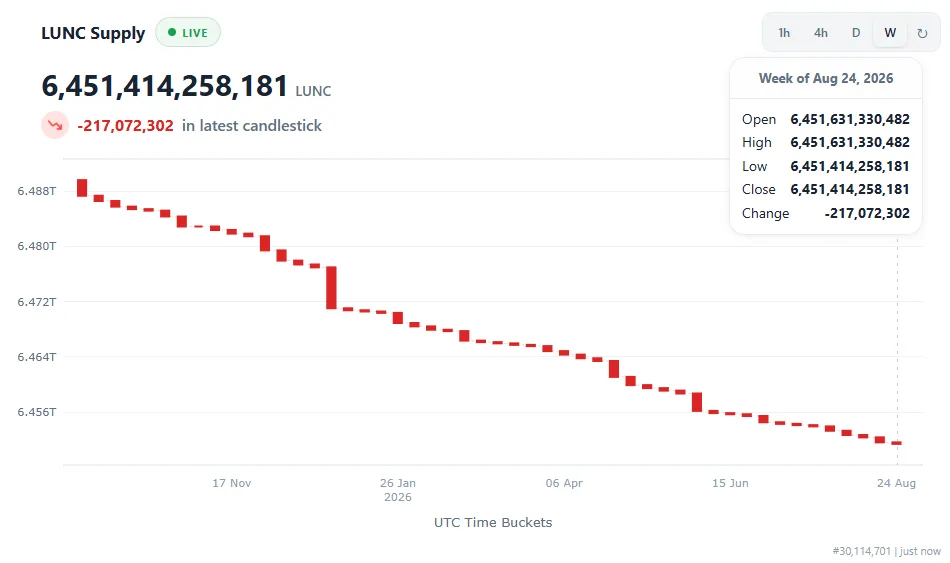
Although the tax rate is now three times higher, the daily burn activity has not increased proportionally. In fact, the average daily burn appears weaker than the previous month when the on chain tax was still 0.5%.
Terra Classic increased its on chain tax from 0.5% to 1.5% on August 2, 2026, marking a threefold increase in the transaction tax. The change was designed to increase the amount of LUNC removed from circulation whenever eligible on chain transactions take place.
However, the latest burn trend raises an important question: has the higher tax actually increased the daily LUNC burn rate?
The data suggests that the answer may be no.
Although the tax rate is now three times higher, the daily burn activity has not increased proportionally. In fact, the average daily burn appears weaker than the previous month when the on chain tax was still 0.5%.
This highlights an important problem with relying on a higher tax rate alone. A larger tax does not automatically produce more burns if it causes on chain transaction activity to decline.
A Higher Tax Does Not Always Mean More LUNC Burned
The basic relationship is simple.
More eligible transaction volume creates more taxable activity. More taxable activity creates more LUNC burned.
The 1.5% tax increases the amount collected from each eligible transaction. But if the number and value of transactions fall significantly, the total amount burned can still decrease.
For example, consider two simplified scenarios.
Under a 0.5% tax, suppose the network processes $100 million worth of taxable activity. The tax mechanism would generate an amount equivalent to roughly $500,000 in tax.
Under a 1.5% tax, the network would need to process only around $33.3 million in taxable activity to generate the same $500,000 equivalent.
But if higher transaction costs cause activity to fall below that level, the higher tax becomes counterproductive from a burn perspective.
The key variable is therefore not the tax rate alone. It is the combination of the tax rate and total taxable on chain activity.
Why Higher Transaction Costs Can Reduce On Chain Activity
The biggest concern with the 1.5% tax is the increase in the cost of moving assets on chain.
A transaction that previously faced a 0.5% tax now faces a 1.5% tax. That represents a 200% increase in the tax burden compared with the previous rate.
For traders, arbitrageurs and users moving funds between wallets, the additional cost can change the economics of a transaction.
This is particularly important for high frequency activity.
Suppose a trader expects to make a small profit from an on chain transaction. Under a 0.5% tax, the transaction may still be profitable. At 1.5%, the additional cost could eliminate the expected profit.
The trader may then choose not to execute the transaction.
The same principle applies to arbitrage.
If an arbitrage opportunity offers a small price difference between two markets, the trader must account for network fees, the on chain tax, slippage and other costs. A higher tax makes more opportunities unprofitable.
When those transactions disappear, the network loses the transaction volume that would otherwise generate burns.
This creates a possible paradox.
Higher tax per transaction can produce fewer transactions.
And fewer transactions can mean fewer total LUNC burned.
The Tax Only Applies to On Chain Activity
Another important factor is that the 1.5% tax does not apply to every LUNC transaction across the entire cryptocurrency market.
The tax applies to eligible transactions occurring on the Terra Classic blockchain. Trading activity taking place inside centralized exchanges is not directly subject to the Terra Classic on chain tax.
This distinction is critical.
LUNC can experience significant trading volume on centralized exchanges without generating an equivalent amount of tax based burns on Terra Classic.
Therefore, a large increase in LUNC trading volume does not necessarily translate into a large increase in on chain burns.
For the 1.5% tax to become highly effective, Terra Classic needs strong and sustained on chain activity.
August Burn Data Creates a Different Picture
The August data is particularly interesting because the 1.5% tax became active on August 2.
At first glance, the higher tax rate appears extremely bullish because the percentage taken from each taxable transaction tripled.
But looking at the daily burn trend provides a different perspective.
The network has continued to burn billions of LUNC during August, but the daily burn rate has not shown the kind of sustained acceleration that would be expected if the higher tax were generating significantly more activity.
That is an important distinction.
The more useful measurement is how much LUNC is being burned per day compared with previous periods.
A monthly total can rise because of large individual burns, including exchange driven burns, while the underlying on chain tax activity remains weak.
This is why the daily burn rate and the source of each burn are more important indicators when evaluating the effectiveness of the 1.5% tax.
Why August Could Be Showing Lower Daily Burns
There are several possible reasons why daily burns can decline despite the higher tax.
Higher Transaction Costs
The most direct explanation is that the higher tax discourages marginal transactions.
Users who previously considered an on chain transaction affordable may now wait, reduce their activity or move their activity elsewhere.
Lower Arbitrage Activity
Arbitrage is particularly sensitive to transaction costs.
If the expected profit from an arbitrage transaction is smaller than the combined tax, gas and slippage costs, the trade will not happen.
This can reduce transaction frequency and therefore reduce the amount of LUNC burned through the tax.
Users Moving Activity to Centralized Exchanges
If users prefer to trade on centralized exchanges instead of interacting directly with the Terra Classic blockchain, that activity does not generate the same on chain tax burns.
This creates a potential migration effect.
The network can still have strong market activity while the number of taxable on chain transactions falls.
Lower On Chain Economic Activity
The most important factor is ultimately network usage.
A burn tax is dependent on economic activity. If the network processes less taxable value, increasing the tax percentage cannot guarantee an increase in total burns.
This is the fundamental limitation of the current strategy.
The 1.5% Tax May Be Too Expensive for Some Transactions
The goal of the higher tax is understandable.
Terra Classic has a massive supply, and the community wants to accelerate supply reduction.
However, the tax creates a tradeoff between burning more from each transaction and maintaining enough transactions to generate those burns.
At 0.5%, the cost of interacting with the chain was lower.
At 1.5%, the cost is substantially higher.
If the increase in tax causes on chain activity to fall by more than the increase in the tax rate, total tax generated can actually decline.
This can be expressed simply:
Total Burn = Tax Rate × Taxable On Chain Activity
The tax rate increased by 200% relative to 0.5%.
Therefore, on chain taxable activity would need to remain sufficiently strong for the higher rate to translate into a meaningful increase in total burns.
If activity falls by more than two thirds, a threefold tax increase would not generate more tax than before.
This is the key economic argument behind the recent burn data.
The Bigger Problem Is Not the Burn Tax
The latest data suggests that Terra Classic may have a bigger problem than simply choosing the wrong tax rate.
The bigger issue is generating sustainable on chain economic activity.
A 1.5% tax can theoretically burn more LUNC than a 0.5% tax if transaction volume remains healthy.
But without users, traders, arbitrageurs, applications and liquidity generating transactions, the higher tax has a limited base from which to collect.
This means Terra Classic needs to focus on increasing genuine network usage alongside the burn mechanism.
More decentralized applications, deeper liquidity, cross chain activity, trading infrastructure and useful on chain services could potentially create the transaction volume needed to make the higher tax effective.
Without that growth, simply increasing the percentage taken from each transaction may not solve the burn rate problem.
1.5% Tax Is Not Necessarily a Failure
It is also too early to conclude that the 1.5% tax has completely failed.
The new rate only became effective on August 2, meaning the available data covers less than one full month.
There can also be significant differences between individual days because LUNC burns are affected by transaction activity, large transfers and other burn mechanisms.
In addition, exchange related burns operate separately from the Terra Classic on chain tax.
Therefore, the more accurate conclusion is that the 1.5% tax has not yet demonstrated a clear and sustained increase in the underlying daily burn rate.
That is different from saying that the mechanism can never work.
What LUNC Holders Should Watch Next
The most important metric going forward is not the headline tax rate.
It is taxable on chain volume.
If Terra Classic can increase on chain activity while maintaining the 1.5% tax, the mechanism could eventually produce a significantly higher burn rate.
However, if transaction activity continues to decline because users consider the tax too expensive, the higher rate could limit its own effectiveness.
LUNC holders should therefore watch several metrics together:
- Daily LUNC burned through on chain taxation
- Daily number of Terra Classic transactions
- Total taxable transaction volume
- Average burn per day
- The percentage of total burns coming from on chain taxation
- Activity generated by decentralized applications and trading infrastructure
These metrics will provide a clearer picture of whether the 1.5% tax is actually improving LUNC’s deflationary economics.
Conclusion
The decision to increase the Terra Classic on chain tax from 0.5% to 1.5% was intended to accelerate LUNC burns. The rate is now three times higher, but the available August data does not yet show a corresponding increase in the underlying daily burn rate.
The reason may be straightforward economics.
A higher transaction tax increases the cost of using the network. That can discourage users, reduce arbitrage opportunities and push some activity away from the Terra Classic blockchain. When taxable activity falls, the higher tax rate has a smaller transaction base from which to generate burns.
This creates a critical distinction between burning more per transaction and burning more LUNC overall.
The 1.5% tax can only deliver stronger deflation if Terra Classic maintains or increases the amount of taxable on chain activity.
For LUNC, the real question is therefore no longer simply whether the tax is high enough.
The bigger question is whether Terra Classic can generate enough economic activity to make that higher tax productive.
If on chain usage continues to decline, the 1.5% tax could end up producing the opposite effect from what the community intended: a higher cost per transaction without a meaningful increase in the daily LUNC burn rate.
–>
Although the tax rate is now three times higher, the daily burn activity has not increased proportionally. In fact, the average daily burn appears weaker than the previous month when the on chain tax was still 0.5%.
This highlights an important problem with relying on a higher tax rate alone. A larger tax does not automatically produce more burns if it causes on chain transaction activity to decline.
A Higher Tax Does Not Always Mean More LUNC Burned
The basic relationship is simple.
More eligible transaction volume creates more taxable activity. More taxable activity creates more LUNC burned.
The 1.5% tax increases the amount collected from each eligible transaction. But if the number and value of transactions fall significantly, the total amount burned can still decrease.
For example, consider two simplified scenarios.
Under a 0.5% tax, suppose the network processes $100 million worth of taxable activity. The tax mechanism would generate an amount equivalent to roughly $500,000 in tax.
Under a 1.5% tax, the network would need to process only around $33.3 million in taxable activity to generate the same $500,000 equivalent.
But if higher transaction costs cause activity to fall below that level, the higher tax becomes counterproductive from a burn perspective.
The key variable is therefore not the tax rate alone. It is the combination of the tax rate and total taxable on chain activity.
Why Higher Transaction Costs Can Reduce On Chain Activity
The biggest concern with the 1.5% tax is the increase in the cost of moving assets on chain.
A transaction that previously faced a 0.5% tax now faces a 1.5% tax. That represents a 200% increase in the tax burden compared with the previous rate.
For traders, arbitrageurs and users moving funds between wallets, the additional cost can change the economics of a transaction.
This is particularly important for high frequency activity.
Suppose a trader expects to make a small profit from an on chain transaction. Under a 0.5% tax, the transaction may still be profitable. At 1.5%, the additional cost could eliminate the expected profit.
The trader may then choose not to execute the transaction.
The same principle applies to arbitrage.
If an arbitrage opportunity offers a small price difference between two markets, the trader must account for network fees, the on chain tax, slippage and other costs. A higher tax makes more opportunities unprofitable.
When those transactions disappear, the network loses the transaction volume that would otherwise generate burns.
This creates a possible paradox.
Higher tax per transaction can produce fewer transactions.
And fewer transactions can mean fewer total LUNC burned.
The Tax Only Applies to On Chain Activity
Another important factor is that the 1.5% tax does not apply to every LUNC transaction across the entire cryptocurrency market.
The tax applies to eligible transactions occurring on the Terra Classic blockchain. Trading activity taking place inside centralized exchanges is not directly subject to the Terra Classic on chain tax.
This distinction is critical.
LUNC can experience significant trading volume on centralized exchanges without generating an equivalent amount of tax based burns on Terra Classic.
Therefore, a large increase in LUNC trading volume does not necessarily translate into a large increase in on chain burns.
For the 1.5% tax to become highly effective, Terra Classic needs strong and sustained on chain activity.
August Burn Data Creates a Different Picture
The August data is particularly interesting because the 1.5% tax became active on August 2.
At first glance, the higher tax rate appears extremely bullish because the percentage taken from each taxable transaction tripled.
But looking at the daily burn trend provides a different perspective.
The network has continued to burn billions of LUNC during August, but the daily burn rate has not shown the kind of sustained acceleration that would be expected if the higher tax were generating significantly more activity.
That is an important distinction.
The more useful measurement is how much LUNC is being burned per day compared with previous periods.
A monthly total can rise because of large individual burns, including exchange driven burns, while the underlying on chain tax activity remains weak.
This is why the daily burn rate and the source of each burn are more important indicators when evaluating the effectiveness of the 1.5% tax.
Why August Could Be Showing Lower Daily Burns
There are several possible reasons why daily burns can decline despite the higher tax.
Higher Transaction Costs
The most direct explanation is that the higher tax discourages marginal transactions.
Users who previously considered an on chain transaction affordable may now wait, reduce their activity or move their activity elsewhere.
Lower Arbitrage Activity
Arbitrage is particularly sensitive to transaction costs.
If the expected profit from an arbitrage transaction is smaller than the combined tax, gas and slippage costs, the trade will not happen.
This can reduce transaction frequency and therefore reduce the amount of LUNC burned through the tax.
Users Moving Activity to Centralized Exchanges
If users prefer to trade on centralized exchanges instead of interacting directly with the Terra Classic blockchain, that activity does not generate the same on chain tax burns.
This creates a potential migration effect.
The network can still have strong market activity while the number of taxable on chain transactions falls.
Lower On Chain Economic Activity
The most important factor is ultimately network usage.
A burn tax is dependent on economic activity. If the network processes less taxable value, increasing the tax percentage cannot guarantee an increase in total burns.
This is the fundamental limitation of the current strategy.
The 1.5% Tax May Be Too Expensive for Some Transactions
The goal of the higher tax is understandable.
Terra Classic has a massive supply, and the community wants to accelerate supply reduction.
However, the tax creates a tradeoff between burning more from each transaction and maintaining enough transactions to generate those burns.
At 0.5%, the cost of interacting with the chain was lower.
At 1.5%, the cost is substantially higher.
If the increase in tax causes on chain activity to fall by more than the increase in the tax rate, total tax generated can actually decline.
This can be expressed simply:
Total Burn = Tax Rate × Taxable On Chain Activity
The tax rate increased by 200% relative to 0.5%.
Therefore, on chain taxable activity would need to remain sufficiently strong for the higher rate to translate into a meaningful increase in total burns.
If activity falls by more than two thirds, a threefold tax increase would not generate more tax than before.
This is the key economic argument behind the recent burn data.
The Bigger Problem Is Not the Burn Tax
The latest data suggests that Terra Classic may have a bigger problem than simply choosing the wrong tax rate.
The bigger issue is generating sustainable on chain economic activity.
A 1.5% tax can theoretically burn more LUNC than a 0.5% tax if transaction volume remains healthy.
But without users, traders, arbitrageurs, applications and liquidity generating transactions, the higher tax has a limited base from which to collect.
This means Terra Classic needs to focus on increasing genuine network usage alongside the burn mechanism.
More decentralized applications, deeper liquidity, cross chain activity, trading infrastructure and useful on chain services could potentially create the transaction volume needed to make the higher tax effective.
Without that growth, simply increasing the percentage taken from each transaction may not solve the burn rate problem.
1.5% Tax Is Not Necessarily a Failure
It is also too early to conclude that the 1.5% tax has completely failed.
The new rate only became effective on August 2, meaning the available data covers less than one full month.
There can also be significant differences between individual days because LUNC burns are affected by transaction activity, large transfers and other burn mechanisms.
In addition, exchange related burns operate separately from the Terra Classic on chain tax.
Therefore, the more accurate conclusion is that the 1.5% tax has not yet demonstrated a clear and sustained increase in the underlying daily burn rate.
That is different from saying that the mechanism can never work.
What LUNC Holders Should Watch Next
The most important metric going forward is not the headline tax rate.
It is taxable on chain volume.
If Terra Classic can increase on chain activity while maintaining the 1.5% tax, the mechanism could eventually produce a significantly higher burn rate.
However, if transaction activity continues to decline because users consider the tax too expensive, the higher rate could limit its own effectiveness.
LUNC holders should therefore watch several metrics together:
- Daily LUNC burned through on chain taxation
- Daily number of Terra Classic transactions
- Total taxable transaction volume
- Average burn per day
- The percentage of total burns coming from on chain taxation
- Activity generated by decentralized applications and trading infrastructure
These metrics will provide a clearer picture of whether the 1.5% tax is actually improving LUNC’s deflationary economics.
Conclusion
The decision to increase the Terra Classic on chain tax from 0.5% to 1.5% was intended to accelerate LUNC burns. The rate is now three times higher, but the available August data does not yet show a corresponding increase in the underlying daily burn rate.
The reason may be straightforward economics.
A higher transaction tax increases the cost of using the network. That can discourage users, reduce arbitrage opportunities and push some activity away from the Terra Classic blockchain. When taxable activity falls, the higher tax rate has a smaller transaction base from which to generate burns.
This creates a critical distinction between burning more per transaction and burning more LUNC overall.
The 1.5% tax can only deliver stronger deflation if Terra Classic maintains or increases the amount of taxable on chain activity.
For LUNC, the real question is therefore no longer simply whether the tax is high enough.
The bigger question is whether Terra Classic can generate enough economic activity to make that higher tax productive.
If on chain usage continues to decline, the 1.5% tax could end up producing the opposite effect from what the community intended: a higher cost per transaction without a meaningful increase in the daily LUNC burn rate.