
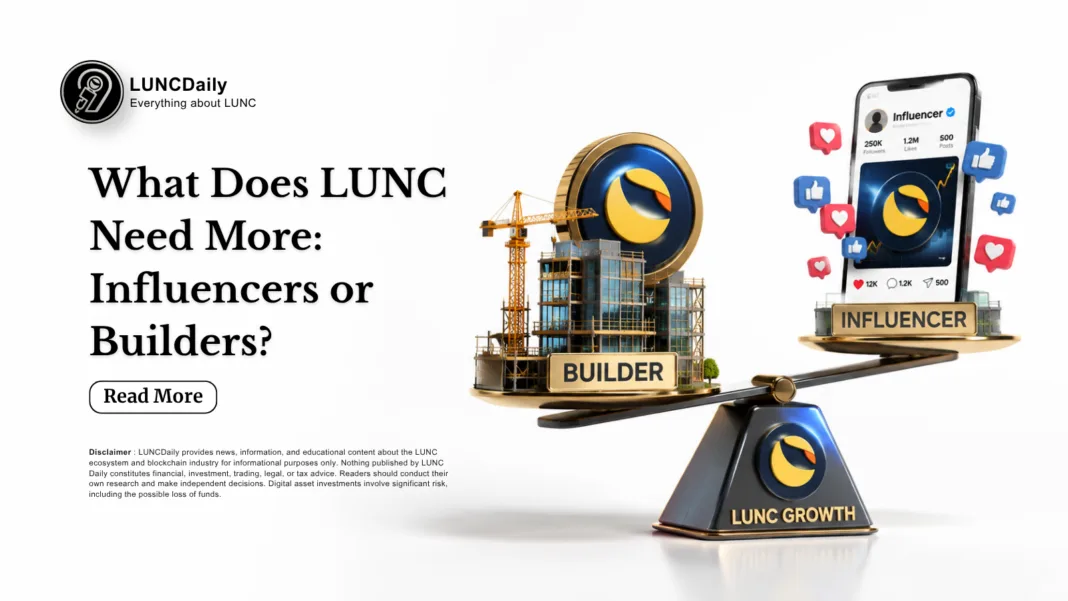

LUNC Growth: Why Builders May Matter More Than Influencers
The Terra Classic community has spent years discussing how LUNC can recover and grow. Marketing, community activity, token burns, staking, trading volume, and development all play a role. But one question remains important: What matters more for the long term growth of LUNC, influencers or builders?
The answer is not that influencers are unimportant. Influencers can attract attention, bring new users into the ecosystem, and help important developments reach a much larger audience.
However, for sustainable growth, builders may have the more important role.
Builders Create the Foundation
A strong blockchain ecosystem needs products and services that people actually want to use.
Builders create decentralized applications, exchanges, wallets, bridges, payment solutions, trading tools, games, NFT platforms, and other forms of utility. These products can create real demand for the network.
For LUNC, this is particularly important.
If more useful applications are built on Terra Classic, the network has more reasons for users to transact, trade, hold assets, provide liquidity, and participate in the ecosystem.
This creates a stronger foundation for long term growth.
Without useful products, marketing can generate attention, but that attention may not turn into sustained adoption.
Influencers Create Attention
Influencers have a different but equally valuable function.
A major LUNC development can have limited impact if nobody knows about it. Influencers and content creators can help communicate new products, partnerships, governance decisions, ecosystem developments, and market opportunities to a larger audience.
They can also introduce LUNC to people who have never interacted with Terra Classic before.
This makes influencers powerful distribution channels.
The problem begins when attention becomes the main objective instead of a tool for promoting real development.
A large audience can create short term excitement, but it cannot replace actual utility.
Builders and Influencers Need Each Other
The strongest ecosystem growth happens when builders and influencers work together.
Builders create something valuable.
Influencers explain it, promote it, and bring attention to it.
Users then have a reason to enter the ecosystem and continue using it.
This creates a simple growth cycle:
Build → Promote → Attract Users → Generate Activity → Build More
If builders are missing, there may be nothing meaningful to promote.
If influencers are missing, valuable products may struggle to reach potential users.
Therefore, the real question may not be whether LUNC needs builders or influencers. It is which one should come first.
Why Builders May Be More Important for LUNC
For the long term, builders have a slight advantage because they create the underlying economic activity.
Consider a new decentralized exchange built on Terra Classic.
The builder creates the infrastructure.
Liquidity providers supply liquidity.
Traders use the platform.
Transactions generate network activity.
The project can attract additional users and developers.
Influencers can then amplify the development and introduce it to a larger audience.
The influencer helps accelerate the process, but the product provides the reason for users to stay.
This distinction is important.
Attention can bring people to an ecosystem once.
Utility can give them a reason to return.
LUNC Needs More Than Price Speculation
Another important part of LUNC growth is moving beyond pure price speculation.
If the primary reason people interact with LUNC is to speculate on its price, ecosystem activity can become heavily dependent on market sentiment.
A healthier ecosystem would give users multiple reasons to participate.
- Trading
- DeFi
- Payments
- Staking
- Liquidity provision
- Cross chain activity
- Applications
- Gaming
- NFTs
- Infrastructure
The more useful activities available, the stronger the ecosystem can become.
This is where builders have a major responsibility.
Burns Alone Are Not Enough
LUNC burns remain an important topic within the Terra Classic community. Reducing supply can contribute to the long term token economics, but burns alone do not create a thriving blockchain ecosystem.
A blockchain also needs users, applications, liquidity, developers, transactions, and sustainable economic activity.
A smaller supply does not automatically create demand.
Building useful products can help create the demand side of the equation.
That is why ecosystem development should remain a major focus alongside the burn strategy.
The Best Strategy for LUNC
LUNC does not need to choose between development and marketing.
It needs both.
Builders should focus on creating products that solve real problems and provide genuine utility.
Influencers should focus on communicating those developments clearly and bringing new users into the ecosystem.
The community should also reward substance over hype.
A project that delivers a working product should receive more attention than an empty promise.
A development that increases real network usage should be promoted more aggressively than a temporary price prediction.
A growing ecosystem should become the story.
Conclusion
Influencers can bring attention to LUNC, but builders can create the reasons for that attention to last.
For short term visibility, influencers may have the bigger impact.
For long term ecosystem growth, builders are arguably more important because they create the infrastructure, applications, and utility that can generate sustainable adoption.
The ideal future for Terra Classic is not a competition between builders and influencers.
It is an ecosystem where builders create, influencers communicate, users participate, and successful products generate more opportunities for further development.
LUNC needs attention, but it needs something worth paying attention to even more.
The biggest question for the Terra Classic ecosystem may therefore be simple:
Who is building the next reason for people to use LUNC?