
In January, Orbit Labs shared important development updates regarding the Terra Classic blockchain with the successful testing of the Cosmos SDK v53 upgrade. This update represents a major technical milestone that prepares the network for future improvements while prioritizing stability and security.
January 11 SDK 53 Update
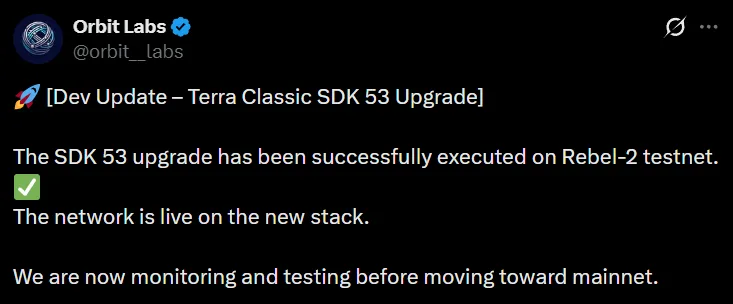
On January 11, Orbit Labs announced that the SDK 53 upgrade was successfully executed on the Rebel 2 testnet. Following the upgrade, the testnet went live on the new software stack and entered an active monitoring and testing phase.
Testing on a testnet is a critical step for any blockchain upgrade. It allows developers to safely identify bugs, performance issues, or compatibility problems without risking real assets. The successful deployment and live operation of Rebel 2 indicate that the new SDK version is functioning as expected so far.
The ongoing monitoring phase serves as a final safety measure. Developers are closely observing network behavior to ensure stability before proposing any move toward mainnet deployment. This approach helps reduce risk for validators, developers, and users across the Terra Classic ecosystem.
Overall, this testnet success marked a positive technical step forward and demonstrated readiness for a future mainnet upgrade.
January 13 SDK 53 Update
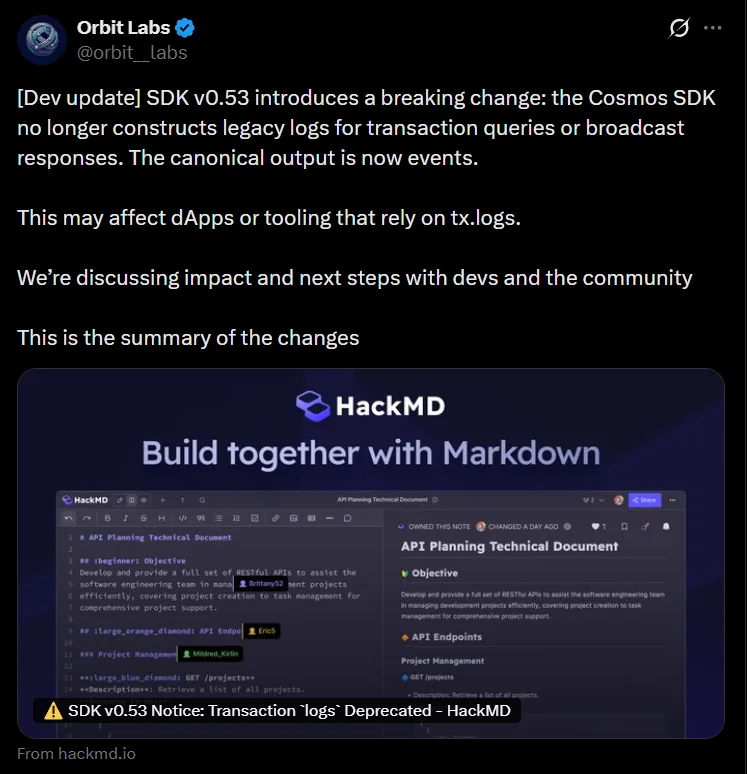
On January 13, Orbit Labs followed up with an important developer update highlighting a breaking change introduced by Cosmos SDK v53. This change affects how transaction data is returned by the blockchain.
With SDK v53, the Cosmos SDK no longer constructs legacy transaction logs. Instead, events are now the official and canonical output for transaction results. This applies to both transaction broadcasts and transaction queries.
This change is part of the broader ABCI 2.0 upgrade and affects all Cosmos SDK based blockchains, including Terra Classic and its related tooling.
What Changed in Simple Terms
Before SDK v53, many applications relied on transaction logs such as tx.logs and raw_log to read transaction results. These logs contained event data but were built using legacy structures.
After SDK v53, the SDK no longer creates these legacy logs. The only official and supported output is transaction events.
Applications that require message level details must now reconstruct them on the client side using event data.
What Did Not Change
Smart contracts continue to emit events as before. Events remain indexed and searchable across the network. Block explorers and indexers that already rely on events are not affected. Modern libraries such as CosmJS already follow this event based approach.
The blockchain still provides full transaction information, but in a cleaner and more structured format.
Who Is Affected
Older decentralized applications or tools that rely directly on tx.logs or raw_log may require updates. Legacy scripts or indexers not adapted for event parsing may also be impacted.
Applications already using events, modern explorers, and tools built on current Cosmos standards are not affected.
Why This Change Matters
Using events as the canonical output improves reliability and consistency across the ecosystem. It aligns Terra Classic with modern Cosmos SDK standards, reduces legacy behavior, and improves long term maintainability for developers.
What Happens Next
Orbit Labs, developers, and the Terra Classic community are reviewing the ecosystem impact of this change. Discussions are ongoing to determine whether a temporary compatibility layer is needed to support older tools during the transition.
Conclusion
The January SDK 53 updates represent a strong and positive step for Terra Classic. The successful testnet deployment confirms technical readiness, while the shift from legacy logs to structured events signals a move toward a more modern, reliable, and future proof blockchain infrastructure.
Although some older tools may require updates, the network itself remains fully functional and improved in clarity, stability, and long term sustainability. SDK 53 positions Terra Classic for safer upgrades, a better developer experience, and stronger ecosystem growth as it moves closer to mainnet deployment.