
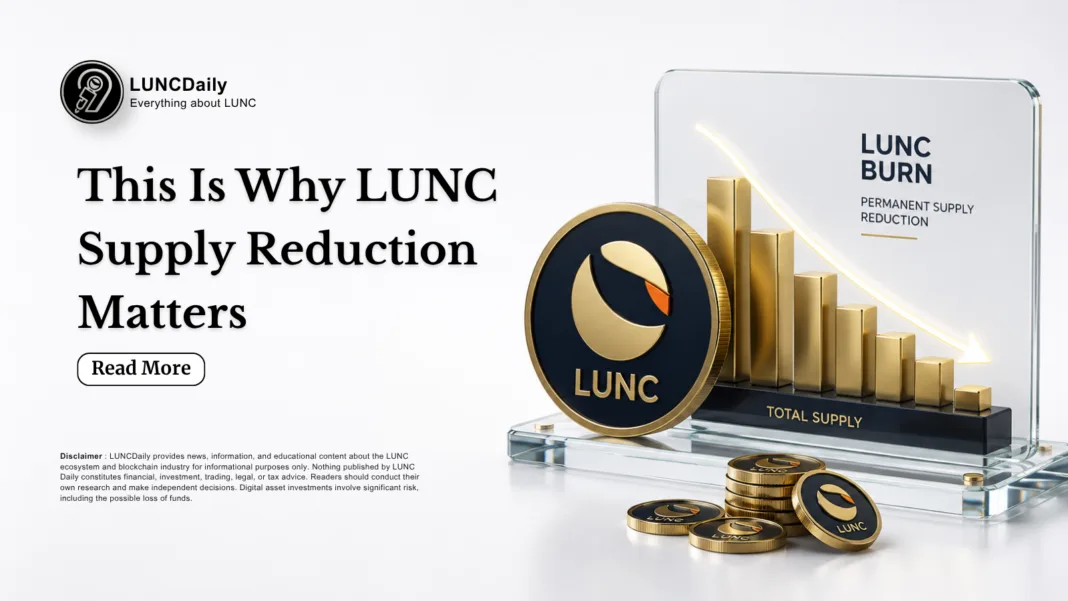

Why LUNC Supply Reduction Matters for Price, Tokenomics and Terra Classic’s Future
Terra Classic has one of the largest token supplies in the cryptocurrency market, making supply reduction a critical part of its long term economic strategy. As billions of LUNC are burned over time, the reduction in circulating supply can gradually change the token’s scarcity and improve the structure of its tokenomics.
For LUNC, the importance of burning tokens goes beyond simply reducing a large number on the supply chart. A sustained burn mechanism can influence scarcity, supply dynamics, market psychology and the relationship between supply and demand.
However, burning tokens alone does not guarantee a higher price. For supply reduction to have a meaningful impact, it needs to happen alongside sustainable demand, network activity, utility and continued ecosystem development.
Why LUNC Has a Supply Problem
One of the biggest challenges facing Terra Classic is its extremely large token supply.
When an asset has a very large supply, reaching higher prices requires substantially greater market demand. This is because market capitalization is calculated by multiplying the token price by the circulating supply.
The basic relationship is:
Market Capitalization = Token Price × Circulating Supply
This means that reducing supply can make the mathematics behind higher prices more favorable, assuming demand remains stable or increases.
For example, if two assets have the same market capitalization but one has a significantly smaller supply, the asset with the smaller supply will have a higher price per token.
This is why supply reduction has become an important part of the long term LUNC narrative.
How LUNC Burns Affect Tokenomics
Token burns permanently reduce the number of tokens available in the ecosystem.
For LUNC, this can create several potential effects.
1. Lower Supply
Every successful LUNC burn decreases the total number of tokens available.
While individual burns may appear small compared with the overall supply, consistent burns can accumulate over months and years.
The key factor is not necessarily one large burn event. It is the continuation of the burn process over time.
2. Increased Scarcity
Scarcity is an important component of token economics.
If demand for LUNC remains strong while the available supply gradually decreases, each remaining token can represent a larger share of the total supply.
This does not automatically increase the market price, but it can create a more favorable supply and demand structure.
3. Better Long Term Supply Dynamics
LUNC’s historical supply remains a major challenge for its tokenomics.
A sustained burn mechanism provides a way to gradually address this issue rather than relying on a single event.
This creates a long term supply reduction strategy where the token supply can decline progressively as burns continue.
4. Greater Importance of Demand
Burning LUNC is only one side of the equation.
The other side is demand.
If supply decreases but demand also falls, the effect of the burn may be limited. However, if supply continues to decline while demand grows through trading, staking, applications and broader ecosystem activity, the economic impact of supply reduction can become more significant.
This is why LUNC burns should be viewed as part of a larger tokenomics strategy rather than a standalone price mechanism.
Why Supply Reduction Matters for LUNC Price
One of the most common questions in the Terra Classic community is whether LUNC burns can eventually lead to a higher price.
The answer depends on both supply and demand.
Consider a simplified example.
If an asset has a supply of 6 trillion tokens and a market capitalization of $600 million, its theoretical price would be:
$600 million ÷ 6 trillion = $0.0001
Now imagine the supply gradually decreases while market capitalization remains unchanged.
If supply falls to 3 trillion tokens, the theoretical price at the same $600 million market capitalization would become:
$600 million ÷ 3 trillion = $0.0002
This example demonstrates why supply reduction matters.
It does not mean that LUNC will automatically reach a particular price. Instead, it shows how a smaller supply can change the mathematical relationship between market capitalization and token price.
Burns Can Strengthen the Scarcity Narrative
In cryptocurrency markets, narrative can play an important role in investor attention.
LUNC burns provide the Terra Classic ecosystem with a measurable metric that the community can track over time.
Daily, weekly and monthly burn figures can demonstrate that the supply reduction process is continuing.
As more LUNC is burned, the cumulative number becomes increasingly important because it shows the long term progress of the supply reduction strategy.
A consistent burn narrative can also help investors understand that the ecosystem is addressing one of its biggest tokenomic challenges.
The Difference Between Burning and Demand Growth
It is important to understand that supply reduction and demand growth are two different mechanisms.
Burning reduces supply.
Utility and adoption can increase demand.
For a sustainable long term price improvement, both can matter.
If Terra Classic continues to burn LUNC while its ecosystem develops greater utility, trading activity and broader adoption, the combination could create a stronger economic foundation.
This is more sustainable than relying exclusively on speculation about burns.
Why Large Burns Alone Are Not Enough
A common misconception is that a large burn automatically causes a large price increase.
That is not necessarily the case.
For example, burning hundreds of millions of tokens may sound significant, but the impact must be evaluated against the total supply and overall market demand.
If billions of tokens are burned but the total supply remains extremely large, the immediate effect on scarcity may be relatively limited.
This is why the long term burn rate matters.
A sustained reduction over years can have a much greater impact than isolated burn events.
LUNC Burns and Long Term Tokenomics
The ultimate objective of a burn strategy is not simply to create headlines about the number of tokens burned.
The larger objective is to gradually create a healthier supply structure.
A successful long term LUNC tokenomics model could involve several elements:
- Consistent token burns
- Increased network utility
- Growing ecosystem activity
- Sustainable demand
- Stronger liquidity
- Continued development
- Responsible economic mechanisms
When these elements work together, supply reduction can become part of a broader economic cycle.
What Would Make LUNC Burns More Significant?
The impact of future LUNC burns could become more meaningful if several conditions develop simultaneously.
Continued Burn Activity
Regular burns gradually reduce the available supply and demonstrate that supply reduction is an ongoing process.
Increased Utility
More reasons to use LUNC can create organic demand rather than demand based solely on speculation.
Higher Network Activity
Greater transaction activity can support stronger economic activity across the Terra Classic ecosystem.
Ecosystem Growth
New applications, services and integrations can potentially increase the number of users interacting with the network.
Long Term Demand
Ultimately, supply reduction becomes more powerful when accompanied by sustainable demand.
The Long Term Goal Is a Healthier Supply and Demand Balance
LUNC does not need to rely on burns alone.
The strongest long term scenario would involve a gradual decline in supply combined with increasing utility and demand.
This creates a more balanced tokenomic model.
The basic principle is straightforward:
Lower supply + stable demand = greater scarcity
Lower supply + growing demand = potentially stronger price dynamics
But the reverse is also true.
Lower supply + declining demand = limited economic impact
This is why investors should look at LUNC burns together with market capitalization, trading activity, ecosystem development and adoption.
Why LUNC Burns Matter for the Terra Classic Community
For the Terra Classic community, burns represent more than a number being added to a tracker.
They represent an ongoing effort to address the enormous supply that has been one of LUNC’s biggest economic challenges.
Every burn contributes to the broader supply reduction process.
The effect of an individual burn may be difficult to see immediately, but the cumulative impact becomes more important as the process continues.
This makes long term consistency one of the most important factors to watch.
Final Thoughts
LUNC supply reduction is an important part of Terra Classic’s long term tokenomics because supply directly influences the price required to reach different market capitalization levels.
Burns can gradually reduce supply, increase scarcity and create a more favorable foundation for future price dynamics.
However, burns alone cannot determine the future price of LUNC.
The most important combination is supply reduction, growing utility and sustainable demand.
If Terra Classic continues reducing its supply while expanding real ecosystem activity and maintaining demand for LUNC, the burn strategy could become increasingly important to the token’s long term economic structure.
For LUNC, the goal is not simply to burn more tokens.
The bigger goal is to build a healthier and more sustainable token economy where a continuously declining supply is supported by real utility and demand.