
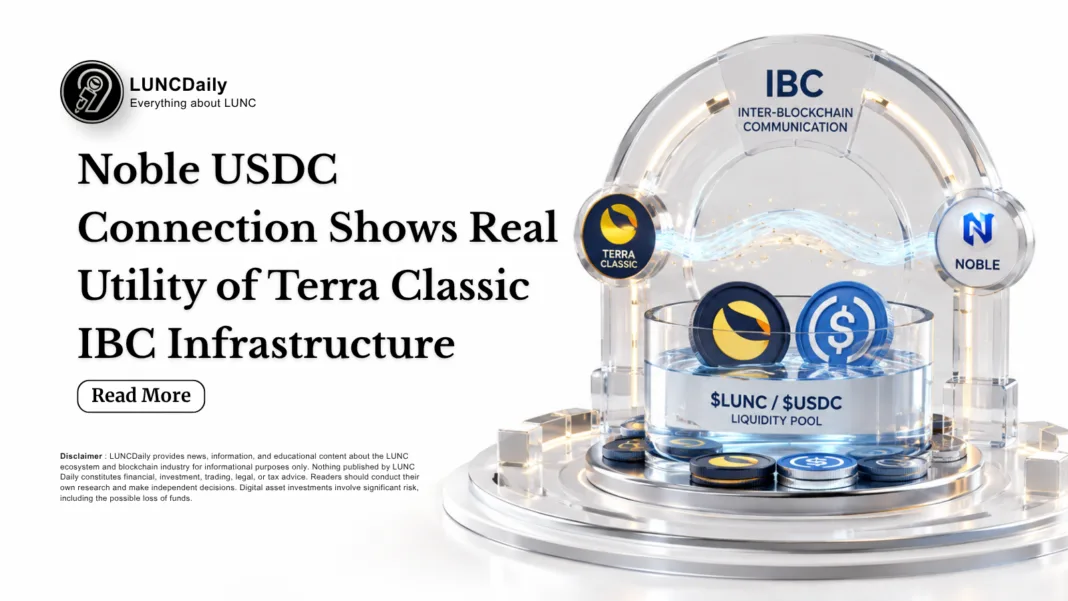

Terra Classic IBC Is More Than Connectivity: How Noble USDC Creates Real Utility for LUNC
The Terra Classic community is currently considering continued funding for its IBC relaying infrastructure, and the proposal is already showing strong support as voting progresses. Proposal #12225, titled Fund Terra Classic IBC Relaying Activity Q3/Q4 2026, seeks to keep Terra Classic connected to Osmosis, Noble and Axelar through the end of 2026.
But an important question remains for some community members:
What does IBC actually do for Terra Classic in everyday use?
The answer is more practical than it may first appear.
One of the clearest examples is the connection between Terra Classic and Noble, because it helps provide access to USDC liquidity that can be used within the Terra Classic ecosystem.
Why Terra Classic Needs IBC Relaying
IBC, or Inter Blockchain Communication, is the technology that allows compatible Cosmos based blockchains to communicate with one another and transfer assets between them.
However, these transfers do not happen automatically. Relayers are required to monitor the connected chains, submit transactions and deliver IBC packets. If the relaying infrastructure stops operating, transfers can become delayed or fail to reach their destination.
This means IBC relayers are not simply a technical connection sitting in the background. They are part of the infrastructure that keeps cross chain asset movement functioning.
For Terra Classic, the current funding proposal specifically covers the existing IBC connections with Osmosis, Noble and Axelar.
The Noble connection provides a particularly useful example.
Terra Classic and Noble: Where USDC Comes In
Many users are familiar with LUNC liquidity pools that pair LUNC with USDC.
These pools allow users to exchange LUNC for USDC or exchange USDC back into LUNC, providing an important stablecoin trading pair for the ecosystem.
But where does that USDC come from?
A key part of the answer is Noble.
Noble is a Cosmos based blockchain specifically designed for native asset issuance. It became the issuance chain for Circle’s native USDC within the Cosmos and IBC ecosystem.
This distinction matters.
What Is Noble USDC?
USDC on Noble is not simply a random wrapped version of USDC created by an unrelated third party.
It is Circle’s natively issued USDC for the Cosmos ecosystem, with Noble acting as the issuance chain.
In simple terms, the structure looks like this:
Circle → Noble → IBC → Terra Classic → LUNC/USDC liquidity
This is where the Terra Classic IBC connection becomes relevant to everyday users.
How the Connection Can Be Used
Imagine a user wants to trade LUNC for USDC.
The user interacts with a LUNC and USDC liquidity pool on Terra Classic. The USDC side of that liquidity can originate from the broader Cosmos liquidity network, with Noble serving as the native issuance hub for USDC.
IBC provides the infrastructure that allows assets to move between compatible chains.
Without an active IBC connection between Terra Classic and Noble, that cross chain movement would not function as intended.
Therefore, maintaining the relayer is not about creating a theoretical future use case.
It helps maintain infrastructure that can support actual asset movement and liquidity access.
Why Native USDC Matters
Before native USDC became available through Noble, Cosmos users often relied on bridged versions of USDC originating from other networks.
That created additional complexity because different bridges could produce different versions of the same asset.
Noble was created to address this fragmentation by providing a native issuance point for USDC within the Cosmos ecosystem.
For Terra Classic, this creates an important connection to the wider Cosmos liquidity environment.
Instead of viewing IBC as simply a bridge between two chains, it is better understood as part of the infrastructure that allows Terra Classic to participate in a larger interconnected blockchain economy.
IBC Creates More Than One Use Case
The Noble example also shows why the value of IBC should not be measured only by the number of transactions occurring directly between two chains.
IBC infrastructure can support several layers of utility.
First, it enables cross chain asset transfers.
Second, it helps connect Terra Classic to liquidity originating elsewhere in the Cosmos ecosystem.
Third, it supports stablecoin availability through assets such as native USDC.
Fourth, it creates infrastructure that applications and wallets can use when interacting with assets across connected networks.
The current proposal itself identifies access to Cosmos liquidity, USDC availability through Noble, liquidity access through Osmosis, cross chain applications and wallet interoperability among the benefits of maintaining Terra Classic’s IBC infrastructure.
The Bigger Picture for LUNC
For LUNC holders, the important point is that blockchain utility does not always appear as a standalone application.
Sometimes the utility is infrastructure.
A functioning IBC connection can operate quietly in the background while enabling users to move assets, access liquidity and interact with applications across multiple networks.
The Terra Classic and Noble connection is one example of this infrastructure at work.
If a user can access a LUNC and USDC market on Terra Classic, and that USDC is connected to the wider Cosmos liquidity ecosystem through Noble and IBC, then the IBC connection has a practical role in the ecosystem.
That makes the proposed funding for IBC relaying more than a technical maintenance expense. It is an investment in keeping Terra Classic connected to external liquidity and the broader Cosmos ecosystem.
Why the Q3 and Q4 2026 Proposal Matters
Proposal #12225 requests continued funding for Terra Classic’s IBC relaying infrastructure through December 31, 2026. The proposal covers the continued operation of the existing Terra Classic connections with Osmosis, Noble and Axelar.
At the time of writing, the proposal has reached quorum and the pass threshold, with YES holding the largest share of voting power. The vote is scheduled to end on September 4, 2026.
The decision therefore goes beyond simply asking whether Terra Classic should maintain a technical connection.
It raises a larger question about the role Terra Classic wants to play within the Cosmos ecosystem.
If Terra Classic wants access to external liquidity, stablecoins and cross chain applications, reliable IBC infrastructure is an important part of that strategy.
IBC Is Infrastructure, Not Just a Feature
The Noble example makes the use case easier to understand.
USDC issued on Noble provides native stablecoin liquidity for the Cosmos ecosystem. IBC allows that liquidity to move between connected chains. Terra Classic can then participate in that interconnected liquidity environment.
For LUNC users, the result can be as simple as trading LUNC against USDC.
Behind that simple transaction is an infrastructure layer involving multiple blockchains, IBC channels and relayers.
That is why the question should not simply be whether Terra Classic uses IBC every day.
The better question is:
How much of Terra Classic’s cross chain liquidity and interoperability depends on IBC continuing to work reliably?
The Noble and USDC connection provides one clear answer.