Home Blog Page 108

Why Terra Classic Could Become a Leading Blockchain in the Future

0

In the fast paced world of cryptocurrency, projects rise and fall at lightning speed. Few, however, have a story as dramatic and potentially inspiring as Terra Classic ($LUNC). After experiencing one of the most high profile crashes in crypto history, $LUNC is now positioning itself for a powerful comeback. While the road ahead is long, there are real reasons to believe that Terra Classic could evolve into one of the strongest blockchains in the future.

Here’s why.

1. A Community That Didn’t Give Up
When the original Terra ecosystem collapsed in 2022, many thought it was over. But instead of fading away, the $LUNC community regrouped. Rather than waiting for someone else to fix things, they stepped in, took control, and started building again.

Today, Terra Classic is community led. Proposals are voted on by token holders, and key decisions from token burns to tech upgrades—are made in the open. This kind of grassroots energy is powerful and rare in crypto.

2. Focused on Reducing Supply
One of the most talked about features of the Terra Classic revival is its token burn mechanism. Simply put, the community and validators are working together to permanently remove billions of $LUNC tokens from circulation. This helps lower the overall supply, which in theory increases value over time—especially as demand begins to return.

3. Bringing Real Utility Back
A blockchain is only as strong as the apps built on it. That’s why developers are now returning to $LUNC, launching DeFi protocols, NFT projects, games, and other real world tools. These applications generate transactions and increase network activity, helping make Terra Classic a useful, functioning ecosystem again—not just a speculative asset.

4. Built for Interoperability
$LUNC runs on the Cosmos SDK, one of the most advanced blockchain frameworks out there. This allows Terra Classic to connect with other blockchains through the IBC protocol, making it easier for users and developers to move assets between ecosystems. In a multi chain future, this kind of flexibility is essential.

5. An Underdog with Room to Grow
Right now, $LUNC trades at a fraction of its past value. But that also means it has significant upside potential. With a committed user base, continued development, and a focus on long-term utility, the project is building a foundation that could lead to serious growth in the years ahead.

It’s not without risk but that’s part of what makes it appealing to those who believe in long-term recovery stories.

6. It’s More Than Just a Token, It’s a Movement
What makes $LUNC unique isn’t just its technology, it’s the story. People love a comeback. Terra Classic is being rebuilt not by a company, but by thousands of individuals who believe in second chances, decentralized control, and the power of community. That kind of spirit can’t be bought or faked. It has to be earned.

Final Thoughts
$LUNC has gone from collapse to comeback. And while it still has work to do, the progress so far has been real and the momentum is growing.

With a strong community, a deflationary model, real use cases, and a passion for rebuilding, Terra Classic is proving that it’s more than just a memory. It’s a blockchain with a future.

Keep an eye on $LUNC. The story isn’t over, it might just be getting started.

LUNC price stalls at crucial support as Terra Classic burn rate soars

0

Terra Luna Classic Terra Luna Classiclunc-1.02%Terra Luna Classic was trading at $0.000060 on Wednesday, where it has remained over the past few days. The token has dropped by over 66% from its December high.

LUNC continued to slide even as more coins were incinerated. According to LUNC Metrics, over 727 million tokens were burned in the past seven days. These burns brought the total number of tokens destroyed since inception to over 407 billion.

Most of this week’s burns came from the Luna Foundation Guard, which burned over 211 million tokens on Wednesday. It also incinerated more than 1.7 billion TerraClassic USD tokens.

Terraform Labs established the Luna Foundation Guard to support the growth of the Terra ecosystem, particularly its stablecoin.

You might also like:Bitcoin price could pump after Trump’s Liberation Day speech

LUNC price has also remained flat after some users proposed to introduce a phased approach to establish an on-chain liquidity for the USD Coin USDCusdc0%USDC

The goal is to set up USDC/LUNC liquidity pools to improve on-chain liquidity, provide decentralized finance utility, reduce reliance on centralized exchanges, and create arbitrage opportunities. Additionally, the pair would help generate tax volume and increase the burn rate.

LUNC price technical analysis

lunc price
LUNC price chart | Source: crypto.news

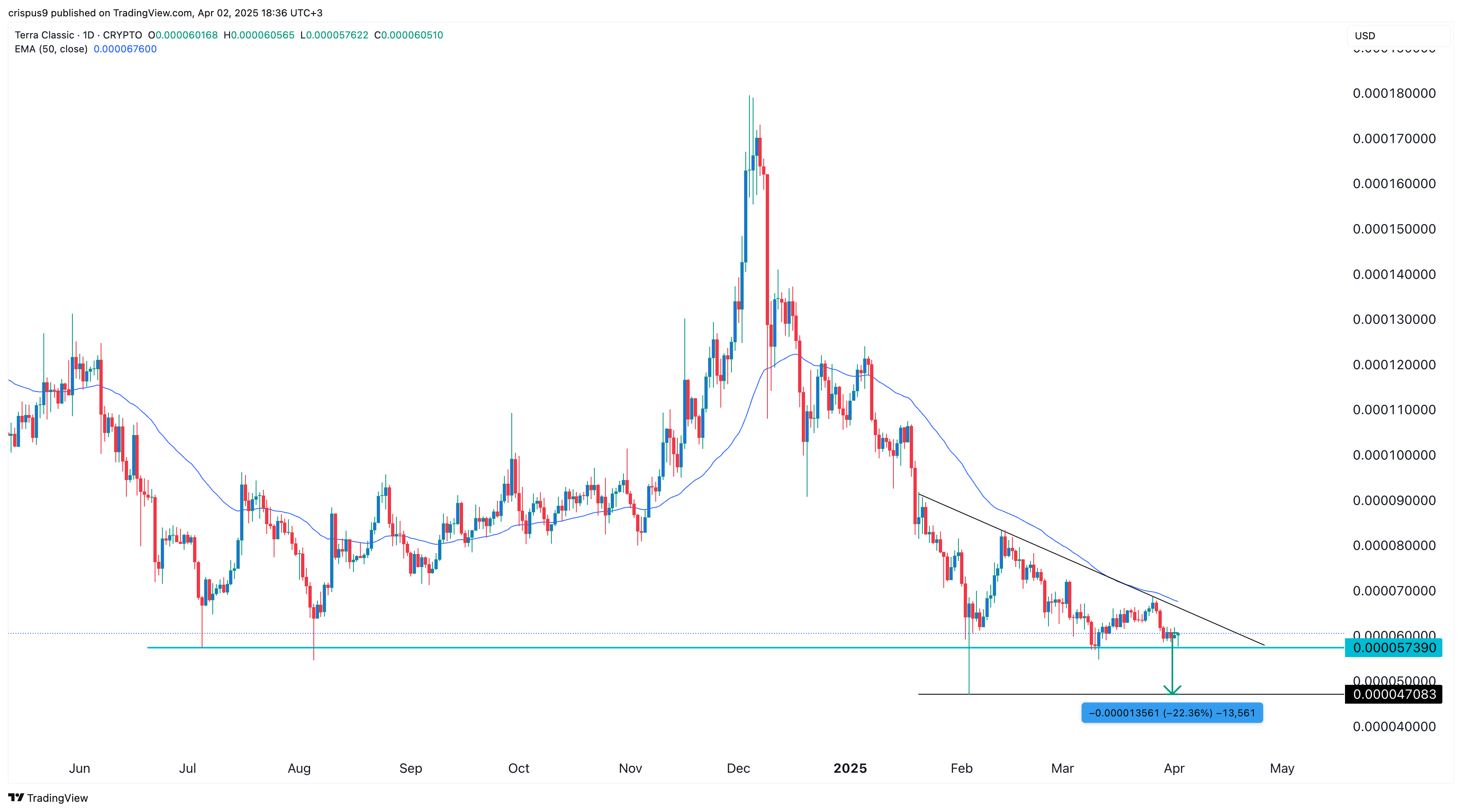
The daily chart shows that Terra Luna Classic has stalled at a key support level, one it has failed to break below multiple times since July last year. This suggests that bears are hesitant to push LUNC lower at current levels.

LUNC remains below the 50-day moving average and the descending trendline connecting the swing highs since Jan. 19. This indicates the formation of a descending triangle, a popular bearish continuation pattern.

More downside would be confirmed if the price breaks below the horizontal support that connects the lowest level since July 2024. A break beneath that zone could push LUNC to the next key support at $0.000047, approximately 22% below the current level.

You might also like:

USTC Is Now a Meme Coin and Traders Are Paying Attention

0

TerraClassicUSD, also known as USTC, has officially changed its identity. It is no longer trying to be a stablecoin. USTC is now a meme coin and this new role is bringing it back into the spotlight.

After the crash in 2022, USTC lost its one dollar value and could never recover. Instead of continuing to fight for the past, the Terra Classic community decided to move forward with a fresh direction. That direction is full of energy, fun, and big potential.


What Does It Mean to Be a Meme Coin

Meme coins are cryptocurrencies that grow because of community power, social media trends, and internet humor. They do not need to follow the usual rules of serious finance. What they do need is attention and excitement.

USTC is now free to join the same crowd as Dogecoin and Shiba Inu. That means it can build a strong online following and create hype that brings in new traders.


Why USTC Is Getting Attention Again

New Energy
Becoming a meme coin has brought fresh life to USTC. People are talking about it again and that attention can help boost trading and price movement.

More Exchange Support
Without the pressure of being a stablecoin, USTC can avoid strict regulations. That means it might stay listed on major exchanges which helps it stay accessible to global traders.

A New Beginning
USTC had a rough past but this new meme coin identity gives it a chance to start over. It is now part of a culture where community matters more than perfect systems. That story of change is exciting for a lot of people.


Can the Price Go Up

Prices in meme coin markets are never easy to predict. But USTC has some key ingredients that could help. It has a strong and active community. It is trading at a very low price which some see as a chance to get in early. And it now has a story that traders love to share.

Of course, risks remain. Meme coins can rise fast but also fall just as quickly. Still, for those who enjoy fast-moving markets and online-driven trends, USTC is now back on the radar.


Final Thoughts

USTC is no longer focused on being stable. It is focused on being seen and being shared. With a loyal community and a fresh meme coin identity, USTC has a new path forward.

This may not be the return everyone expected. But sometimes, changing the story is exactly what a token needs to rise again.

Terra Classic: Why Rising Burn Rates May Signal a Strategic Entry Point for LUNC

0

Investor interest in Terra Classic (LUNC) is beginning to build once again, driven by a marked increase in token burn activity. In the past week alone, more than 727 million LUNC tokens have been permanently removed from circulation, bringing the total burned to over 407 billion. This development has placed LUNC back into the spotlight as market participants evaluate its future potential.

With the token consolidating near a key support level, many are now asking: is this a timely opportunity to accumulate?


Understanding Token Burns and Their Market Significance

Token burning is a deflationary mechanism wherein a portion of a cryptocurrency’s supply is deliberately destroyed, effectively reducing the number of coins in circulation. The goal is to enhance scarcity, which, in turn, may support price appreciation and assuming demand remains steady or increases.

For Terra Classic, the sharp rise in burn activity suggests a renewed focus on strengthening tokenomics and restoring investor confidence.


Where LUNC Stands Today

As of early April, LUNC is trading around the $0.000060 level. Although it remains well below its December 2024 peak, this price point represents a zone of historical support. In technical terms, such levels often attract accumulation from value-seeking investors who believe in the asset’s long-term prospects.

Despite its previous volatility, LUNC continues to maintain a strong community base and a growing number of developers working to revitalize the ecosystem.


Factors Supporting a Potential Rebound

1. Accelerated Token Burns
The recent surge in burn volume demonstrates active participation from both the community and supporting platforms. Sustained reductions in circulating supply may contribute to upward pressure on price over time.

2. Attractive Entry Point
With LUNC significantly off its highs, current price levels could be considered undervalued, particularly for those with a long-term investment horizon.

3. Community Resilience and Ecosystem Renewal
Terra Classic has undergone significant changes since its early challenges, and it continues to attract both contributors and users. Ongoing development efforts, including governance upgrades and utility-based integrations, underscore the project’s ambition to evolve.


Conclusion

In an environment where investors are seeking asymmetric opportunities in the digital asset space, Terra Classic offers a unique combination of deflationary mechanics, grassroots support, and technical rebuilding.

While no asset is without risk, the current confluence of increased token burns and technical positioning suggests that LUNC may be entering a pivotal phase. For those willing to look beyond short-term fluctuations, Terra Classic warrants close attention as a potential high-upside component of a diversified crypto portfolio.

Why Tariffs Make Now a Strategic Time to Buy LUNC

0

As the United States enacts a new wave of tariffs aimed at protecting domestic industries, markets are responding with characteristic uncertainty. Historically, such periods of economic disruption have prompted investors to re-evaluate asset allocations, with many turning to alternatives that offer resilience against inflation, currency devaluation, and geopolitical tension. While Bitcoin often captures headlines during such shifts, there is a growing case for considering Terra Classic (LUNC) as a strategic asset in this new landscape.


The Impact of Tariffs on Global Markets

Tariffs, by design, increase the cost of imported goods. While they can offer short-term relief to domestic producers, they also tend to raise prices for consumers and create frictions in global supply chains. These effects, in turn, can stoke inflation and dampen consumer confidence with two key variables that influence market behavior.

In response, investors typically seek out stores of value or assets not directly exposed to centralized monetary policy. Cryptocurrencies have increasingly filled that role.


Why Terra Classic (LUNC) Deserves Attention

Terra Classic may not be the largest player in the digital asset space, but it remains one of the most active and resilient blockchain ecosystems, supported by a decentralized governance model and a vibrant global community. As traditional markets react to policy induced volatility, LUNC offers a unique value proposition:

1. Decentralization as a Hedge Against Policy Risk
LUNC operates outside the jurisdiction of any single government or central bank. This independence makes it attractive in times of economic nationalism, when capital controls, monetary expansion, or tariffs disrupt conventional investment channels.

2. A Deflationary Supply Mechanism
One of Terra Classic’s most notable features is its ongoing token burn strategy, which gradually reduces the total supply of LUNC. In an inflationary environment, assets with deflationary mechanics often gain attention as potential stores of value.

3. Broad Accessibility and Liquidity
Unlike traditional assets, LUNC can be accessed and traded 24/7 across global exchanges. This level of liquidity is particularly useful during market disruptions, when timing and accessibility can be critical.

4. Ecosystem Rebuilding and Community Engagement
Despite its past challenges, Terra Classic has demonstrated strong grassroots support and a renewed focus on building practical use cases. From decentralized finance applications to governance upgrades, the ecosystem continues to evolve in response to both community needs and market trends.


Strategic Timing

In periods of macroeconomic transition, first-movers tend to outperform. The imposition of tariffs represents not only a shift in trade policy but a broader indication of uncertainty ahead. As institutional and retail investors look to diversify beyond traditional assets, early positioning in high-potential blockchain networks like Terra Classic could yield significant upside.


Conclusion

Tariffs rarely operate in isolation; their economic consequences ripple through markets, influencing everything from interest rates to global capital flows. In this climate, Terra Classic (LUNC) emerges as a viable alternative which offering decentralization, deflationary potential, and strong community-driven momentum. For those seeking a hedge against policy-driven volatility, now may be a particularly strategic time to explore LUNC as part of a broader, future-oriented investment strategy.

Bit Bonds: A $2 Trillion Proposal and What It Signals for Terra Classic

0

In a bold new vision to combat rising national debt, the U.S. government is exploring the issuance of “Bit Bonds” a $2 trillion initiative that would tie sovereign debt instruments to Bitcoin. As reported by Forbes, this proposal could represent one of the most significant intersections between traditional finance and decentralized digital assets to date. While its immediate implications center on fiscal policy and macroeconomics, the ripple effects across the blockchain industry are far-reaching.

Among the projects poised to benefit from such a shift is Terra Classic (LUNC), a decentralized blockchain ecosystem with an active community and a growing suite of use cases.


A Paradigm Shift in Government Finance

The concept behind Bit Bonds is simple but revolutionary: rather than issuing traditional Treasury bonds denominated solely in U.S. dollars, the government would incorporate Bitcoin exposure into the instruments. Proponents argue that doing so could attract a broader range of investors, reduce long-term borrowing costs, and hedge against inflation while demonstrating a willingness to engage with the future of money.

This represents not just an evolution in government financing, but a powerful validation of the broader digital asset market.


Implications for Terra Classic (LUNC)

While Bitcoin may be the anchor asset in the Bit Bond discussion, its formal integration into government finance serves as a bellwether for the entire blockchain sector. Terra Classic, though not directly involved, stands to gain in several key areas:

1. Market Legitimacy
Government led adoption of blockchain-based instruments sends a strong signal to investors and institutions that digital assets are here to stay. This could lead to increased scrutiny but also increased legitimacy for projects like Terra Classic that have weathered volatility and evolved through community governance.

2. Regulatory Maturity
A move as significant as Bit Bonds would likely necessitate clearer policy and compliance frameworks around digital assets. For Terra Classic, a more stable and transparent regulatory environment would lower entry barriers for developers, investors, and ecosystem partners.

3. Investor Diversification
As capital begins to flow into government-linked crypto products, attention will naturally turn to high-potential altcoin ecosystems. LUNC, with its vibrant community and ongoing development roadmap, may become an attractive diversification option for those seeking exposure beyond Bitcoin and Ethereum.

4. Infrastructure Expansion
Bit Bonds could accelerate public-private partnerships and the integration of blockchain technologies into legacy systems. This could pave the way for platforms like Terra Classic to participate in future initiatives, including stablecoin frameworks, decentralized finance applications, and cross-chain solutions.


Looking Ahead

The U.S. government’s consideration of Bit Bonds is more than a fiscal innovation, it is a statement about the role of digital assets in the global financial future. For Terra Classic and other decentralized networks, it is both a challenge and an opportunity: to rise to the level of trust and utility required to play a meaningful role in a changing financial order.

If Bit Bonds become a reality, they could represent the beginning of a new era, one where traditional finance and decentralized technologies not only coexist but collaborate.

Over 2B LUNC, USTC Burned As Terra Gets Rid Of Luna Classic

0

On-chain records showcase a massive burn of Terra system’s native tokens, sparking rebound hopes for LUNC holders.

Better days are coming soon for the game-tested Terra Luna Classic (LUNC) community, as the altcoin’s parent company TerraForm Labs is forced by the U.S. Securities and Exchange Commission (SEC) to wind down operations.

Terra Burns Big Pile Of LUNC & USTC

For the LUNC community, there’s a bi-folded benefit in these circumstances, as the $4.47B settlement with the SEC obliges TerraForm Labs to get rid of all their Terra Luna token reserves. Not only that solidifies independence from the embattled fintech company, but also eliminates a big portion of Terra Luna Classic (LUNC) and Terra Classic USD (USTC) coins from circulation.

The latest on-chain records show that the wait is over – Luna Foundation Guard (LFG) processed two crucial burning transactions today, eradicating 211,577,500 LUNC and 1,754,725,793 USTC tokens and restoring some optimism among community members.

After this LUNC & USTC burning deed, the malfunctioning USTC stablecoin’s supply has been cut down to 5,596,629,711, while Terra Luna Classic’s (LUNC) highly overminted supply plunged to 5,443,544,767,812 tokens. These deflationary tactics aim at long-term sustainability, while neither Terra Classic, nor the USTC coin had seen immediate price appreciation.

Why Terra Luna Classic’s Price Lags

With over $19 million down the drain, this supply cut for USTC & LUNC could only bear fruit in bullish price momentum if Terra Luna Classic’s chain picks up a significant trading volume. Currently, Terra Classic is on the verge of exiting the TOP 200 by global market cap, nabbing just $12.9 million in trades in the latest 24-hour frame.

And so, short-sellers, known as bears in crypto slang, have annihilated a major LUNC support level at $0.00006, Terra Luna Classic’s price could face a further freefall. Meanwhile, things are not looking better for USTC, as the de-pegged stablecoin is trading at a 1.1% fraction of its original price. Grasping twice as less in trading volume as LUNC, the $1 re-peg dream for USTC is still far away.

$LUNC $USDC

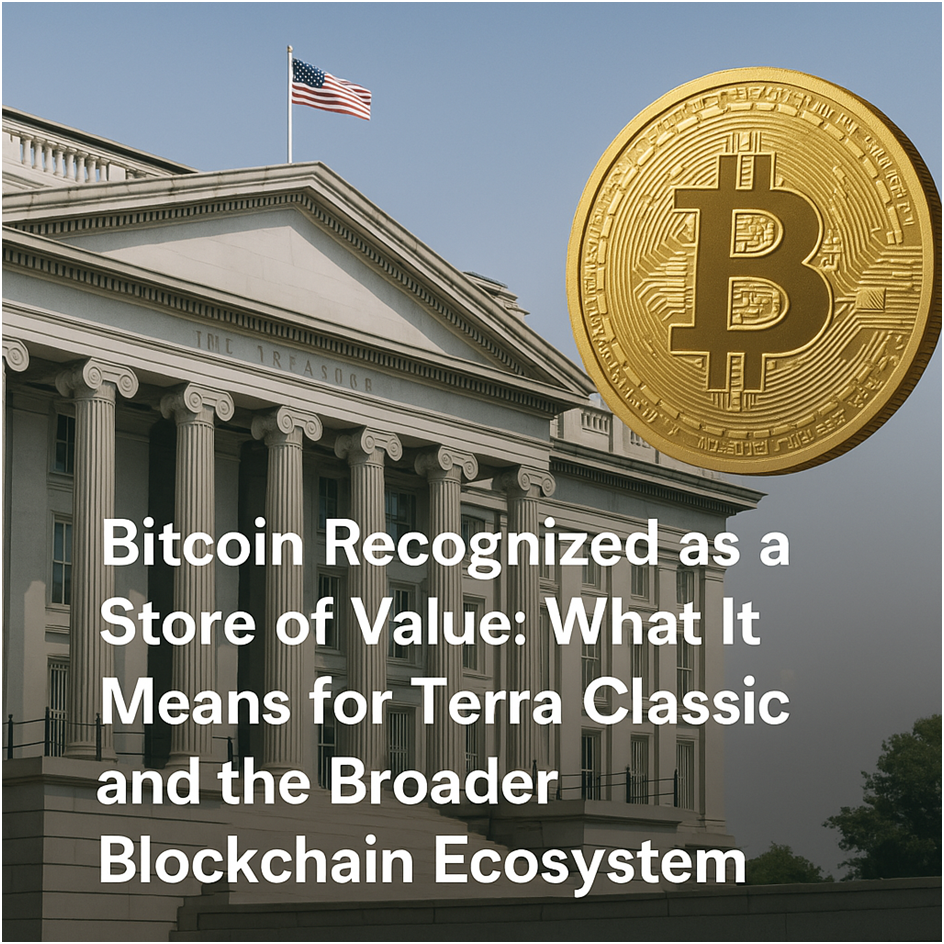
Bitcoin Recognized as a Store of Value: What It Means for Terra Classic and the Broader Blockchain Ecosystem

0

In a landmark statement that may reshape the global financial landscape, the U.S. Treasury Secretary has publicly recognized Bitcoin as a “store of value to rival gold,” according to a report published by Forbes. This declaration follows a period of heightened market volatility, with Bitcoin’s price outperforming traditional equities amid a sharp downturn in U.S. stock markets under the current administration.

The announcement is being hailed as a turning point for digital assets, marking the first time a sitting Treasury Secretary has placed Bitcoin on par with one of the world’s oldest and most recognized stores of value. But beyond Bitcoin, the implications for the broader crypto ecosystem, including emerging and legacy blockchains such as Terra Classic (LUNC)—are substantial.

A Shift in Market Perception

Bitcoin’s recognition by a top U.S. official signals growing institutional and governmental acknowledgment of digital assets as viable components of the financial system. For projects like Terra Classic, this shift brings new legitimacy. Once associated primarily with retail driven speculation, LUNC now has an opportunity to be reevaluated in the context of a maturing crypto landscape.

Renewed Institutional Interest

While Terra Classic has had a complex history, it remains supported by a committed community and continues to evolve through decentralized governance. The Treasury Secretary’s statement could indirectly stimulate renewed institutional interest in alternative blockchain ecosystems, as investors diversify beyond Bitcoin in search of undervalued or high-utility digital assets. For Terra Classic, this could mean increased liquidity, market engagement, and technical contributions.

Policy and Regulatory Tailwinds

With the U.S. Treasury now openly discussing the role of cryptocurrencies in wealth preservation, the regulatory narrative may begin to shift. Clearer policy frameworks are likely to follow, potentially reducing uncertainty around development and investment in projects like Terra Classic. This would be especially beneficial for protocols aiming to rebuild credibility and provide real world utility.

Positioning for the Next Phase

Terra Classic, with its revitalized community and push toward sustainable development, is well-positioned to benefit from this macro-level momentum. As capital begins to flow more freely into the digital asset space under a more favorable regulatory and institutional lens, LUNC could emerge as a strategic part of diversified crypto portfolios, particularly for those seeking exposure to community driven ecosystems with long-term growth potential.


Conclusion

The U.S. Treasury Secretary’s recognition of Bitcoin as a modern equivalent to gold marks a pivotal moment in the mainstreaming of digital assets. For Terra Classic and similar projects, it opens the door to renewed credibility, institutional visibility, and broader market participation. In this new chapter of digital finance, LUNC may find not just a place in the conversation but a meaningful role in the future of decentralized value.