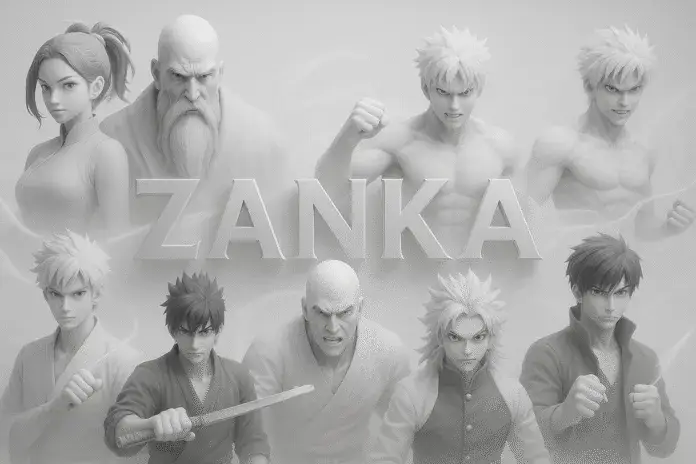
At a time when many blockchains are struggling with congestion, costs or loss of trust, the Terra Luna Classic (LUNC) chain is gaining momentum again through layer-2 (L2) token projects. One of these projects is ZANKA – a community-driven, fire and anime-inspired meme token with a DeFi approach. But what makes such tokens really relevant – not just for themselves, but for the entire LUNC and USTC ecosystem?
What is an L2 token?
A layer-2 token on LUNC is a token that does not directly secure or change the chain itself, but is based on it. It uses the infrastructure (smart contracts, CW20 standard, DEXs) of Terra Luna Classic, but has its own use cases – such as farming, games or community projects.
The benefits for LUNC – using ZANKA as an example
1. More demand for LUNC through DEX pairs
ZANKA’s first DEX pair is ZANKA/LUNC. To buy or farm this token, you need LUNC – which creates artificial but real buying pressure on LUNC.
Effect: Every trade in ZANKA increases the volume & importance of LUNC in the market.
2. Strengthen farming pools USTC
In addition to LUNC pools, ZANKA is also planning future pairs with USDC or other L2 projects.
Effect: Utility and easier exchange options within Lunc and beyond
3. Burns & deflation
ZANKA integrates utility burns through future developments in which tokens are burned – partly also through purchase actions in which LUNC is used. This mechanism increases scarcity – for both assets.
Effect: More L2 usage = more potential token burns = more appreciation for LUNC.
4. Community engagement & onboarding
L2 projects such as ZANKA offer low-threshold entry into the LUNC world: through memes, NFTs, games or farming. This attracts new users who previously had nothing to do with Terra.
Effect: New wallets, more activity, stronger community.
5. Future: DeFi & NFT use cases
ZANKA brings a functional application to LUNC with an NFT-supported game. This proves that the chain is not “just nostalgic”, but fit for the future.
Conclusion: ZANKA shows what is possible
ZANKA may be a memetoken – but it is an example of the renaissance of the Terra Classic Chain. It’s another example of how the will of the community is creating Layer 2 projects that serve the entire chain.
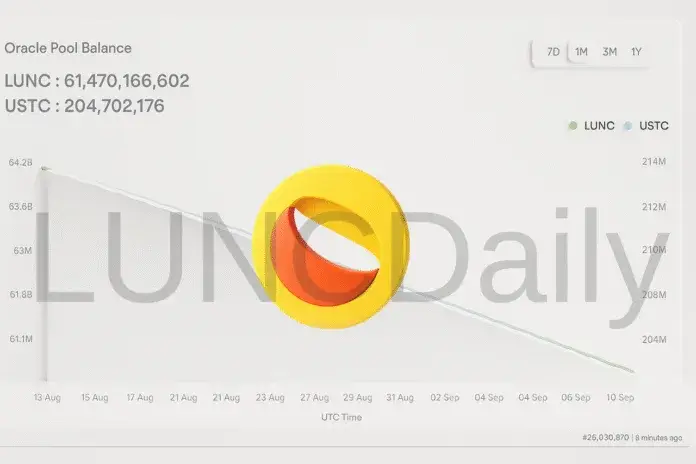
The Oracle Pool, a key component of the Terra Classic ecosystem, has recorded a consistent decrease in its balance over the past month. As of the latest data, the balance stands at:
● LUNC: 61,470,166,602
● USTC: 204,702,176
This represents a noticeable decline compared to mid-August levels, where the balance was above 64.2 billion LUNC and 214 million USTC.
One-Month Trend Analysis
From August 13 to September 10, both LUNC and USTC balances have followed a downward trajectory. The chart shows a parallel decline, suggesting that both assets within the Oracle Pool are being gradually reduced at a consistent pace.
● LUNC: Dropped from approximately 64.2B to 61.4B
● USTC: Dropped from approximately 214M to 204.7M
This steady decrease could indicate ongoing outflows, redistribution of rewards, or adjustments within the ecosystem’s economic model.
What This Means for Terra Classic
The Oracle Pool plays a vital role in sustaining the Terra Classic network, particularly for validator rewards and ecosystem stability. A shrinking pool balance may raise concerns about long-term sustainability if the trend continues without replenishment.
Community members and investors will likely monitor whether future governance decisions, ecosystem activity, or market dynamics can help stabilize or replenish the Oracle Pool balance.
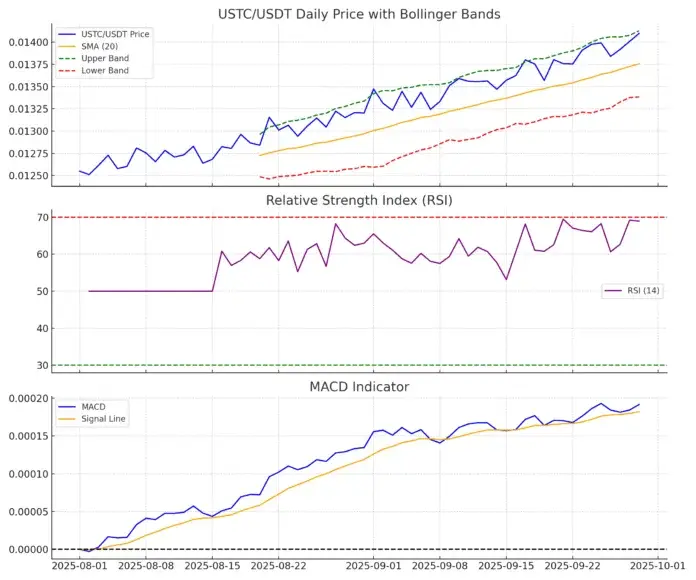
Current Price: ~$0.01358
Daily Range: $0.01336 – $0.01381
Change: +0.016%
Technical Overview
● Momentum Indicators: RSI and Stochastics show steady buying pressure.
● Moving Averages: All major MAs (5–200) are aligned bullish, signaling a strong short-term trend.
● Chart Pattern: USTC has formed a higher-low structure, which often signals continuation to the upside.
● Pivot Zone: $0.01353–$0.01357 is the critical level to watch.
Short-Term Forecast
● A decisive break above $0.01360 could lead to a test of $0.0138 or higher.
● Failure to hold support may trigger a pullback toward $0.0134–$0.0135.
Long-Term Perspective
While daily signals are bullish, monthly outlooks remain mixed, with some sell indicators suggesting this move may be temporary unless confirmed by stronger volume and momentum.
Conclusion
USTC/USDT is showing bullish momentum in the short term, supported by technical indicators and moving averages. Traders should monitor the $0.01353–$0.01357 pivot zone closely, as it will likely determine whether USTC continues higher or faces another pullback.
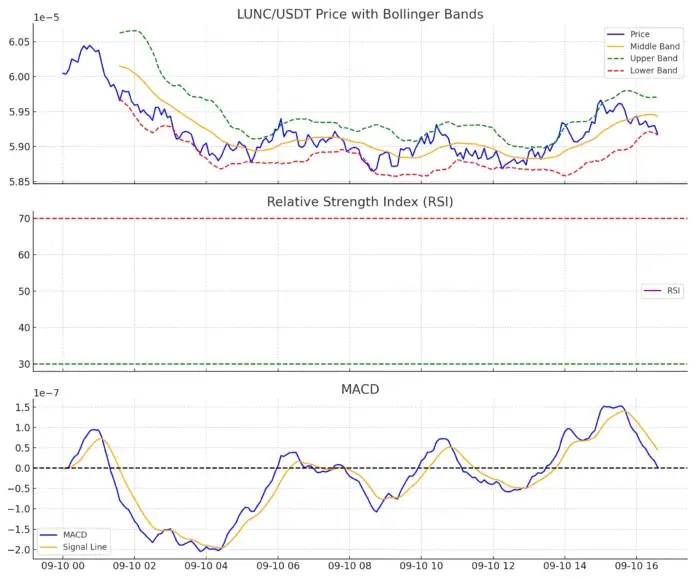
Terra Classic (LUNC) continues to trade in a tight range against USDT, with the price hovering around $0.000060. Over the past 24 hours, LUNC has recorded slight gains of less than 2 percent, but the market remains uncertain about its next move.
Technical indicators show mixed signals. The Relative Strength Index (RSI) currently sits around neutral levels, suggesting that the market is neither overbought nor oversold. The Moving Average Convergence Divergence (MACD) indicator remains flat, showing no clear bullish or bearish momentum. Meanwhile, Bollinger Bands have tightened, reflecting reduced volatility and the possibility of an upcoming breakout.
Key levels are crucial for traders to watch. Support is holding near $0.0000593, while resistance stands around $0.0000611. A breakout above resistance could push LUNC toward $0.0000630 in the short term, while a breakdown below support may open the door for further downside pressure.
Trading volume remains relatively low at around $9 to $10 million daily, which aligns with the consolidation trend. Without strong buying interest, LUNC is likely to continue moving sideways until a catalyst drives momentum.
For traders, the strategy remains cautious. Range trading between support and resistance can provide opportunities, but clear breakout confirmation is needed before committing to larger positions.
Terra Classic has often been called a “market on pause.” Low liquidity, low activity, and low excitement. But that changes today.
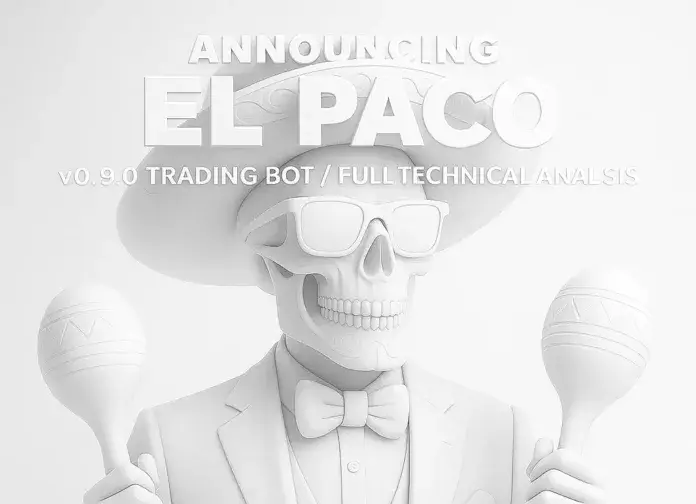
Introducing the El Paco Trade Botv0.9.0 — a full technical analysis trading system for Linux and Windows, designed to bring liquidity, volume, and momentum back to Terra Classic.
Why This Matters
For years, Terra Classic has been waiting for a spark. The El Paco Trade Bot is more than just another tool—it’s the kind of layer 2 innovation that can:
Reignite trading activity
Support healthier price discovery
Reinvent how Terra Classic markets function
This isn’t just about making trades. It’s about breathing life into a stalled ecosystem.
How It Works
The bot uses real technical analysis every minute to decide whether to buy, sell, or hold. Strategies are powered by:
MACD (momentum shifts)
RSI (overbought/oversold signals)
SMA (trend confirmation)
Bollinger Bands (volatility zones)
Instead of dumping full positions, each trade is tracked and managed independently, making the bot both a trader and a market maker.
Designed for Sustainable Activity
Provides liquidity around the clock
Executes only when signals align—no random trades
Builds support & resistance naturally by trading ranges
Increases token volume without resorting to wash trading
Profitability Disclaimer
The El Paco Trade Bot is built to seek out profitable entries and exits. But let’s be clear: profitability is not guaranteed. It depends on the market—volatility, liquidity, and natural participation.
What is guaranteed is that the bot will: ✅ Keep Terra Classic moving ✅ Support projects with real liquidity ✅ Reinvent what “Layer 2” can mean on this chain
The Bigger Picture
This is more than trading. It’s about reigniting Terra Classic’s heartbeat. With every buy, sell, or hold decision, the El Paco Trade Bot strengthens the ecosystem, proving that smart automation can build sustainable momentum.
The Terra Classic community has been waiting for something new, something real, something alive. This is it.
👉 Ready to try it out? Check out the El Paco Trade Bot and download the bot for either Windows or Linux
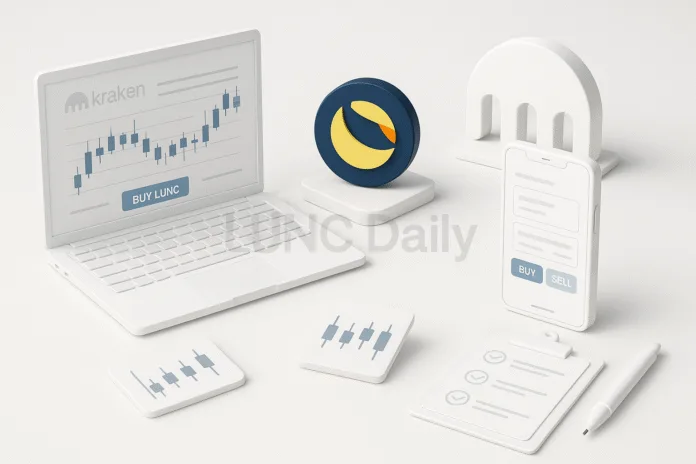
Trading Terra Luna Classic (LUNC) on Kraken is straightforward if you follow these steps. Kraken is a trusted cryptocurrency exchange, ideal for beginners and experienced traders. Here’s how to trade LUNC securely and efficiently.
Step 1: Create a Kraken Account
Visit Kraken’s official website and click “Sign Up.” Provide your email, create a username, and set a strong password. Verify your email address to activate your account. Complete the identity verification process by submitting required documents, ensuring compliance with Kraken’s KYC policies.
Step 2: Fund Your Account
Log in to your Kraken account and navigate to the “Funding” tab. Select a deposit method, such as USD, EUR, or cryptocurrencies like BTC or USDT. Follow the instructions to transfer funds. Kraken requires a minimum deposit, typically $5-$10, depending on the method. Ensure funds are available before trading.
Step 3: Locate LUNC on Kraken
Go to the “Trade” section and search for Terra Luna Classic (LUNC). Kraken supports LUNC trading but not the new Terra (LUNA) token. Check the LUNC/USD or LUNC/USDT trading pairs to view real-time prices and market trends.
Step 4: Place a Buy or Sell Order
Choose between a market order for instant execution or a limit order to set your desired price. Specify the amount of LUNC you want to buy or sell. Review the order details and confirm. Kraken’s interface provides advanced charting tools for informed decisions.
Step 5: Monitor and Manage Your Trades
Track your LUNC holdings in the “Portfolio” tab. Set price alerts to stay updated on market movements. For security, enable two-factor authentication (2FA) and store excess LUNC in a secure wallet.
By following these steps, you can trade LUNC on Kraken efficiently. Always research market trends and trade responsibly.
A new discussion around USTD, a yield-bearing stablecoin on Terra Classic, has sparked wide debate across the community. While some see it as an innovative step toward a fully collateralized and automated stable asset, others urge caution.
One such voice is LUNC Strategist, the owner of the Alpine Digital validator, who shares a measured perspective on the risks and systemic challenges USTD could bring. From asymmetry in asset classes to cross-chain fragility and the potential impact on key partners like Binance, this analysis highlights why prudence is essential as the community considers the discussion.
A Cautious Look at USTD: Asymmetry, Fragility, and Systemic Risk
The introduction of USTD, a proposed yield-bearing stablecoin on Terra Classic, has generated significant discussion. While the vision of a fully collateralized and automated stable asset is compelling, it is equally important to examine the risks with a clear and measured perspective.
Asymmetry in Asset Classes
In markets, outcomes often follow what investors call asymmetry. In equities and venture capital, upside can be exponential: one winner can offset many losses. In credit and fixed-income markets, however, the situation is reversed. Gains are capped, while one failure can erase years of steady income.
Viewed through this lens, USTD resembles a fixed-income product. It promises predictable yield but carries the possibility of rare, devastating failure. For any credit-like structure, sustainability is everything. Fragile designs eventually break, and the discipline lies not in chasing yield, but in avoiding catastrophic loss.
The “Three-Body Problem”
USTD’s collateral design introduces what can be described as a correlation squared problem. Each token is backed not by cash or Treasuries, but by other stablecoins, USDC and USDT.
This creates multiple layers of dependency:
● If USDT faces a freeze, USTD is impaired.
● If USDC encounters governance or operational missteps, USTD is impaired.
● And if either depegs, USTD is impaired.
Rather than reducing risk through diversification, this approach amplifies correlation. Just as in the structured-finance crises of the past, recombining correlated assets does not make the system stronger; it can make it more fragile.
Systemic Implications for Terra Classic
If this were a stand-alone protocol on the edge of the ecosystem, the risks would remain largely contained. Investors could choose to participate or abstain. But USTD is designed to sit at the core of Terra Classic. That magnifies the stakes.
A failure in USTD would not remain isolated. Redemptions seizing up or collateral instability would ripple outward, impacting LUNC, USTC, and the credibility of the entire chain. After surviving the largest collapse in crypto history, Terra Classic is slowly regaining trust through careful rebuilding. Embedding systemic risk at the foundation could jeopardize that progress.
The Cross-Chain Fragility
The USTD whitepaper itself acknowledges one of the largest risk factors: reliance on cross-chain bridges. These bridges, while essential to moving collateral, are also among the most targeted and exploited components in DeFi. History shows that a single bridge exploit can erase billions in value overnight.
This dependency raises questions about whether USTD can truly serve as a “stable” foundation for Terra Classic, or whether it embeds too much fragility into the base layer of the ecosystem.
The Binance Factor
Another key consideration is the role of Binance. The exchange has been the single largest contributor to LUNC burns and also holds significant amounts of USTC. This support has been critical in maintaining community confidence and advancing recovery efforts.
If USTD replaces USTC as the primary stablecoin of the ecosystem, there is a legitimate concern that Binance may reduce or even withdraw its support. Any reduction in Binance’s commitment, whether in burns, liquidity, or token exposure, could have serious consequences for Terra Classic’s recovery trajectory.
For a chain still rebuilding its reputation, the alignment of key external partners should not be taken for granted.
A Call for Prudence
Raising these concerns is not an argument against innovation. Terra Classic must continue to explore new designs, products, and use cases. But risk at the foundation is different from risk at the edges. The cost of failure in the former is existential, and the community must weigh carefully whether the potential rewards outweigh the systemic dangers.
As discussions continue, it is vital that the community approaches USTD with caution, transparency, and rigorous debate. The path to recovery for Terra Classic is hard-won, and protecting the chain’s credibility, including its relationships with crucial partners like Binance, must remain the top priority.
Looking Ahead
Many community members ask: if this idea has risk and we don’t want to take that risk, what should we do? Should we just wait for years without doing anything?
The reality is that, whether we like it or not, Luna Classic is still impacted by the Do Kwon case. Perhaps the best course for now is patience, allowing that process to reach its conclusion before embedding new systemic risks at the base layer.
In the meantime, the community can focus on what is both safe and productive: educating new users, strengthening governance, and building more utility around LUNC itself. This has been one of the stated aims of initiatives like WESO/REBASE, which emphasize sustainable growth without repeating the fragile structures of the past.
The Terra Classic (LUNC) community has received positive news as LUNC has been successfully relisted on the CetoEX Exchange. This development marks another important step toward strengthening market accessibility and providing more trading opportunities for the community.
The relisting on CetoEX means that users can now trade LUNC with ease and benefit from the exchange’s global reach. Increased exchange availability helps improve liquidity, attract more traders, and enhance overall confidence in the Terra Classic ecosystem.
For the community, each exchange listing or relisting represents more than just accessibility. It is also a signal that interest and trust in LUNC remain strong. By being present on more exchanges, LUNC is better positioned to expand its adoption and visibility in the broader crypto market.
As Terra Classic continues its revival journey, the relisting on CetoEX adds momentum to community-driven efforts aimed at long-term growth and stability.
Out of a total of 198 validators on the Terra Classic network, only 102 are currently active. This means that 96 validators are inactive, representing almost half of the validator set.
Validators play a vital role in securing the blockchain, validating transactions, and maintaining decentralization. When a large portion of validators remain inactive, it reduces the diversity of governance and can concentrate influence in fewer hands.
For delegators, this highlights the importance of choosing active validators when staking. Supporting smaller but reliable validators helps strengthen decentralization, spreads voting power more evenly, and ensures the long-term stability of the Terra Classic ecosystem.
A healthy validator set not only secures the network but also builds trust among its users. By understanding the balance between active and inactive validators, the community can make informed decisions to safeguard the future of Terra Classic.
Did You Know?
The top five validators in the Terra Classic network currently hold more than 33.33% of the total stake. While this concentration shows trust in their reliability, it can also reduce the overall decentralization of the network.
Delegating to smaller validators helps improve decentralization, strengthen governance, and ensure a healthier blockchain ecosystem. By distributing your stake more evenly, you contribute to the long-term stability and fairness of Terra Classic.
Consider supporting validators outside the top five to keep the network balanced and community-driven.