Home Blog Page 20

Is This the Best Time to Buy LUNC? Chart Analysis and Extreme Fear Signal a Possible Accumulation Zone

0

Market Context: Sentiment First

The Crypto Fear and Greed Index has dropped to 5, placing the market in extreme fear territory. This level historically appears near major local bottoms and late stage corrections. By the time sentiment reaches this point, retail investors have typically exited positions, momentum traders step aside, and only patient capital remains active.

Markets rarely stay in this zone for long because extreme fear often signals seller exhaustion and the early stages of accumulation.

LUNC 4H Chart — Technical Breakdown
Macro Structure

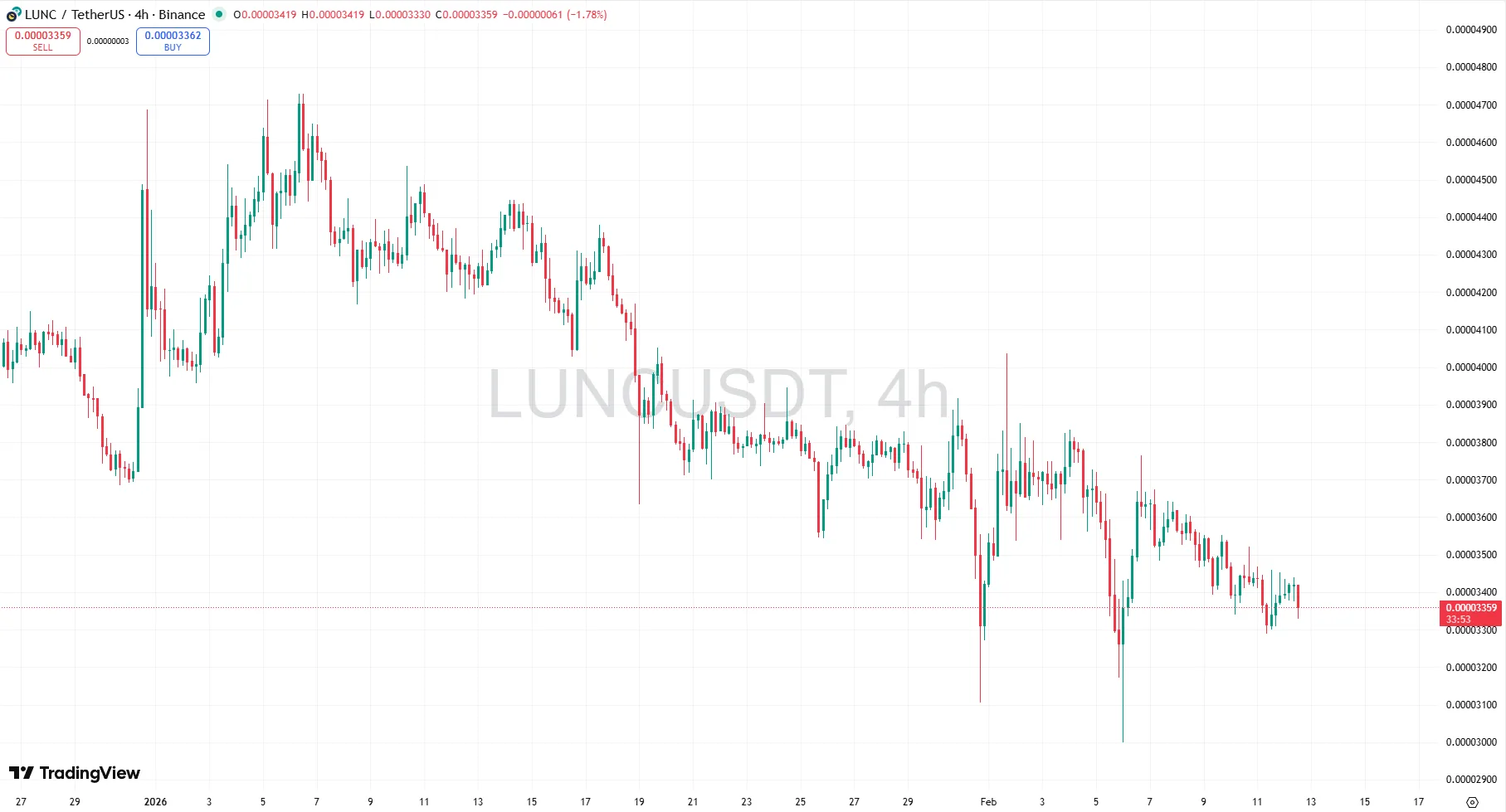
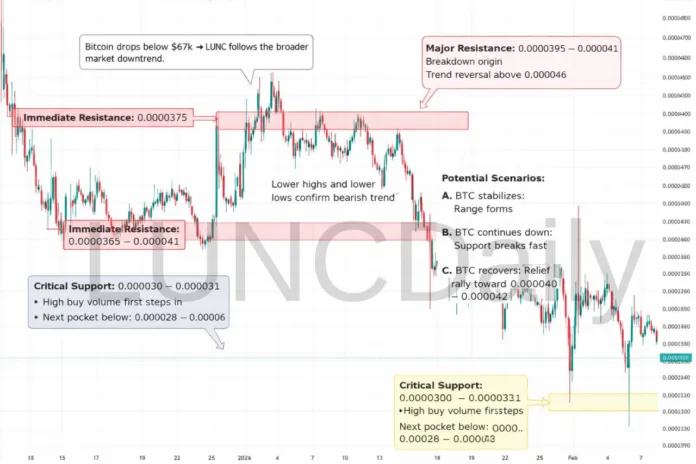
The chart shows a clear downtrend channel since early January with lower highs and lower lows. However, price action now sits in a late stage decline zone where momentum is weakening, candle sizes are shrinking, and volatility spikes are producing wicks instead of continuation. This behavior often signals seller exhaustion.

Key Price Zone

The current price area around 0.000033 to 0.000034 has become a repeated reaction zone. The market has tested this level multiple times without a strong continuation breakdown, suggesting sellers are losing momentum.

Capitulation Wicks and Liquidity Sweeps

Two major downside wicks appeared in late January and early February. These sharp selloffs were quickly bought back, showing classic liquidity sweeps where panic sellers exit and stronger hands accumulate.

Momentum Shift Signals

Recent candles show smaller bodies, sideways compression, and reduced downside acceleration. This often marks the transition from trend to compression, which typically precedes a reversal setup.

Sentiment + Technical Alignment
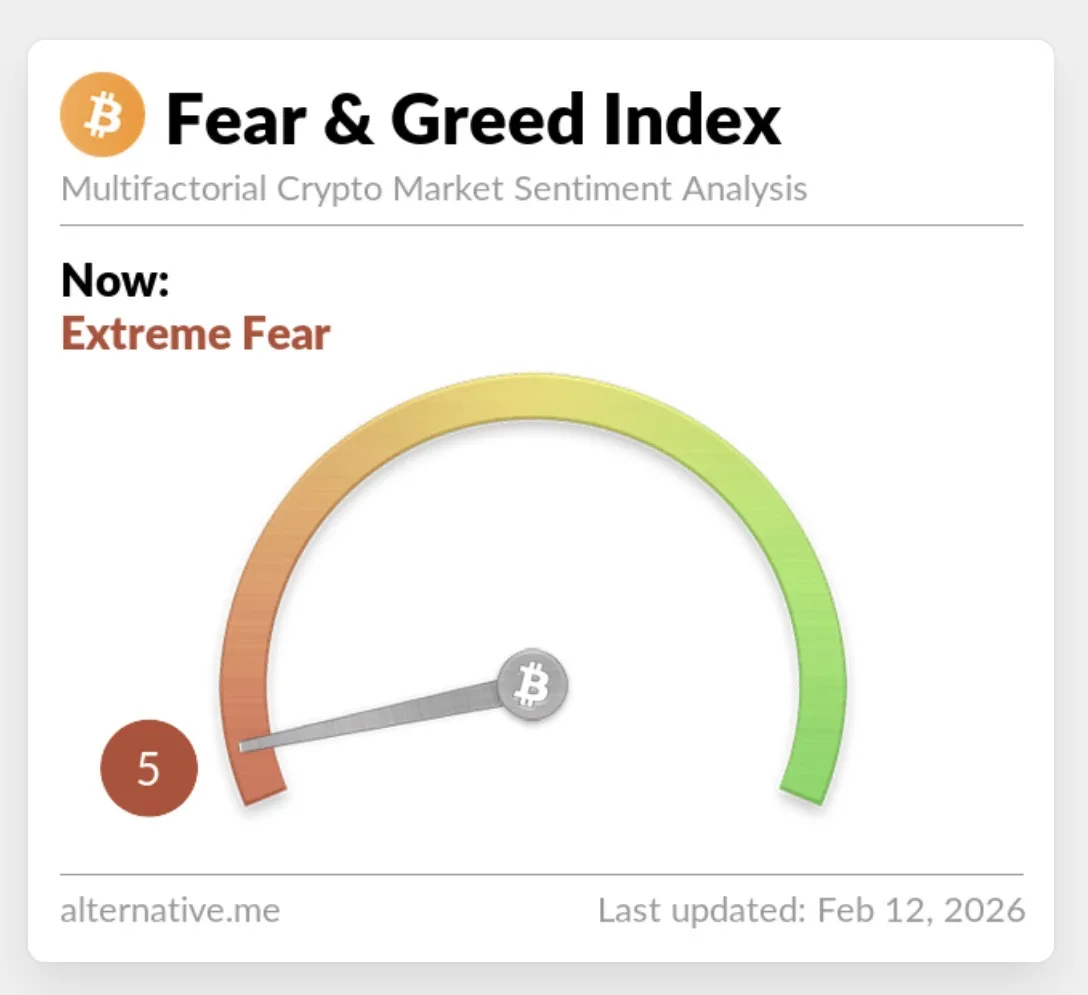
It is rare to see extreme fear in sentiment align with late stage downtrend compression in technical structure. When these two conditions appear together, markets often enter high probability accumulation zones.

This is the phase where buying feels uncomfortable, news sentiment remains negative, and volume appears weak. Historically, this environment has often preceded the early stages of trend reversals.

Is This the Best Time to Buy LUNC

This is not the safest time to buy. It is the highest asymmetry time. The safest entries typically occur after breakouts when confirmation appears. However, the highest reward opportunities often occur during fear driven compression phases.

LUNC currently sits in a contrarian accumulation window. While a confirmed reversal is not yet present, the risk to reward profile has improved significantly compared to earlier stages of the decline.

Scenario Outlook

Bear Case

If support breaks, the next liquidity zone sits near 0.000030. Downside risk appears limited relative to the magnitude of the correction already completed.

Bull Case

If accumulation completes and momentum shifts, potential relief rally targets include 0.000037, 0.000041, and 0.000045 as natural recovery levels.

Final Analyst View

When the market feels inactive, sentiment reads extreme fear, and price stops falling aggressively, conditions often favor early positioning rather than panic selling. This phase represents a dollar cost averaging and accumulation environment rather than a momentum chase phase.

Extreme fear rarely signals the exact bottom, but historically it marks the beginning of the next market chapter.
Crypto Fear and Greed Index Falls to Level 5. What Extreme Fear Means for the Market

0

Crypto Fear and Greed Index Falls to Level 5. What Extreme Fear Means for the Market

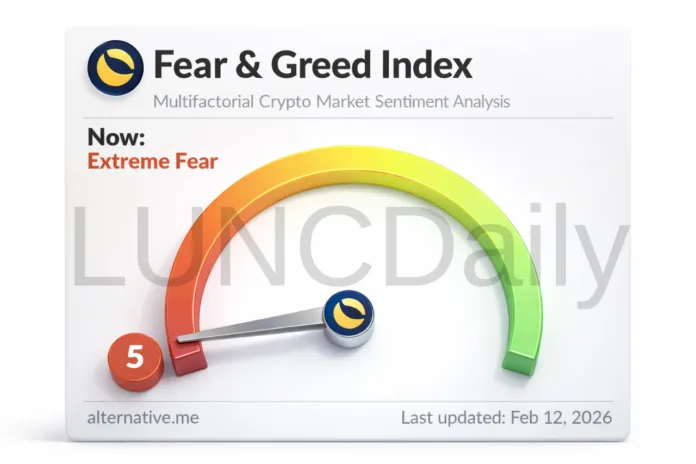
The Crypto Fear and Greed Index has dropped to a level of 5, marking one of the lowest readings in its history. This level is widely considered extreme fear and signals a market environment driven by strong negative sentiment.

Such conditions are often associated with market capitulation rather than a simple bearish phase.

Understanding Extreme Fear in Crypto Markets

Extreme fear does not automatically predict a market reversal. However, historically, periods of intense fear have often appeared near local market bottoms. This happens because market positioning changes dramatically during sharp declines.

When sentiment becomes overwhelmingly negative, many investors have already sold their positions. This process removes weaker participants from the market and reduces selling pressure over time.

At this stage, the market is no longer dominated by panic selling. Instead, it begins to shift toward a more balanced risk and reward environment.

Why Capitulation Matters

When most participants expect prices to fall further, two important dynamics typically emerge.

First, weak hands have largely exited the market. These participants are usually more reactive to volatility and are quicker to sell during uncertainty.

Second, the overall risk and reward profile quietly improves. With fewer sellers left, the potential downside may decrease while the upside becomes more attractive for long term investors.

This does not mean prices will immediately rise. It means the market structure begins to change beneath the surface.

Sentiment Is Not a Trading Signal

It is important to understand that sentiment alone is not a trading signal. The Fear and Greed Index provides context, not direction.

The key question is what is driving the current fear.

Is it the result of tightening global liquidity and macroeconomic pressure, or is it driven by short term volatility and market noise?

The answer to this question determines whether the fear reflects deeper structural risks or a temporary emotional reaction.

The Bigger Picture

The Fear and Greed Index should be viewed as a backdrop for market analysis rather than a standalone indicator. It helps investors understand how the market feels, but not necessarily what the market will do next.

Extreme fear highlights stress within the system, but it also signals that much of the negative positioning may already be in place.

As always, sentiment should be combined with macro trends, liquidity conditions, and technical analysis to build a complete market view.

LUNC Price Analysis: Terra Classic Is Falling After Bitcoin Dropped To $67K

0

Introduction

Terra Classic (LUNC) has recently experienced a noticeable price decline. The main reason behind this move is Bitcoin falling below the $67,000 level. When Bitcoin weakens, capital often leaves higher-risk altcoins first, and LUNC is one of the assets that reacts strongly to these market changes.

This analysis explains the current LUNC trend, key support and resistance levels, and what traders should watch next.

Why LUNC Dropped After Bitcoin Fell

The recent drop is not caused by internal weakness in Terra Classic. Instead, it is mainly a reaction to the broader crypto market.

  • Investors move funds back into Bitcoin or stablecoins
  • Liquidity leaves smaller altcoins
  • Support levels break more easily due to thinner order books

LUNC was already showing weakness before Bitcoin dropped. The BTC move simply accelerated the decline.

Current Market Trend

On the 4-hour chart, LUNC is clearly in a downtrend.

  • Lower highs forming repeatedly
  • Lower lows continuing to appear
  • Smaller and weaker price bounces

This pattern usually means sellers remain in control. However, a potential early accumulation zone is now starting to appear.

Critical Support Zone

Key demand area: 0.000030 – 0.000031

  • Buyers stepped in aggressively for the first time in weeks
  • Long lower wicks show strong buying interest
  • Panic selling was absorbed at this level

This is currently the most important support for LUNC.

Resistance Levels to Watch

Short-term resistance: 0.0000365 – 0.0000375
This level has rejected multiple recent rallies.

Major resistance: 0.0000395 – 0.000041
This was the previous breakdown zone and remains strong supply.

A real trend reversal would only begin above 0.000046.

Market Momentum Explained Simply

Price behavior has changed recently:

  • Earlier: big drops followed by big rebounds
  • Now: small rebounds followed by steady decline

This means buyers are weakening, but the recent strong wick suggests some sellers have already exited the market. This often happens before a consolidation phase.

Possible Scenarios for LUNC

Scenario 1: Bitcoin Stabilizes

LUNC may move sideways between 0.000031 – 0.000037. This would be a base-building phase.

Scenario 2: Bitcoin Continues Falling

  • LUNC could break support
  • Next target becomes 0.000028 – 0.000026
  • A new wave of panic selling may begin

Scenario 3: Bitcoin Recovers

  • LUNC could break above 0.000037
  • A relief rally toward 0.000040 – 0.000042 becomes possible
  • Still a temporary rally unless 0.000046 is reclaimed

Final Summary

LUNC is currently moving in line with Bitcoin and the overall crypto market.

  • Trend remains bearish
  • Short-term accumulation may be forming
  • 0.000030 is the most important level to hold

If this support holds, LUNC may move sideways. If it breaks, another downward move becomes likely.

Luna Classic Oracle Pool Continues to Decline as Income Falls Behind Outflows

0

Luna Classic Oracle Pool Continues to Decline as Income Falls Behind Outflows

The Terra Classic Oracle Pool, which funds staking rewards for validators and delegators, continues to show a steady decline. This pool plays a key role in maintaining network security by ensuring that participants who secure the blockchain receive consistent incentives.

What Is the Oracle Pool

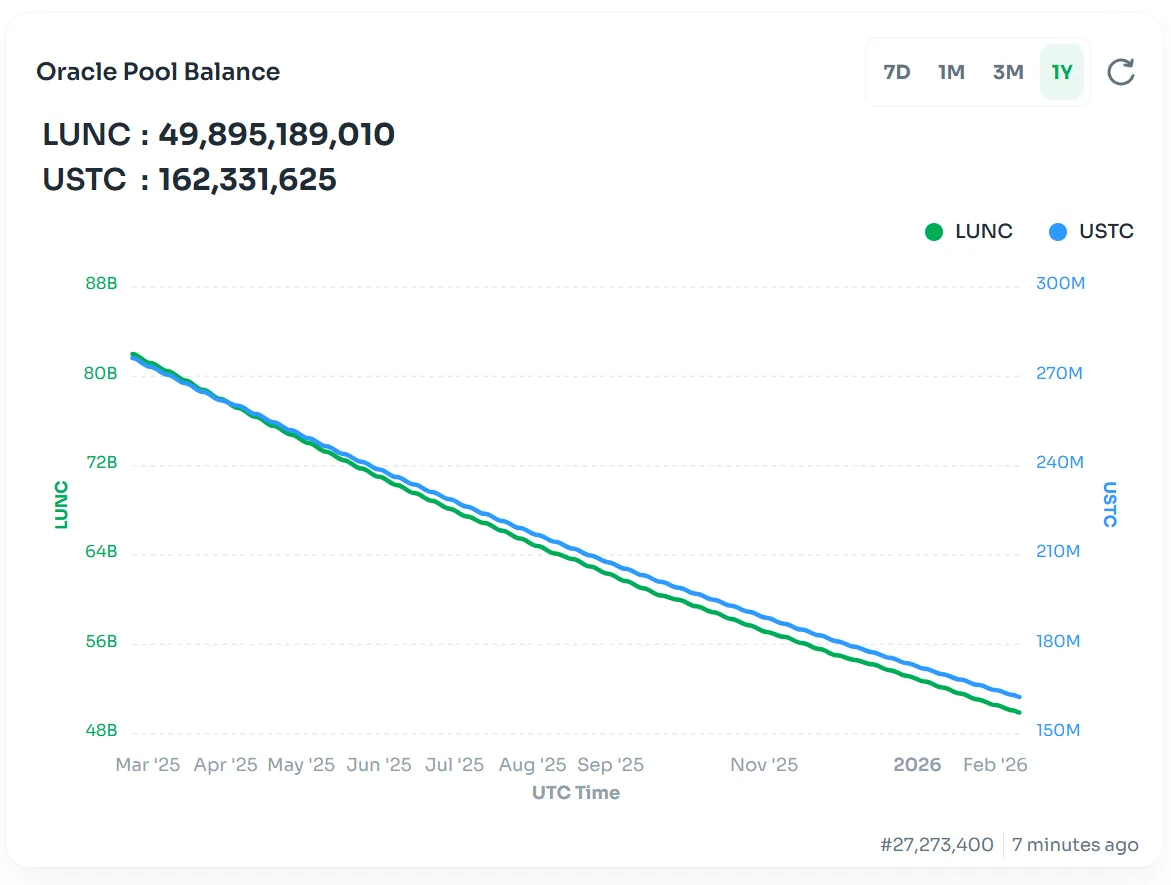
The Oracle Pool is a reserve of LUNC and USTC used to pay staking rewards to validators and delegators. These rewards help keep the network active, secure, and decentralized. When the pool balance decreases over time, it signals that more rewards are being paid out than the pool is receiving in income.

Current Oracle Pool Balances

Asset Balance
LUNC 49,895,189,010
USTC 162,331,625

Why the Oracle Pool Is Declining

The reason behind the decline is straightforward. The pool is experiencing less incoming revenue while outgoing rewards remain high.

Lower income sources
The Oracle Pool receives funds from network activity such as fees and other ecosystem contributions. Reduced on chain activity means less income flowing into the pool.

Ongoing reward payouts
Staking rewards continue to be distributed regularly to validators and delegators. When payouts exceed incoming funds, the balance naturally decreases over time.

Why This Matters for Terra Classic

The health of the Oracle Pool is important for the long term sustainability of the Terra Classic network. A declining pool highlights the need for stronger ecosystem activity and new sources of revenue to support staking rewards.

Understanding this trend helps the community stay informed about the network’s economic health and the importance of increasing usage and activity across the ecosystem.

Over 1.7 billion LUNC was burned in the last 10 days

0

Terra Classic Burn Update Reaches 1.7 Billion LUNC in Ten Days

Terra Classic Burn Update for Early February

The Terra Classic ecosystem continues to record steady burn activity. During the first ten days of February, a total of more than 1.7 billion LUNC was removed from circulation through ongoing burn initiatives.

Token burns remain an important part of Terra Classic’s long term supply reduction strategy. By gradually reducing circulating supply, the community aims to strengthen the foundation for long term ecosystem recovery and growth.

Daily LUNC Burn Breakdown

Below is the complete daily burn recap for the first ten days of February.

Date LUNC Burned
February 1 1,147,191,675
February 2 168,648,532
February 3 55,419,874
February 4 138,464,391
February 5 36,216,303
February 6 48,908,522
February 7 20,794,946
February 8 32,404,845
February 9 30,669,205
February 10 33,716,529

Total burned: 1,712,434,822 LUNC

Burn Activity Overview

Most of the burn volume occurred at the beginning of the month, with February 1 contributing more than 1.14 billion LUNC. Large single day burns typically happen when exchanges or ecosystem partners execute scheduled burn events.

After the initial spike, daily burns continued at a steady pace, showing ongoing participation from different parts of the ecosystem.

Why Ongoing Burns Matter

Burning tokens permanently removes them from circulation. For Terra Classic, this process helps reduce the large token supply created in 2022.

  • Supporting long term supply reduction
  • Strengthening community confidence
  • Encouraging ecosystem participation
  • Supporting the recovery roadmap

Looking Ahead

Consistent burn activity continues to play a role in Terra Classic’s broader recovery efforts. As development and adoption progress, regular supply reduction remains a key focus for the community.

Galaxy Station Enables Direct Credit Card Purchases of LUNC From the Wallet

0

Introduction

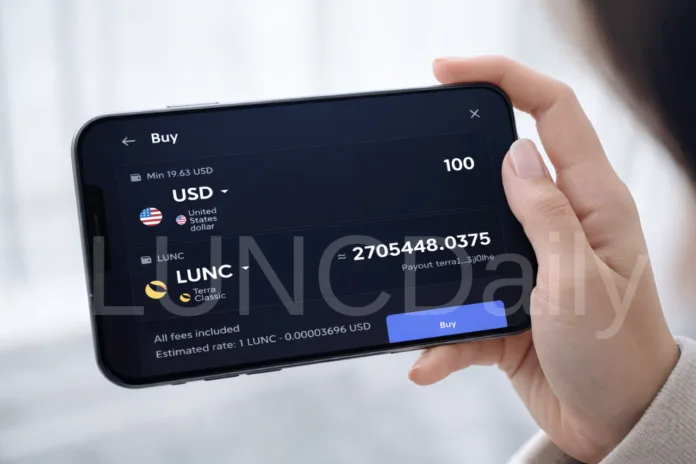
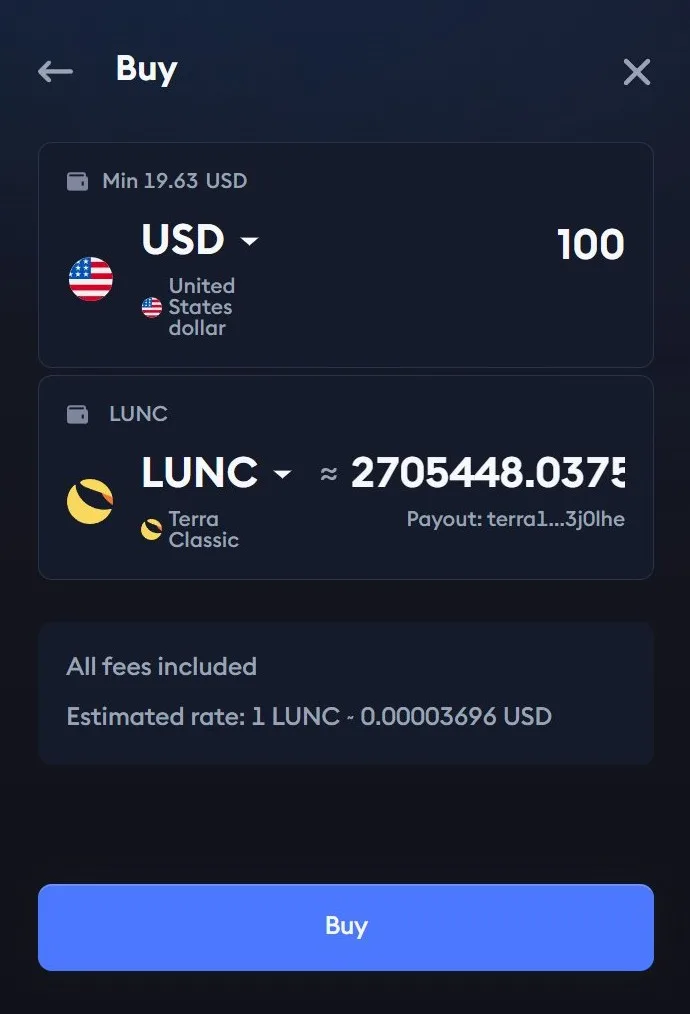
The Terra Classic community has received a major usability upgrade. Galaxy Station has integrated a new feature that allows users to purchase LUNC directly from the wallet using a credit card. This improvement makes it easier for both new and existing users to enter the Terra Classic ecosystem without relying on centralized exchanges.

What Changed in Galaxy Station

Galaxy Station has upgraded its wallet integration to support direct LUNC purchases with credit cards. The wallet is already available as a Chrome extension and on Android, making the feature accessible to a wide audience.

This update simplifies the onboarding process. Instead of moving funds across multiple platforms, users can now complete the entire process from within the wallet.

Why This Matters for Terra Classic

Galaxy Station is a decentralized application built directly on chain. This means that when users purchase LUNC through the wallet, the tokens can be used immediately within the Terra Classic ecosystem without transferring funds from an exchange.

This removes a major barrier for new users and improves the overall user experience.

Impact on On Chain Activity

On chain activity plays a critical role in the Terra Classic economy. Higher on chain volume contributes to several key mechanisms that support the network, including:

  • LUNC burn mechanisms
  • Community pool funding
  • Oracle pool support

With direct credit card purchases now available, users can buy LUNC and immediately participate in on chain activities such as trading, staking, and interacting with decentralized applications.

Lower Friction for New Users

One of the biggest challenges in crypto adoption is onboarding. Many new users find the process of using exchanges, transferring funds, and connecting wallets complicated.

This upgrade removes multiple steps and allows users to move from purchase to participation in a single environment. The result is a smoother and more accessible experience for newcomers.

Conclusion

The Galaxy Station upgrade marks an important step forward for Terra Classic. By enabling direct credit card purchases inside the wallet, the ecosystem becomes more accessible, more efficient, and more supportive of on chain growth.

This improvement has the potential to increase participation, strengthen network activity, and contribute to the long term sustainability of Terra Classic.

Hyperlane Work in Progress Update Brings Cross Chain Connectivity Closer to Terra Classic

0

Introduction

A new development update has been released for Hyperlane integration on Terra Classic. The update highlights early testnet progress, an open source bridge interface, and successful cross chain transfers in a testing environment. While the work is still in progress, the milestone marks an important step toward future interoperability for the Terra Classic ecosystem.

What Is Hyperlane

Hyperlane is a cross chain messaging and bridging protocol that allows tokens and data to move between different blockchains. In simple terms, it acts as a bridge that enables Terra Classic to communicate with other networks.

This type of technology is designed to connect ecosystems, allowing assets and information to move beyond a single blockchain.

Testnet Phase Begins

The project has officially entered the testnet stage. A public test link is expected to be shared soon, allowing the community to interact with the bridge directly.

A dedicated server has already been running for two weeks to prepare the environment and ensure smoother community testing. At this stage, the system is not live on mainnet and remains in a testing and validation phase.

Open Source Bridge Interface

One of the most significant updates is the decision to make the bridge interface fully open source. The user interface will be public and forkable, meaning anyone can copy it and deploy their own version.

This approach removes centralized control of the bridge website and eliminates reliance on a single domain owner. The goal is to increase decentralization and transparency across the ecosystem.

The team emphasized that the main complexity lies behind the interface. Configuring chains, running relayers and validators, and adjusting the code are the most demanding parts of the process.

Working Demo Already Deployed


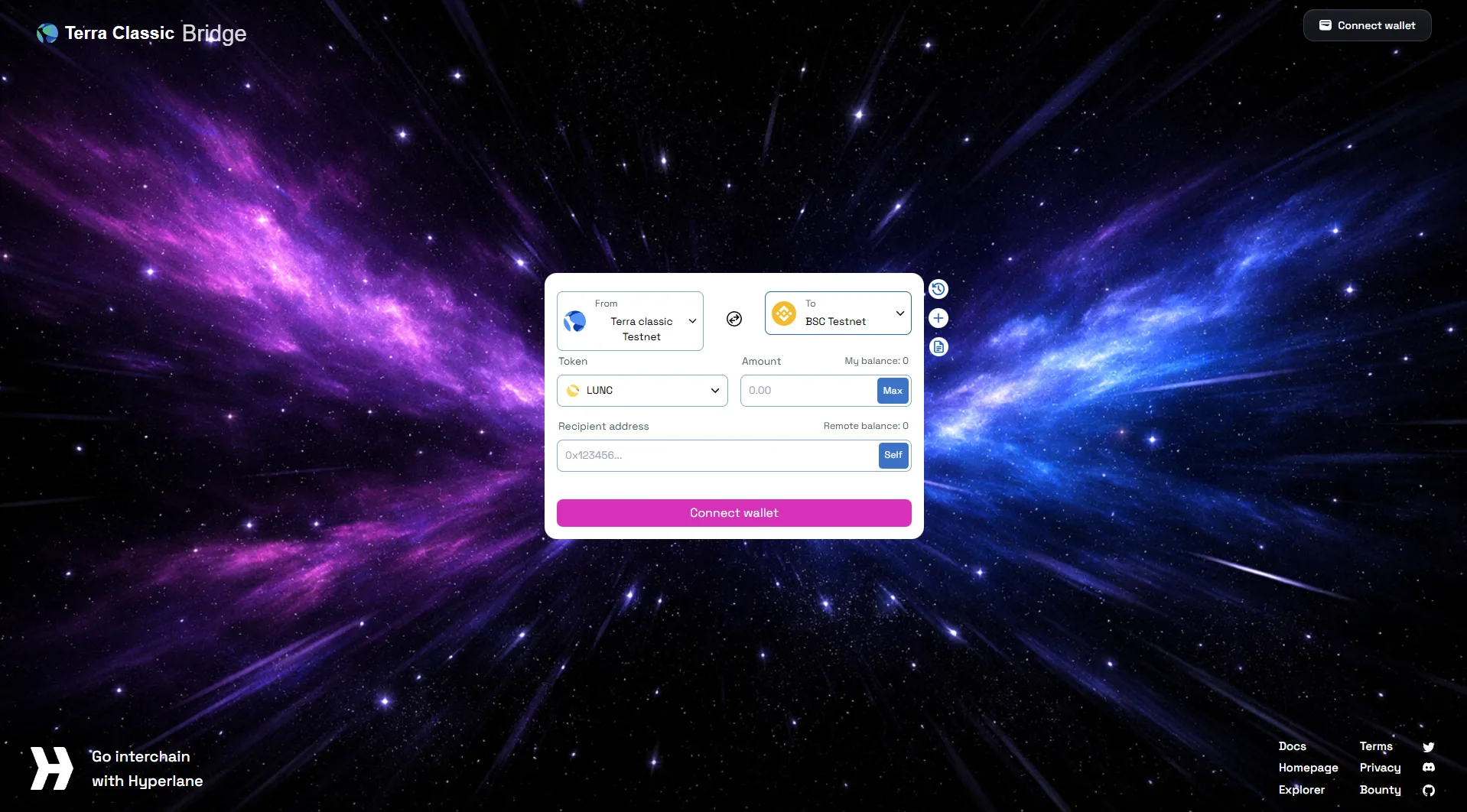
A working demo has already been deployed on the Terra Classic testnet using a standard bridge model. The demo environment is available at terraclassic bridge dot xyz and serves as a testing ground for cross chain functionality.

Cross Chain Transfers Successfully Tested

Early testing confirms that cross chain transfers are already functioning in the testnet environment.

Current tested routes from Terra Classic testnet include Solana testnet, BSC testnet, and Ethereum Sepolia testnet. This means LUNC test tokens can already move between multiple blockchain ecosystems during testing.

Why This Matters for Terra Classic

If the bridge eventually reaches mainnet, the impact could be significant. Cross chain connectivity would allow LUNC to move across ecosystems, opening access to liquidity on other chains and attracting new users and developers.

It could also enable broader DeFi integrations and strengthen interoperability with major blockchain networks.

Conclusion

The Hyperlane integration remains in its early stages, but the latest progress shows clear momentum. Testnet transfers, an open source interface, and a working demo signal a meaningful step toward cross chain connectivity for Terra Classic.

Luna Classic Daily Burn Declines as On Chain Activity Slows

0

Luna Classic Daily Burn Declines as On Chain Activity Slows

Introduction

The Luna Classic burn rate plays a major role in reducing the circulating supply of LUNC. Over the last five days, daily burns have struggled to pass 50 million LUNC per day, raising questions within the community about what is happening and why the numbers have dropped.

Why the Burn Rate Is Falling

To understand the recent decline, it is important to remember how the burn mechanism works. Luna Classic uses an on chain tax that burns a portion of transactions that happen directly on the blockchain. This means the burn rate depends heavily on on chain activity and trading volume.

When on chain activity slows, the amount of LUNC burned also decreases. The recent decline in daily burn figures is a direct reflection of lower on chain transaction volume rather than a change in the burn mechanism itself.

Recent Daily Burn Data

Below is the latest daily burn data for February.

Month Date LUNC Burned
February 1 1,147,191,675
February 2 168,648,532
February 3 55,419,874
February 4 138,464,391
February 5 36,216,303
February 6 48,908,522
February 7 20,794,946
February 8 32,404,845
February 9 30,669,205

What This Means for the Community

Lower burn numbers do not mean the burn system is failing. Instead, they highlight the importance of on chain activity for maintaining consistent supply reduction. Increased trading, transactions, and network usage directly contribute to higher burn levels.

Conclusion

The recent decline in Luna Classic daily burn is a reflection of reduced on chain volume. For the burn rate to increase again, stronger network activity and engagement are essential. The connection between usage and supply reduction remains one of the most important dynamics for the future of the Terra Classic ecosystem.

The New On-Chain Tool to Help the Community Understand the True Health of the Luna Classic Blockchain

0

Truth Dashboard Launches to Help the Community Understand the Real Health of the Terra Classic Blockchain

Introduction

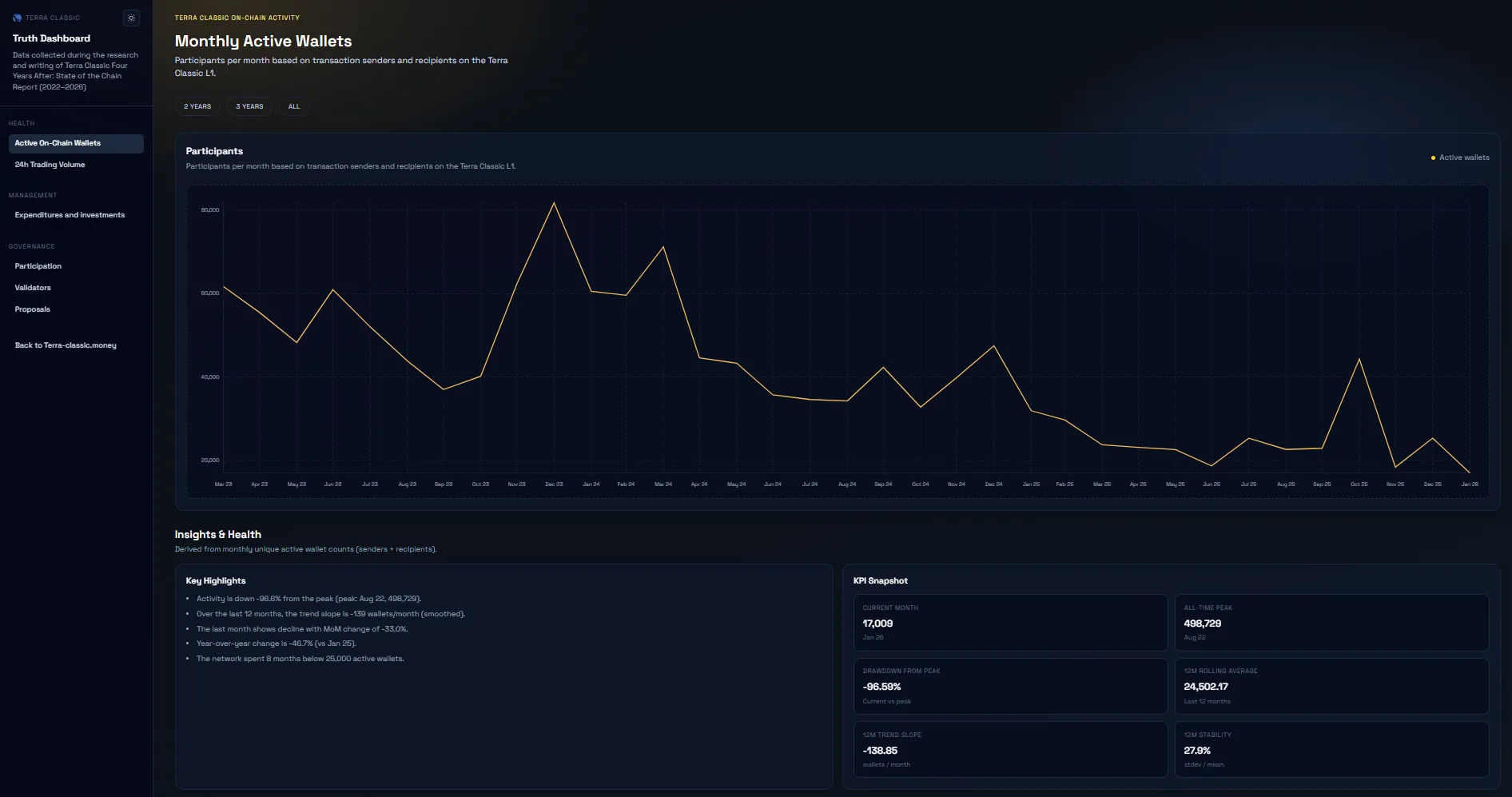
A new on chain analytics tool has arrived for Terra Classic. The Truth Dashboard is designed to help the community understand the real health of the Terra Classic blockchain using transparent data, research, and reports collected from 2022 to 2026.


Available through Terra-Classic.money, this public dashboard aims to make blockchain data easier to understand for investors, developers, validators, and the broader community.

What Is the Truth Dashboard

The Truth Dashboard is a public analytics platform focused on Terra Classic. It gathers on chain metrics, governance data, and financial transparency reports into one accessible website (https://truth.terra-classic.money/).

Its goal is simple. Provide clear and reliable information so the community can measure real progress instead of relying on hype or speculation.

Key Sections and Benefits

Active On Chain Wallets

One of the most important features tracks monthly active wallets, including both senders and receivers.

Why this matters:

  • Shows real user activity on the blockchain
  • Helps answer whether the chain is growing or shrinking
  • Provides a reliable adoption metric for investors and builders
  • Encourages decisions based on real usage rather than speculation

When wallet activity increases, it signals growing adoption and stronger ecosystem activity. A decrease may highlight areas that need attention. This metric is widely considered one of the most important indicators of blockchain health.

24 Hour Trading Volume

This section focuses on trading activity across the ecosystem.

Benefits:

  • Demonstrates liquidity and demand
  • Helps evaluate market interest in Terra Classic
  • Provides valuable insights for traders and analysts

Expenditures and Investments

The dashboard also tracks how community pool funds are used.

Benefits:

  • Provides transparency on spending
  • Shows where development funding is allocated
  • Builds trust in governance processes
  • Helps voters make informed decisions

Financial transparency is essential for maintaining decentralization and community trust.

Governance Insights

The governance section includes data about participation, validators, and proposals.

Benefits:

  • Shows how active the community is in voting
  • Tracks validator health and decentralization
  • Helps voters understand proposal impact and engagement

This section demonstrates whether Terra Classic is truly community driven.

Why the Truth Dashboard Matters

Transparency

All information is based on real blockchain data, giving the community reliable and verifiable insights.

Education

New users can understand the health of Terra Classic without needing deep technical knowledge.

Better Decision Making

The dashboard is useful for:

  • Investors
  • Validators
  • Developers
  • Governance voters
  • Content creators and researchers

Fighting Misinformation

By providing real metrics, the community can rely on data instead of rumors or speculation.

Improvement Proposals Feature

Another major addition is the Improvement Proposals section. This feature allows the community to suggest, discuss, and vote on improvements for Terra-Classic.money.

Public Improvement Backlog

The section creates a structured process for gathering community feedback and prioritizing the most important needs.

Accountability for Validators

Validators are encouraged to publish professional roadmaps or acknowledge the need for external support. This creates pressure for meaningful progress and real action.

Stronger Credibility

A transparent and professional approach can improve how builders, media, and external partners view Terra Classic.

Foundation for Long Term Growth

When used effectively, these tools can help Terra Classic move toward a sustainable operating model while attracting new builders, partners, and users.

Conclusion

The Truth Dashboard represents a major step toward transparency, accountability, and data driven decision making for Terra Classic.

By combining on chain analytics, governance insights, and financial transparency in one place, the platform provides the community with a clearer view of the blockchain’s real health and long term progress.

Visit : http://terra-classic.money/

Over 700,000 USTC Burned in Just 8 Days

0

Over 700,000 USTC Burned in Just 8 Days

The Terra Classic ecosystem continues to show steady commitment to supply reduction. During the first eight days of February, the community successfully removed more than 700,000 USTC from circulation. This milestone highlights the ongoing effort to support long term recovery and strengthen confidence in the ecosystem.

Burning tokens permanently removes them from circulation. Over time, this process reduces available supply and supports broader stabilization goals. Consistent burns remain an important part of the Terra Classic recovery strategy.

Daily USTC Burn Breakdown

Below is the daily burn activity recorded between February 1 and February 8.

Month Date USTC Burn
February 1 32,646
February 2 25,778
February 3 22,360
February 4 397,058
February 5 38,305
February 6 37,655
February 7 143,878
February 8 6,247
Total 703,927

The largest burn occurred on February 4, when more than 397,000 USTC were removed in a single day. Another notable spike happened on February 7, adding over 143,000 USTC to the burn total. These two days accounted for the majority of the weekly burn.

Why USTC Burns Matter

USTC remains a key asset within the Terra Classic ecosystem. Supply reduction is widely viewed as an important step toward long term stability. While burns alone cannot determine price direction, consistent removal of tokens demonstrates continued community engagement and commitment to the project.

Every burn contributes to the broader objective of improving tokenomics and rebuilding confidence across the ecosystem.

Looking Ahead

The first week of February sets a strong tone for continued burn activity. If this pace continues, February could become another meaningful month for USTC supply reduction.

Ongoing community participation remains central to these efforts, reinforcing the long term vision for Terra Classic recovery.